The morning after a wedding in Hakuba, with the snow from the day before still deep on the ground, one of the guests turned to us with a question. “How do we even explain what we just experienced yesterday?”
We’ve noticed who asks that. Nobody asks it about an evening they attended. People ask it about days they lived through together, in the same weather, a long way from home.
So here’s the short answer, if you’re deciding now. Plan your destination wedding weekend in Japan across two or three days. A welcome dinner on the first night. The wedding. Then a slow day after, with one thing everyone shares and plenty of room around it. Your guests are crossing oceans, many of them are meeting for the first time, and Japan is asking to be seen. One day can hold a ceremony. It struggles to hold all of that. The shape of the whole weekend should influence the venue and location from the beginning, and our wider Japan wedding planning guide covers the decisions to make before booking.
A word on the word weekend. It’s what people search for, so it’s what we’ve called this guide, but our weddings rarely fall on one. Your guests are flying in and on holiday, with no office waiting for them on Monday, so we often run the celebration midweek: Tuesday to Thursday, or Monday to Wednesday. Weekends are when Japanese couples marry, so those dates are scarcer, and at many venues they cost more. For a couple taking a whole ryokan on a kashikiri buyout, with the place reserved for their guests alone, a weekday is often the better value. So read weekend here as the few days around your wedding, whichever days of the week they fall on.
Below is how weddings usually work in Japan, and how we plan the days around one for guests arriving from the other side of the world. Every example is from a wedding we planned or photographed.
How Many Days Should a Destination Wedding in Japan Be?
In Japan, a wedding usually fits inside one day. There’s the ceremony, then the hirōen, the reception where the couple host family and friends. Later there’s often a nijikai, a looser party for friends, usually a standing buffet with a fee at the door. It’s a rhythm built for guests who live a train ride away, and for them it works beautifully.
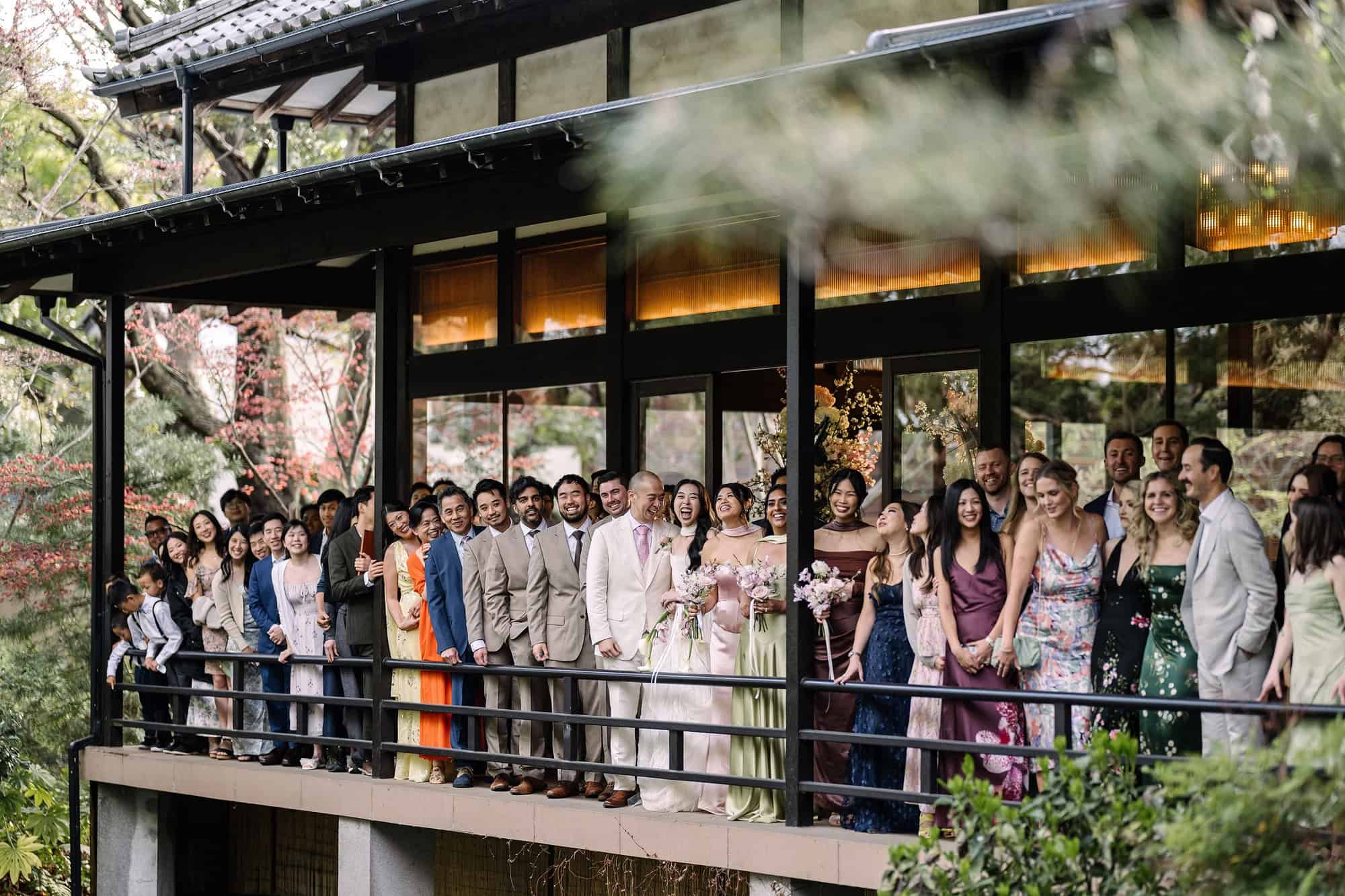
Your guests aren’t a train ride away. At one rainy spring wedding at Jinya, more than eighty guests came from Australia, the United States, Japan and beyond, and for many of them it was their first time in the country. Ask people to travel that far for a single afternoon and they arrive tired, celebrate in a rush and leave before any of it has landed.
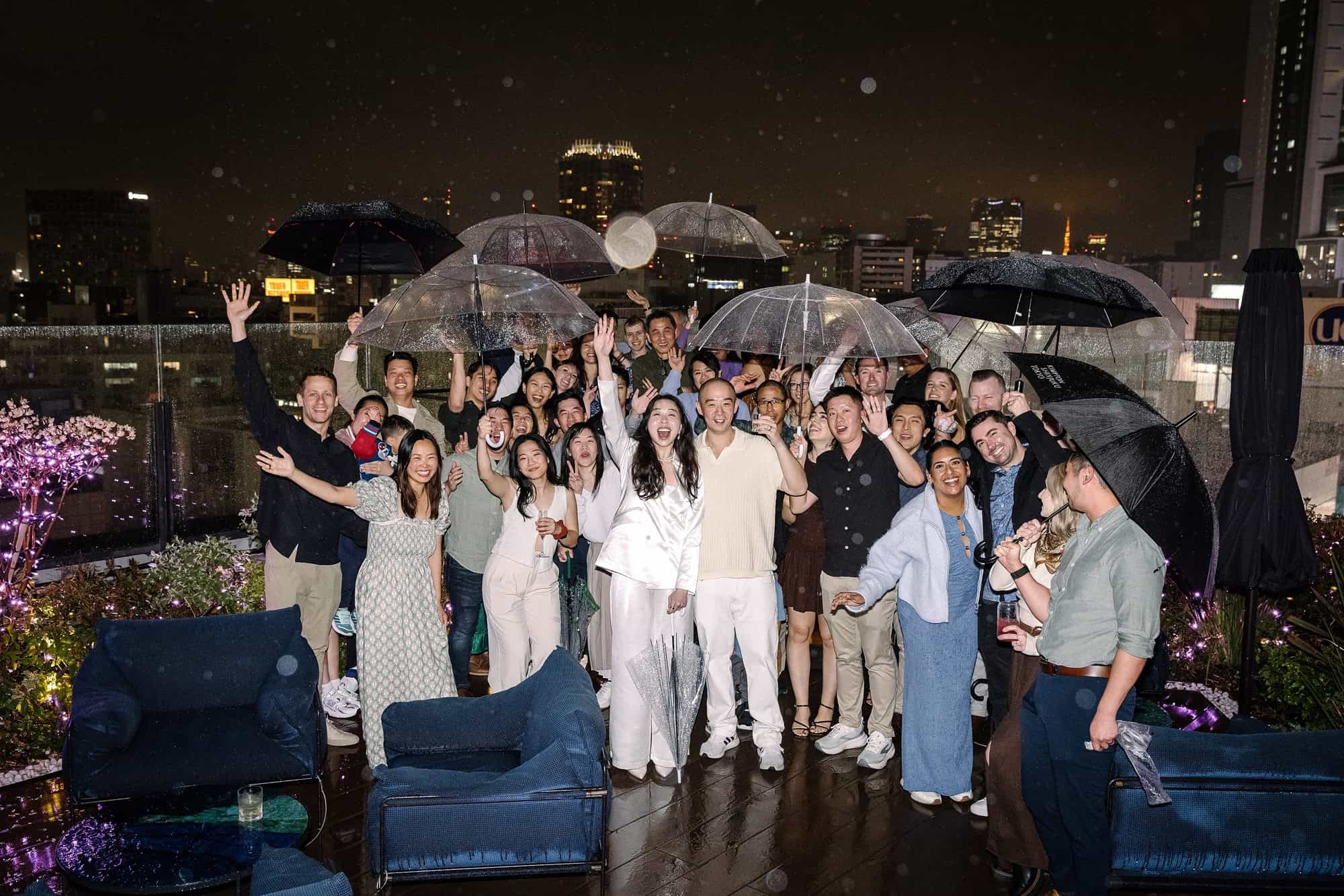
So most of the celebrations in this guide run across two or three days. A couple from the Bay Area began theirs with a welcome party on a Shibuya rooftop, in the rain. Two days later, sixty-six guests sat down to dinner at a ryokan in Tsurumaki Onsen, and most of them had sheltered from that downpour together. The college friends, the families and the plus-ones had stopped being separate tables.
Nobody planned that part. The extra days made room for it.
The Welcome Dinner: Where a Guest List Becomes a Gathering
The welcome dinner is the custom most of our couples bring with them from home. If you plan one thing beyond the wedding itself, make it this. It’s where strangers become company. We like it on the first night, never the last.
At a two-day wedding at Jinya, the groom’s welcome speech warned the room about “these next 48 hours”: stretch your bellies, prepare your liver, prepare to get no sleep. Then everyone counted the mochi mallet down onto the rice, eight strikes, every one called out loud. By the last dance, the same people had closed into a ring around the couple.
On the water
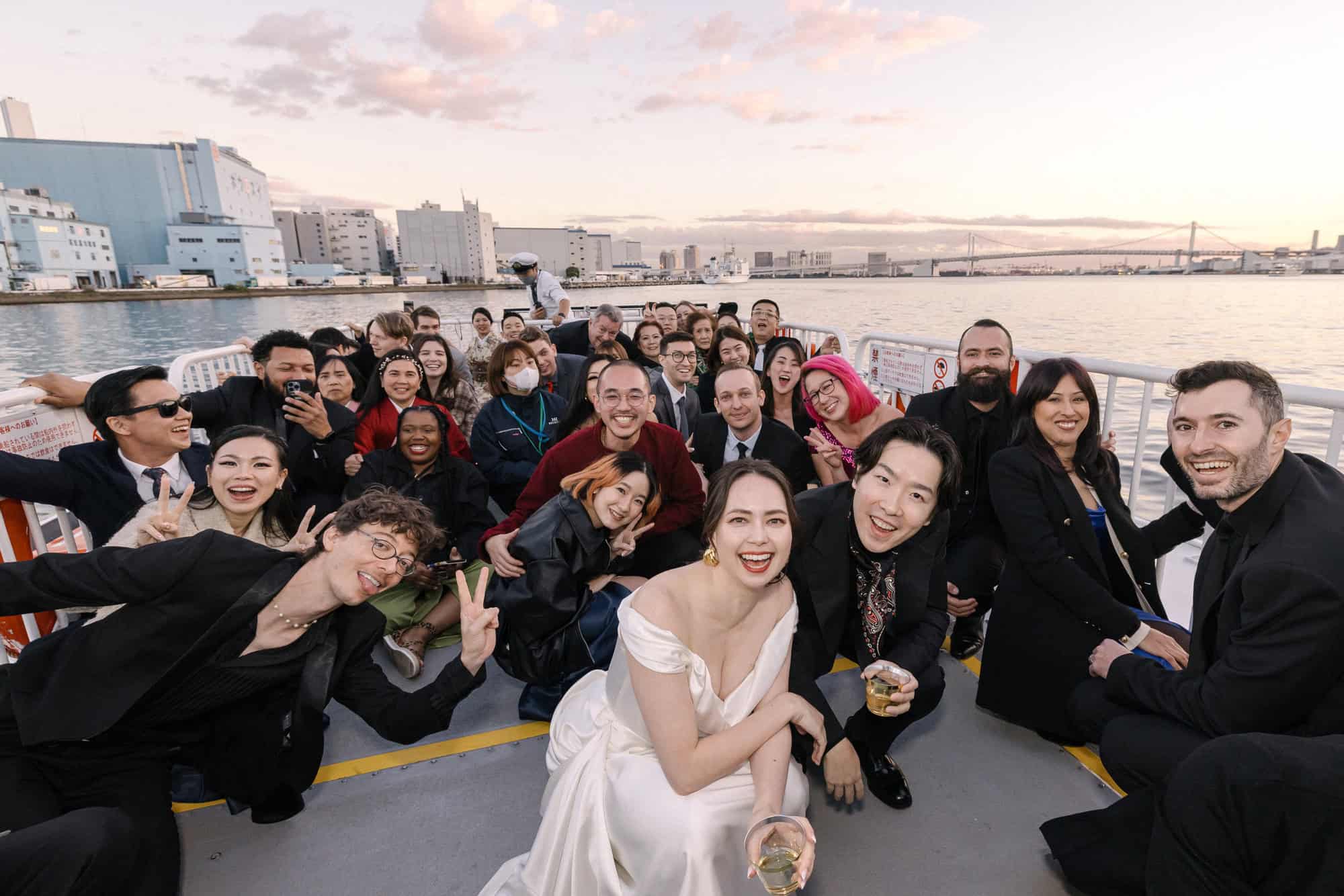
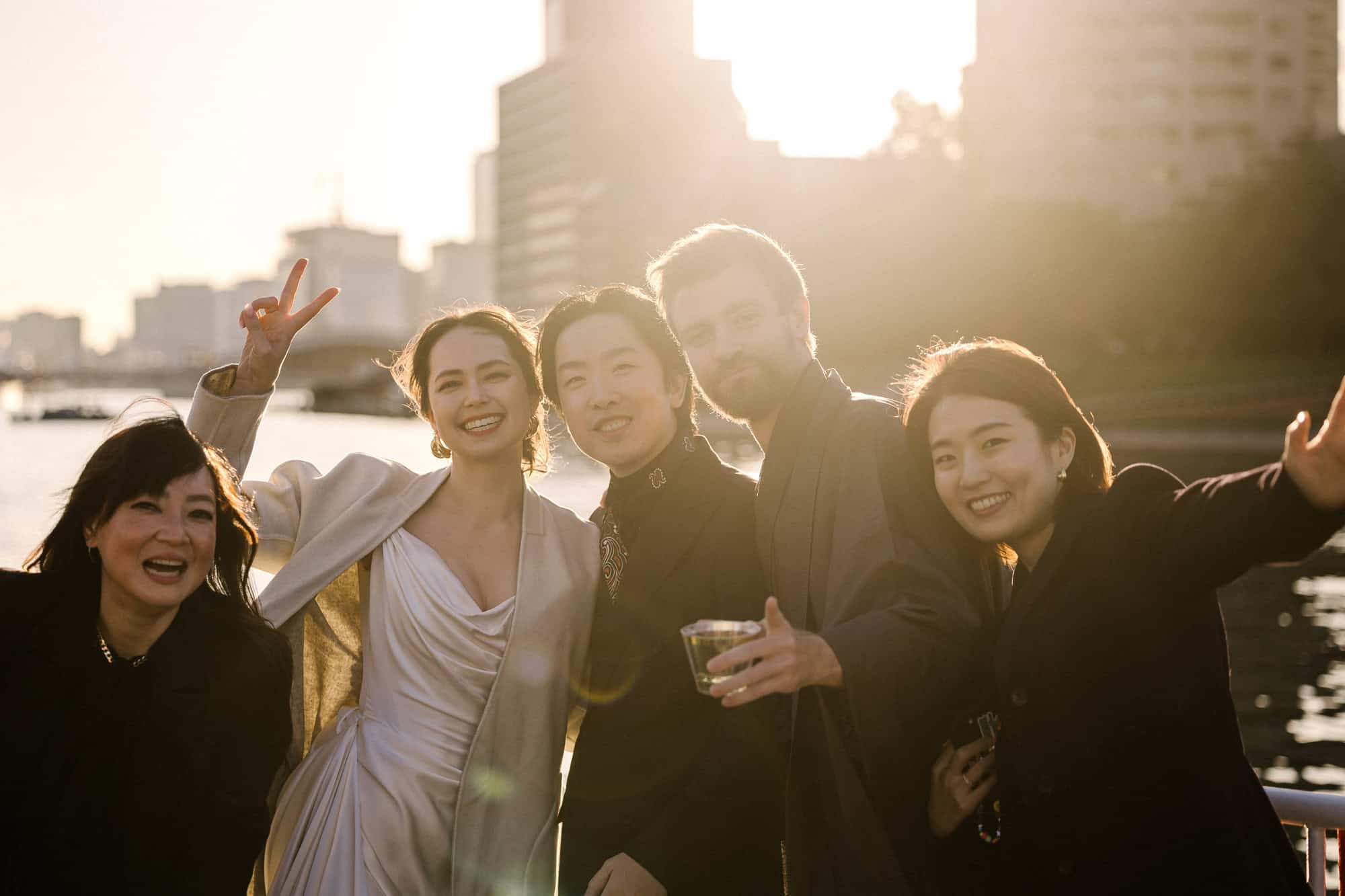
For a couple from Portland, the whole group boarded a yakatabune on the Sumida River from Azuma-bashi in Asakusa. The bride asked for a boat on the fun side, a bit rowdy, which is exactly right for a first night. Tokyo’s yakatabune cooperative traces these roofed boats back to Heian aristocrats floating out to recite poetry and play music, so people have been using the water to become a party of their own for about a thousand years.
In a hall with a history
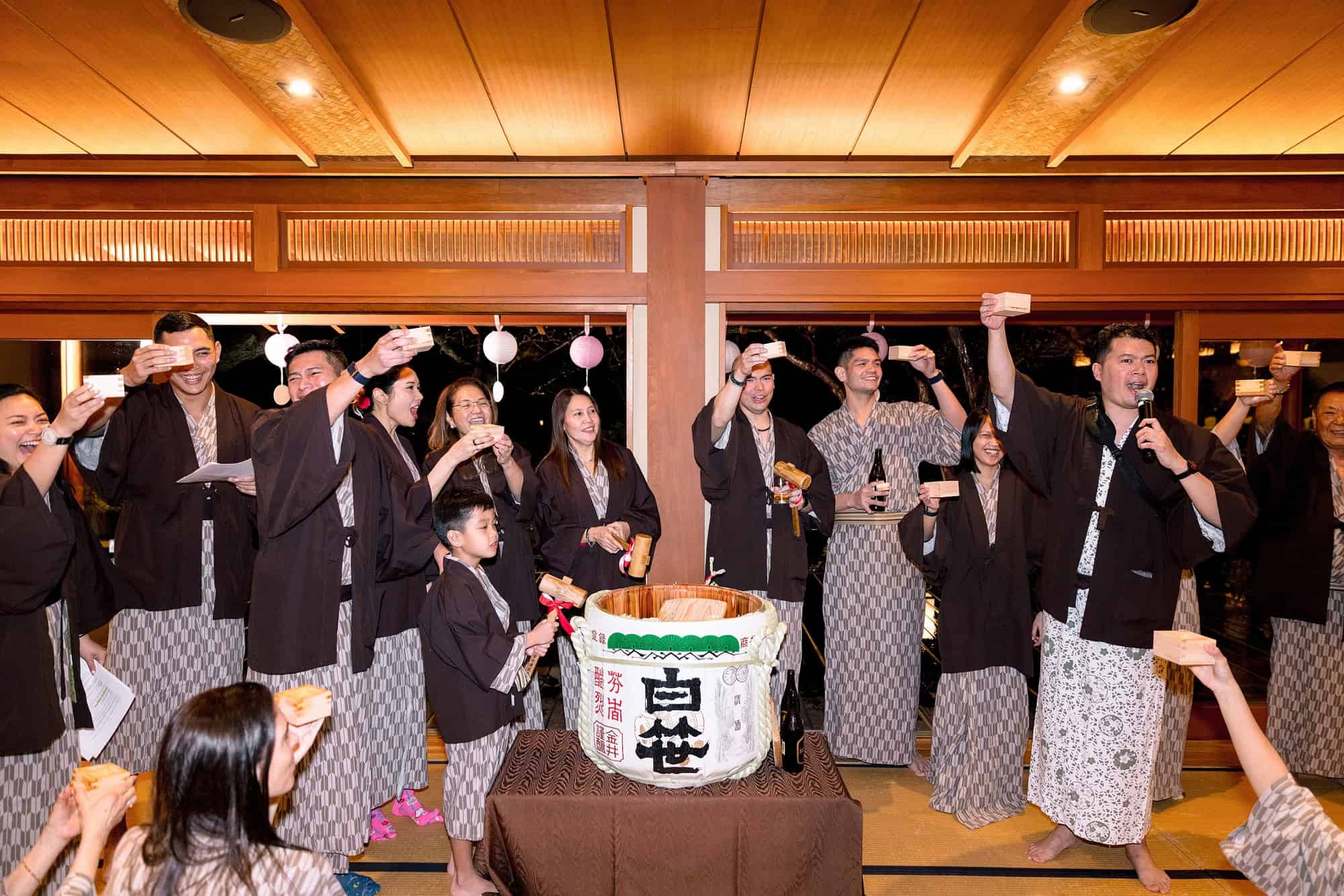
Another couple welcomed their guests at Meiji Kinenkan, whose main hall was built in 1881 as a dining hall where the imperial court received foreign guests. Dinner opened with kagami biraki, the opening of a sake cask. Its round lid is called the kagami, the mirror. Breaking is a word Japanese celebrations avoid, so the cask is opened instead. It’s a festive custom rather than a religious rite, and it’s the right way to begin: everyone around one barrel, waiting for the same moment.
At the inn, in yukata
A ryokan gives every guest a yukata, the cotton robe worn around the inn, and the staff will show first-timers how it goes on. At one onsen wedding, everyone came to dinner in them. Grandparents, doctors, builders and children, all in the same plain robe at the same long tables. There’s no quicker way to turn a guest list into a household.
Somewhere simple
It doesn’t need to be grand. In Hakuba, it was mulled wine and air-dried ham at an alpine charcuterie. What matters is that everyone is in one room, early, with nothing yet expected of them. Tell guests what to wear when the invitation goes out; our guide to attending a wedding in Japan covers the rest, from shoes at the door to the onsen.
How We Look After Your Guests in Japan
Japanese hospitality runs on anticipation. A good ryokan has thought about your evening before you arrive, and it rests on expectations most Japanese guests already carry: what the kitchen serves, when the house goes quiet. Our part, as your wedding planner in Japan, is the bridge between that care and a guest list that has never stayed in a ryokan.
Behind every celebration we plan sits a detailed timeline, and the couple never has to carry it. The guests never see it either. They see the result.
They see a table set around them. At a winery wedding near Sendai, a crossword about the couple waited on every lunch mat, and guests called out answers from their own corner of the couple’s lives, finding out what everyone else knew. Dietary needs reach the kitchen long before the guests do; our guide to Japanese wedding food and dietary needs explains why that matters so much here.
They see the weather already handled. The Shibuya welcome party was planned for a rooftop terrace, with a way indoors if the weather turned. It turned. Fifty-nine people came in under one roof, closer than a terrace would ever have put them. In Hakuba, forty-five centimetres of snow fell on the wedding day. Transport was rerouted and a ceremony space was rebuilt with a snow plough. The guests remember the snow.
They find a ride waiting. For a late autumn wedding outside Tokyo, the guests came out together by chartered bus and went home together at the end of the night. In Kawagoe in February, which is properly cold, blankets and snacks were waiting in the van.
And they get their quiet hours. A ryokan keeps its evenings calm, and means it, so the loud part of the night needs somewhere to go. After an October garden wedding in Kawagoe, it went to Shibuya: the crossing after dark, then a private karaoke room, drum kit included. At an Asaba ryokan wedding in Shuzenji, it went behind a closed door: sunglasses, sake in wooden masu and a geisha banquet game that had everyone in stitches. We plan the days around their oldest and youngest guests as carefully as around the couple, so the grandparents get their rest and the dance floor still gets its night.
Things to Do With Wedding Guests in Japan
Here’s our view. Give each day one thing everyone shares, then leave room. Guests who’ve flown across the world don’t need an itinerary. Send a short list of the places you love with the wedding information, and let them find their own Japan in between.
In Tokyo
One couple married on a terrace on Tokyo Bay, then took every guest out on a boat for cocktail hour, Rainbow Bridge across the water and the light going soft. Back on shore, the ceremony space was being turned into the reception. That’s omotenashi as we understand it: thinking far enough ahead that everyone else can enjoy where they are now.
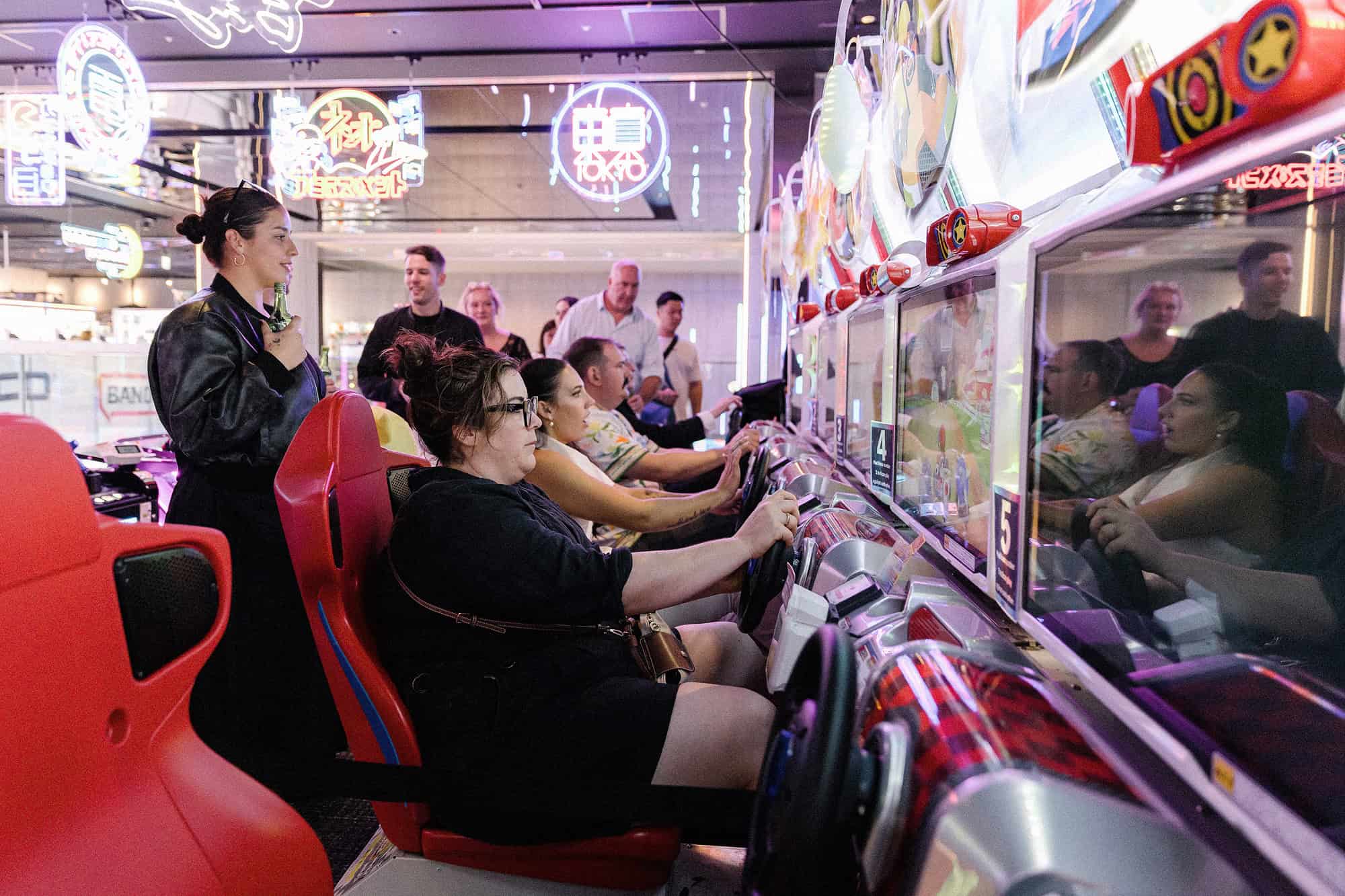
Another couple married in a garden at Jinya, then took the whole party to Shinjuku. Nobody had to decide whether to join the nijikai. They were already on the bus. The night ended in the arcade at Kabukicho Tower, friends racing each other in formalwear. Kabukicho was named in 1948 for a kabuki theatre planned in the postwar rebuilding. The theatre was never built. The name stayed, and that night, so did everyone.
Around Mt Fuji and the Five Lakes
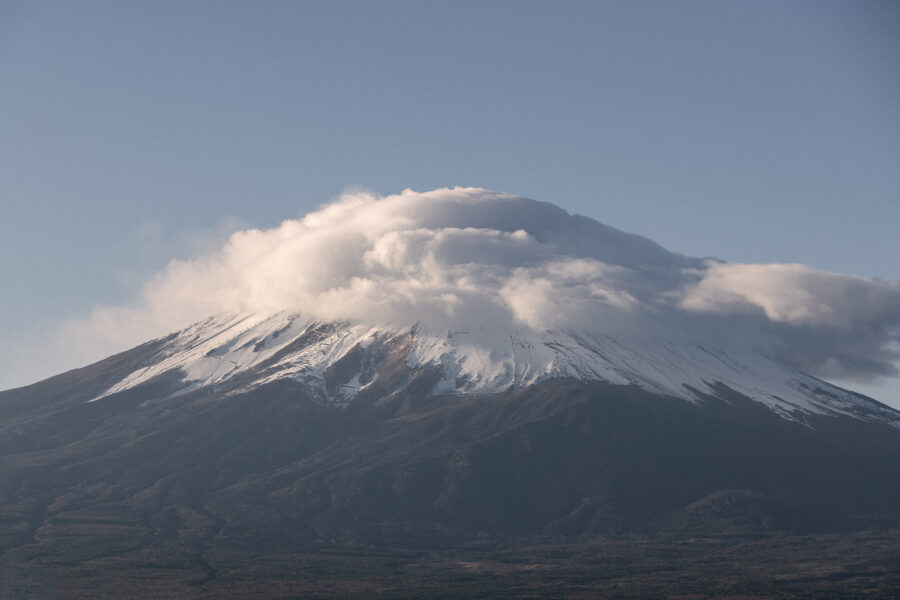
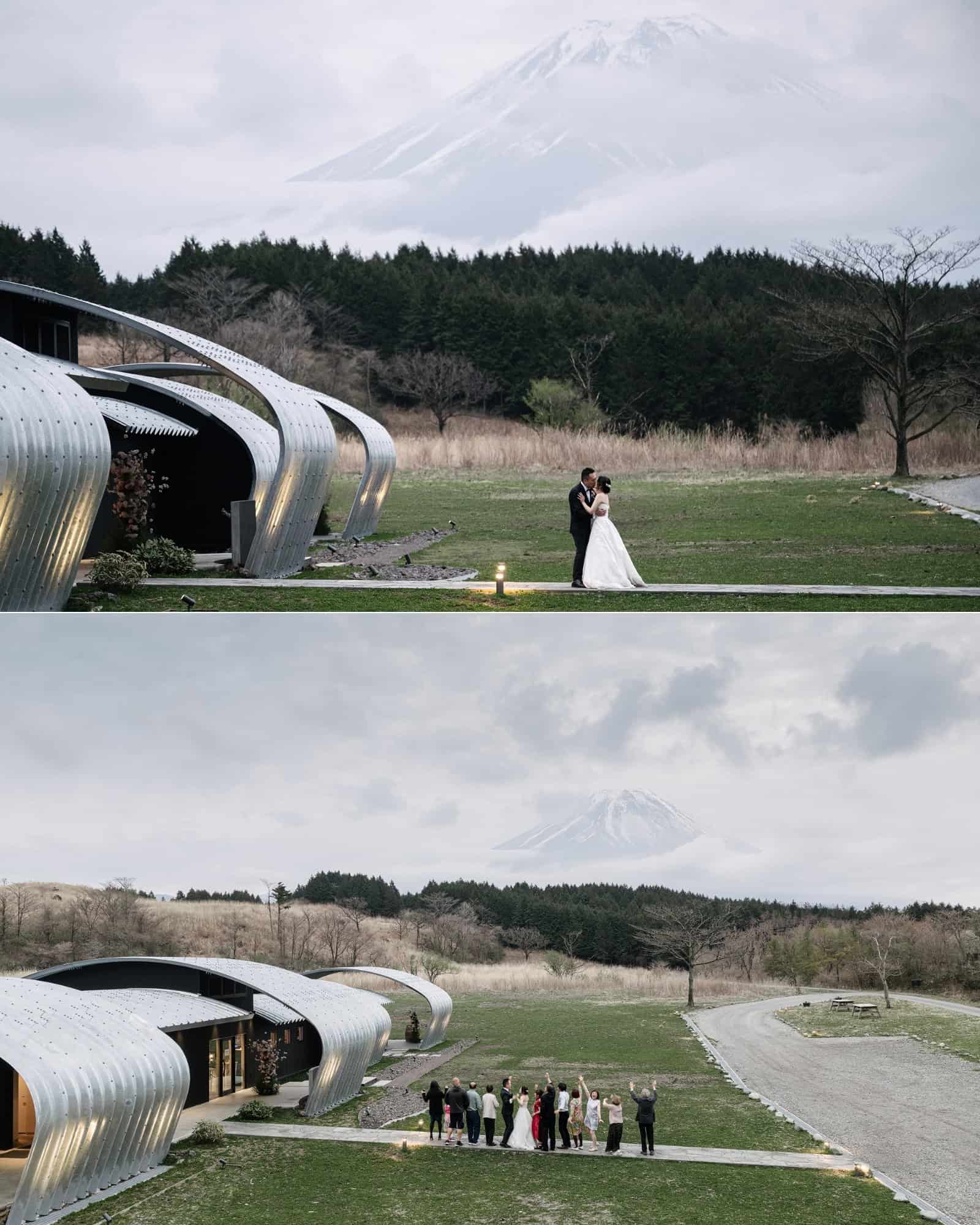
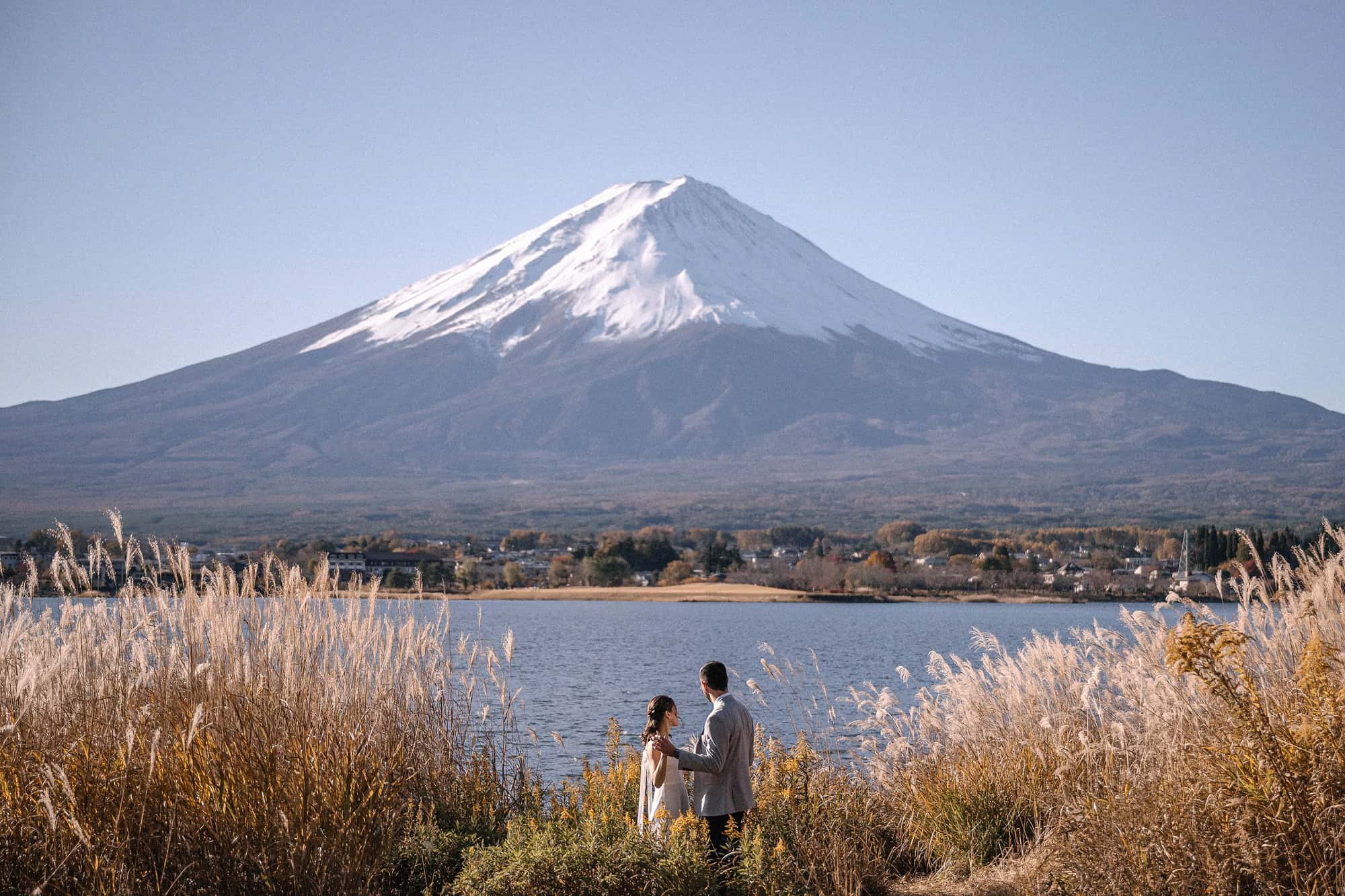
Around the mountain, the best thing to plan is room. The evening before one spring wedding, the couple spent forty minutes simply looking at Fuji. The next day it hid through the ceremony, then came out at dusk at Fujisan Winery just as the bride’s father finished his speech, and the whole wedding got up from dinner to go outside and wave at it.
In the mountains
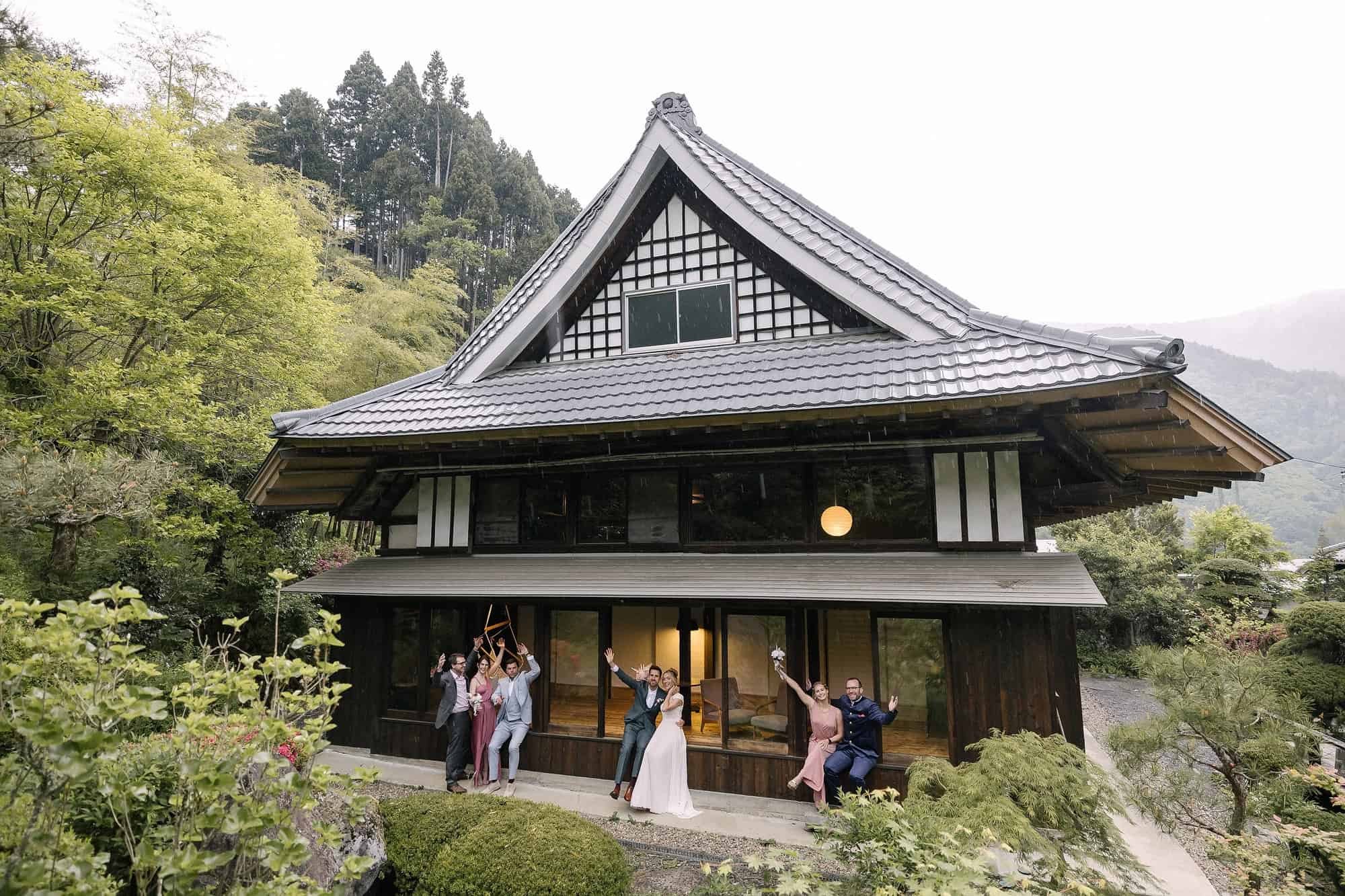
Sometimes the best thing to do with your guests is keep them in one place. A couple from Belgium gave their closest friends two nights in a mountain village in Kosuge, home to about six hundred people. Ramen and local beer on the first evening, the wedding the next day, then a bonfire, a sake barrel broken open, and everyone sleeping under the same old roofs.
Time for Just the Two of You
An elopement is just the two of you. It still deserves more than one day.
One couple spent the morning before their elopement wandering Kyoto with us, by the canal in Gion Shirakawa and up to the great Sanmon gate at Chion-in. The next day, in the mountains near Nara, came a waterfall blessing, vows above a garden and live music in a tatami room.
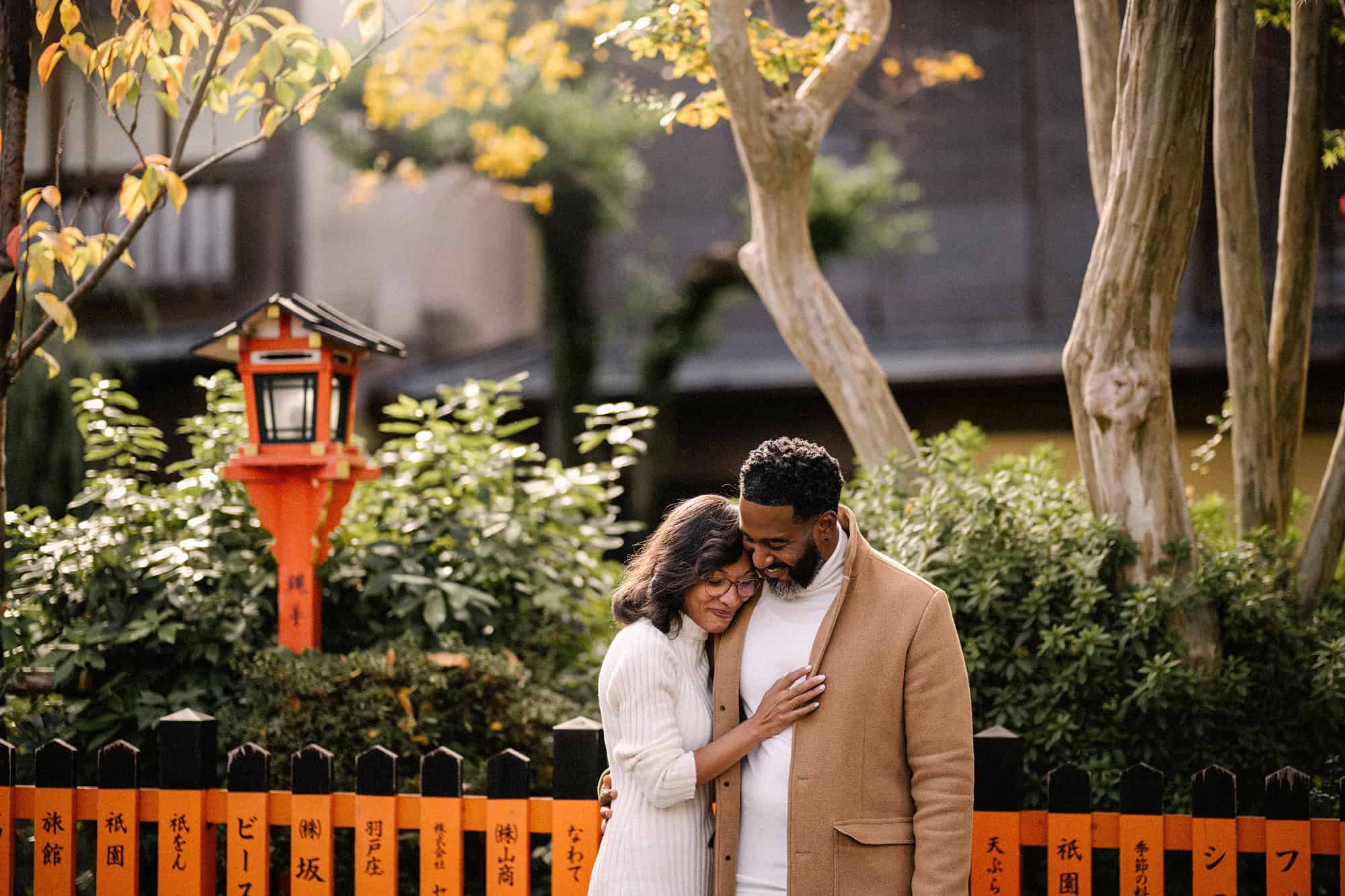
Even inside a single day, we leave a pause. On one Tokyo elopement it was an hour in the tatami rooms with light food, the cake and nothing scheduled: an hour to be married without anyone needing anything from them. An elopement can easily become a photo shoot with vows in the middle. The pause keeps it a wedding.
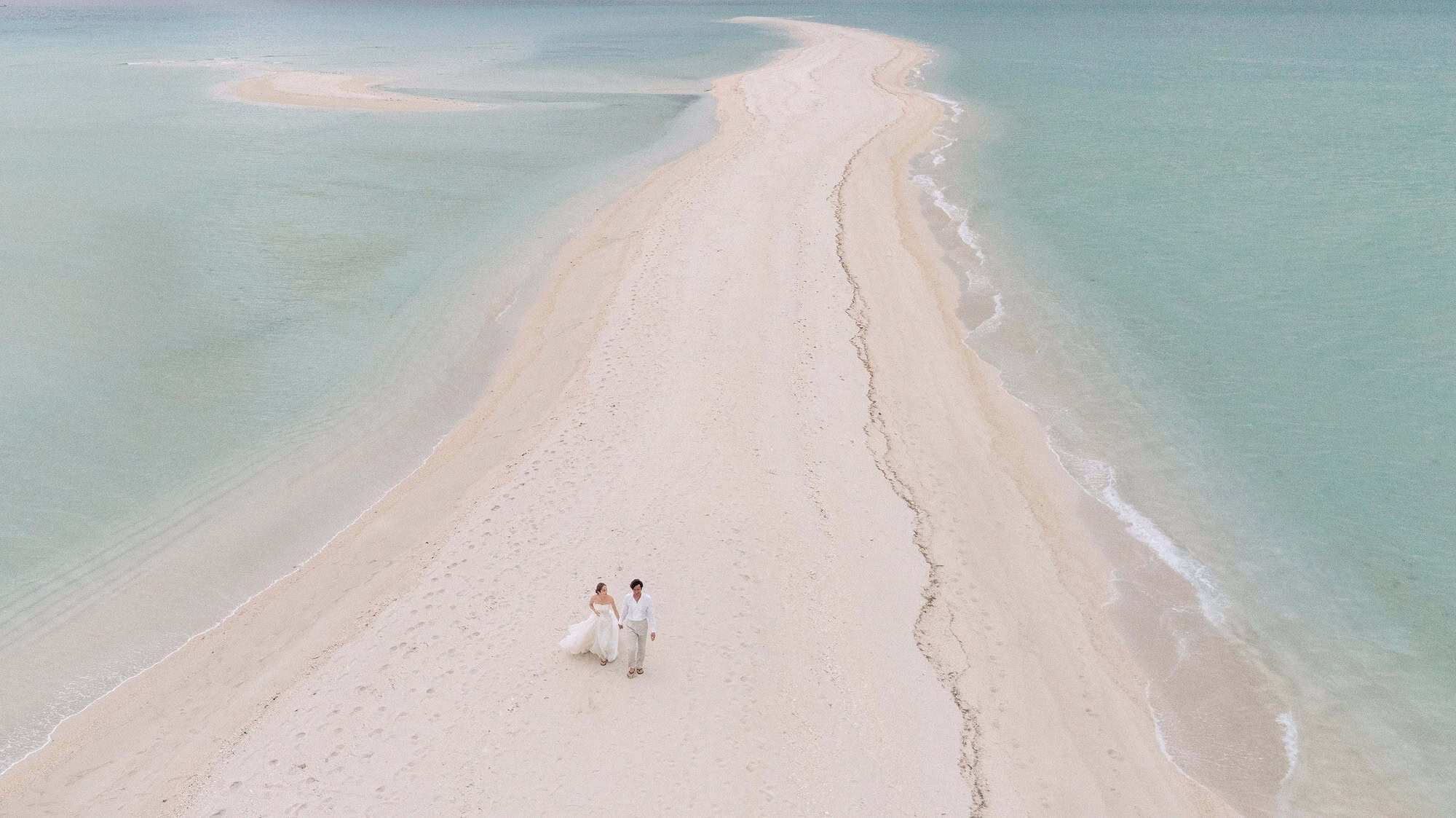
A wedding with family needs the same room. On Miyako Island in Okinawa, one couple went out by boat the afternoon before their ceremony to a sandbar that only appears at low tide. Nobody had to squeeze it between getting dressed and greeting the family.
The Day After the Wedding in Japan
The day after is the part couples forget to plan, and the part they talk about most. Decide early whose day it is. Spend it with your guests or slip away on your own; both are right. It only goes wrong when nobody knows which.
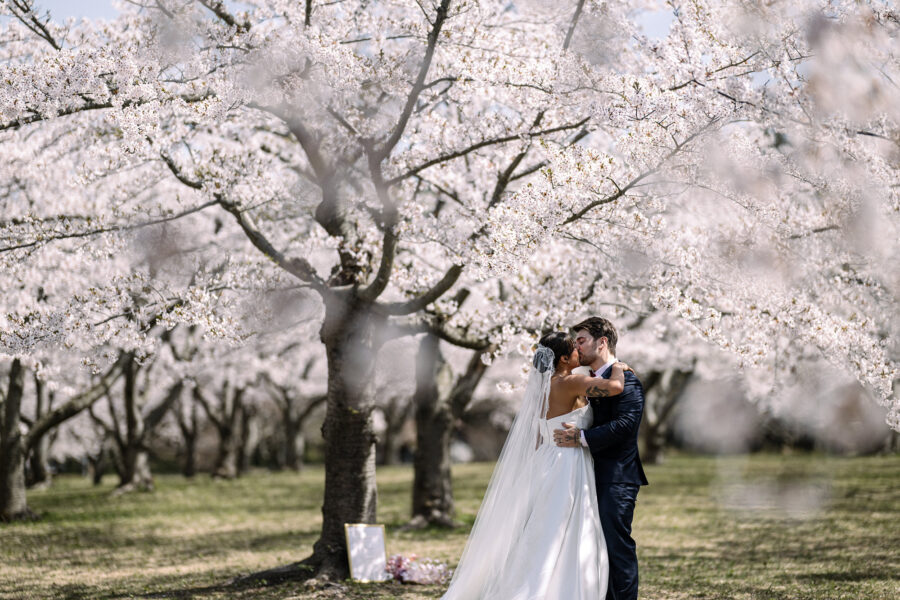
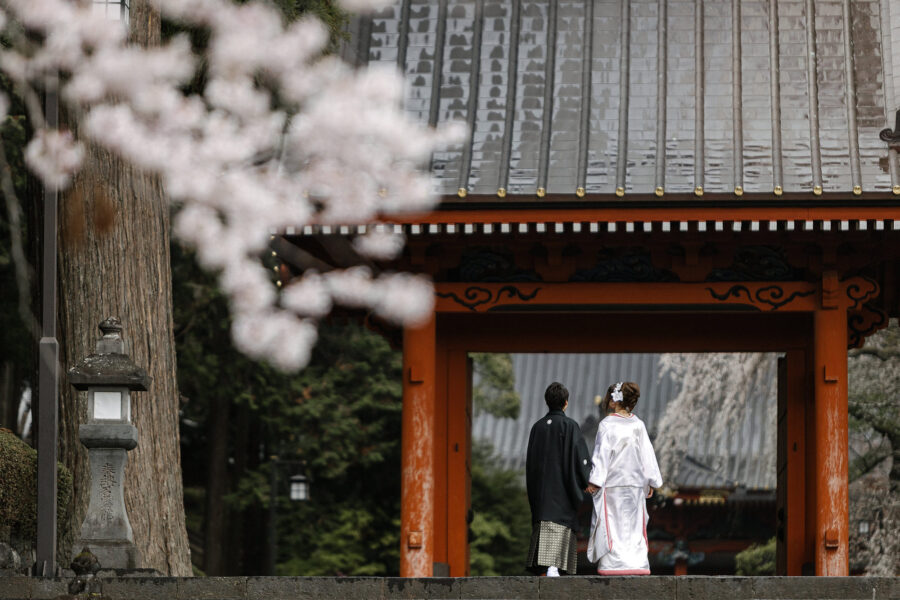
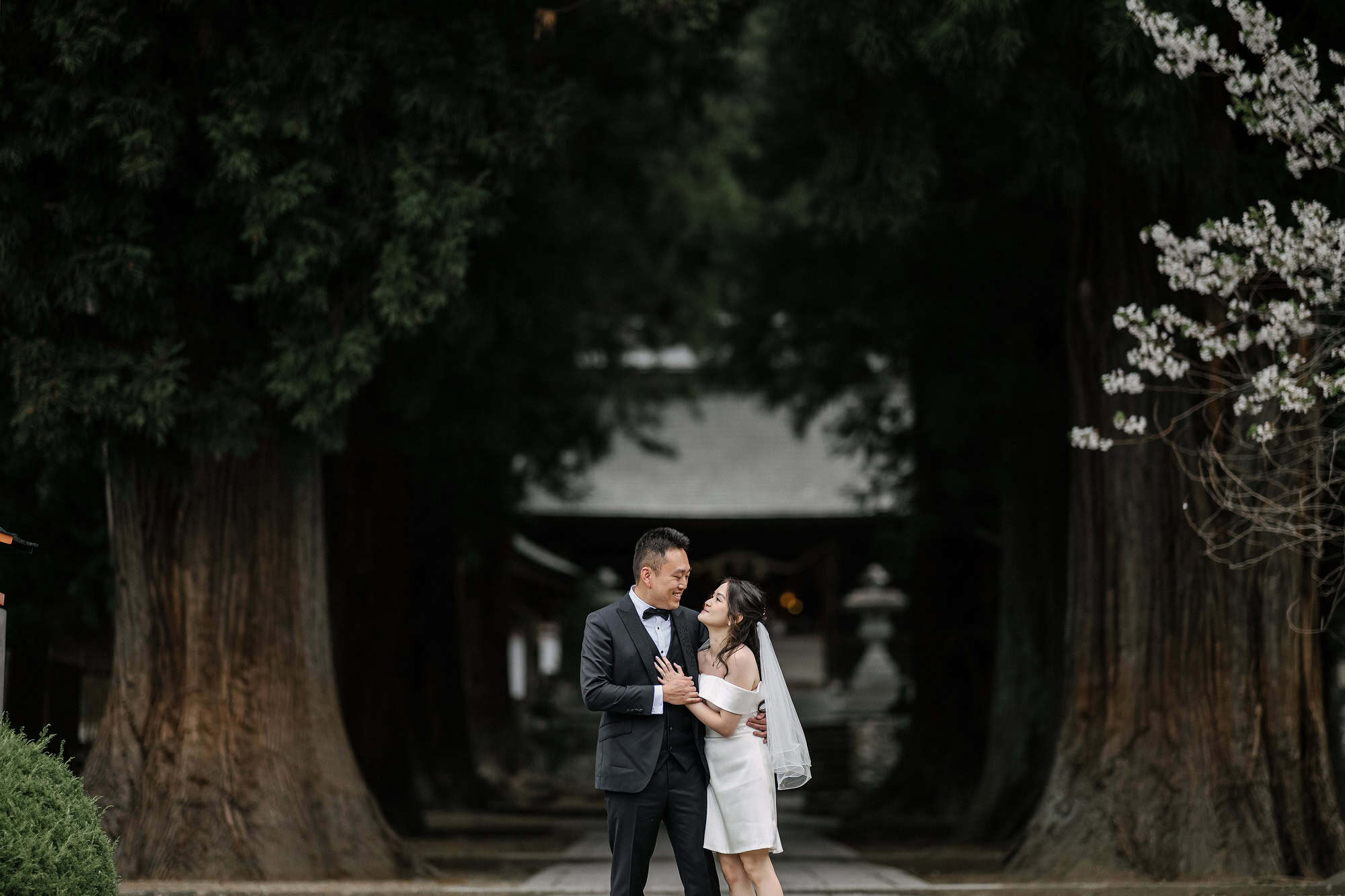
The morning after that winery wedding, the couple went out early beneath the cherry trees. At Kawaguchi Asama Shrine, founded in 865, the year after a great eruption of Fuji, two cedars stand together on one root. The shrine likens them to Izanagi and Izanami, the divine couple of Japanese mythology, and honours them as sacred trees of good relationships. The couple walked around the pair from opposite sides and met at the other side. Then they came running down the path, hand in hand. “We did it!”
The cedars belong to a living shrine, not a backdrop. You don’t have to share a belief to approach a tradition with attention.
Other mornings after are louder. In Hakuba, the blizzard cleared overnight into a bluebird morning, and the couple went back into the mountains, a veil tucked into a ski helmet, before heading off on a snowmobile.
Some end back in the city. The couple married at the winery near Sendai closed their celebration with farewell drinks in Tokyo. Conversations carry on after the wedding clothes come off.
After the Wedding: The Honeymoon and a Spare Day
For some couples the honeymoon is part of the same journey. A couple from Kentucky asked themselves why not marry in Japan and fold the honeymoon into the same trip, then eloped in Niigata’s sake country.
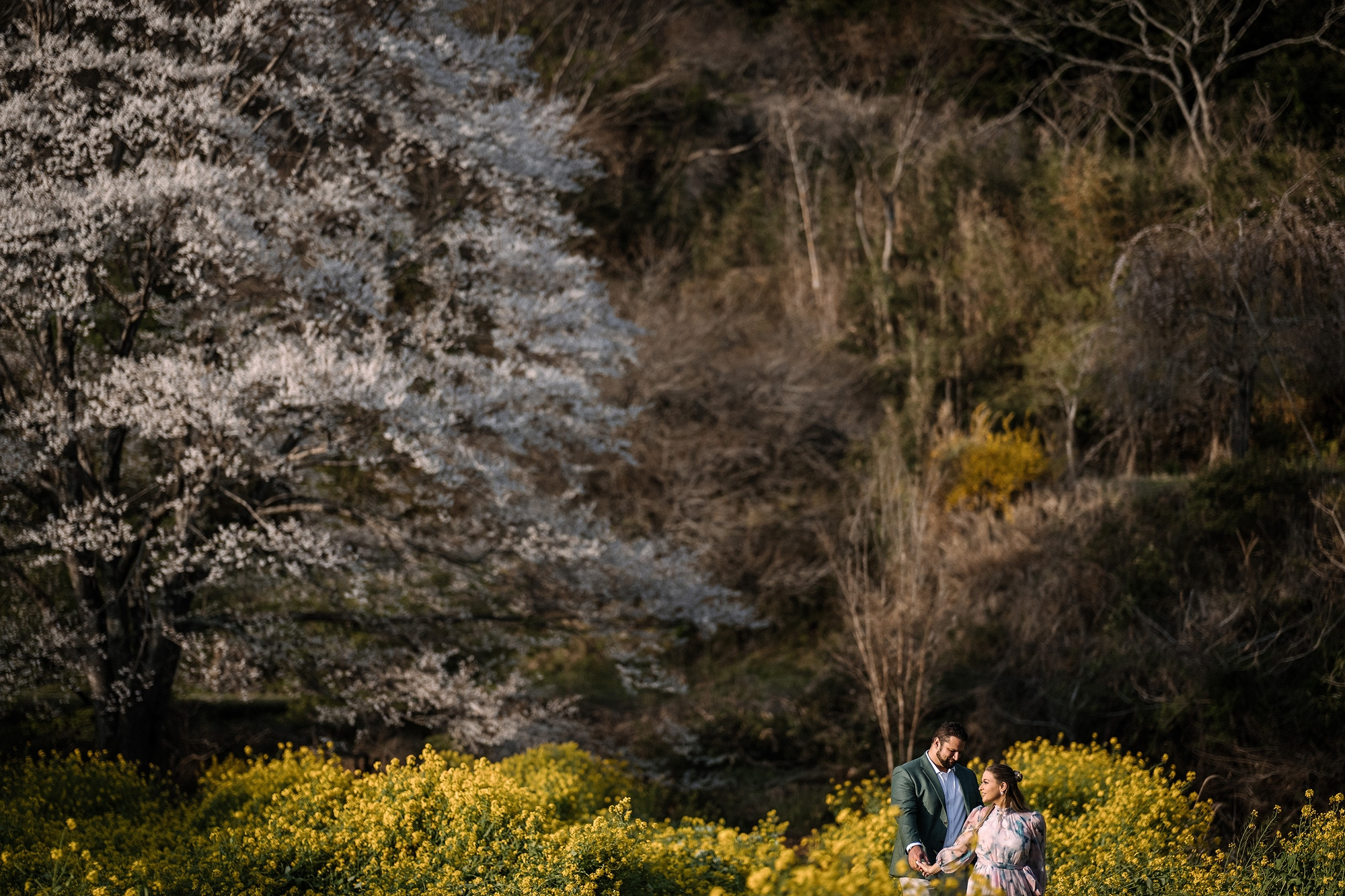
Others come back. A couple from Florida returned on their honeymoon, not quite five months after their wedding, for an afternoon among cherry blossom and nanohana in the hills of Kanagawa. Another met us again in Hirosaki, weeks after their ryokan wedding, to say goodbye to Japan under the blossom.
Whatever else you plan, keep one day after the wedding with nothing scheduled against it. Some couples use it for a post-wedding photoshoot. One couple spent a whole day with us around Mt Fuji: a dark, cold start, drives between lakes, a mountain that hides more often than it shows. It came out for them. They told us afterwards it had been the best day of their whole trip.
How to Plan a Destination Wedding Weekend in Japan
No two of the celebrations we plan run the same, but the ones that work tend to share a shape.
Day one: arrive and gather. Guests land, settle and meet over the welcome dinner.
Day two: the wedding. The day with the most structure, which is exactly what lets everyone stop thinking about structure.
Day three: the long goodbye. A slow morning, farewell drinks, a few hours to yourselves. One shared moment at most, then Japan.
A few decisions make that shape work.
Start with where everyone sleeps. The most generous celebrations keep people under one roof, a whole ryokan or a village of old houses. Then the conversations don’t end at the taxi rank.
Decide the shape early. How many days, and what happens on each, settles between a year and six months out, while venues and rooms can still be held. Our wedding planning timeline for Japan shows when each decision belongs.
Plan all the days as one. The days around a wedding deserve the same care as the ceremony. That’s the work a Japan wedding planner should be judged on: the inns held, the menus confirmed, the buses booked, the rain plan ready, all of it settled long before anyone lands. Our wedding planning in Japan designs the days from the first conversation to the last goodbye, with our photography and film there for all of it.
Quick Answers
How many days should a destination wedding in Japan be?
Two or three days suits most weddings with guests travelling from abroad: a welcome dinner, the wedding, then a slower day after. Those days don’t need to fall on a weekend. Ours often run midweek, Tuesday to Thursday or Monday to Wednesday, because guests who have flown in are on holiday anyway. Elopements can be shorter, but even for two people we like a spare day. Japan’s weather keeps its own plans, and Mt Fuji in particular shows itself when it chooses.
What’s the difference between a welcome dinner and a rehearsal dinner?
A rehearsal dinner is traditionally for the wedding party, after the ceremony rehearsal. A welcome dinner is for everyone who has travelled. For a destination wedding in Japan we prefer the welcome dinner, because it’s the evening strangers become company, and that changes how every day after it feels.
What should guests wear to a welcome dinner in Japan?
Whatever you tell them, so tell them with the invitation. At a ryokan, the inn’s own cotton yukata can be the dress code, and it’s a lovely leveller. Many Japanese rooms are tatami, where shoes and slippers come off at the edge, so a good pair of socks matters more than guests expect.
What can wedding guests do the day after a wedding in Japan?
Keep it loose. One shared moment, such as farewell drinks or a slow morning at the inn, then time to explore. Give guests a short list of places you love rather than an itinerary. Japan rewards wandering, and the stories they bring back are half the pleasure.
Do we need a wedding planner in Japan for a wedding weekend?
You can book a ryokan yourself. Several days with a full guest list are different: venues that work in Japanese, menus and dietary needs confirmed with the kitchen, transport between places, rain plans and inns with their own house rules. A destination wedding planner in Japan holds all of that, so you and your guests only see the celebration.
What You Can’t Explain
Back to that guest in Hakuba. “How do we even explain what we just experienced yesterday?”
You can’t, not to anyone who wasn’t there. The people who were there don’t need it explained. They were on the boat, under the umbrellas, at the long tables in their yukata. They were part of it, and they’ll carry their piece of it home.
Give them the time to get there.