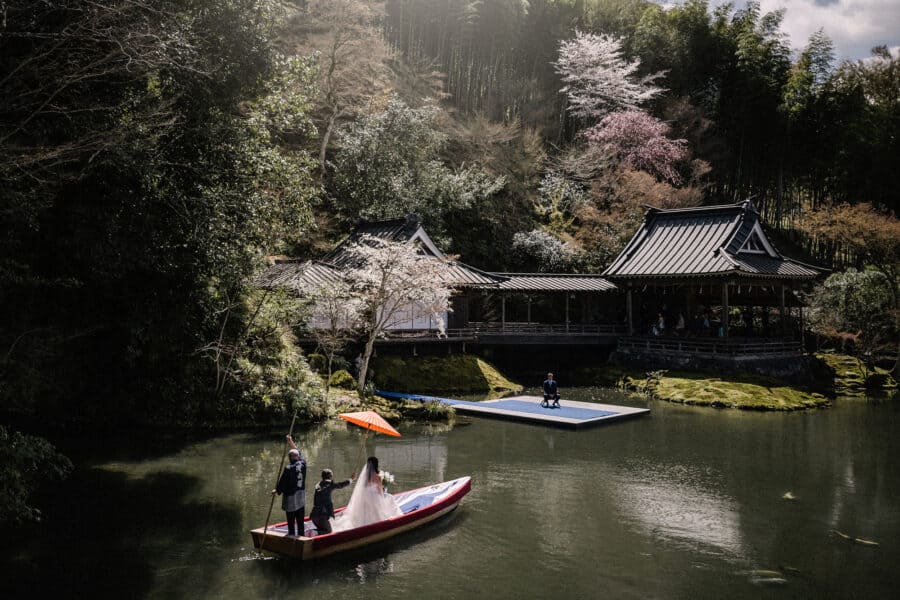
Long before this mountain wedding in Japan, a poet looked at the same ridges. Kosuge’s own account of its history keeps two old poems about the village side by side. One is by a poet nobody remembers, and it imagines someone in the district of Tsuru sewing the village’s sedge into hats. The other it attributes to Sōgi, the great master of linked verse, who died in 1502. Far and far, it says, the high peaks of Kai show themselves and hide, and the small sedge of Itano bends at its tips.
They still do. On the May afternoon this couple married at NIPPONIA Kosuge, cloud settled over the cedar ridges and lifted again, and the mountains came and went behind them the way the poem has them. Few wedding days arrive with a line already written for them. This one’s was more than five centuries old.

It took them almost three years to reach this garden. They first wrote to us from Belgium in 2020, ten years into their life together and five years after she had said yes, and he wrote without telling her, with one idea: if they were finally going to marry, it would be in Japan. They had fallen for the country on a twenty-day trip in 2018, for its shrines and its cities, its cats, matcha and ramen, and they went home and kept sleeping on futons. They wanted a wedding that belonged to Japan rather than one carried in from somewhere else. Then the pandemic closed the borders. The date moved to spring, then to autumn, and in the end they married on her birthday, in May 2023, which was her idea. Over those years they looked at other places, but once Dee showed them NIPPONIA Kosuge they couldn’t imagine anywhere else.
It was everything they had asked for from the start: privacy, forest, an onsen, food from the valley, a village rather than a venue, and somewhere their closest friends could all stay together. They gave those friends two nights in a village of about six hundred in the mountains of Yamanashi: ramen and local beer on the first evening, the wedding the next day, then dinner, a bonfire, a sake barrel broken open, and everyone sleeping under the same old roofs. We loved them for waiting for it, and for spending the whole of their celebration inside it.
A Village Named for a Grass
Most places take their names from something grand. Kosuge is written with the characters for small and sedge, and its old poems take the name at its word. The hat sedge, kasasuge, grows in wet ground and flowers in May and June, and its long leaves were cut in summer and made into hats, straw rain capes and rope. It’s a plant people lived with at close range, cutting it, sewing it, wearing it. The anonymous poet even wrote the district’s name, Tsuru, with the character for crane, so in the poem the village sits in the district of the crane, among white-jewelled sedge.
The sedge village is also, now, a hotel. NIPPONIA has turned Kosuge’s old houses into one hotel spread through the village, and we’ve told that story before, along with an October wedding at NIPPONIA that we still think of as belonging to that couple. May is a different village.


On the old calendar, summer had begun five days before they married, at rikka. The haiku calendar has a phrase for the weeks just before it: yama warau, the mountains laugh. It comes from an old Chinese text on landscape, which says that spring mountains are pale and charming, as if smiling, and it names the moment when every tree on a slope puts out new shoots at once and the whole mountain brightens. A little later the same leaves become shinryoku, new green, and a summer word. A spring wedding in Japan held right at that turn gets a season most visitors never see: the blossom gone, the rainy season not yet come, the wisteria out over the garden rocks, and the mountains at their loudest.
A Silk House in May
NIPPONIA’s main house, the Ōya, is about 150 years old. The villagers have long called it that, the big house, and the hotel describes it as a distinguished family home you could call the village’s front door. It was built by wealthy farmers who raised silkworms, and its garden-view room is said to be where the village’s important visitors once stayed.
For a silk-raising house, these were weeks that counted. The spring silkworms, harugo, were raised as the mulberry leaves opened, and the Japanese dictionaries are exact about their standing: of all the year’s broods, theirs gave the most thread and the finest.


So there’s something right about getting ready for a wedding here in May. A wedding morning is careful work too, done by hand, at close range, by people who know each other well. The Ōya was built for a household busy with something delicate, and for one day in May it had one again. The village’s front door, where its important guests once slept, belonged to a couple and the few people they’d brought with them. We can’t think of better guests for it.


Under the Noren
They saw each other first at NIPPONIA’s gate, under its noren. A noren is the split cloth a Japanese shop or house hangs at its entrance, marked with its name, and the word has never been only about fabric. It also means a house’s good name, the trust it has earned over years: to damage a business’s reputation is, in Japanese, to put a scratch on its noren. The curtain began in Zen temples as a cloth hung against the cold, and ended up as the thing a household stands behind.
It’s a good place to meet the person you’re about to marry: a threshold with a name on it, which you pass under once and never quite pass back through. The rest of that meeting is in the photographs, and we’ll leave it there.


A Mountain Wedding in Japan, Made in Turns
Sōgi’s art was renga, linked verse. One poet offers three lines, the next answers with two, the next takes up that answer and turns it somewhere new, and by the end the poem belongs to no single person in the room. Japanese reference books call it a literature of the gathering, made by people sitting together, and the gathering was half the point. It also ran on rules, the shikimoku, which governed what could follow what, and the freedom lived inside them. The opening verse, the hokku, had one more duty: it had to name the season it was made in.
In 1488 Sōgi and his two best pupils made a hundred verses together as an offering to an emperor’s shrine at Minase, and they’re still held up as the model of the form. Three people, one poem, nobody writing alone.


This ceremony in the Japanese garden at NIPPONIA Kosuge was renga in all but name. A friend led it, then his best man and her bridesmaid each stepped forward to say a few words about the two of them, and the rest of the circle stood close enough among the rocks and wisteria to answer. She walked in to “Sweet Child O’ Mine”, and they walked out to the Backstreet Boys, which, he will tell you, was entirely her doing. An intimate wedding in Japan made this way has no audience, only company, and everyone in it adds a line.
Our part is the shikimoku. When we plan a day like this in the mountains, we hold the rules: the order, the timing, the paths between the house and the garden, the plan for weather. That’s what leaves everyone else free to answer each other. The hokku was the easy part. The season named itself.


Where the Peaks Show and Hide
Sōgi’s opening verse at Minase, the one that begins those hundred verses, is about a mountain seen in part: snow still on it, and yet its foot hazed over in the evening. Read now, it’s a verse about how a mountain that keeps something back holds the eye longer than one laid out in full. It’s close to what we mean by yūgen, the feeling that comes when a landscape withholds a little of itself.
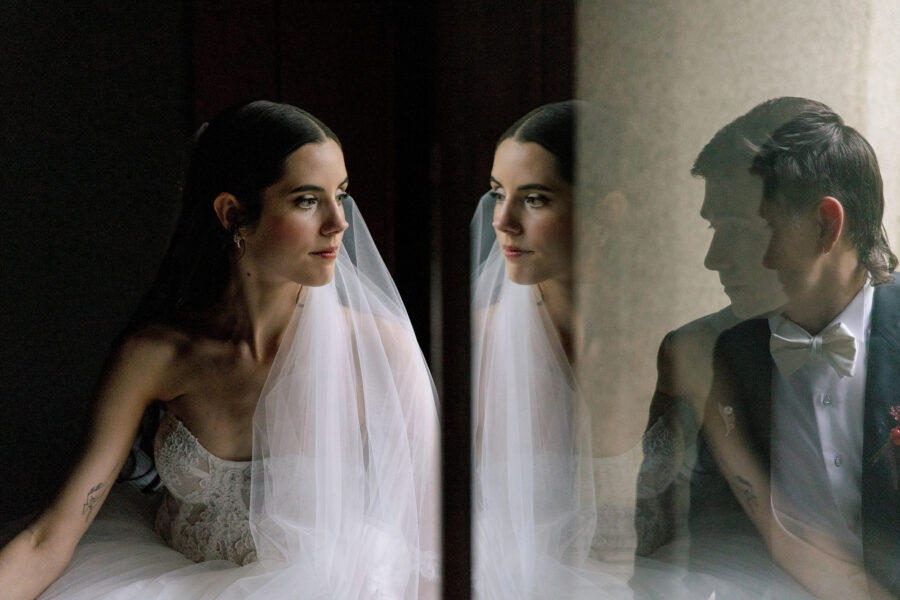
The old house works the same way indoors, where beams, paper and glass let you see people in part: from the loft above, through a lattice, doubled in a window.


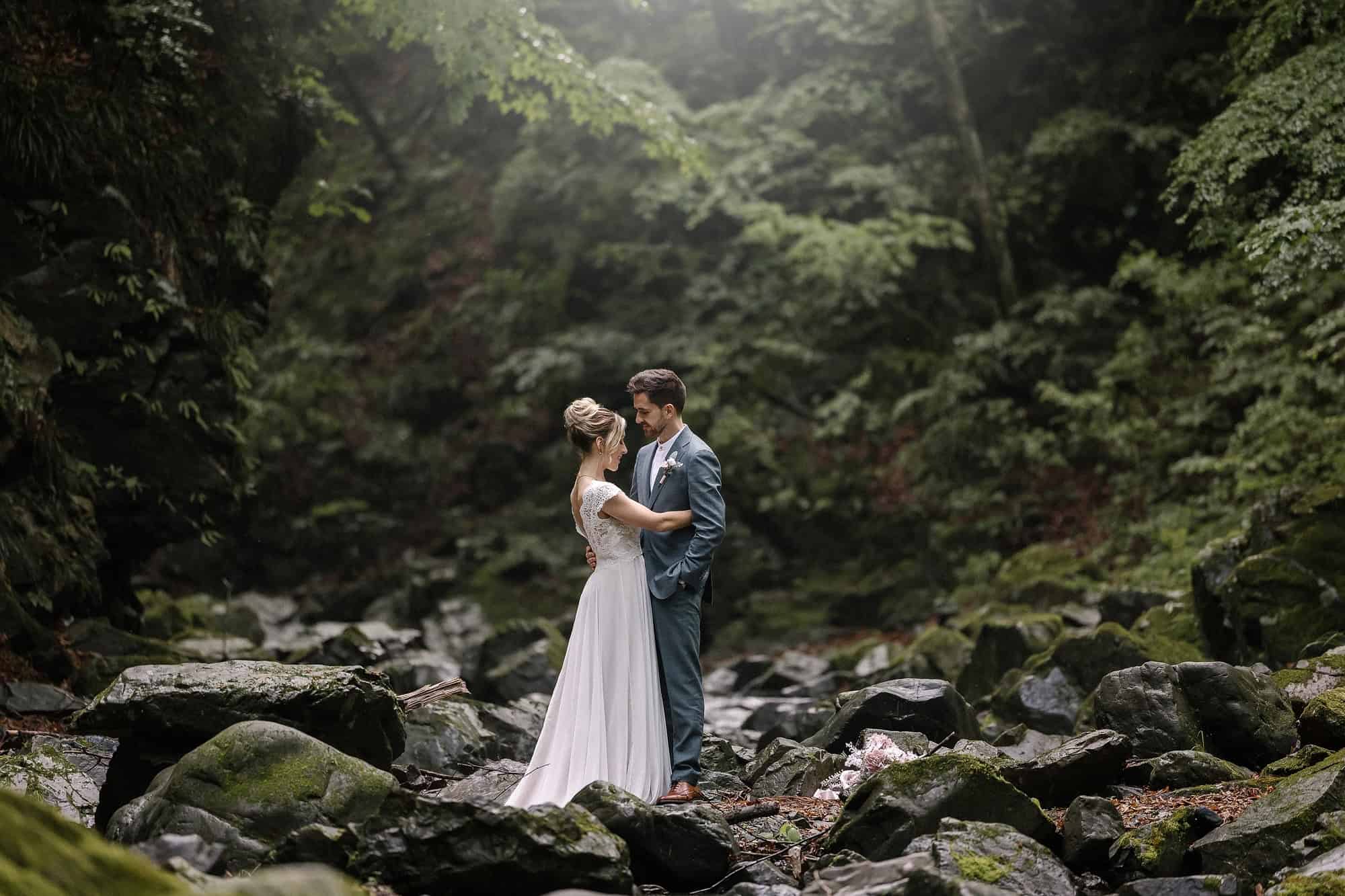
Outside, Kosuge in May did it all afternoon. Light rain came and went, cloud slid down the cedar slopes and lifted, and a ridge that was there one minute was gone the next. When the far mountain disappears, what’s left is closer: two people, a few trees, a small shrine in the forest with a stone torii and a cedar thick with moss, a stream running through a green gorge. We’d take that over a clear horizon most days. A mountain wedding in Japan doesn’t need the whole mountain. It needs the part that shows up.


Travelling Lying Down
Zong Bing, a painter in fifth-century China, loved mountains and rivers and walked a great many of them. When illness brought him home, he painted everywhere he’d walked on the walls of his rooms and said he would roam them lying down. Japanese still uses his phrase, gayū, for the pleasure of travelling a landscape from your bed, through paintings and maps. He also wrote a preface on landscape painting that describes stretching silk on a frame, looking at the scenery through it, and painting what the frame holds, a method now counted among the forerunners of perspective.
Silk on a frame, held up to a mountain, is about as early a description as we know of what a photograph does. Our photographs are made for the years when a couple can’t walk back into Kosuge whenever they like, when the ridges are a long flight away and the people who stood in that garden have scattered again. They’re the walls to travel on lying down.
The last frames of the night were made at the gate, under the noren with the house’s name on it, where they’d first seen each other that day. A curtain that carries a good name, hung over a threshold in a village named for a grass. They stood under it married. The peaks, by then, had hidden for the night.