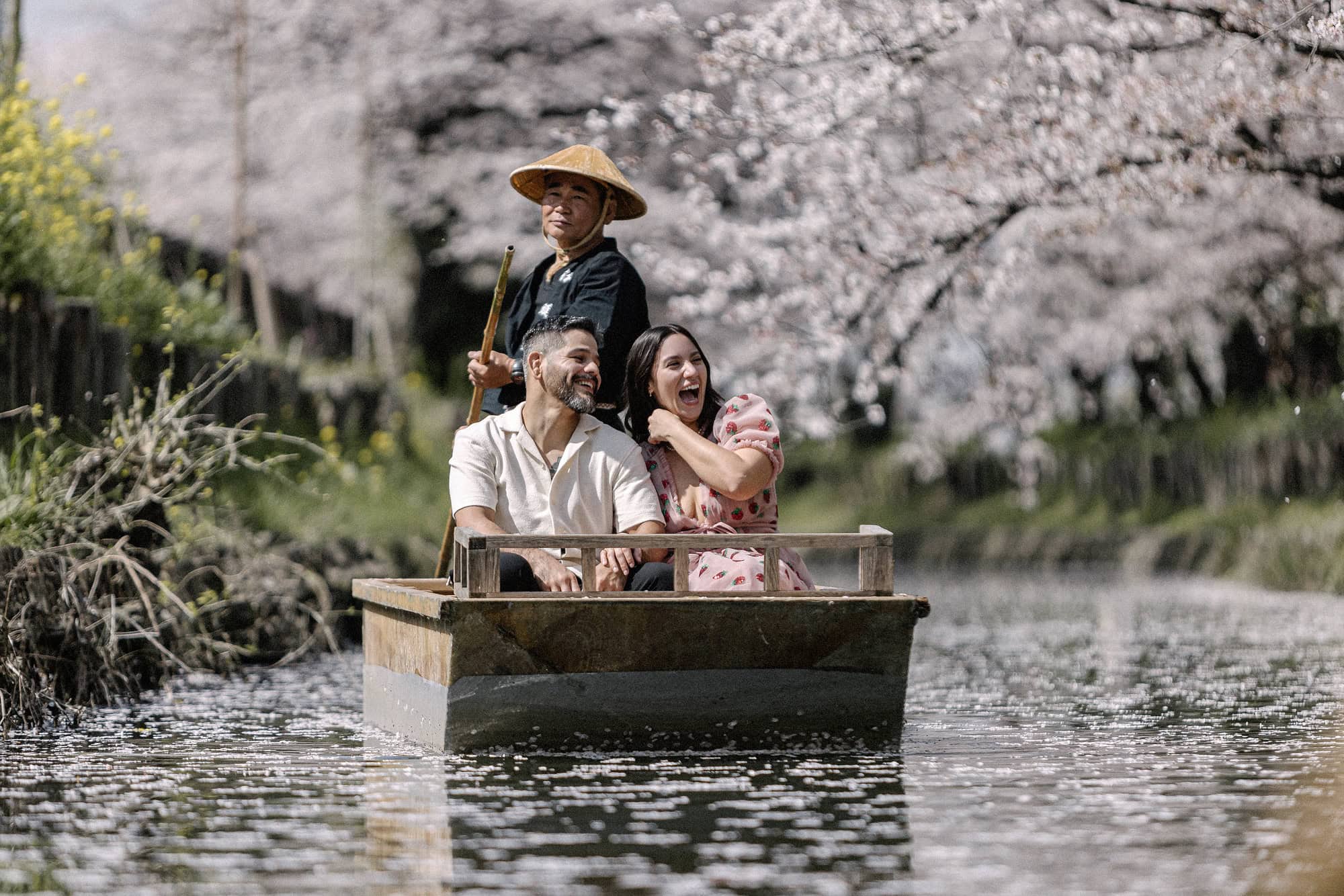
The boat was small enough for the river to feel close, the cherry branches low enough to gather above it. She rested her head on his shoulder while petals moved across the water, and behind them the boatman stood with his pole, guiding them beneath the blossom. This Kawagoe cherry blossom elopement had a ceremony, a garden and, eventually, the lights of Tokyo. But its heart was here, in a wooden boat with very little reason to hurry.
The bride wore a pink dress scattered with sequinned strawberries, puff sleeves and ribbon ties. Their wedding clothes belonged beautifully to them.
Kawagoe is known as Little Edo for its old merchant streets, but the river carries another way of understanding the connection. Long before a train brought visitors from Tokyo, boats linked this town to the capital. The water beneath the petals once had a great deal of work to do.
A Cherry Blossom Boat Ride on the Shingashi River
Behind Kawagoe Hikawa Shrine, cherry trees line the Shingashi River for roughly half a kilometre. Their branches lean over the narrow water, meeting above the boats in a loose, pale canopy. From the bank, you can see the whole passage; from inside it, the blossom surrounds the journey.

That difference matters. A cherry blossom boat ride allows the place to come towards you at its own pace. Branches pass overhead, reflections change beside the hull, the boatman adjusts the pole. You have time to notice another person noticing it too.

Across the water lay the petals that had already fallen, gathering in drifting patches known as hanaikada, flower rafts.


We love that the falling has a name of its own. The blossom continues to make something beautiful after it leaves the branches. Here it gives the river another surface, one that opens around the boat and slowly settles behind it.
The photograph we keep returning to holds all of that in one place: two people laughing, the boatman behind them, flowers above and flowers below. It has the scale of a remarkable landscape and the intimacy of a shared afternoon. You can admire the scene, but you can also imagine being close enough to hear the laughter.

That is what we hope for when we photograph cherry blossom season. The beauty is immense, and the personal detail gives it a way into memory. These two will always have their own answer to what spring in Kawagoe felt like.
The River That Went to Edo
In the seventeenth century, the Shingashi was reshaped with deliberate bends to help maintain water conditions suitable for boats. Goods moved between Kawagoe and Edo: rice, sweet potatoes and timber towards the city; sugar, sake and household wares coming back. The river supported an exchange that continued until rail transport and changes to the waterway brought that working life to an end. Saitama’s account of the river preserves that history beneath the landscape people visit today.
It changes how you look at the water. A curve in a river can appear entirely natural until you learn that people once shaped it around the needs of a boat. Something you encounter as scenery may hold centuries of practical decisions.
The couple had their ceremony in the garden at Tantoku, a property connected to another part of Kawagoe’s commercial history. The family business began as a timber merchant in 1869, and the founder later built a detached house beside the garden. Wood, trade, the river and the old capital sit close together in this part of town.
Their celebration found an echo in those connections: a timber merchant’s garden, a journey on the river, and later, modern Tokyo. They travelled to the city by a very different route, of course. But we like the way a place can quietly give a wedding a deeper geography than the itinerary suggests.
You arrive for the blossom and discover that the water beneath it has been connecting lives for a very long time.
A Kawagoe Cherry Blossom Elopement, With a Garden at Its Centre
In the old house that morning, shoji screens softened the light around the groom as he dressed. A glass-walled corridor looked onto the garden, and a tiered display of hina dolls stood on red cloth in the room behind it.


It was a quiet beginning to a day that would eventually carry them through one of the busiest crossings in the world. The rooms gave time a different texture: light passing through paper, a garden seen from a seated position, the small interval before an occasion begins.

A wedding morning holds anticipation in a way the rest of the day cannot, because the central fact is still ahead of you.
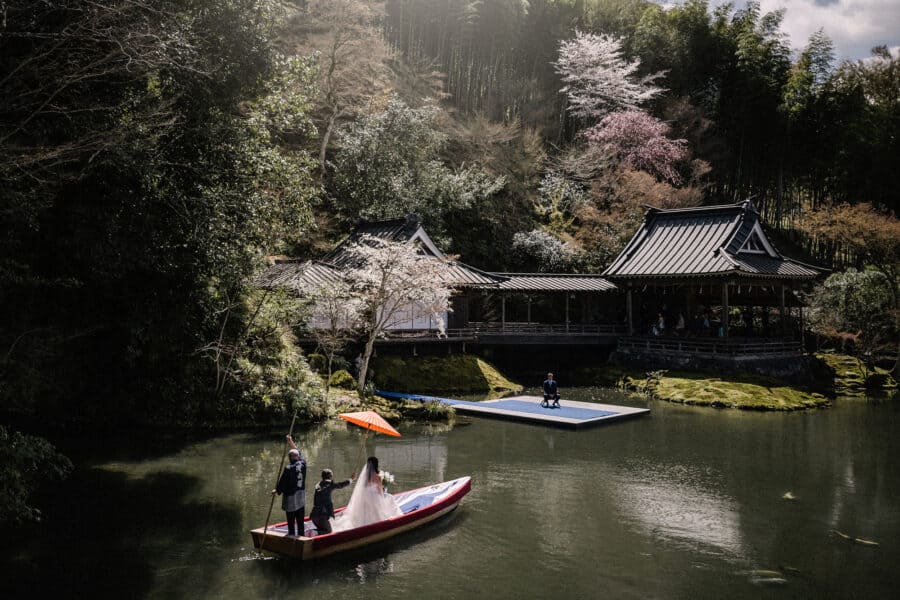
At Tantoku, raked gravel, a moss-covered stone lantern and a red paper umbrella shaped the place where the couple had their ceremony.

We have returned to this garden for an autumn celebration too. Its character changes with the season, while the human scale remains: a place where a small gathering can feel complete, held by the trees and the care of the people who look after it.
For this Kawagoe cherry blossom elopement, that completeness belonged to two people. The photographs moved easily between exuberance and stillness because both were already present between them.


The Clothes, the Place, the People You Are
There is a particular pleasure in a wedding that lets a couple’s own character remain visible in every setting. A pink dress with strawberries can belong beside old timber and raked gravel as naturally as it belongs under a tunnel of flowers. The setting offers its history; the people bring their present lives into it.

We see that exchange often in elopements in Japan. A couple chooses a place because something about it reaches them, then makes a celebration through the way they actually enjoy being together. Their clothes, their pace, the places where they stop, the things that make them laugh: these give the experience its particular identity.
The beautiful image becomes meaningful when the couple can look at it and recognise how they are with one another.
In the boat, you can see a wedding and an afternoon they were enjoying at the same time. That is part of its appeal. The occasion has enough significance to bring them all this way, and enough ease to let them lean together and laugh while they are here.

The correspondence afterwards told us they had particularly loved seeing the blossom from the boat. They already wanted to return and stay. We could think of few better measures of a place’s welcome than that wish to come back before you have quite finished leaving.
When the City Joined In
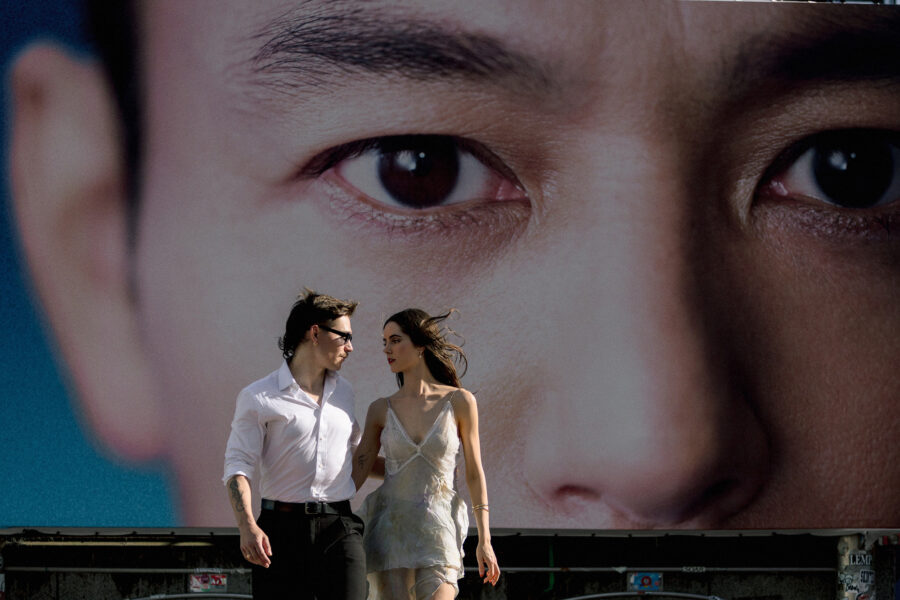
By blue hour, they were at Shibuya Crossing. Big screens brightened above the streets, neon gathered colour as the sky darkened, and the city continued its evening around them.

At the kerb they stood face to face, laughing. Out on the crossing, the white lines stretched beneath their feet and people moved in every direction. In the middle of that movement, they kissed.


The image has a lovely concentration. Tokyo is fully present, with its scale and velocity, while the couple’s attention rests completely on each other. The people passing through have their own destinations and their own evenings ahead; for a fraction of time, all those separate journeys occupy the same photograph.
We have returned to this frame when writing about what wedding photography really means, because it holds something larger than an attractive location. A photograph can preserve the way two people briefly experience a city together, while allowing the city to remain itself.
Earlier, a boatman had guided them through a narrow river beneath the blossom. Here, the crossing gave them a completely different rhythm. Both experiences belonged to the same wedding, and neither needed to diminish the other to feel significant.


A Day With Somewhere to Return To
Dee and our planning team arranged the celebration, and we photographed the people and places that gave it shape. The garden, the boat and the city offered distinct experiences, with enough room between them for the couple to enjoy the change.
A Kawagoe cherry blossom elopement can be light in its atmosphere and still leave a deep impression. The feeling may be carried by something as simple as a shoulder to rest on while the boat moves beneath the trees. The history is there, the landscape is extraordinary, and the person beside you makes it personal.
Years from now, they may return to the river in another season. They may find the trees in leaf, the water clearer of petals, a different light over the banks. The place will have continued with its own life.


But they will know exactly where to find their spring. It will be in a small wooden boat, beneath branches meeting overhead, with the two of them laughing and nowhere else they need to be just yet.