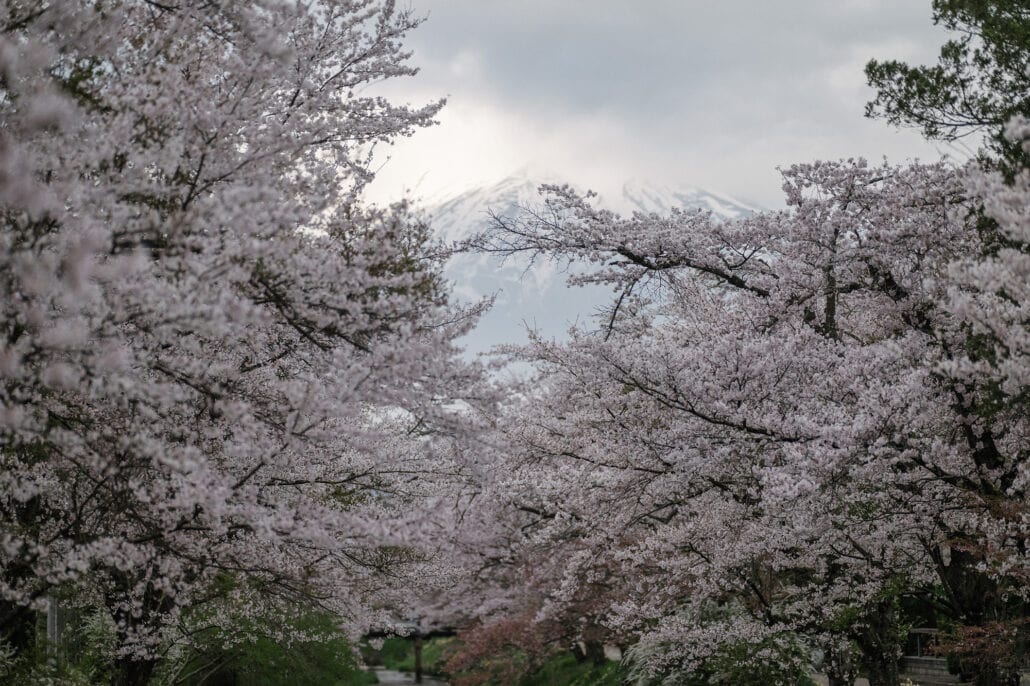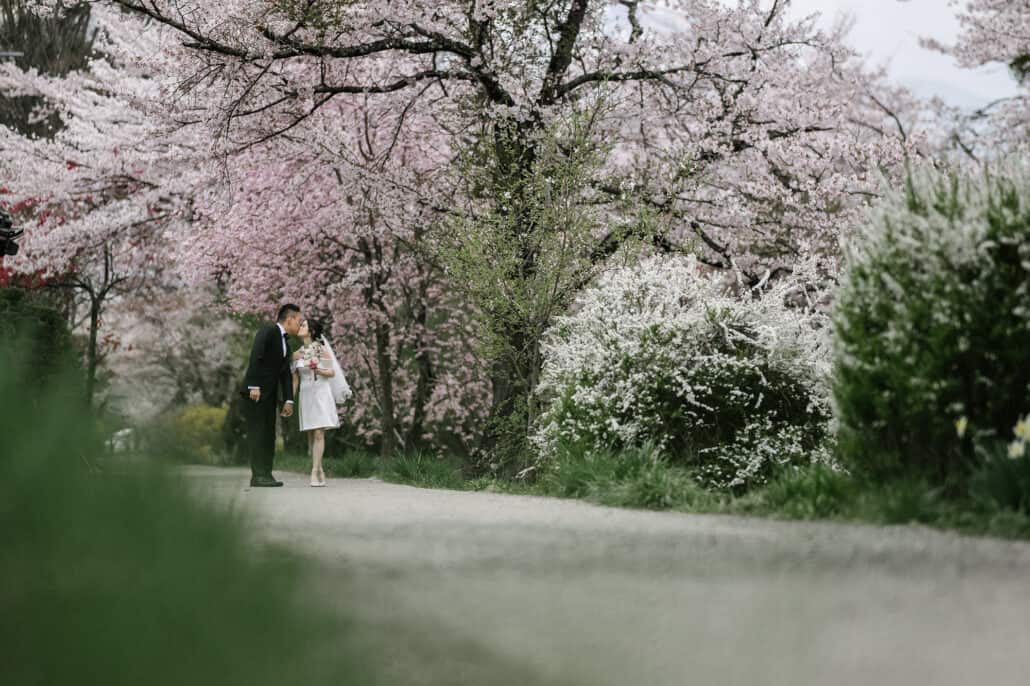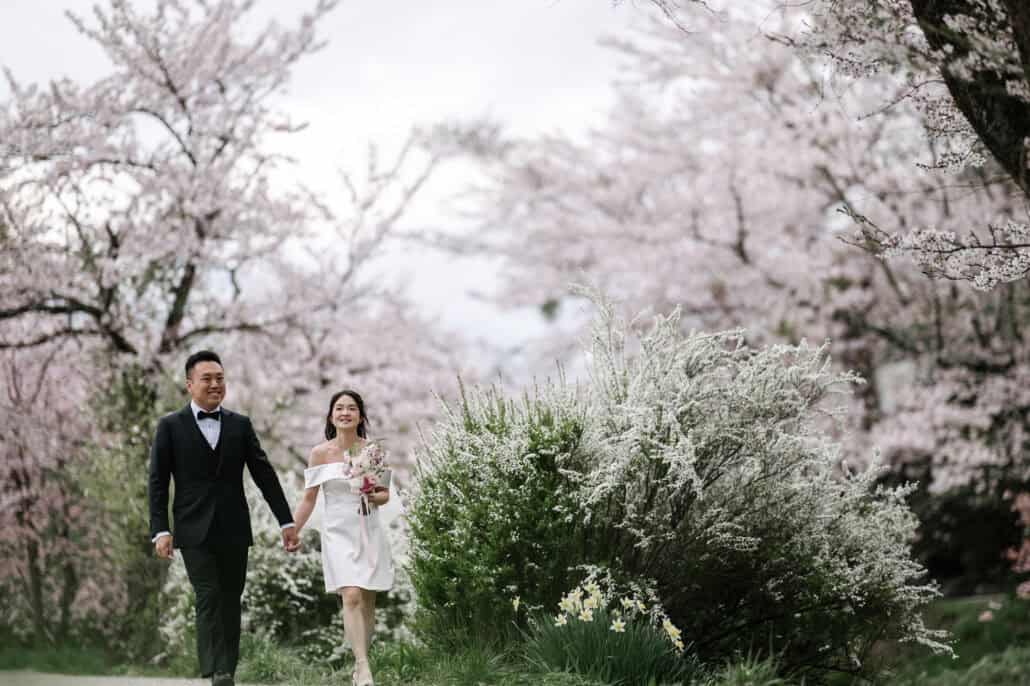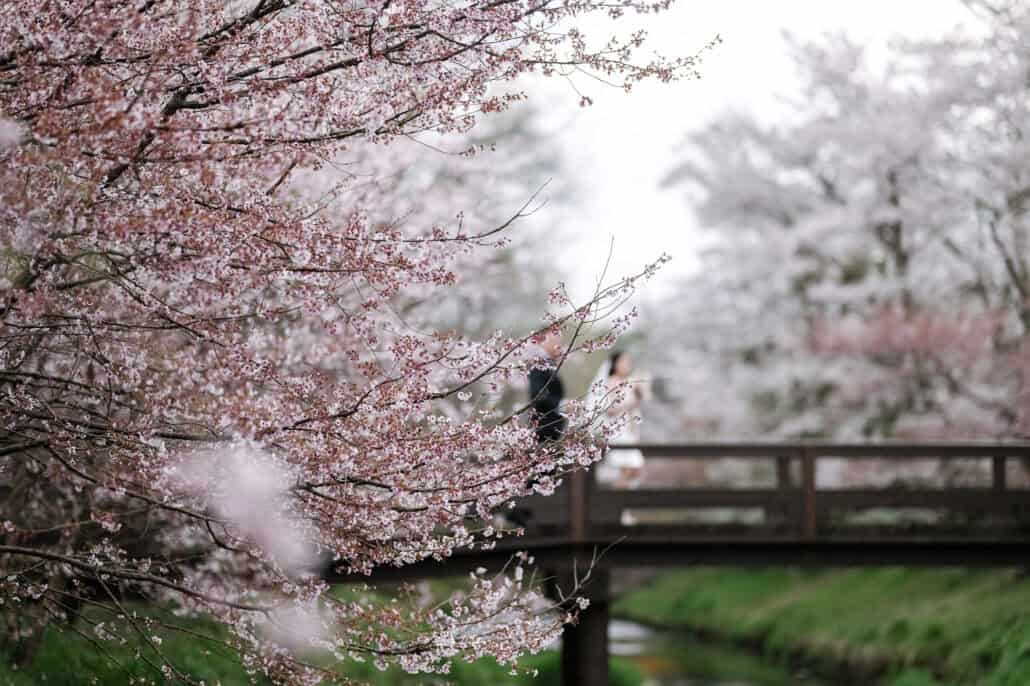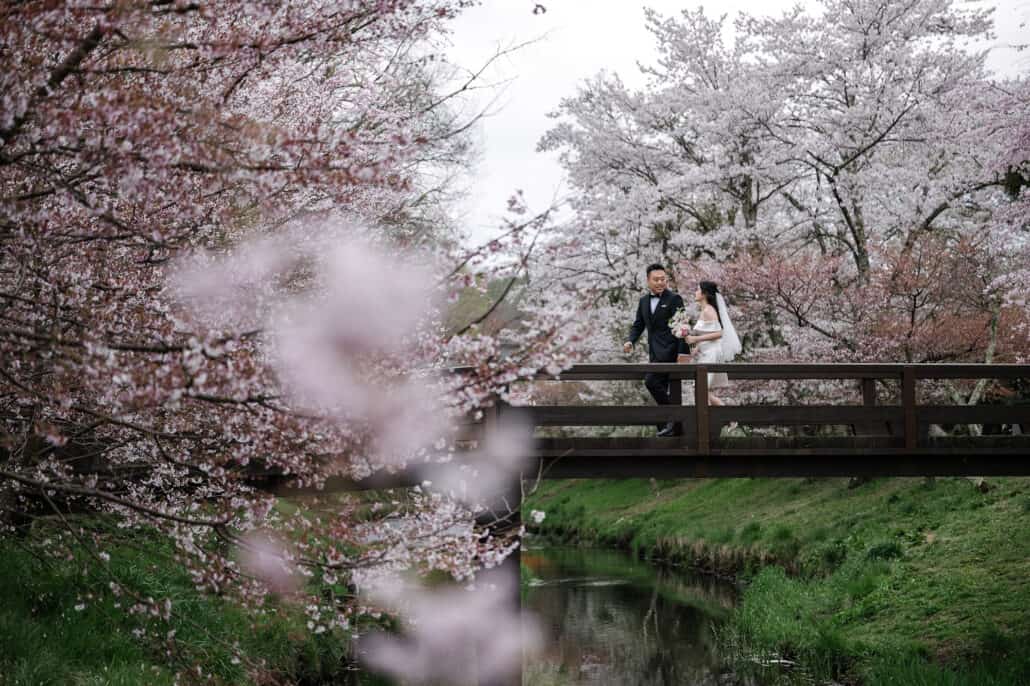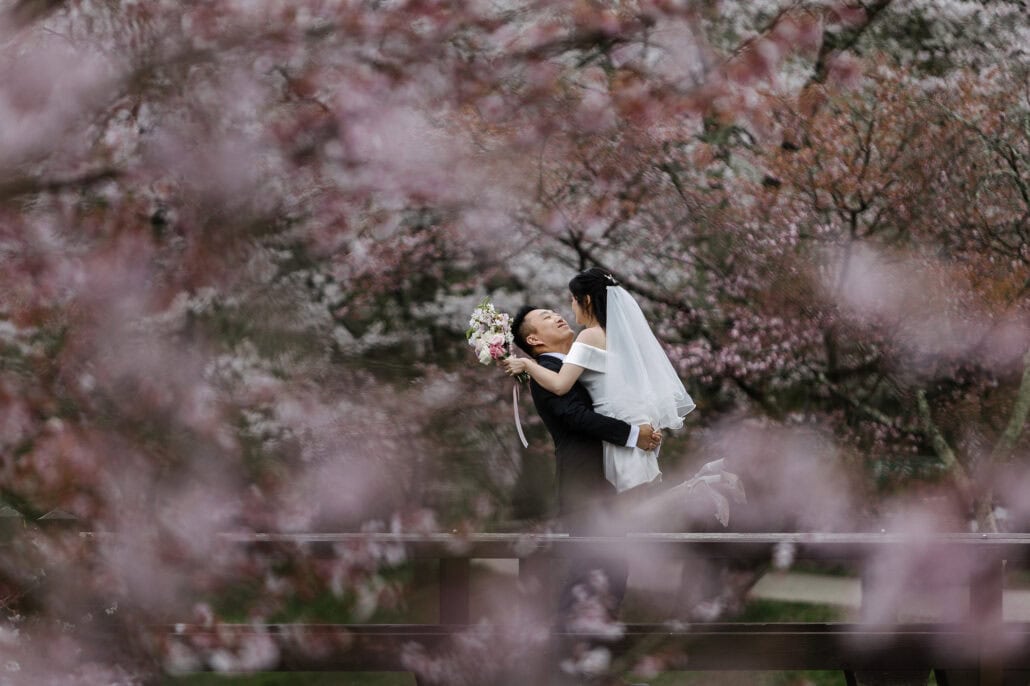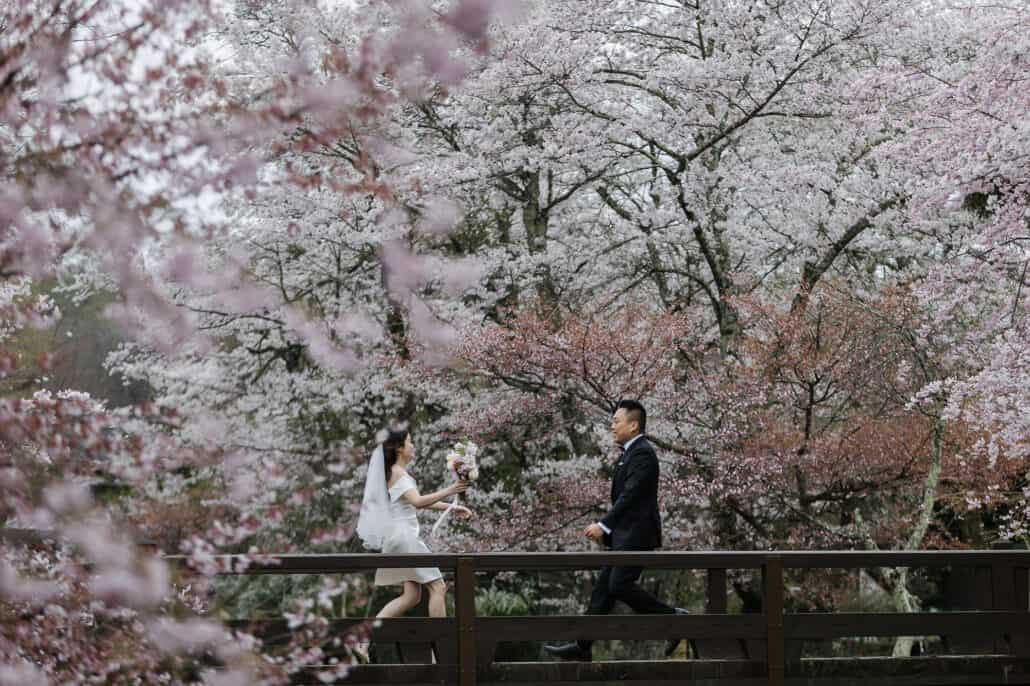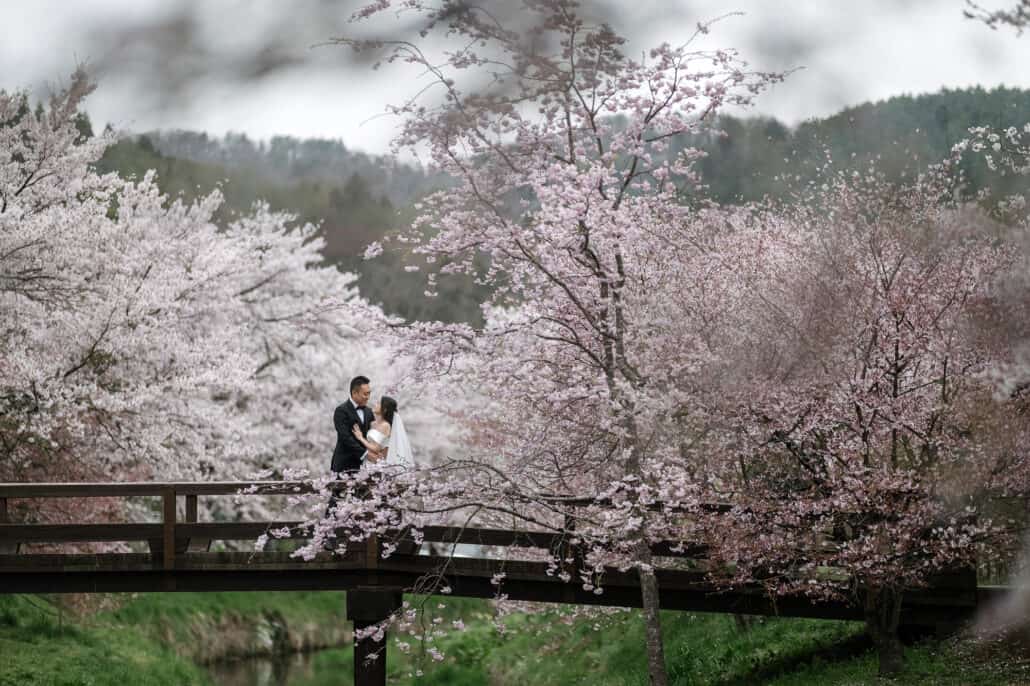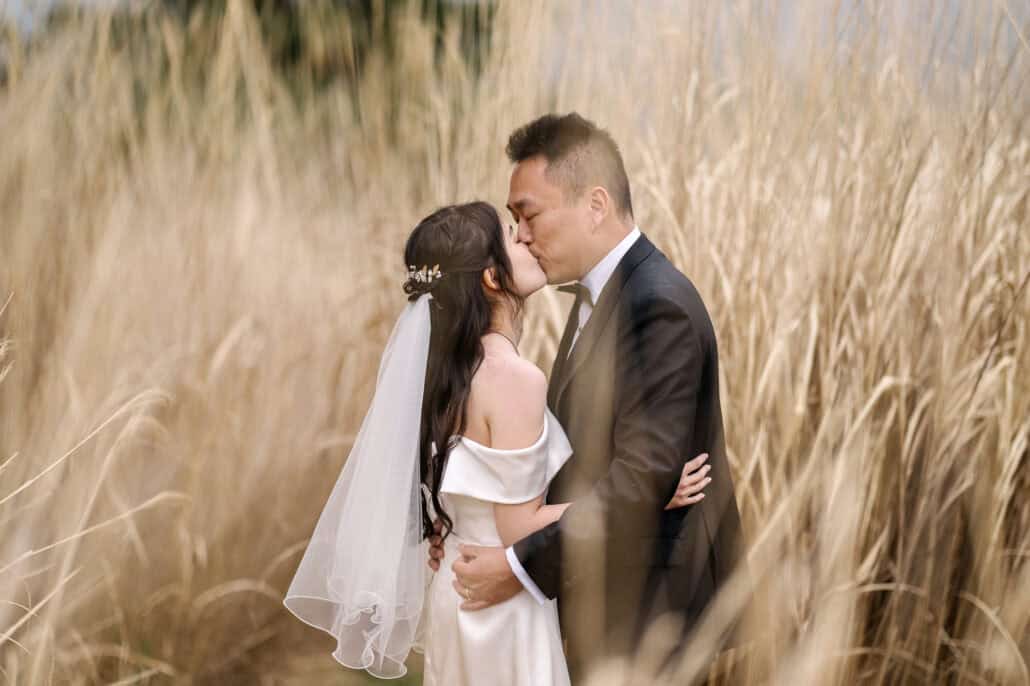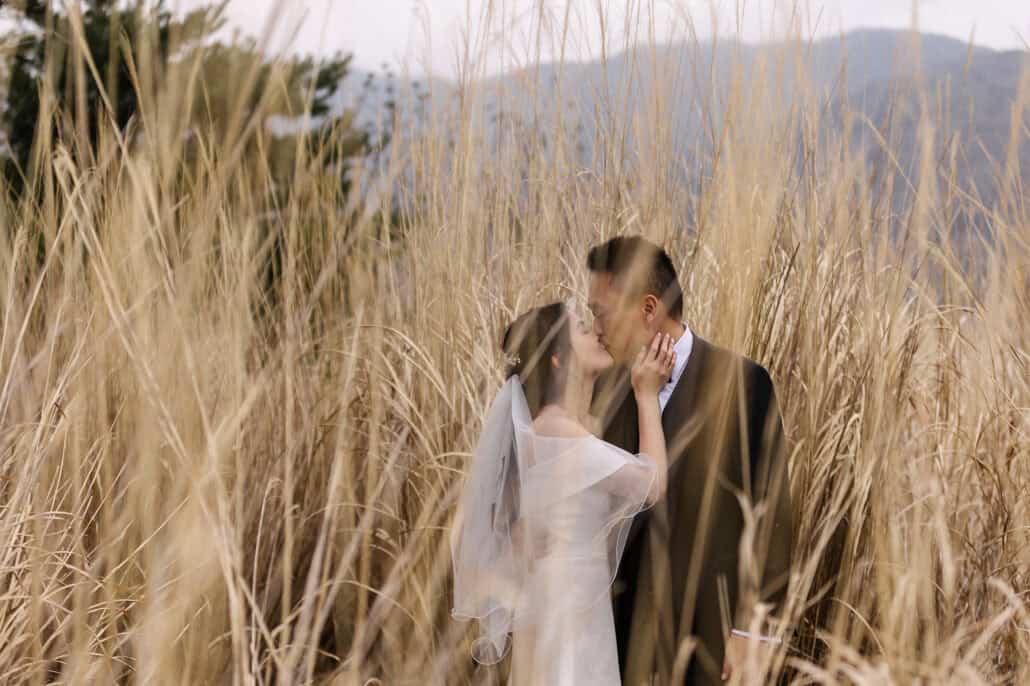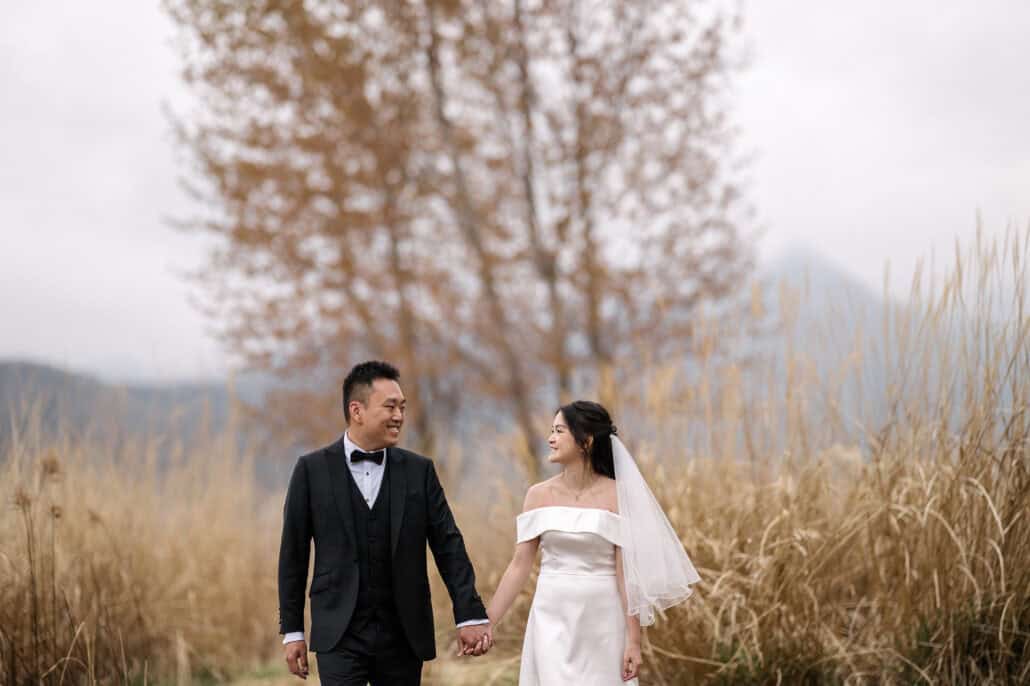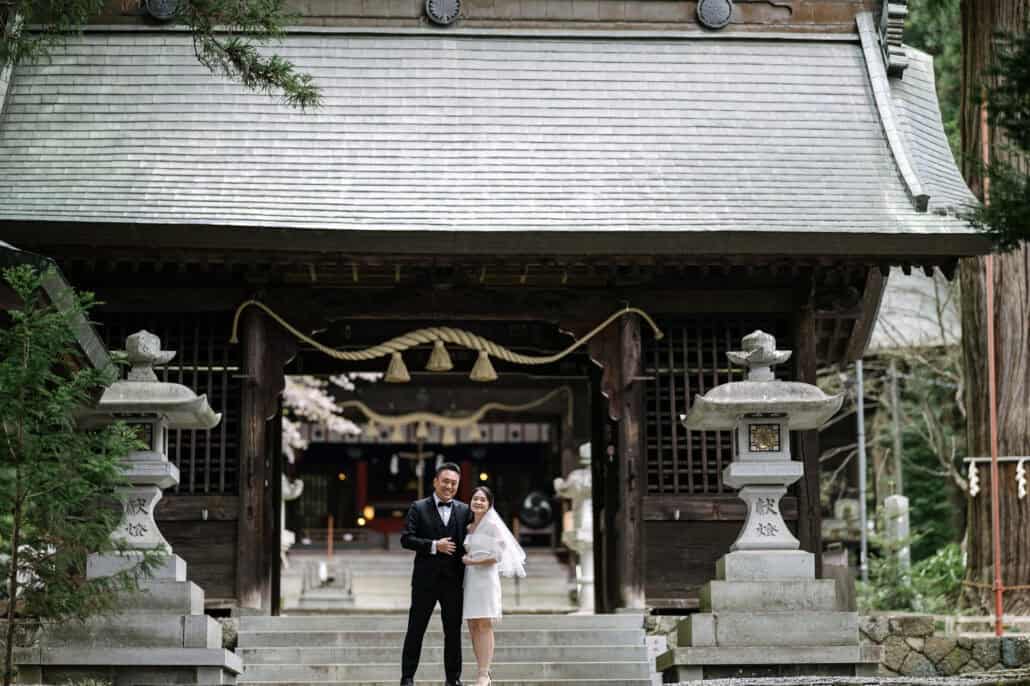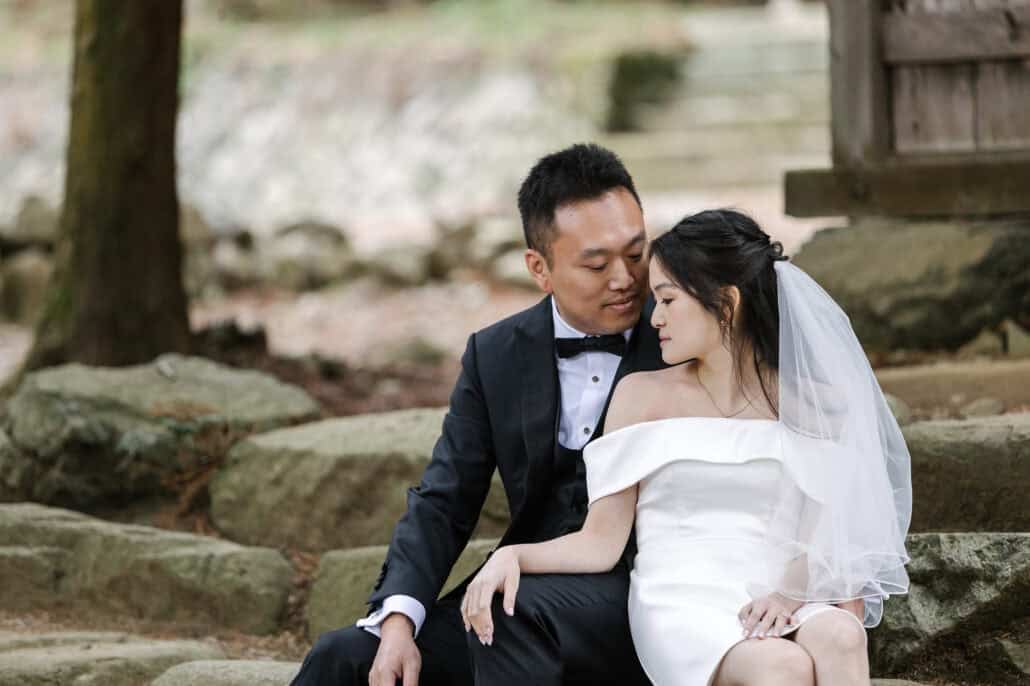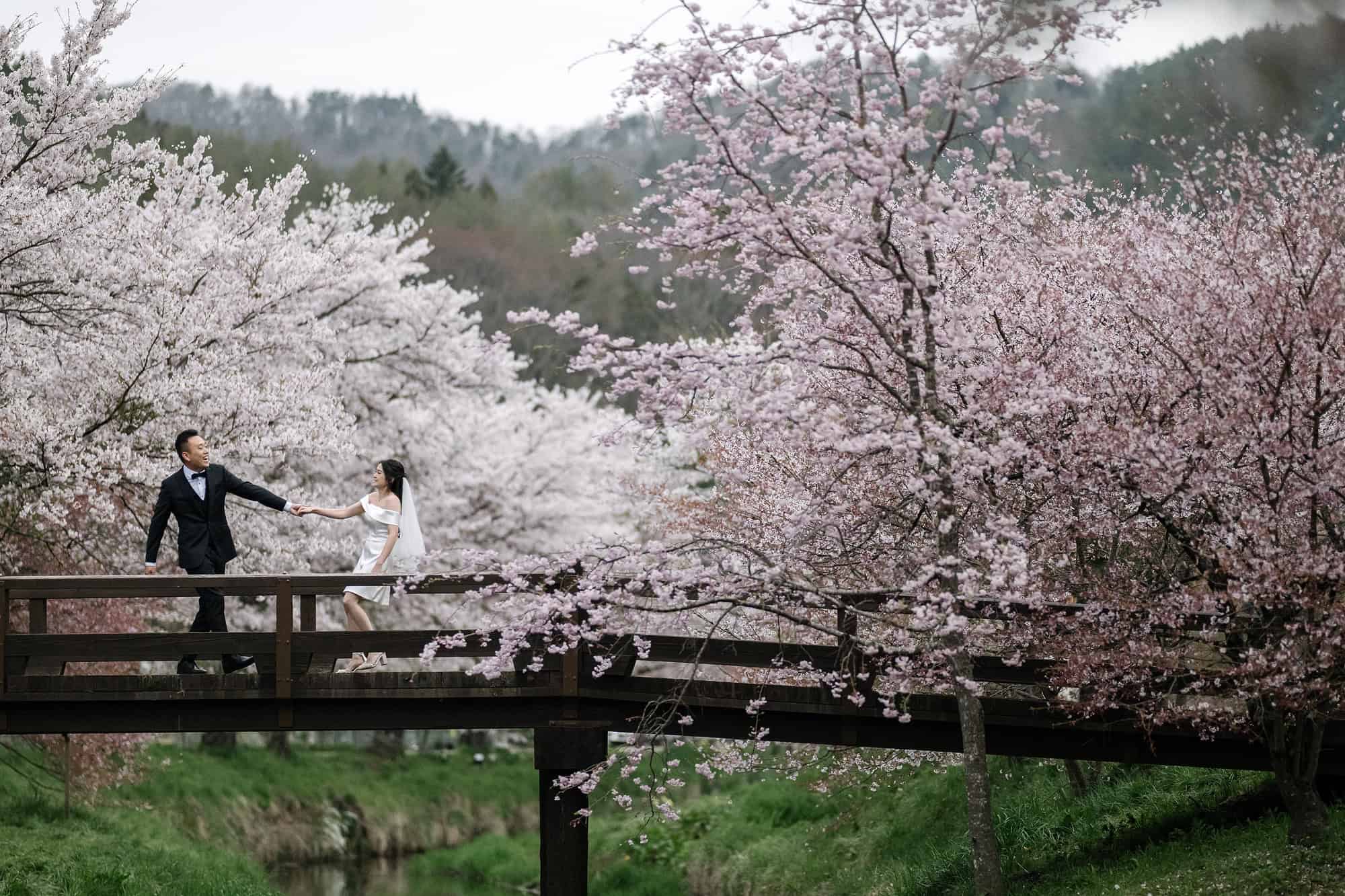
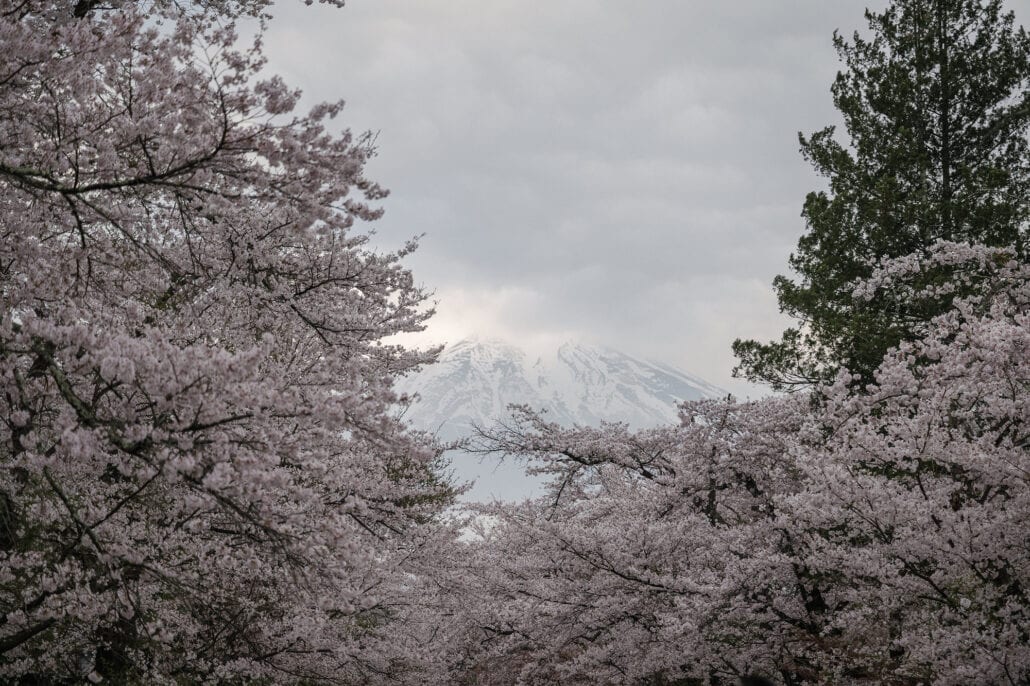
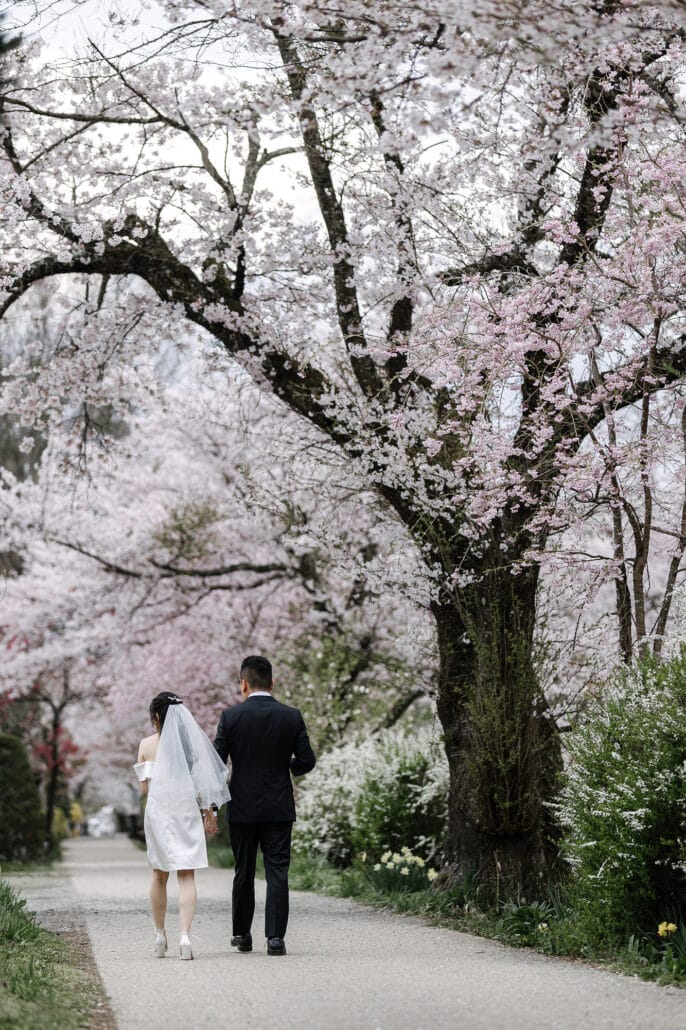
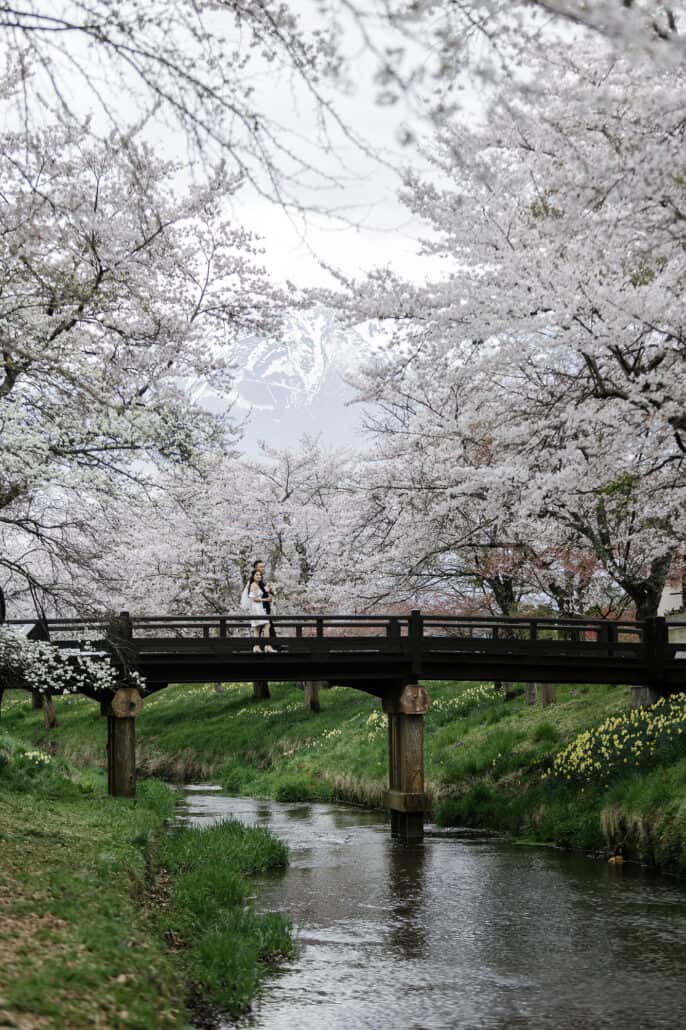
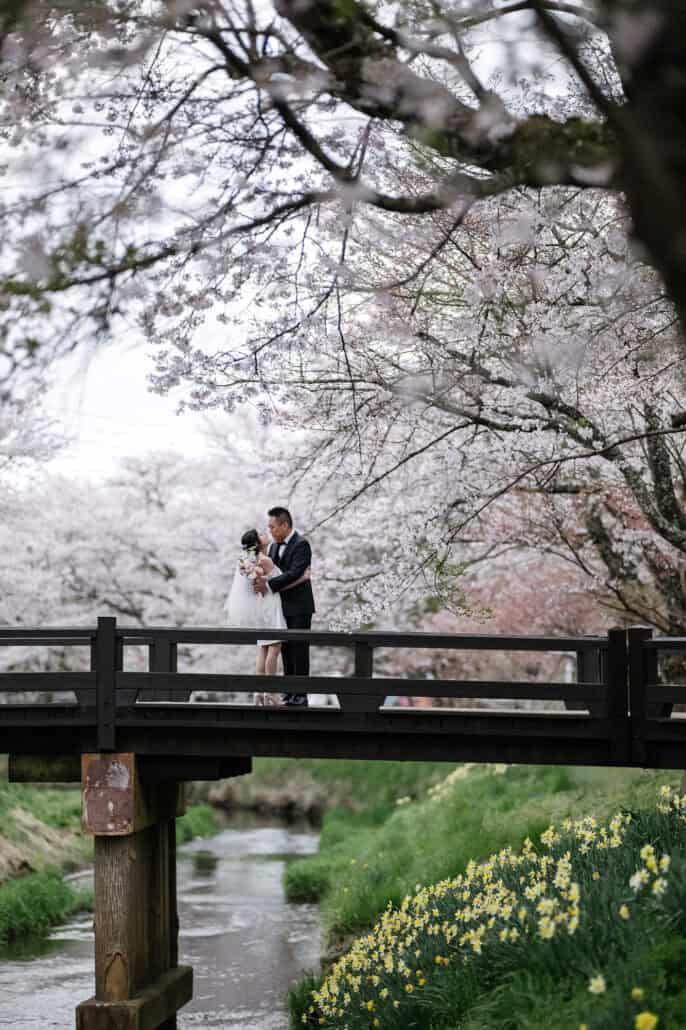
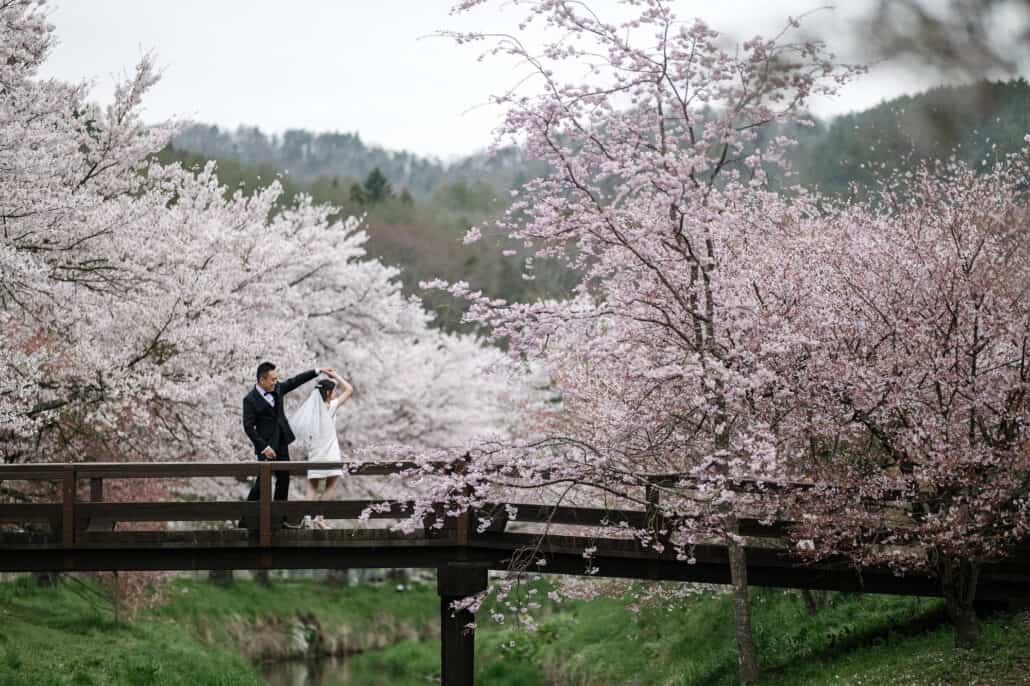
The morning after their wedding, they went out beneath the cherry trees in a shorter dress and a little veil. A stream ran beside the path, a wooden footbridge crossed the water, and through the blossom there was Mt Fuji, its snowfields bright beneath a cap of cloud. This cherry blossom photoshoot in Japan began in the peculiar, lovely space between a wedding having happened and its meaning having fully settled in.
The day before had held everyone: parents who had travelled across the world, a sister remembering childhood forts, friends cheering the mochi pounding, a whole dinner party stepping outside because the mountain had appeared. Their wedding at Fujisan Winery had been full of the pleasure of gathering people.
Now there was a different kind of room around them. The clothes still said wedding, but the pace had changed. They could walk beside a stream, stop on a bridge, look at the mountain, and begin to discover how it felt to have arrived on the other side of all that anticipation.
A Cherry Blossom Photoshoot in Japan, With Time to Notice
A destination wedding asks a great deal of the senses. You are in a place you may have imagined for months. People you love keep appearing in it. There are conversations you want to finish, faces you want to remember, words you have waited to say. Even a beautifully unhurried celebration can feel astonishingly full from the inside.
We think about what follows it. There is value in leaving a little time for the experience to find its shape, while you are still there, before suitcases and departures begin to pull everyone towards home.
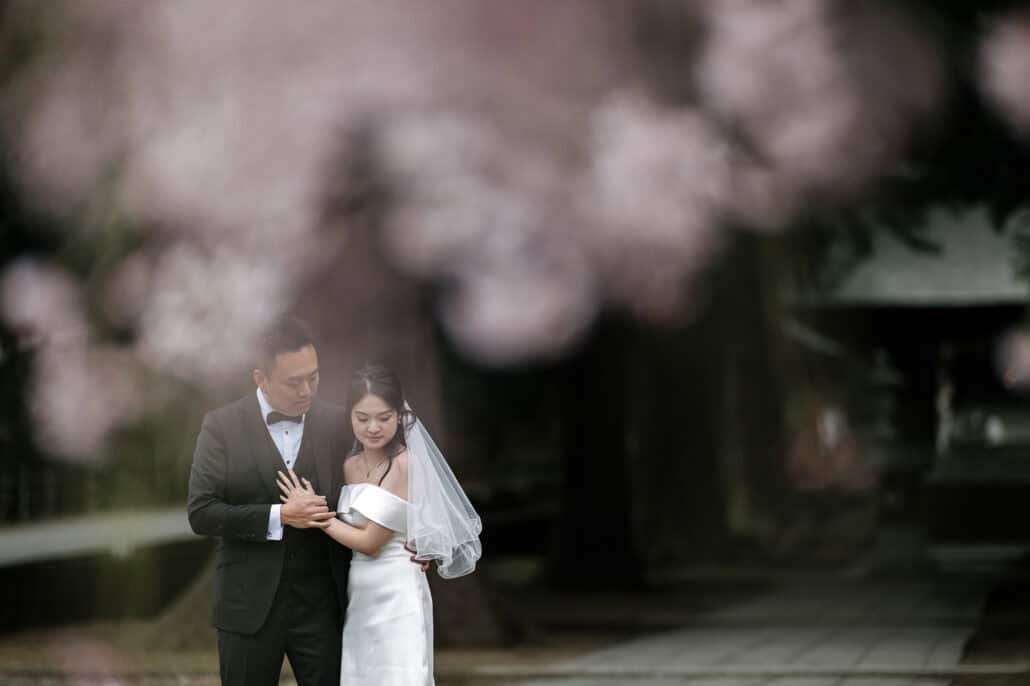
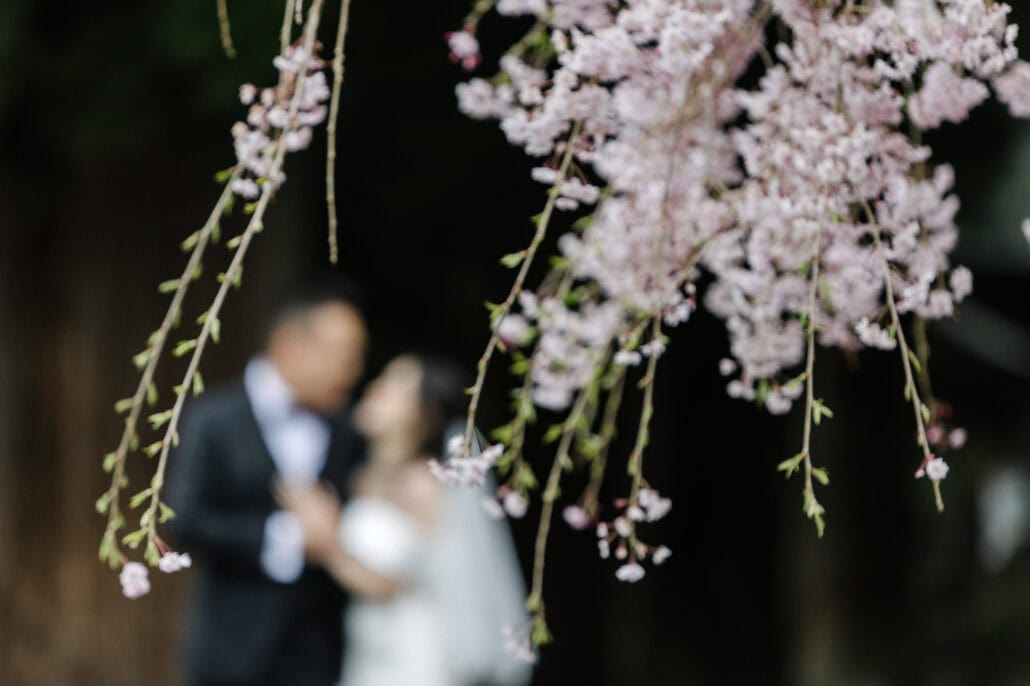
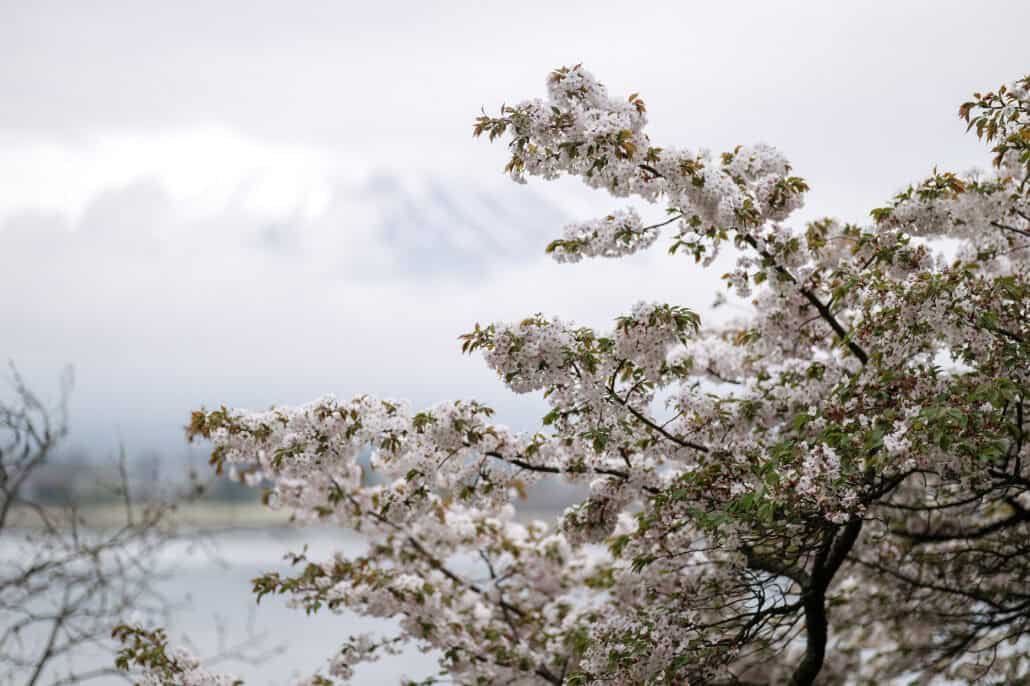
For this couple, that meant being out early in cherry blossom season, while the paths were quieter and the morning light still rested softly on the trees. The previous day, wind had brought petals down around their first kiss in the garden. Now the blossom hung above the water, making a pale tunnel around the footbridge.
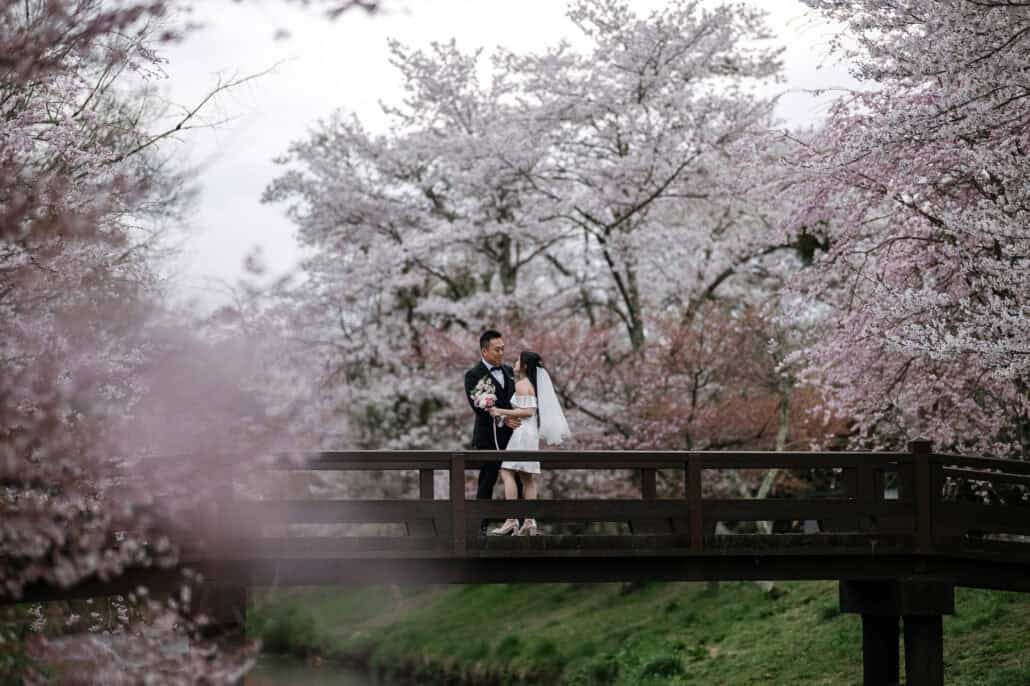
The change was small, but you could feel it. A wedding portrait often carries the energy of what has just happened or is about to happen. Here, the space around the couple was allowed to remain space. Their attention could wander towards the mountain and return to each other without another part of the day waiting for them.
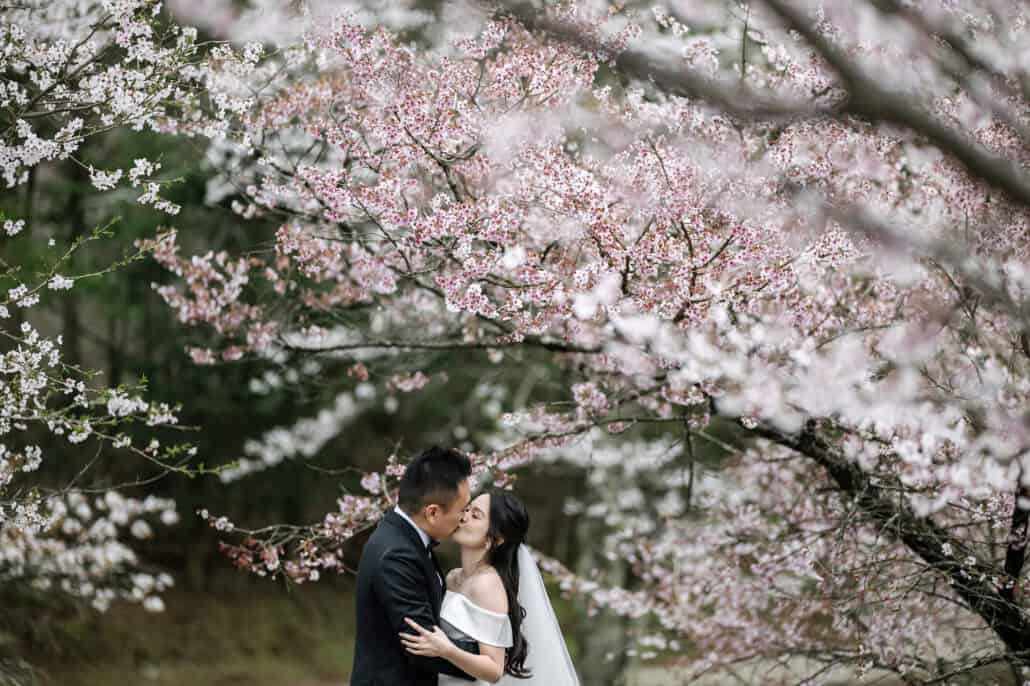
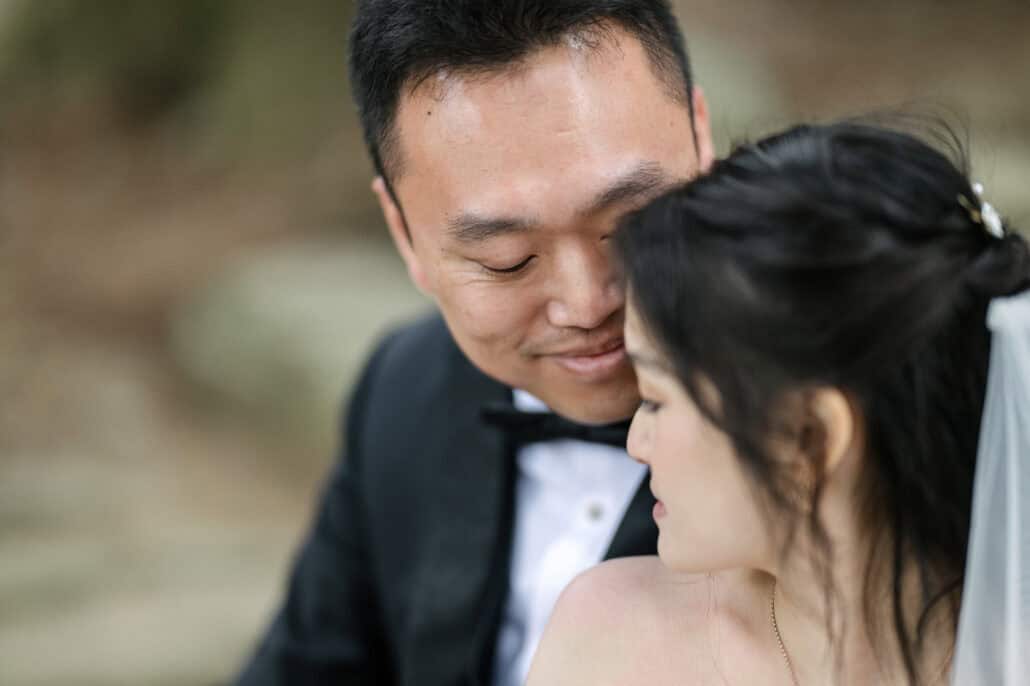
That is a beautiful condition in which to make photographs. You begin to notice a quieter range of expression: the ease between larger moments, the way two people move when they already know where the other is, the companionship that will accompany them long after the occasion has passed.
Rain on Lake Kawaguchi
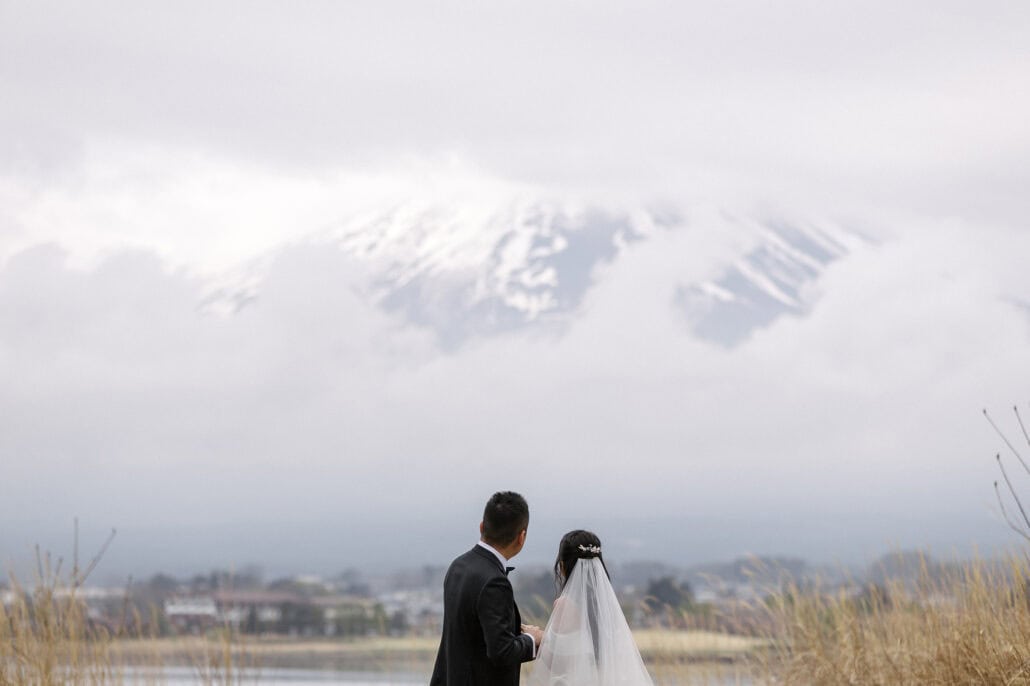
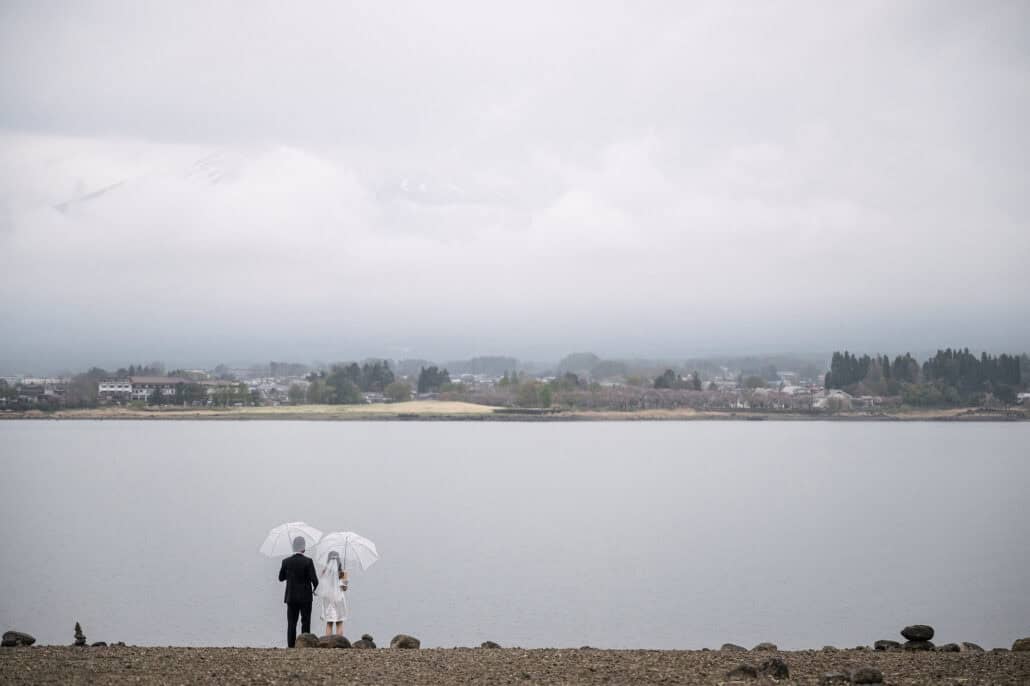
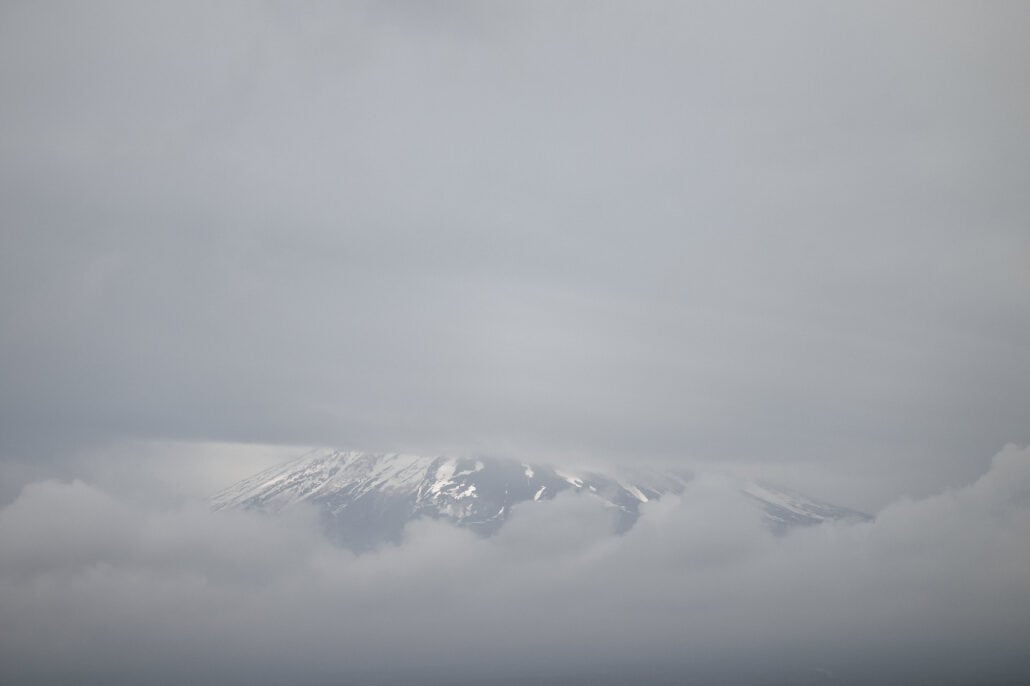
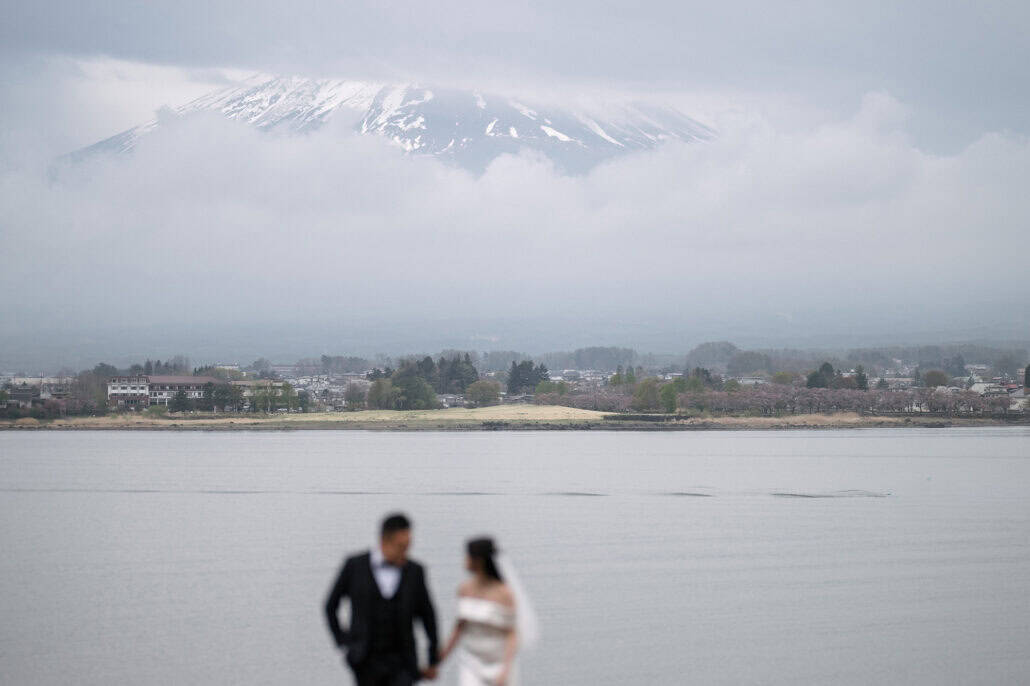
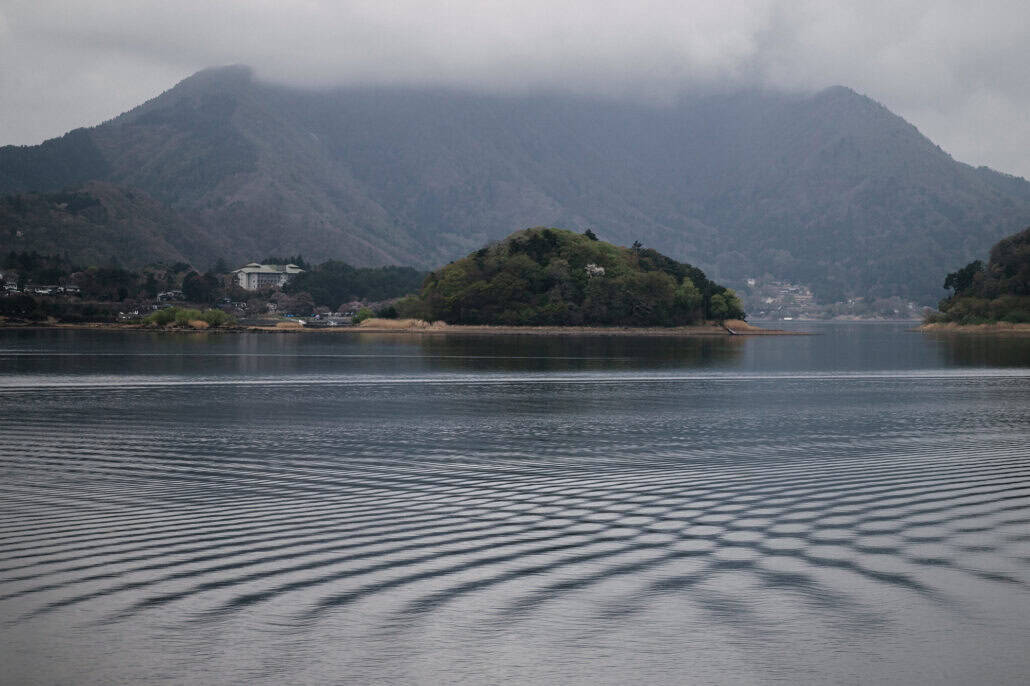
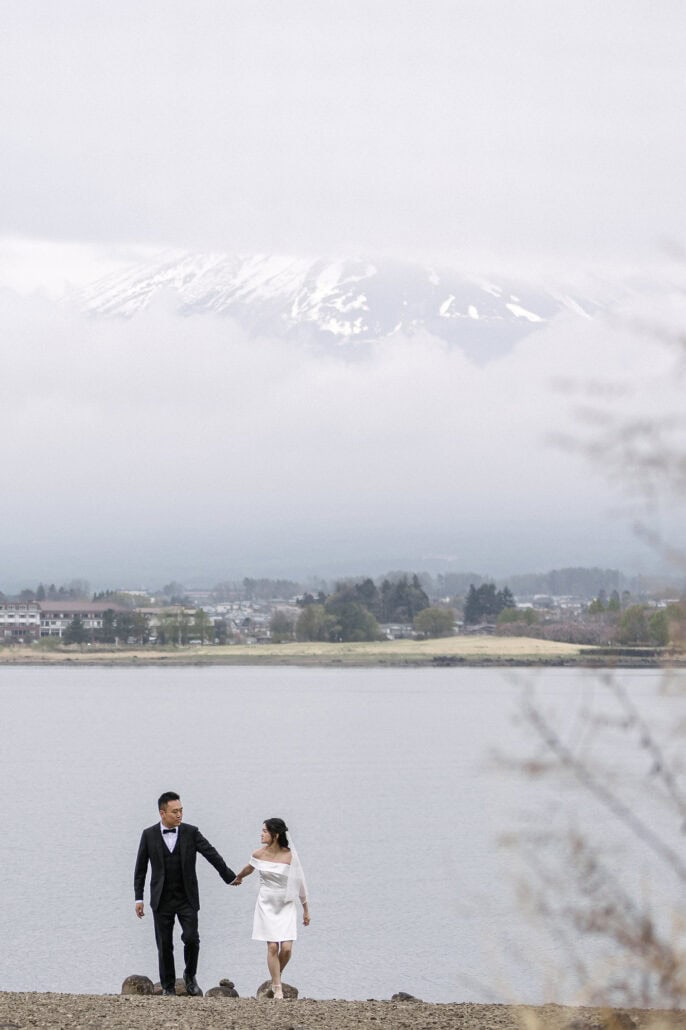
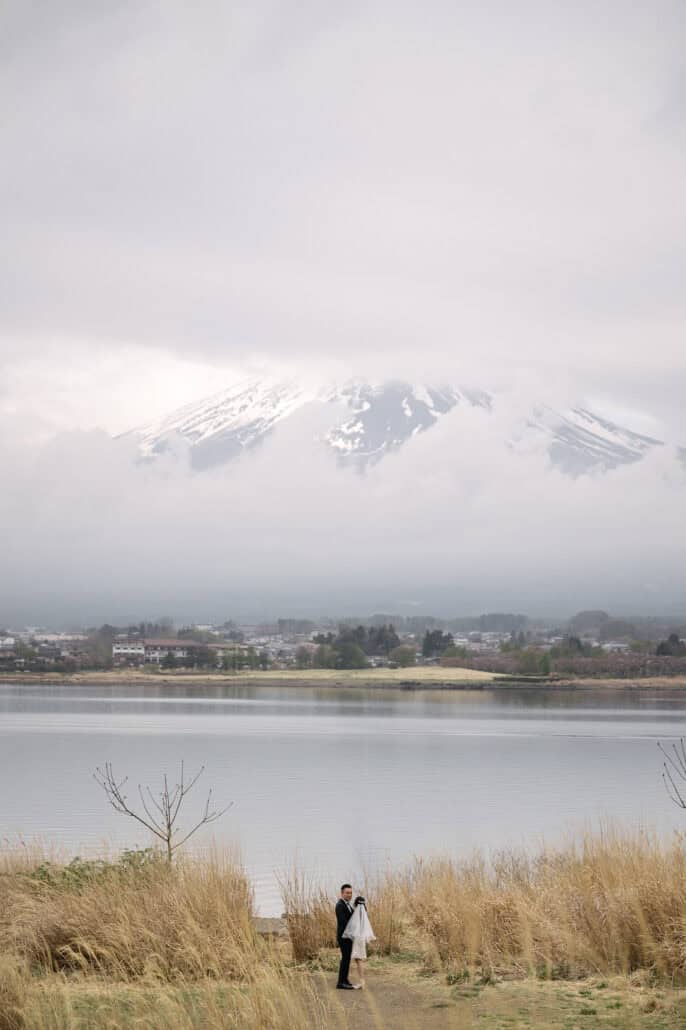
By the lake, rain was falling. Beyond the shore, snow appeared and disappeared on Fuji as the cloud moved across it.
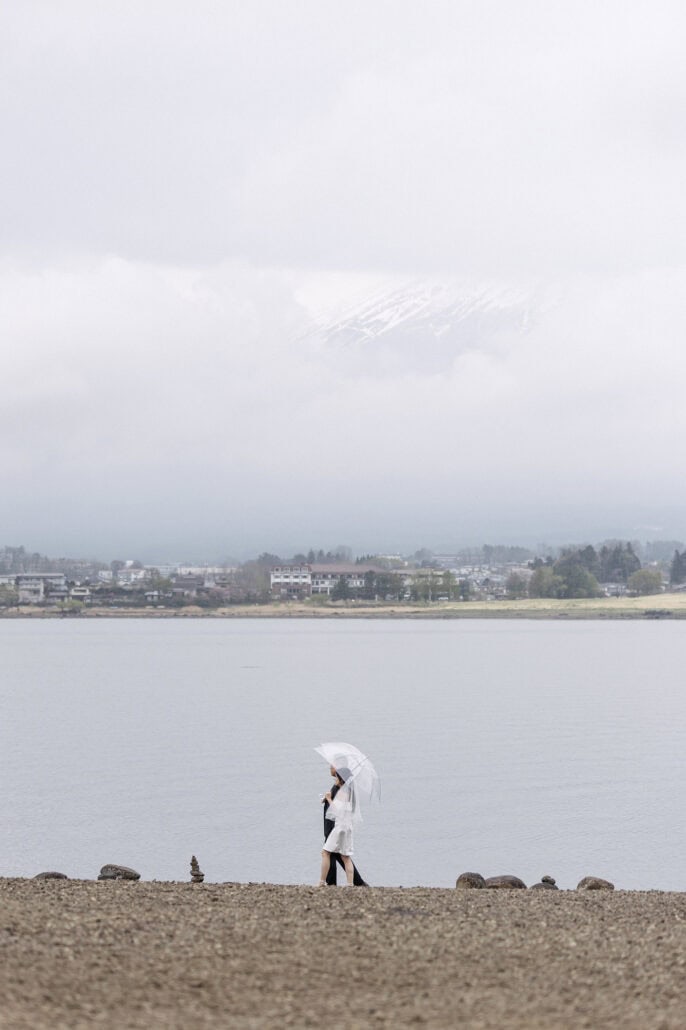
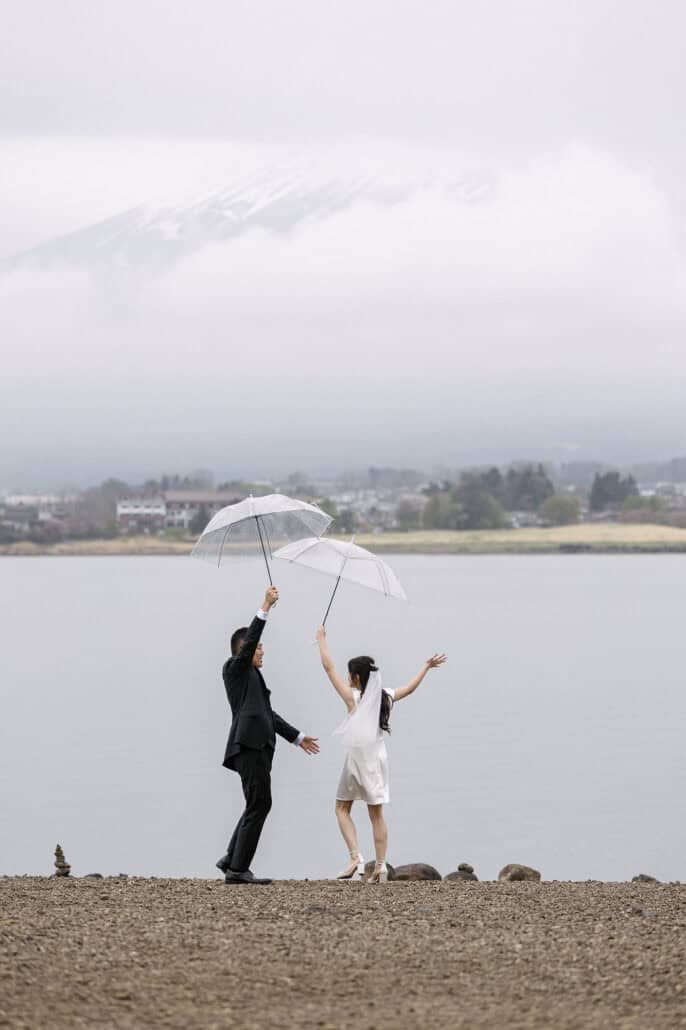
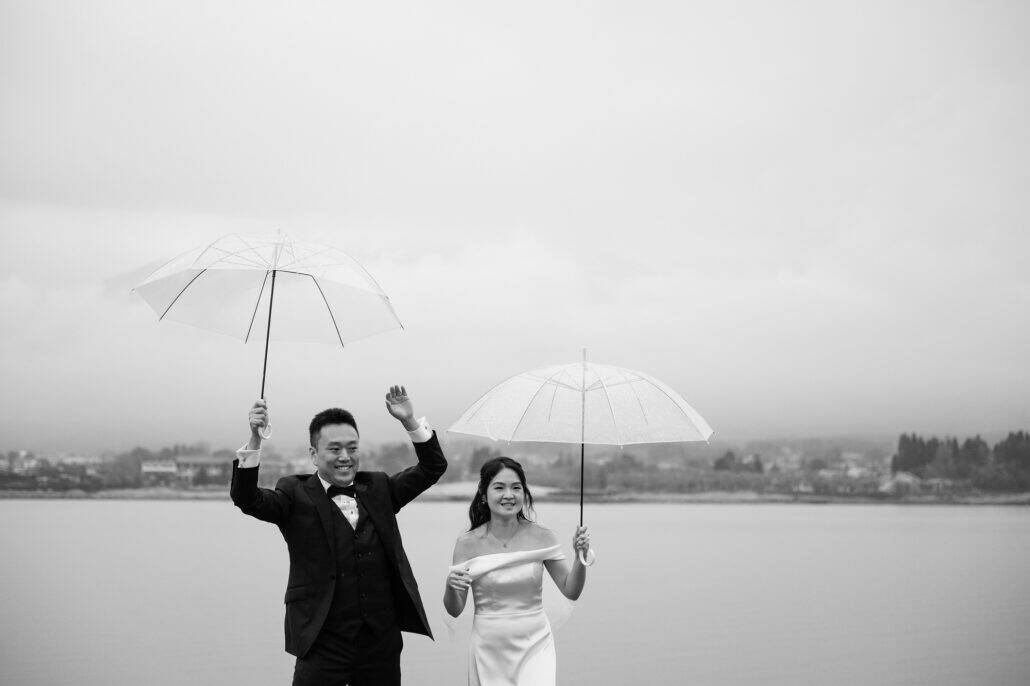
There was golden grass along the lake too, its dry stems giving the spring landscape a trace of another season. The photographs held several kinds of weather at once: rain nearby, cloud across the water, snow much higher up.
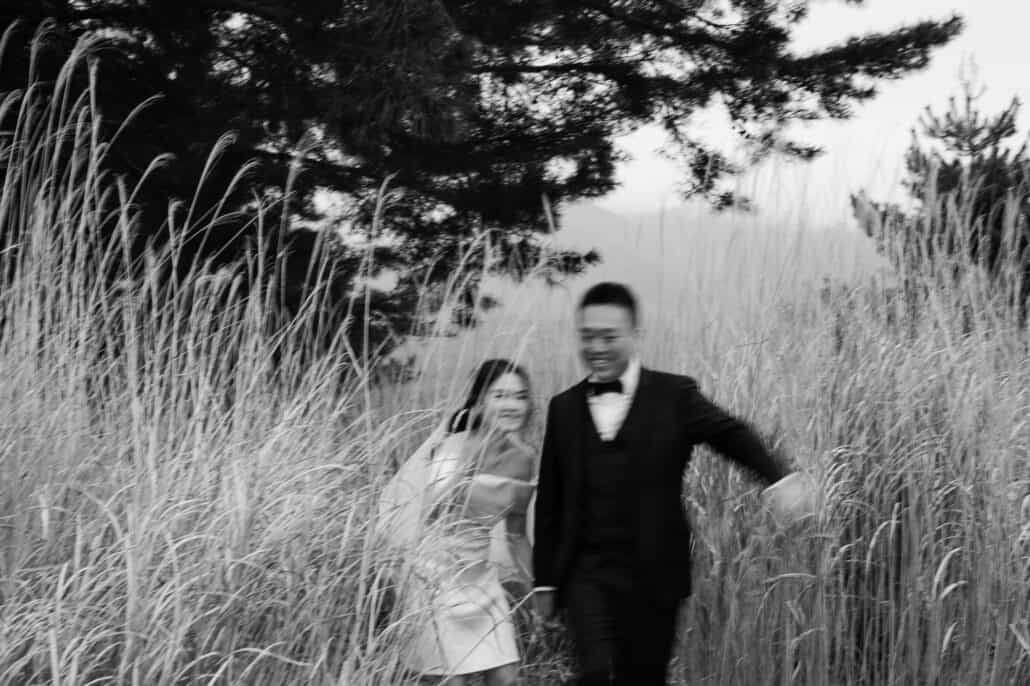
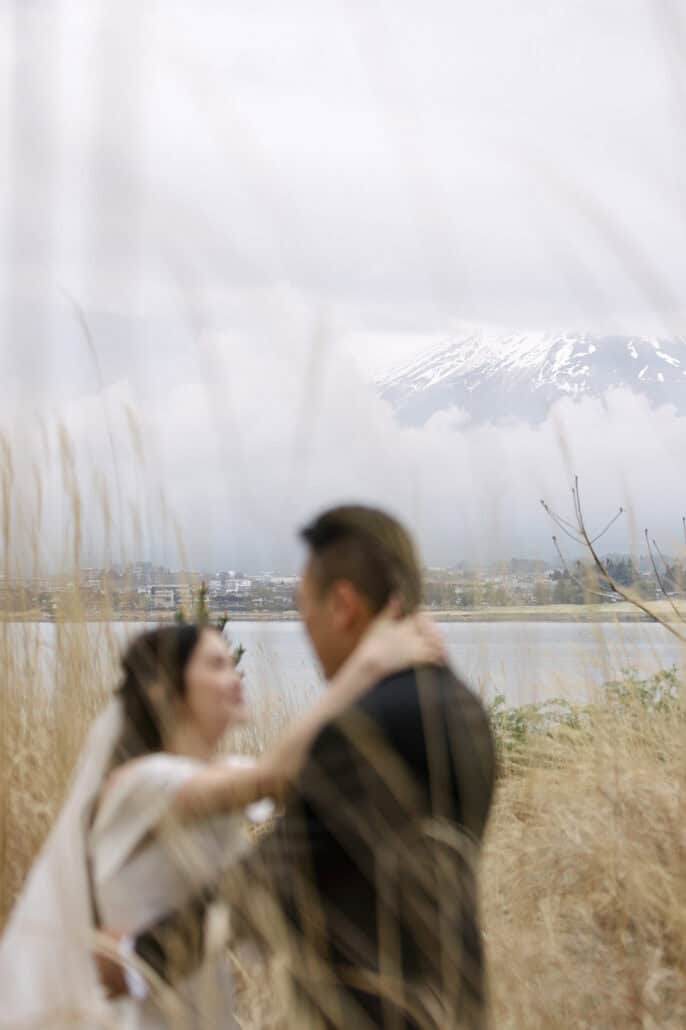
This is one of the pleasures of spending time around Fuji. The mountain gives a familiar outline to a place that keeps changing in front of you. The view belongs to the conditions of the moment, and those conditions make it particular.
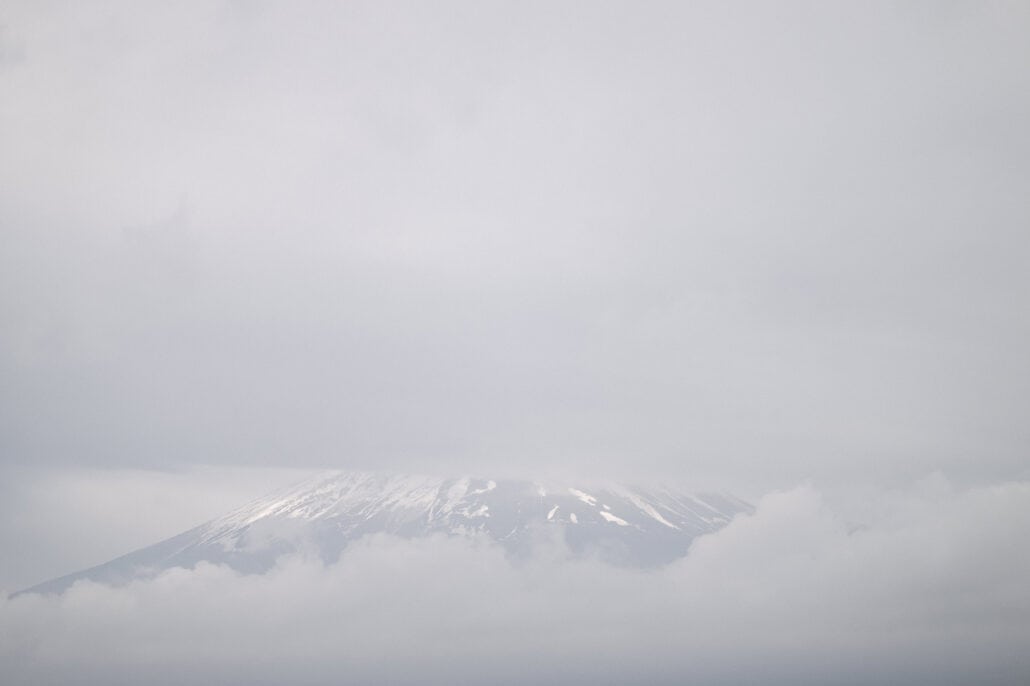
For a couple visiting Japan, that particularity matters. Their memory will include the sound of rain on an umbrella and the feeling of walking by this water together. Years later, another photograph of Fuji may be enough to bring back both. A place becomes personal through the things your body remembers doing there.
As photographers, we hope to make images that leave a route back to that feeling. Beauty draws you into a photograph. Recognition is what allows you to stay.
A Shrine That Has Watched the Mountain for Centuries
Kawaguchi Asama Shrine was founded in 865, following the great eruption of Fuji the year before. Its worship is associated with Konohanasakuya-hime, the deity of the mountain. Around it grew a community of pilgrimage: travellers came through Kawaguchi, stayed with oshi, the guides and hosts who supported their journeys, and prepared to approach Fuji.
The mountain that now draws cameras and wedding journeys once brought people here with a different mixture of reverence, hope and apprehension. Those layers remain close together in this landscape. You can be admiring the snow from across a lake in the morning and stand, soon afterwards, in a place founded in response to the mountain’s immense power.
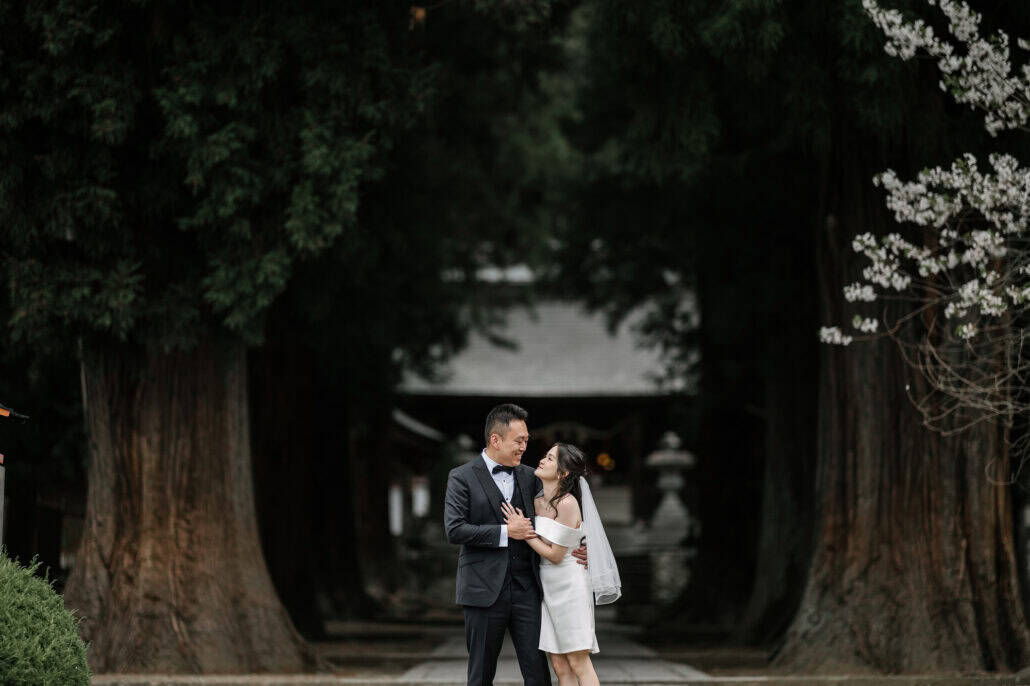
A weeping cherry softened the shrine grounds. Beyond it, the cedar avenue rose towards a canopy so high that looking up became an action in itself.
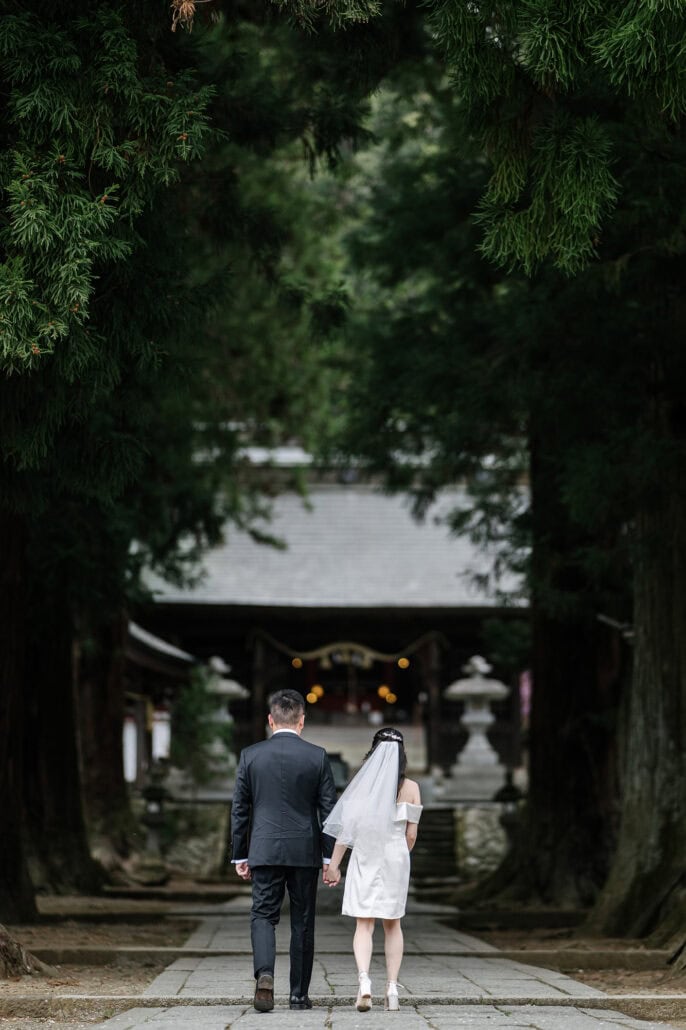
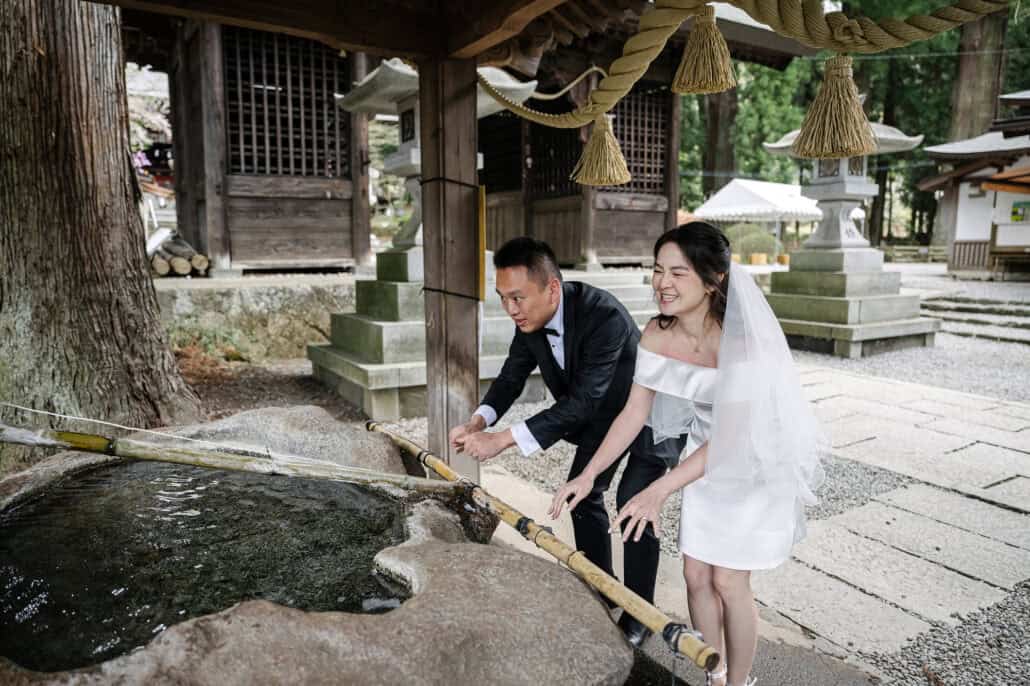
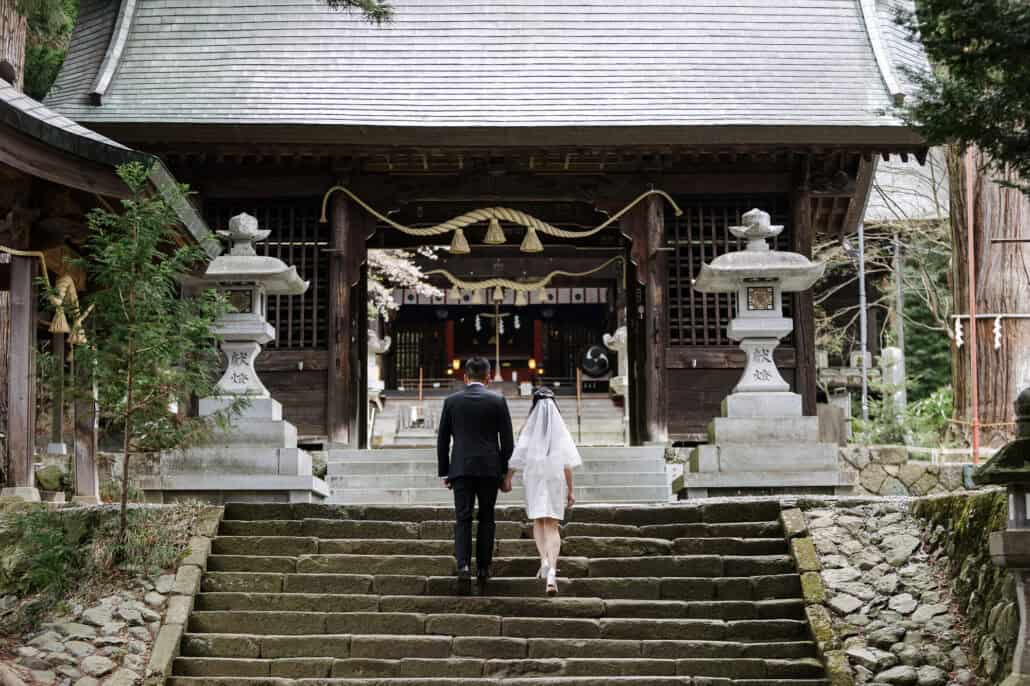
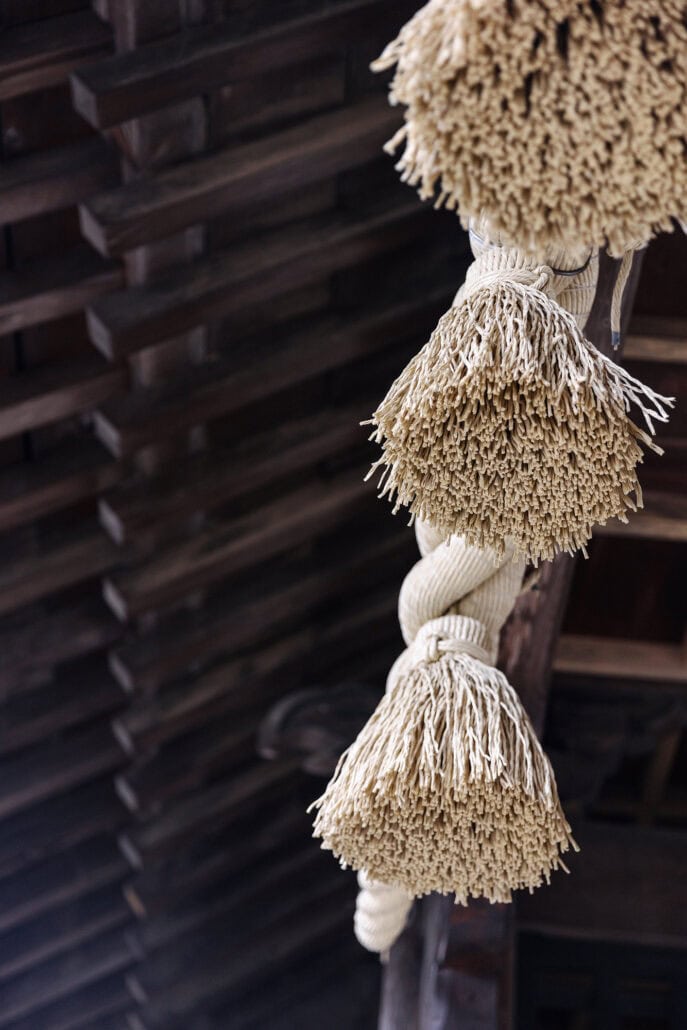
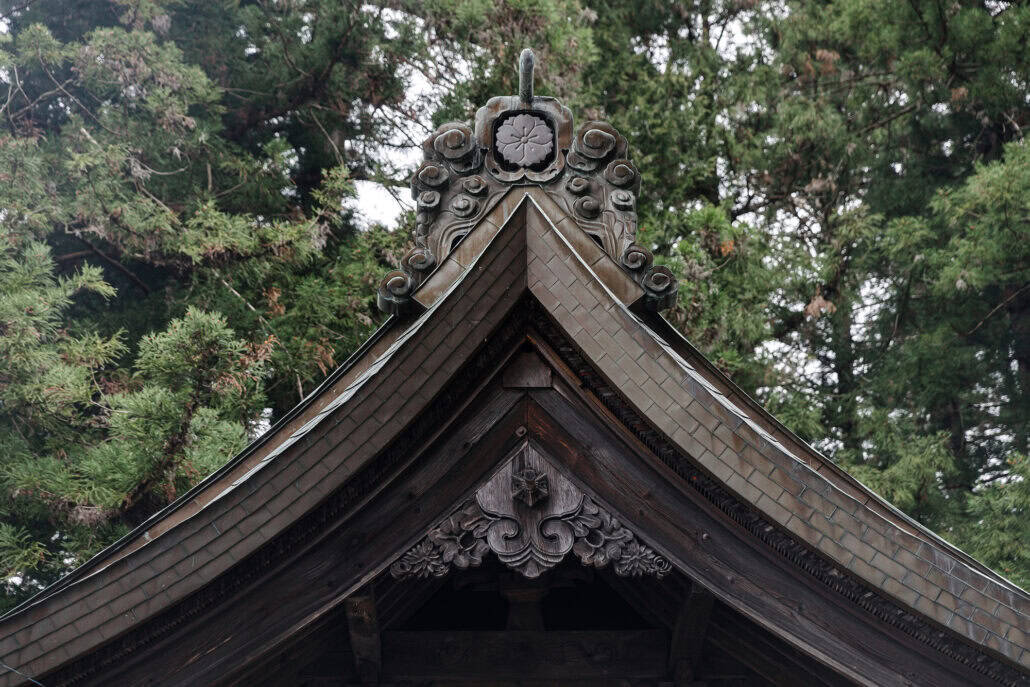
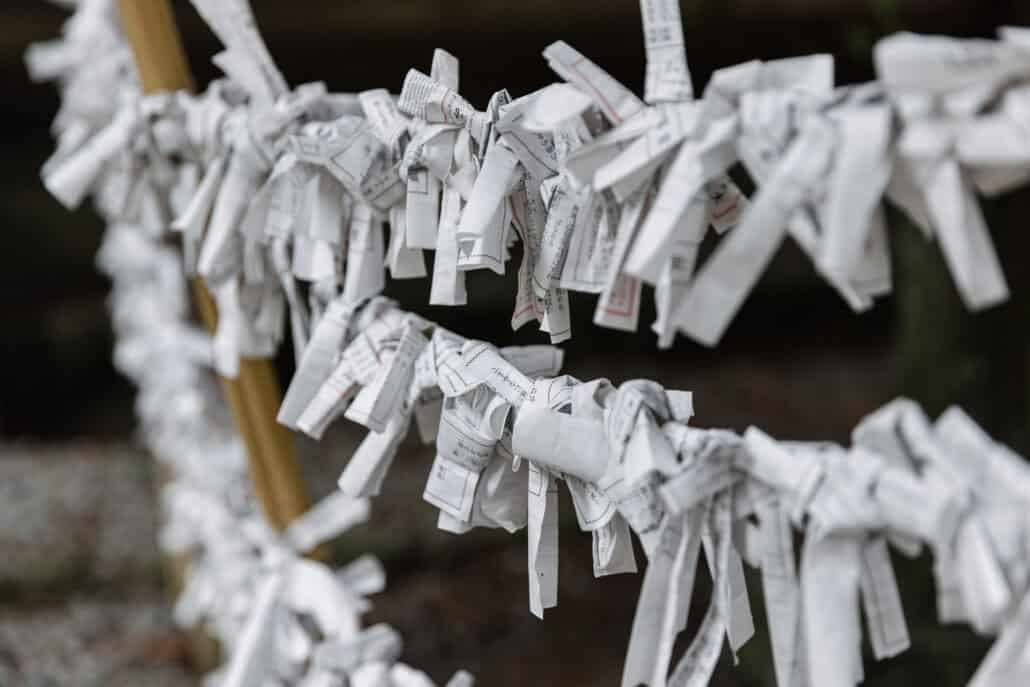
The shrine steps, a cherry blossom crest, paper fortunes tied in the grounds: each detail belonged to a place with its own observances and daily life. Coming here asked for a different pace of attention. There was time to look closely at things that might otherwise have remained scenery around a photograph.
Two Pillars, One Root
Among the shrine’s seven sacred cedars stand a pair known as Futahashira, the two pillars. The shrine describes them as sharing a root and associates them with Izanagi and Izanami, the divine couple of Japanese mythology. It gives the trees an age of around twelve hundred years and recognises them as sacred trees of connection and good relationships.
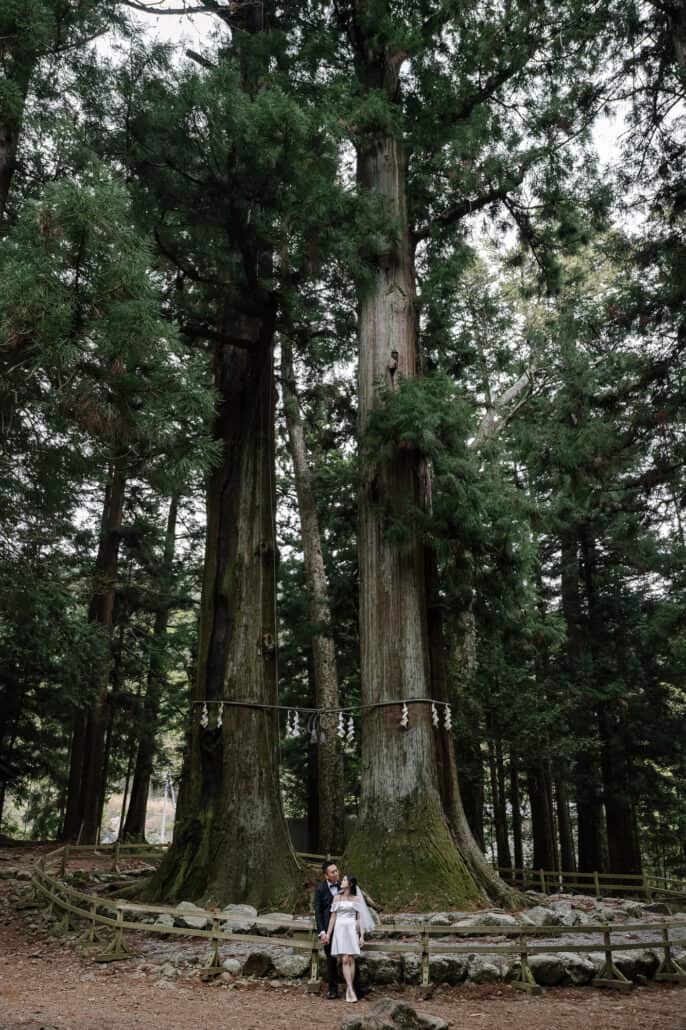
The local tradition of walking around them recalls the old account of the couple approaching a pillar from opposite directions and meeting. The roots are protected now by a low fence, so the space between the trunks is left undisturbed.
The newlyweds walked around the outside, one in each direction, and met on the other side.
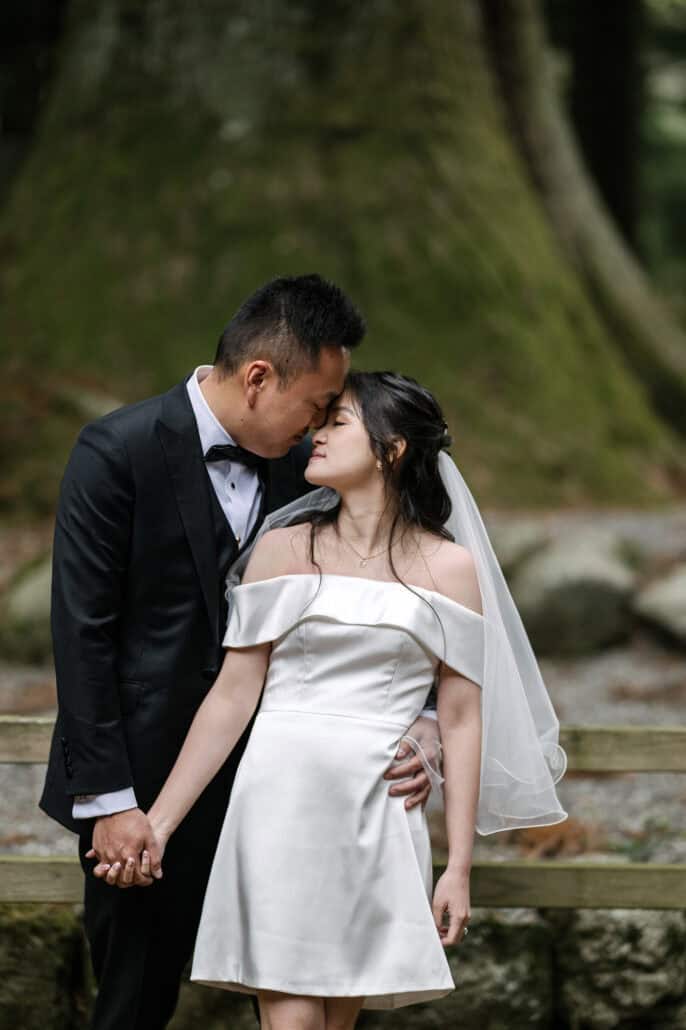
We loved that they did this the morning after their wedding. They had already made their promises, already stood before their families, already celebrated into the night. Here was another way of acknowledging the same relationship, through a small act of movement in a place that had been carrying associations of marriage for far longer than any of us could fully imagine.
You do not have to borrow somebody else’s belief to approach a tradition with attention. You can learn what a place means, honour the way people care for it, and allow the encounter to become part of your own understanding. Travel becomes richer when there is room for that exchange.
The trees offer an unusually long view of companionship. Two distinct trunks, their connection partly hidden beneath the ground: the image invites thought without needing much explanation. A marriage, too, develops a life that other people can see and a deeper system of connection that belongs to the two people living it.
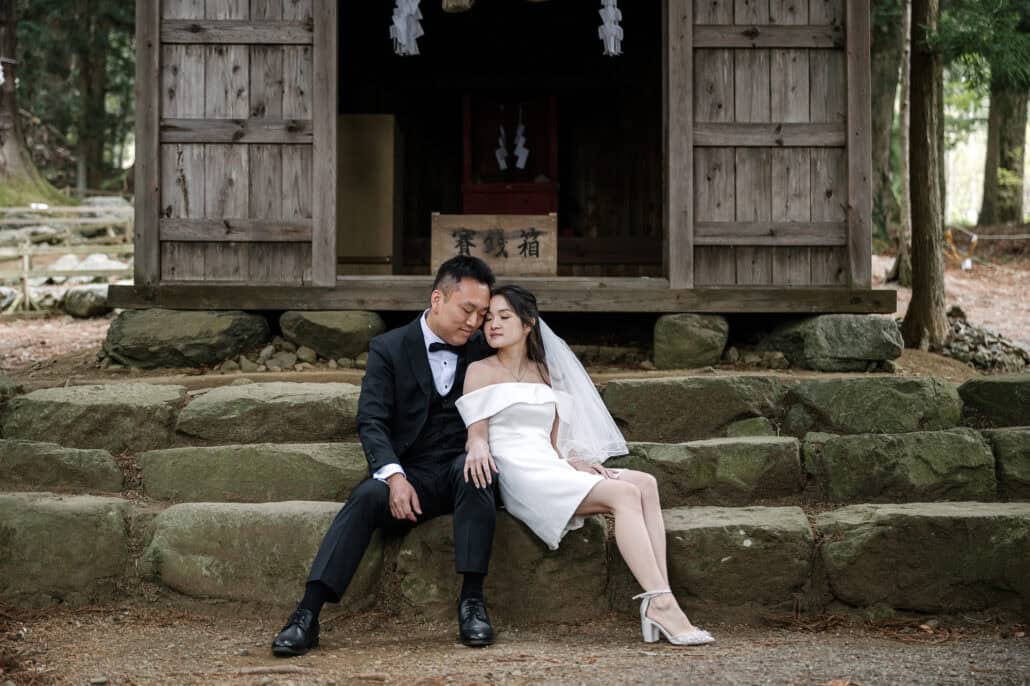
We would never claim that a walk around a tree can tell a couple how to be married. But a small ritual can give feeling a form. Sometimes you understand something more fully because you have done it with your body: walked a path, met someone at the other side, taken their hand again.
The Joy of Having Done It
On the path before the cedars, they came running hand in hand. “We did it!”
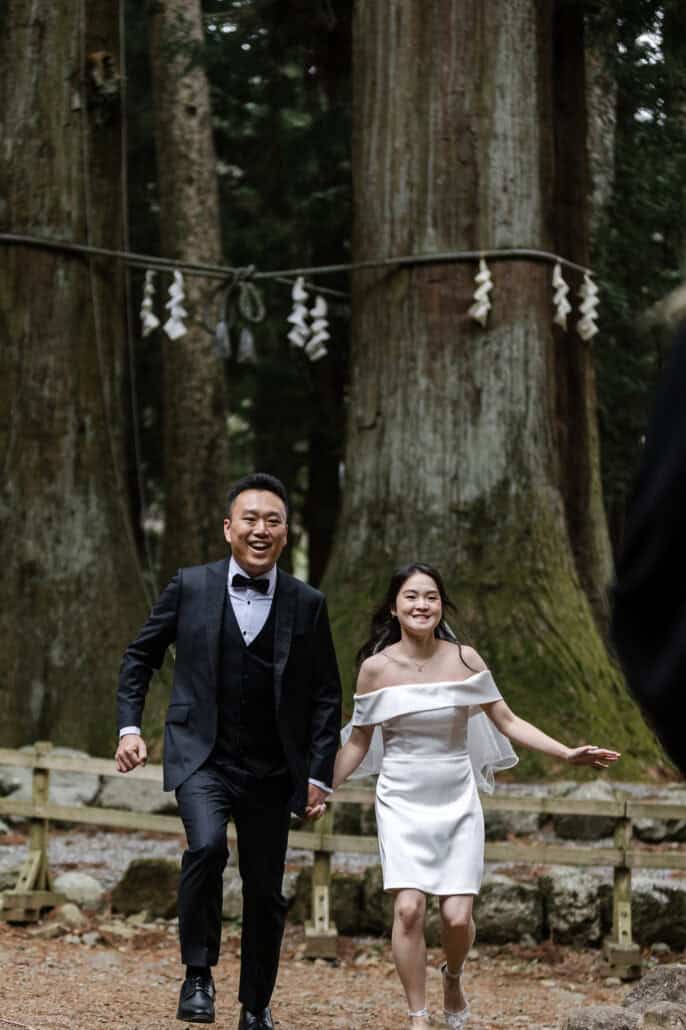
After all the weight of ancient trees and old stories, we should make room for the fact that being newly married can also be tremendously fun. There is relief in those words, and astonishment, and the pleasure of looking at the person beside you and realising that the thing you have been talking about for so long has become something you have actually done.
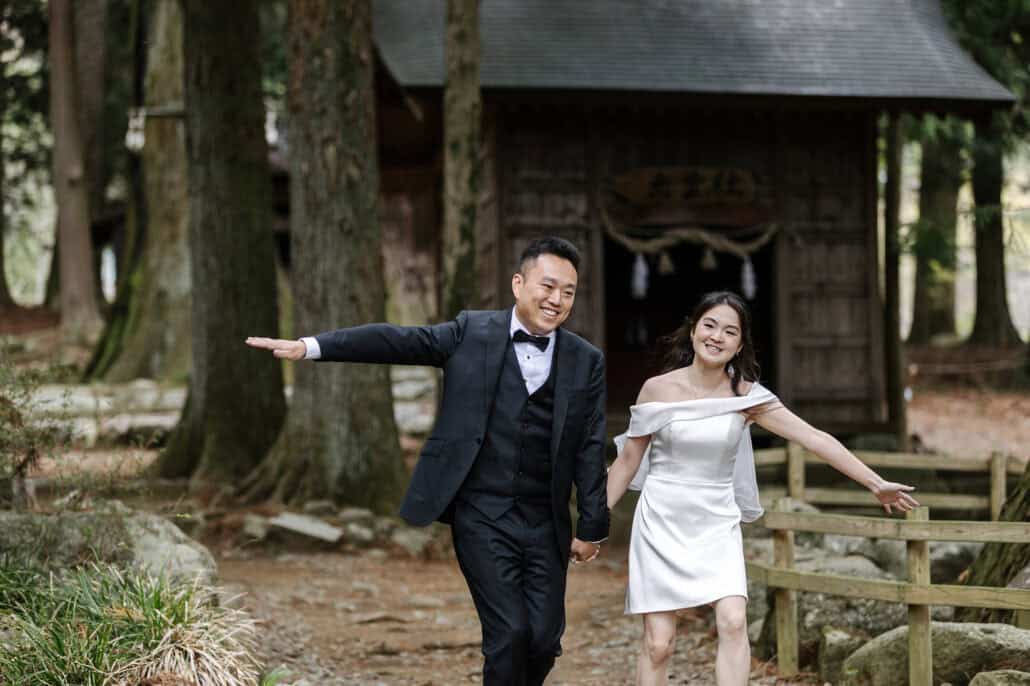
Later, walking beside the lake with Fuji still partly in cloud, the morning had gathered its own collection of experiences. A bridge beneath blossom, rain on clear umbrellas, old trees approached from opposite sides. All of them close enough to the wedding to carry its feeling, each distinct enough to become a memory of its own.
Leave a Little Room After the Wedding
When we plan a celebration in Japan, we think about the experience around the ceremony as carefully as the ceremony itself. How does a couple arrive? When do they get to be with their people? Where is there room to absorb what they have travelled so far to do?
A morning after can answer that last question beautifully. It needs the same thought given to access, season and pace as the rest of the celebration, so that once you are there, your attention is free to settle on being there.
The seventy-two seasons remind us how quickly the qualities of a place can shift. Blossom becomes falling blossom; falling blossom gives way to leaves. You cannot extend a season by wanting it to stay, but you can make room to experience a little more of it.
And there is something moving about letting your first memories after the wedding be this simple. You were in Japan. It rained. You walked around two old trees and found each other at the other side. You were married, and there was still a whole morning left.