Japan’s most formal tea meal is named after hunger.
Kaiseki, as the Omotesenke tea school tells it, comes from a Zen story. Monks in training held a warmed stone inside the fold of their robes to quiet an empty stomach, and the word came to mean simple food. At a full tea gathering the rice still arrives first: freshly cooked, a single mouthful, to show the host has been waiting for you.
That’s the root of Japanese wedding food. The generosity is real, but it grew out of restraint and attention. Every plate is a decision about the season, the place and the person eating it.
It’s also where hospitality is tested hardest. The vegetarian at the end of the table. The guest with a shellfish allergy. The grandmother who doesn’t drink. Our view is simple. The best wedding table in Japan is the one where nobody has to ask. Food is one of several decisions worth settling before the venue is confirmed, so see our guide to planning a wedding in Japan before you book anything.
Japanese Wedding Food: What’s Actually Served
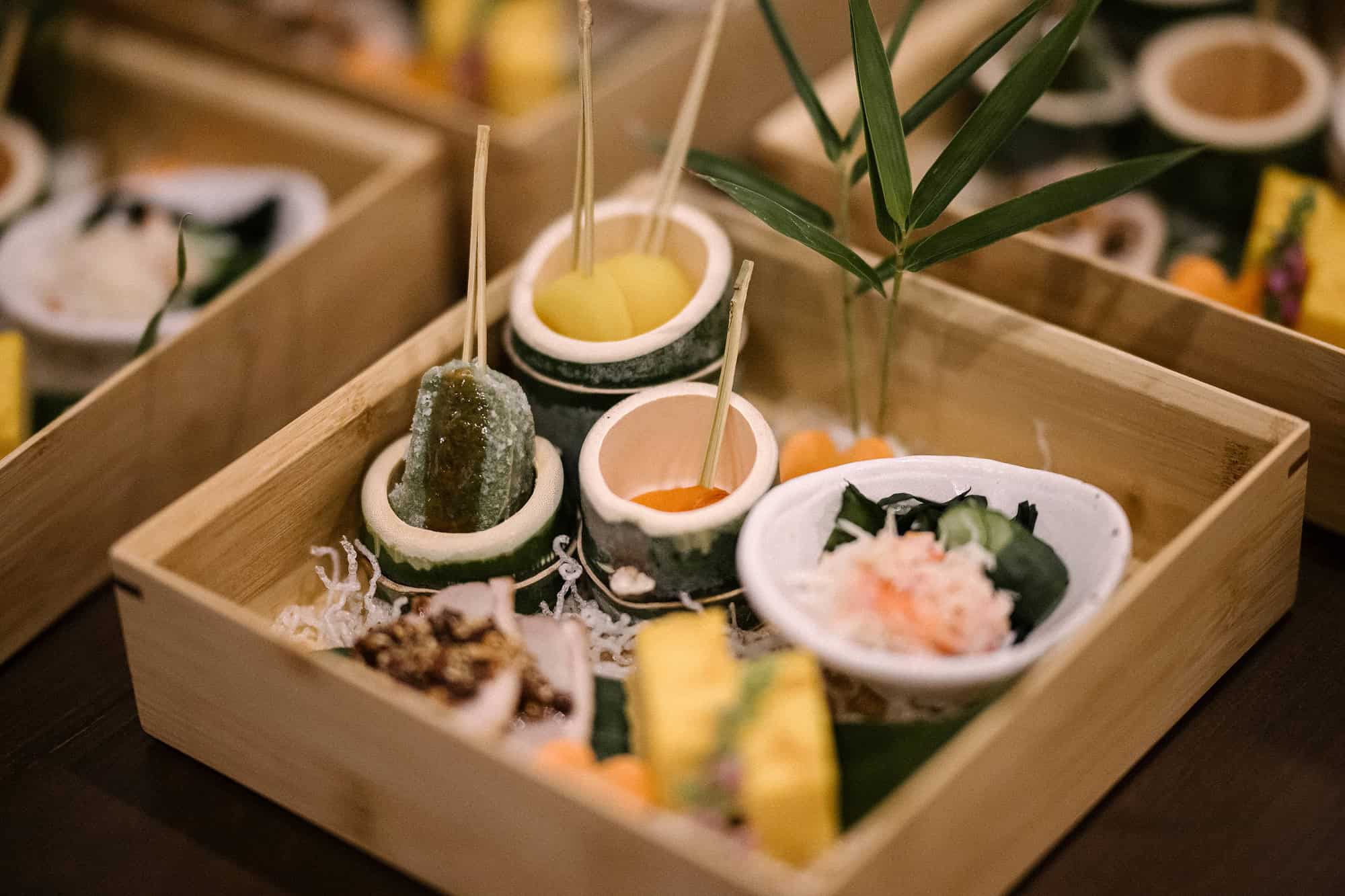
The short answer depends on the room. In Japan’s hotels and wedding halls, the reception meal is usually a plated course menu, and the favourite cuisine is French: more than half of couples chose it in Zexy’s 2023 national wedding trend survey. Ryokan and traditional venues serve kaiseki, a long run of small seasonal courses. Around either meal sit the rituals: sake shared from three cups, a cask opened with wooden mallets, a cake, and often something sweet for guests to carry home.
Many venues offer a tasting, though that varies from one to the next. It’s a polished system, and it serves Japanese couples well. International couples usually want something more particular: a meal that tells guests who flew in from everywhere exactly where they’ve landed. That’s where our work as a wedding planner in Japan really starts. We choose the kitchen before the dishes, whether that’s a ryokan cooking its own seasonal kaiseki or a chef brought to the place.
What Is Kaiseki? The Heart of a Ryokan Wedding Dinner
There are two kaiseki, and they sound exactly the same. The first, written 懐石, is the tea meal. Japan’s agriculture ministry dates its establishment to the age of Sen no Rikyu, built on one soup and three dishes, with seasonal ingredients and close attention to the room. The second, written 会席, grew out of Edo-period restaurants as a meal for enjoying sake with good food. Its characters mean, roughly, a seat at a gathering. A ryokan wedding dinner belongs to the second family and borrows the first one’s discipline. It’s composed ahead and set by the season, unlike omakase, where the chef decides as the meal goes.
For much of the modern era, weddings were served honzen ryori instead: formal meals on individual trays, which the ministry says spread as ceremonial food for weddings in the late Edo period and lasted into the Showa era.
And now? For a family wedding of seven at Jinya, in Tsurumaki Onsen, dinner was the celebration. No mochi pounding, no cocktail hour. A kaiseki of spring instead: junsai, the water shield gathered from ponds, grilled nodoguro, the rosy seabass, and rice cooked with bamboo shoots picked from the inn’s own garden. The menu noted the bamboo in a single line. Eight centuries ago, that ground was chosen partly for its bamboo. It still turns up on the plate.
At the same inn, another couple, foodies through and through, worked closely with the chef. Sesame tofu with lily bulb. Yuba with crab. Simmered wagyu with eggplant. Matcha mousse and musk melon to close. Before any of it, their cocktail hour ran like a matsuri, with yakitori, small onigiri, strawberry daifuku and a manju from the inn, and a cocktail each: an umeshu cooler for her, a yuzu highball for him. That’s the real shape of a ryokan wedding menu: set by the season, then tuned to the people.
Seasonal Menus: Eat Where You Are
We rarely start a menu with dishes. We start with the place and the week, because a wedding in Japan is one of the few times your guests will eat a region at its exact moment. The old calendar divides the year into seventy-two seasons, and some of the kitchens we love most still cook by it.
In a mountain village in Yamanashi, the inn’s kitchen follows the twenty-four solar terms. River fish, wasabi and produce from the growers around it reach the plate while the season is still happening outside.
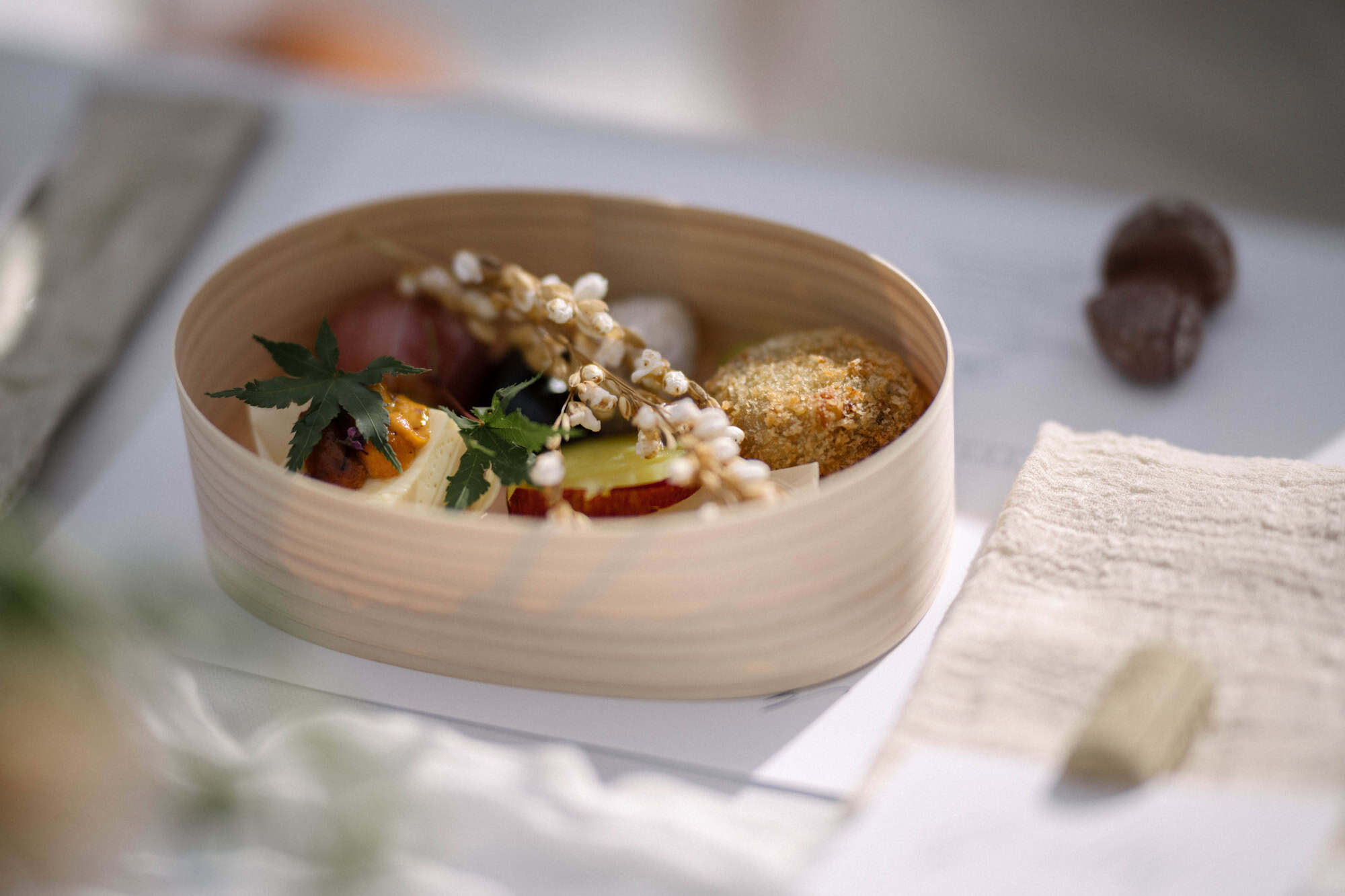
At a winery wedding in the hills west of Sendai, lunch came from a Sendai chef whose restaurant had earned a Michelin star in the Miyagi guide, with his whole team cooking on site. It opened with bento: a Sendai beef croquette seasoned with the winery’s own red wine salt, sea urchin on egg tofu, tuna sushi. Then roasted Sendai beef, salmon, oden and onigiri, arriving in rounds, and warabi mochi to finish. The arrangements stayed low, so people could see the food, and one another.
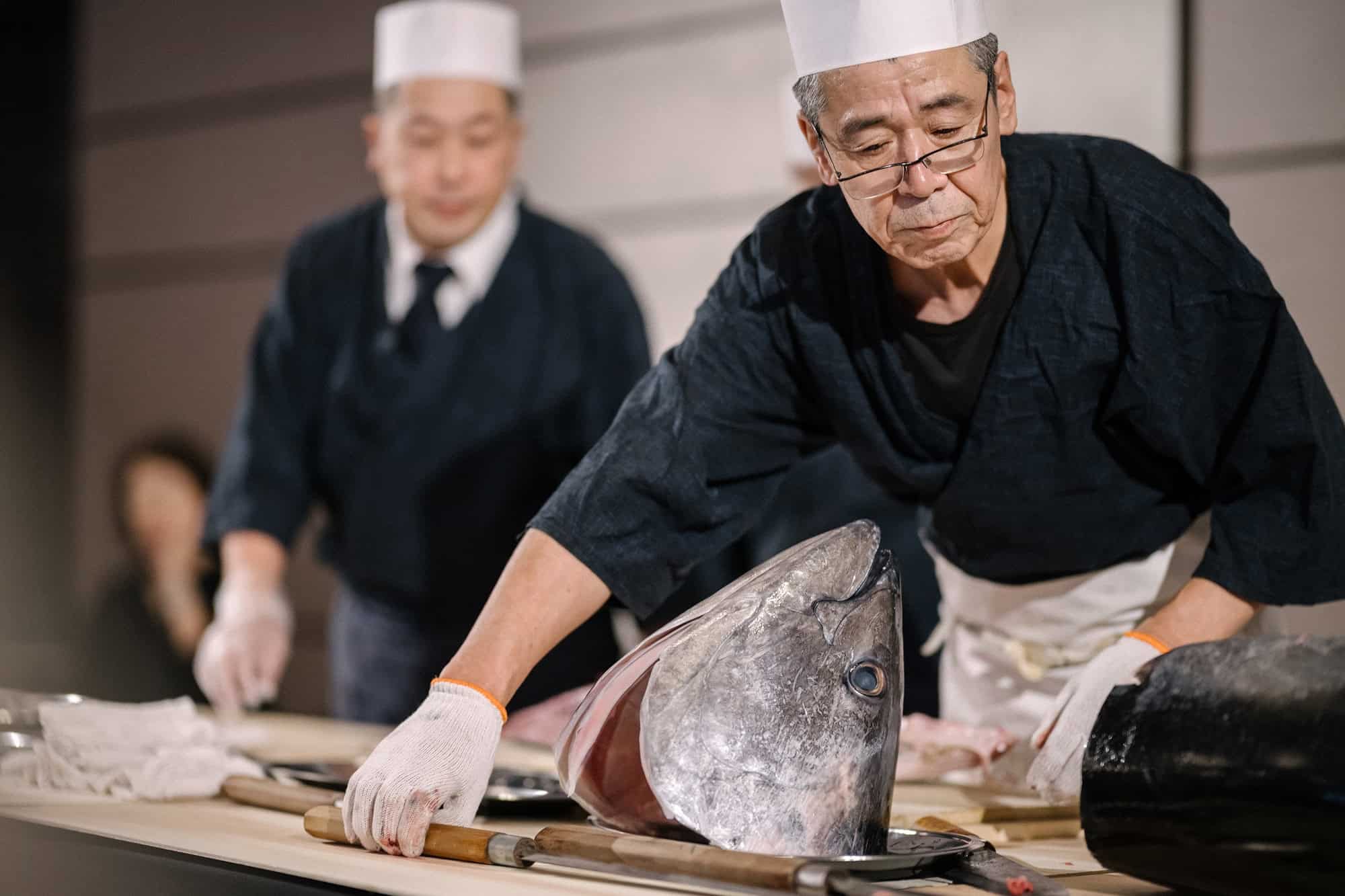
In Okinawa, lunch carried umibudo, the island’s sea grapes. In an old house in Nagano, after time outside in the cold, sake warmed in the sunken hearth while sweet potatoes roasted in the ash. In Tokyo, chefs broke down a whole tuna by hand in front of the guests, a skill the city usually keeps behind its sushi counters.
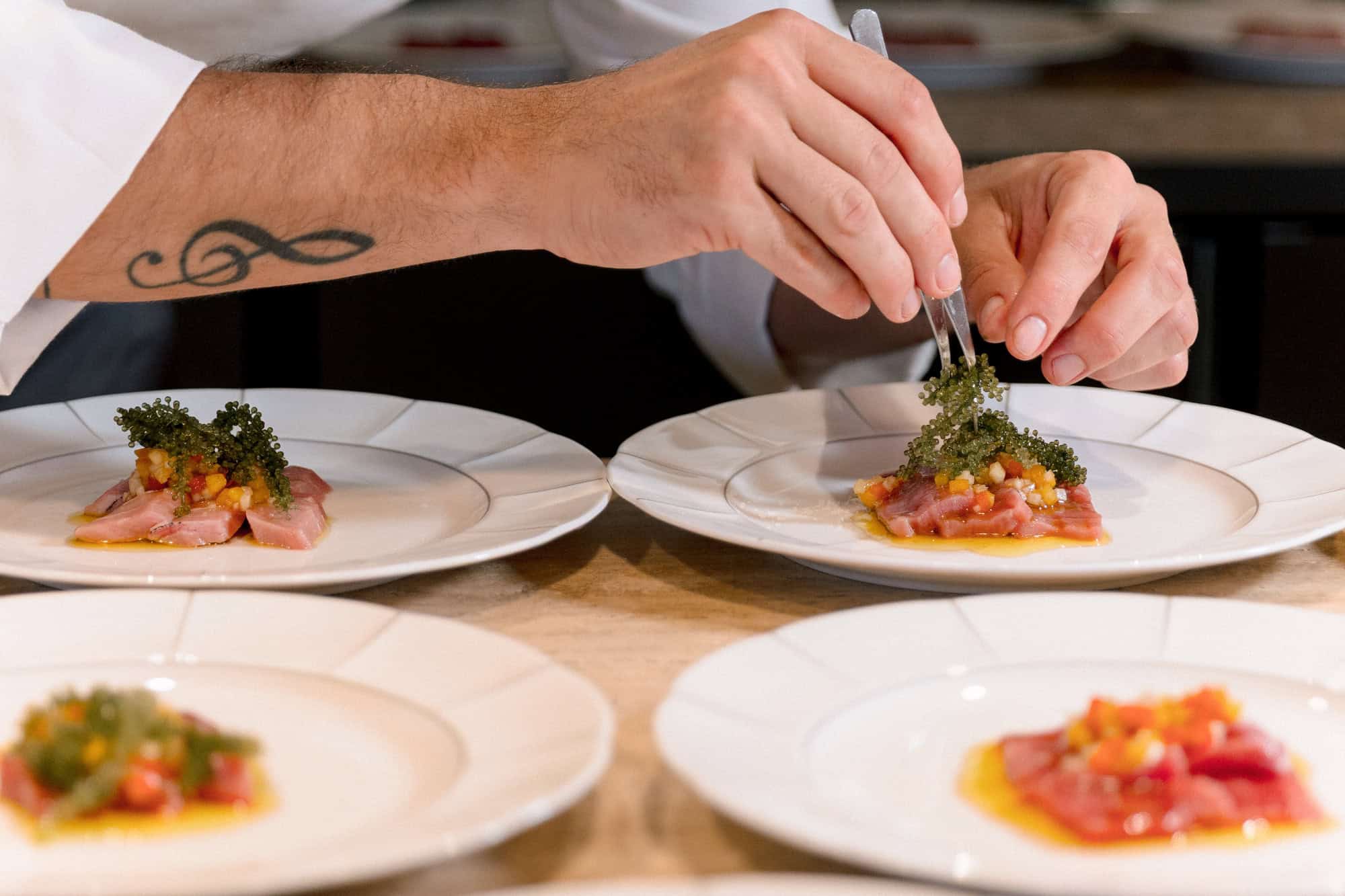
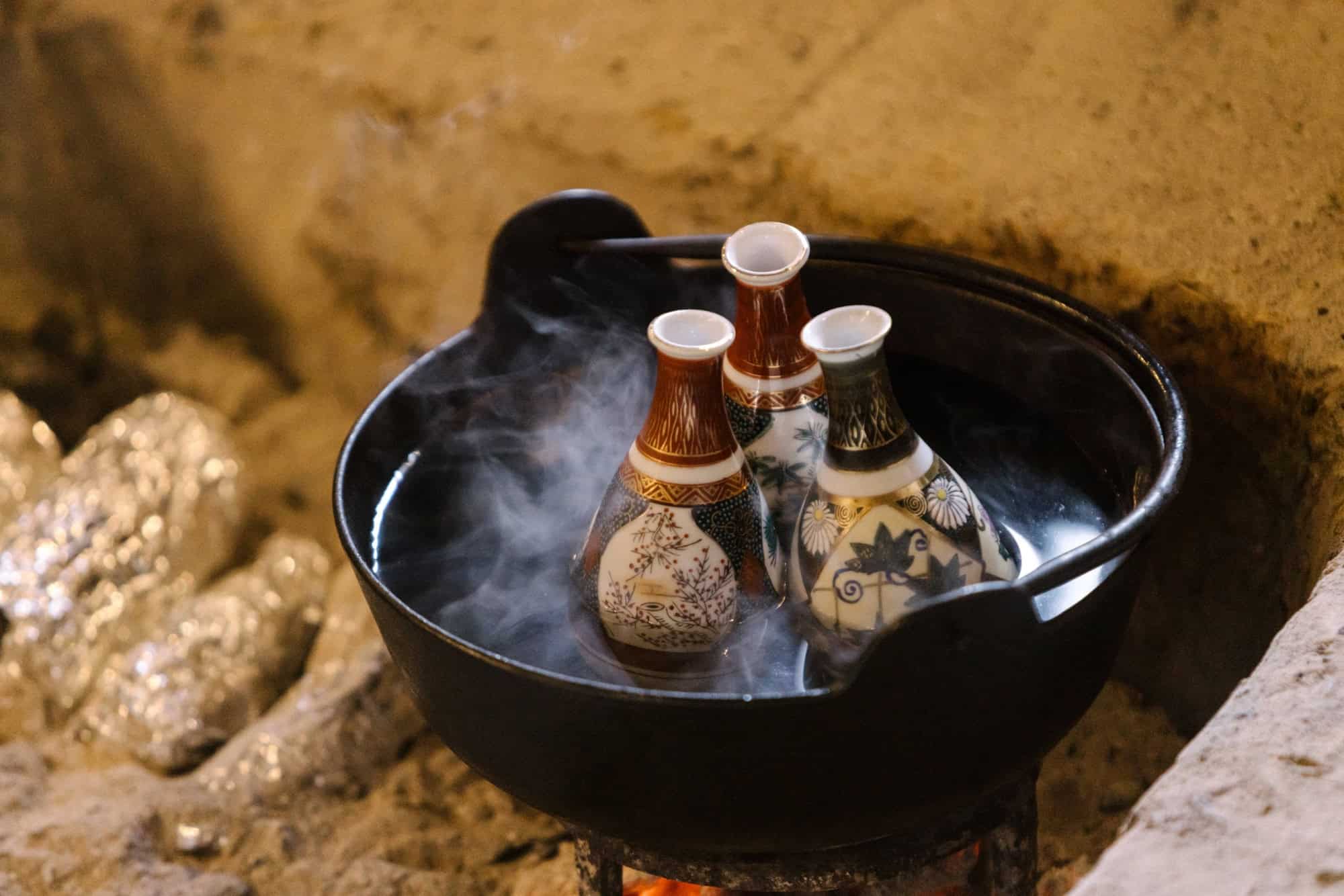
None of those menus could be moved to another region and still make sense. That’s the test we use. If a dish could be served anywhere, it probably shouldn’t be served here.
Japanese Wedding Traditions at the Table
Japanese wedding food comes with rituals, and they aren’t all the same kind of thing. Some are religious. Some are simply how Japan celebrates. For families of other faiths, knowing which is which matters, so it’s one of the first things we talk through.
San-san-kudo: the Shinto sake ceremony
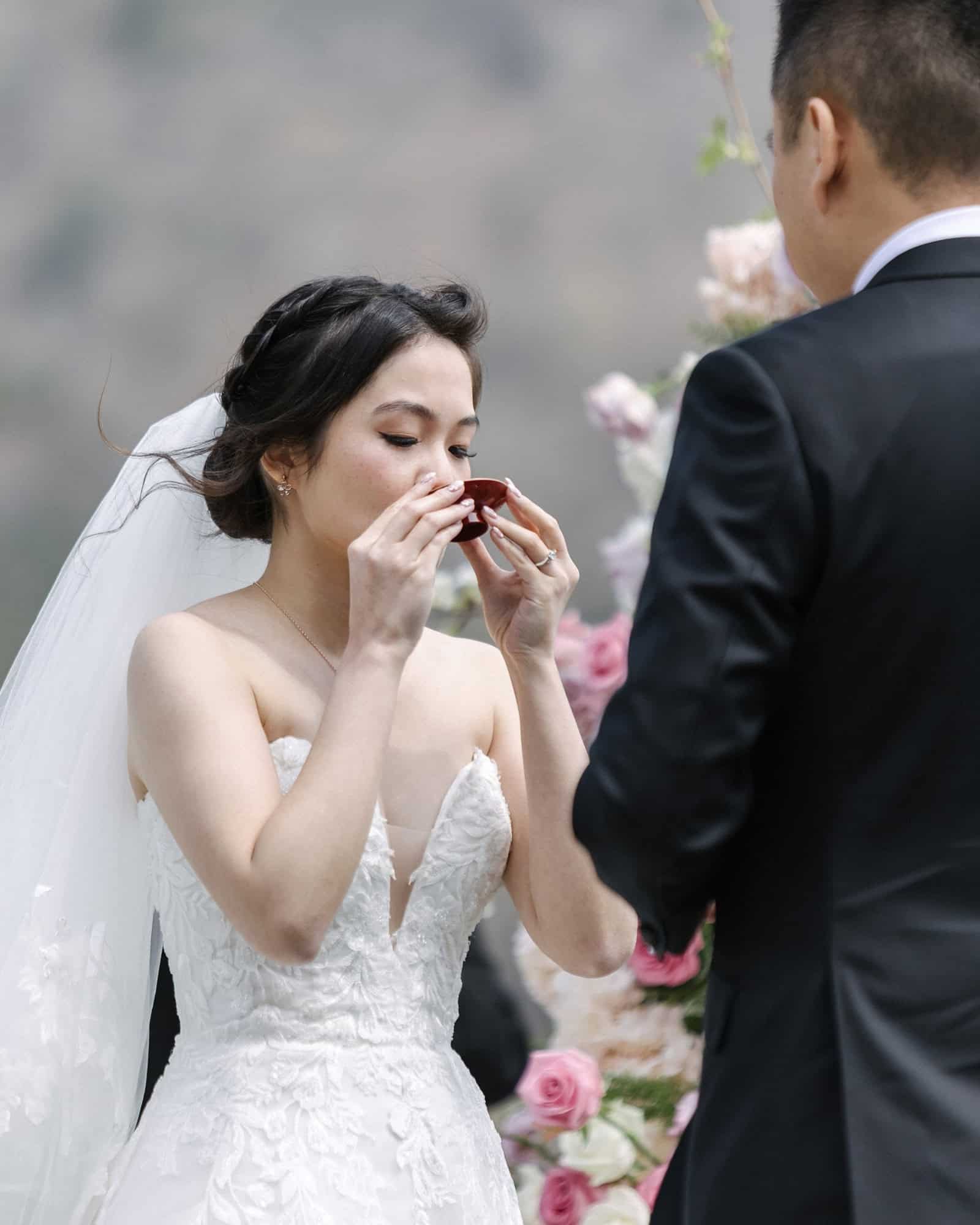
San-san-kudo, three times three sips of sake, is at the heart of a Shinto wedding. The national association of shrines describes it plainly: the couple share sake that has been offered before the kami. In a shrine, it is a religious act.
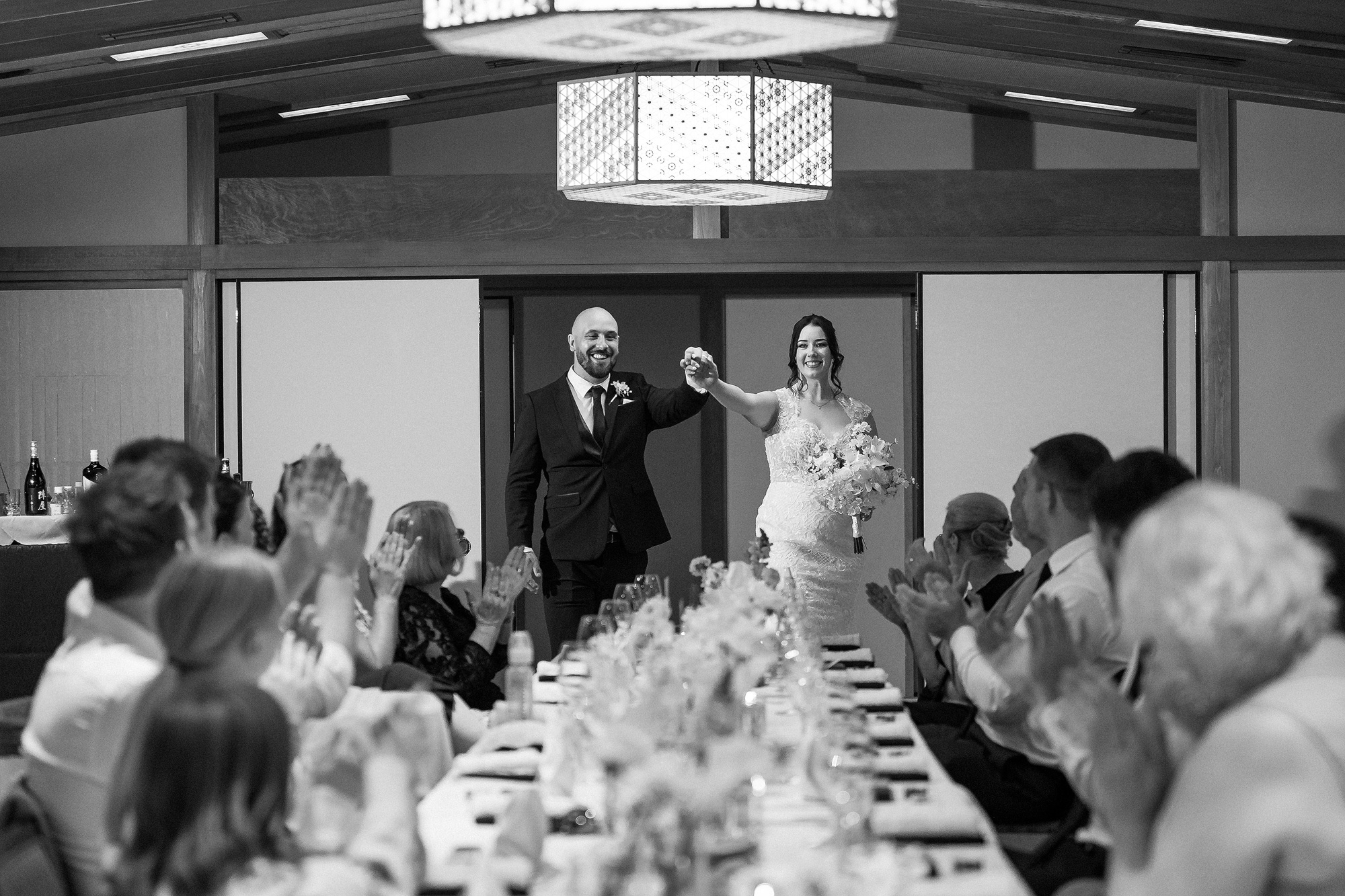
Many of our couples share the three cups outside a shrine too, in garden and lakeside ceremonies, as a gesture of joining. At a Japanese-Filipino wedding at a ryokan in Tsurumaki Onsen, both fathers poured, and when the third cup came round the guests drank as well. They didn’t only witness the promise. They drank to it.
Kagami biraki: a celebration, not a ceremony
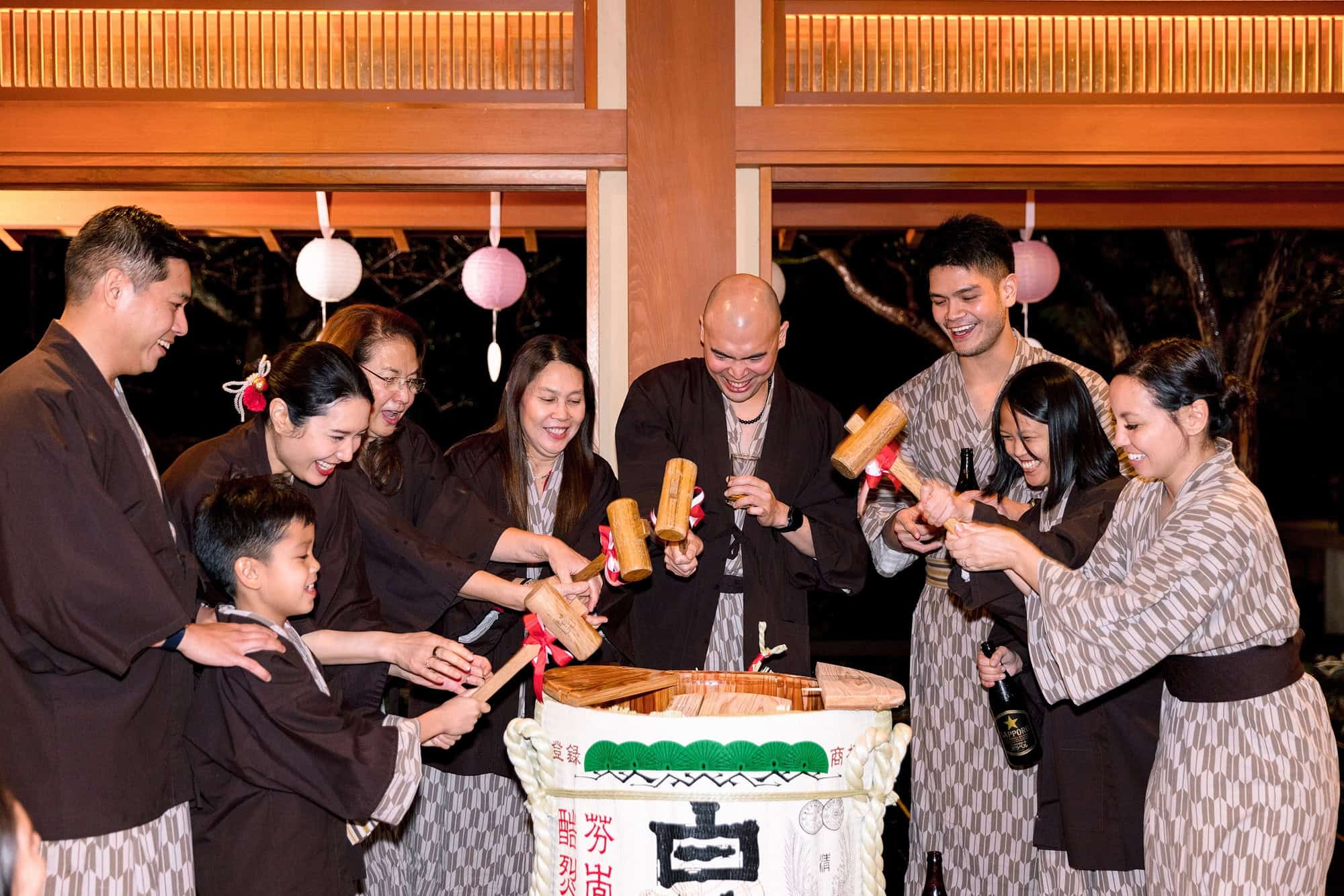
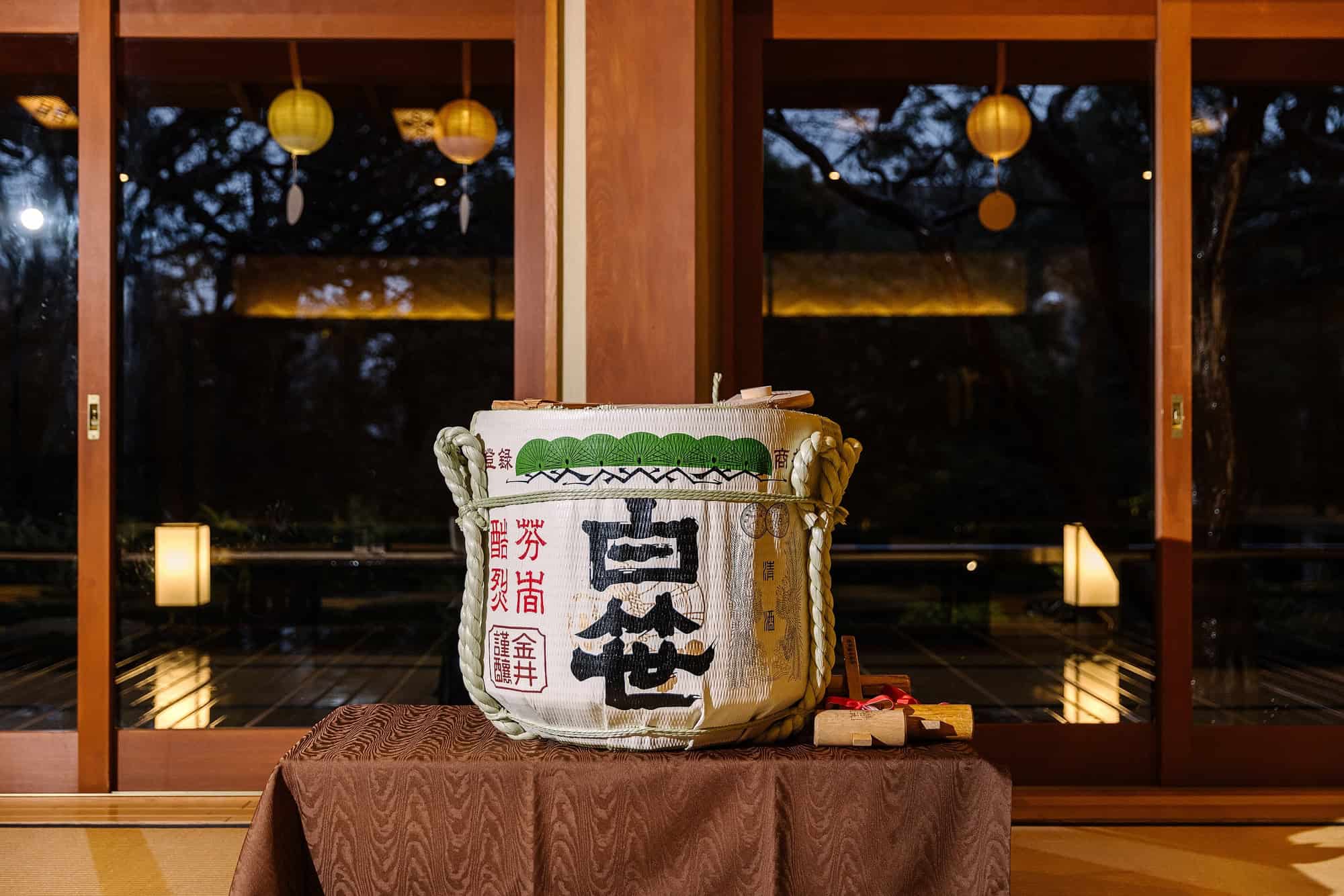
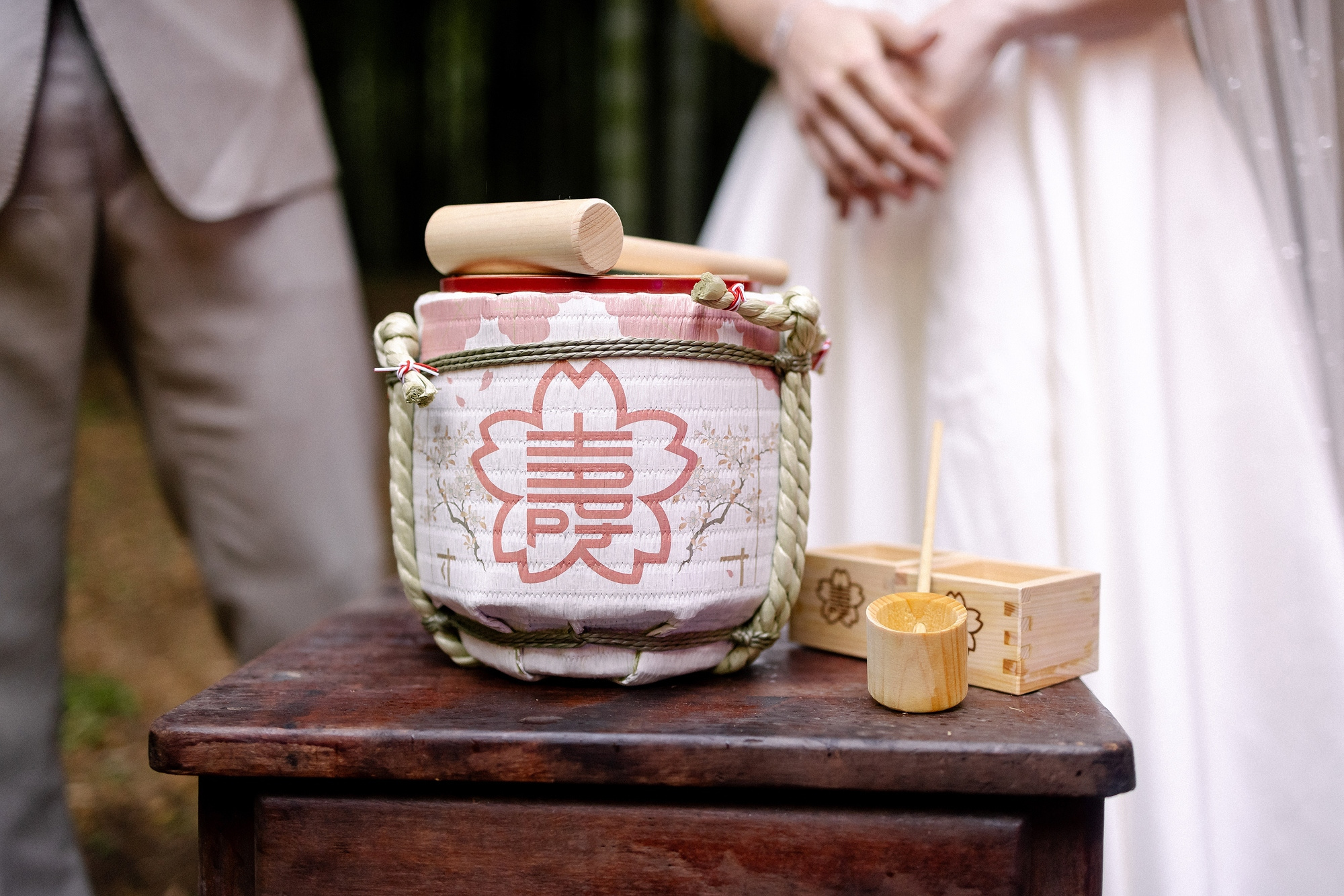
Kagami biraki is cultural. Sake brewers list it at weddings, new homes, company anniversaries and shop openings: a cask of sake opened with wooden mallets to wish for health and happiness at a new start. The language is careful. You never break the barrel. You open it. The round lid is the kagami, the mirror.
At that Tsurumaki Onsen wedding, both families opened a cask at the welcome dinner, everyone in yukata. The barrel wasn’t finished that night. It returned the next evening, with instructions from the microphone that it needed to be. At the wedding of seven, the cask held sake from a Kanagawa brewery making sake since 1830, with water from the Tanzawa mountains, the same range whose springs rise at the inn.
Mochi pounding, red rice and sea bream
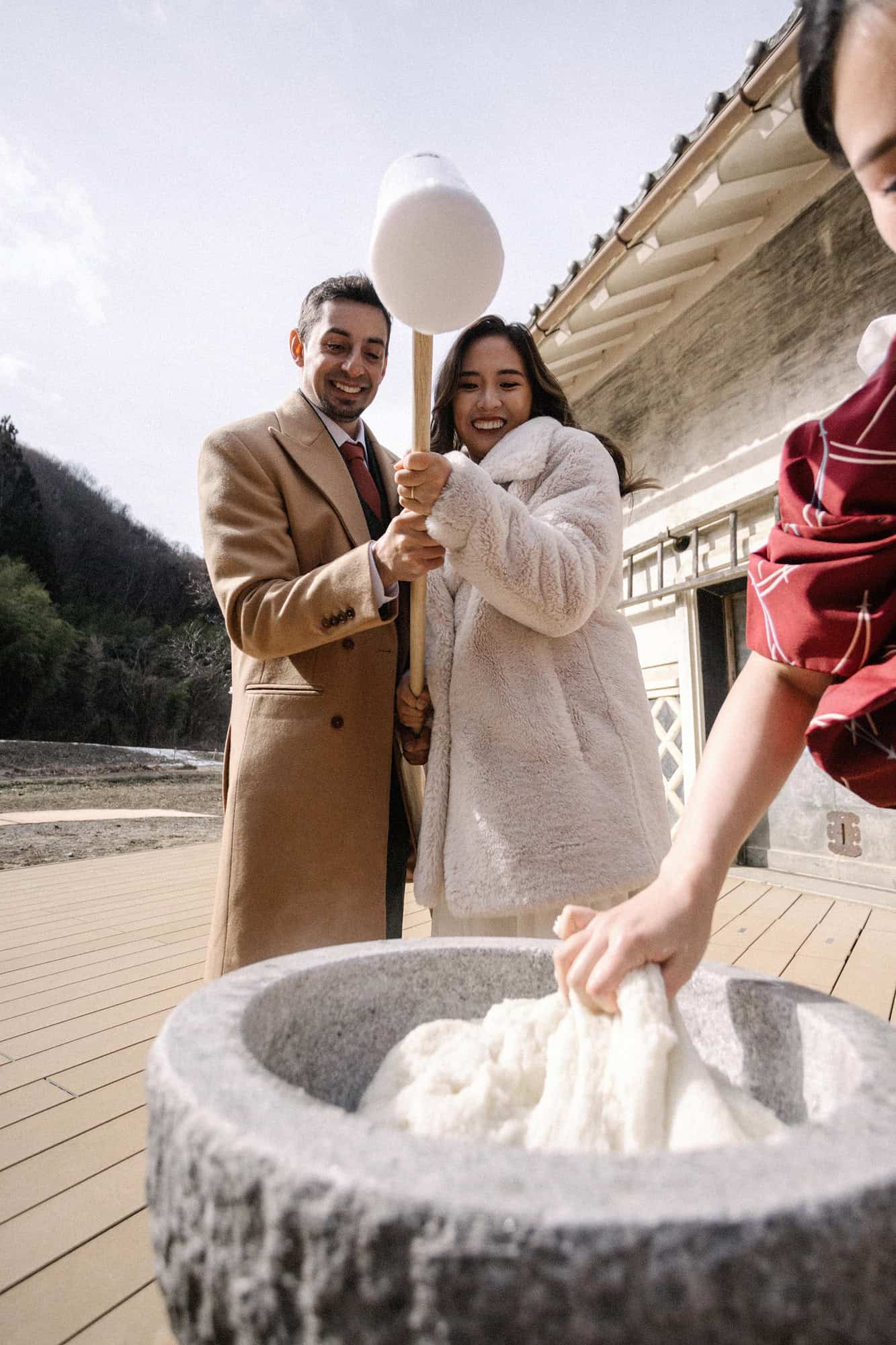
Mochitsuki, pounding steamed rice into mochi, is festival work. One person swings the mallet, another turns the rice between strikes, and the rhythm only holds if each trusts the other’s timing. In Nagano, local hands guided the couple, and then everyone ate the mochi together.
Japanese families may also recognise two older celebration foods. Sekihan, glutinous rice steamed with red adzuki beans, has long marked festive days, because red was believed to keep bad luck away. Sea bream is still treated as a lucky fish. Neither is required. Both are worth knowing about if a Japanese grandparent is coming.
Cake, the first bite and a sweet for the road
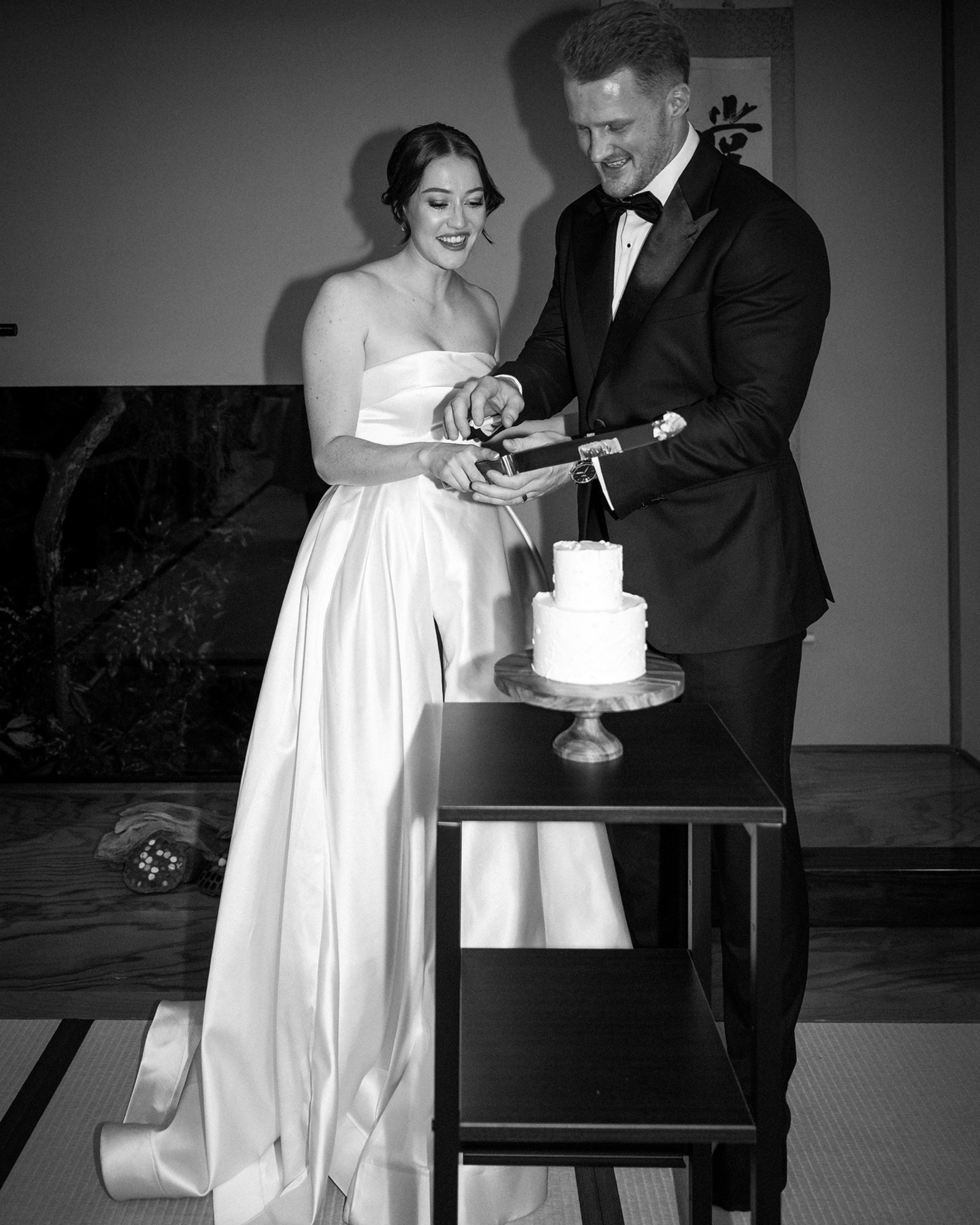
In many Japanese wedding halls, the tall cake is a display piece. What follows the cut is real: the first bite, when the couple feed each other a spoonful. Japanese wedding guides read it as two promises. One says you’ll never go hungry. The other promises a lifetime of good cooking. Guests often leave with something sweet, and baumkuchen is a favourite, its rings read as years laid down together.
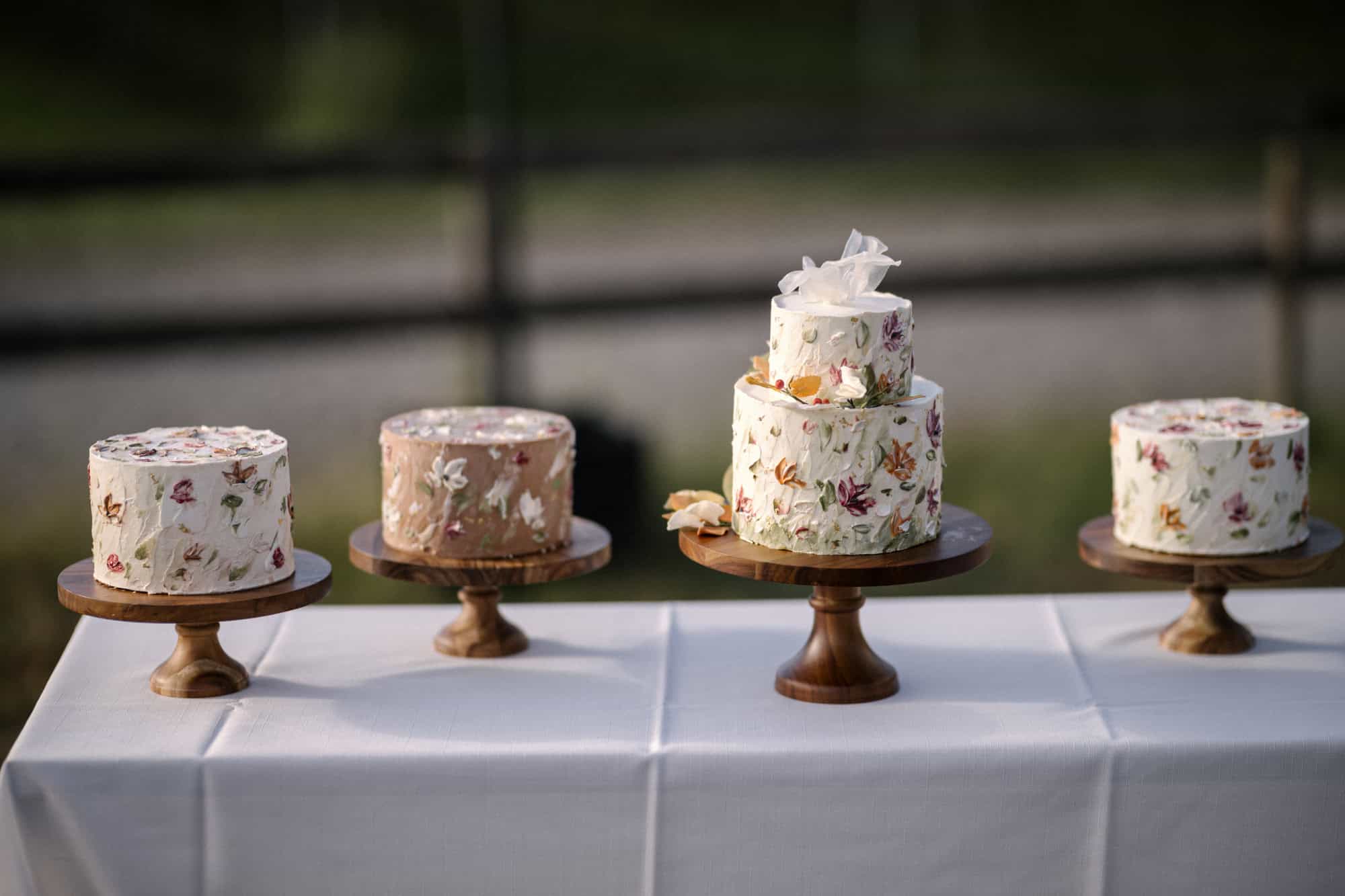
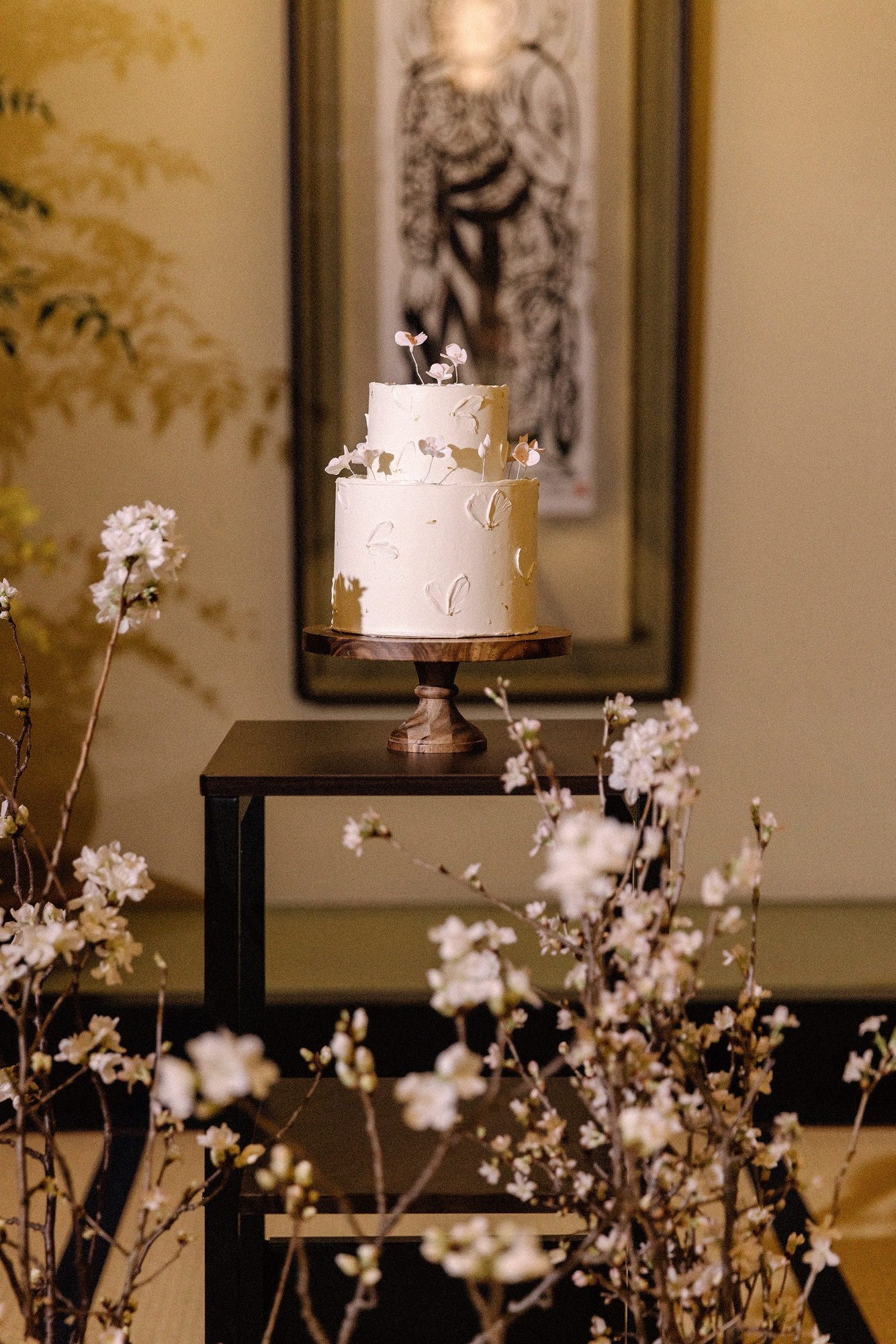
So a real, fully edible tiered cake is something we ask for by name. One autumn winery wedding had four, each painted with autumn leaves. The wedding of seven had two tiers of raspberry and pistachio.
Dietary Needs at a Wedding in Japan
A couple from New Zealand married at a ryokan at the foot of the Tanzawa mountains. A ryokan menu leans on the sea. Theirs had no seafood at all, because they don’t eat it. The groom is vegetarian. There were gluten-free and lactose-free plates where they were needed, and two cakes, one of them gluten-free, so nobody’s dessert was an exception.
The measure of it is that no one at the table had to ask. That’s what omotenashi means to us in practice. It takes real work, because Japanese kitchens are careful, and Japanese cooking hides its ingredients well.
Dashi is the hidden ingredient
Dashi, the stock under most Japanese cooking, is most often made from kombu, a kelp, and katsuobushi, dried bonito. Small dried fish are used too. So a clear soup, a simmered vegetable or a bowl of noodles can carry fish without a flake of it in sight.
Kombu alone makes a fish-free dashi, and so does dried shiitake. We ask for it by name, in the soup, the simmered dishes and the dipping sauces, not only the main course.
Shojin ryori: Japan’s own vegetarian cooking
Is Japan vegetarian friendly? More than it looks from a ramen counter. Japan has a centuries-old plant-based cuisine of its own. Shojin ryori is Buddhist temple cooking, made without meat, fish or animal products, and its stock can be drawn from kombu and shiitake. In the thirteenth century, the Zen master Dogen wrote a guide for temple cooks that treated preparing a meal as part of practice.
So we don’t ask a kaiseki kitchen to remove things from a meat menu. We ask it to cook from its own vegetarian tradition. The plate looks like it belongs at the table, because it does.
Soy sauce, mirin and halal
Standard soy sauce is brewed from soybeans, wheat, salt and water. For a coeliac guest, that wheat matters as much as the bread. Mirin, the sweet rice seasoning, can contain alcohol, and traces can remain in a sauce or marinade. For guests who keep halal, avoiding alcohol and pork, those quiet ingredients are the whole conversation. We raise them with the kitchen early, and we tell couples honestly what a given kitchen can and can’t promise.
Allergies: name the ingredient, not the category
Japan’s allergen labelling rules require packaged food to declare a list of ingredients that includes shrimp, crab, walnut, wheat, buckwheat, egg, milk and peanut, with cashew added from April 2026. Restaurant and banquet meals sit outside that rule. There, the national consumer agency encourages voluntary allergy information and warns about cross-contact.
That’s why we never send a kitchen a word like “allergy” on its own. Each guest’s needs go to the kitchen in Japanese, ingredient by ingredient, with how serious it is. Some kitchens will tell us they can’t guarantee a trace-free plate. We’d rather hear that in planning than at dinner.
A few phrases help guests travelling before or after the wedding:
- Ebi to kani no arerugī ga arimasu. えびとかにのアレルギーがあります。 I’m allergic to shrimp and crab.
- Shōryō demo taberaremasen. 少量でも食べられません。 I can’t eat even a small amount.
- Niku mo sakana mo tabemasen. 肉も魚も食べません。 I don’t eat meat or fish.
- Sakana no dashi mo taberaremasen. 魚のだしも食べられません。 I can’t have fish stock either.
The drinks list is a dietary need too
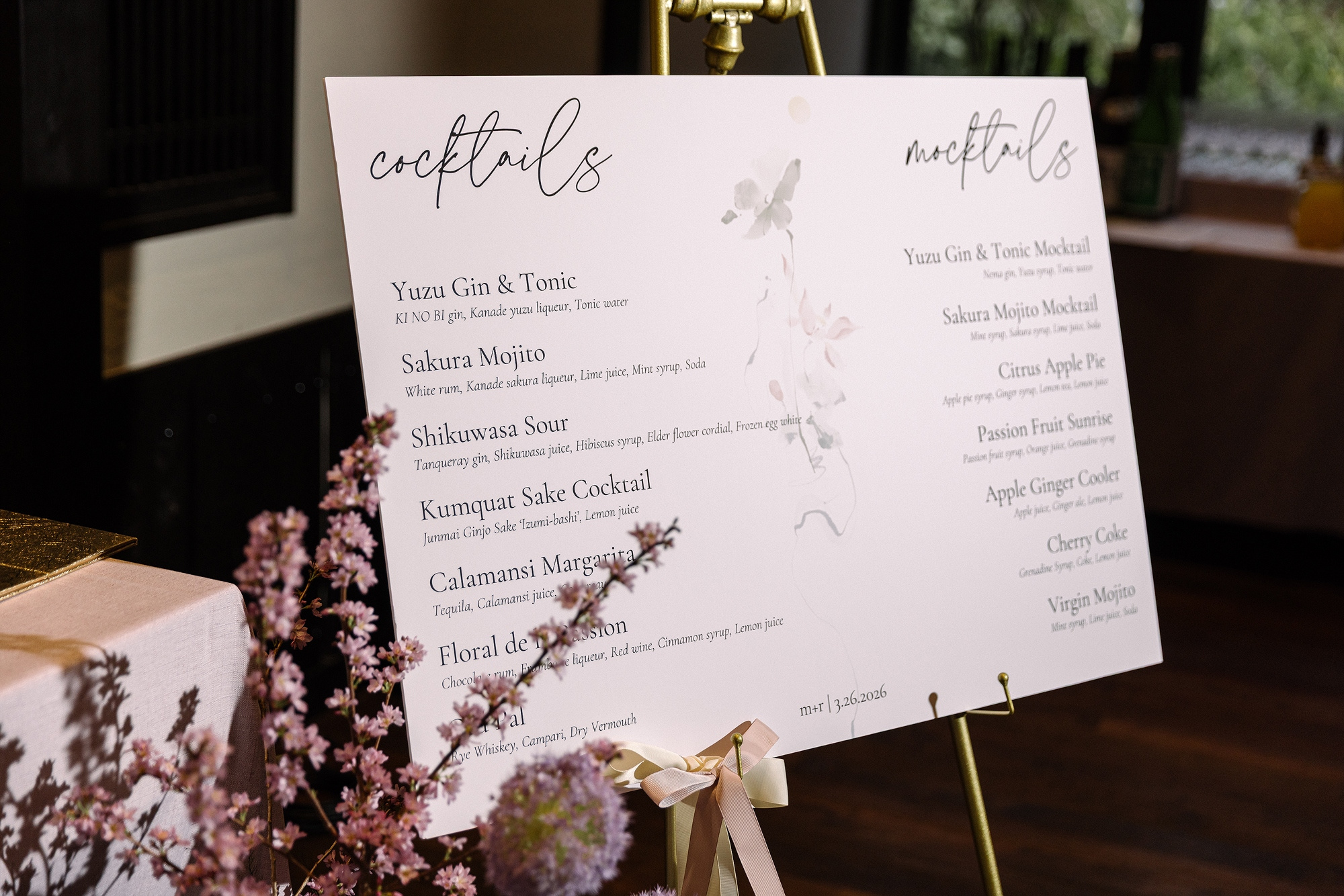
Not drinking is a dietary need. So is loving one particular beer. At the Tsurumaki Onsen wedding, the cocktail board set calamansi from the Philippines beside shikuwasa from Okinawa, with a full mocktail list alongside. At the winery, the back of the menu was a stamp card for tasting three wines, with non-alcoholic options included. For the New Zealand couple, who love a good IPA, the inn sourced craft IPA especially for them.
Planning the Table: How We Look After Every Guest
A wedding meal starts long before anyone sits down, with who is coming. At one autumn ryokan wedding, the couple knew their room: world-champion cocktail artists ran the bar, and a barista made cortados and flat whites through the evening, alongside a kaiseki-inspired dinner. A menu is for the people at the table, not the venue’s habits, and across the two or three days of a wedding weekend in Japan, whichever days of the week they fall on, that thinking covers every meal.
Most of what a destination wedding planner in Japan does well, nobody should see. At a Tokyo hotel wedding, every seat had a small wooden box with a guest’s name on it, and inside, a sake cup with the same name. It’s a small thing, and it tells every guest they were expected.
We plan food the way we plan the whole day, around who is coming and how they’re getting there, for an elopement as much as a full house. Menus settle in the months before the wedding, in the stage our wedding planning timeline for Japan calls the details people feel. Dietary needs travel with the menu, so we gather them with your guests’ replies. Severe allergies we want at the very start: a ryokan cooking one seasonal menu for the whole house and a restaurant kitchen cooking to order handle them differently, and that can shape where the dinner happens. What guests wear and expect is in our guide to attending a wedding in Japan.
What we need from you is short: who eats what, who can’t, how serious it is, and what you love. We do the translating, the kitchen conversations and the follow-up. Our wedding planning in Japan carries the menu from the first conversation to the last plate, and our photography and film keep the table as it was.
Quick Answers
What food is served at a Japanese wedding?
At hotels and wedding halls, usually a plated course menu, most often French. At ryokan and traditional venues, kaiseki: a long sequence of small seasonal courses. Around the meal come sake rituals, a cake with the first bite, and often a sweet gift to take home.
What is kaiseki, and how is it different from omakase?
Kaiseki began as the tea ceremony meal, built on one soup and three dishes, and became the formal seasonal dinner of Japan’s ryokan and restaurants. It’s planned ahead as a composed sequence. Omakase means “I’ll leave it to you”: the chef decides what comes next.
Can a Japanese wedding menu be vegetarian or vegan?
Yes, and beautifully, if the kitchen cooks from shojin ryori, Japan’s Buddhist temple cuisine, rather than stripping a meat menu. The catch is dashi. Most stock contains fish, so we ask for kombu or shiitake dashi by name, in every dish that uses stock, not only the main course.
How are food allergies handled at weddings in Japan?
Japan’s allergen labelling covers packaged food, not restaurant or banquet meals, where sharing allergy information is voluntary. So we send each guest’s needs to the kitchen in Japanese, ingredient by ingredient, with severity, and we tell you plainly if a kitchen can’t promise a trace-free plate.
What is the sake ceremony at a Japanese wedding?
There are two. San-san-kudo, three times three sips from three cups, is a Shinto rite at the heart of a shrine wedding. Kagami biraki, opening a cask of sake with wooden mallets, is cultural celebration, held at weddings, openings and anniversaries, and it suits any reception or welcome dinner.
The Meal Named for Hunger
Kaiseki began with a warm stone and a single mouthful of rice, offered to show someone had been expected. Strip away the lacquer and the courses, and that’s still the job.
A wedding table in Japan should taste of the place and the week, and hold everyone who came, including the guest who doesn’t eat fish and the one who can’t touch shrimp, without making either feel like a special case. Done well, nobody notices the work. They just remember the dinner.