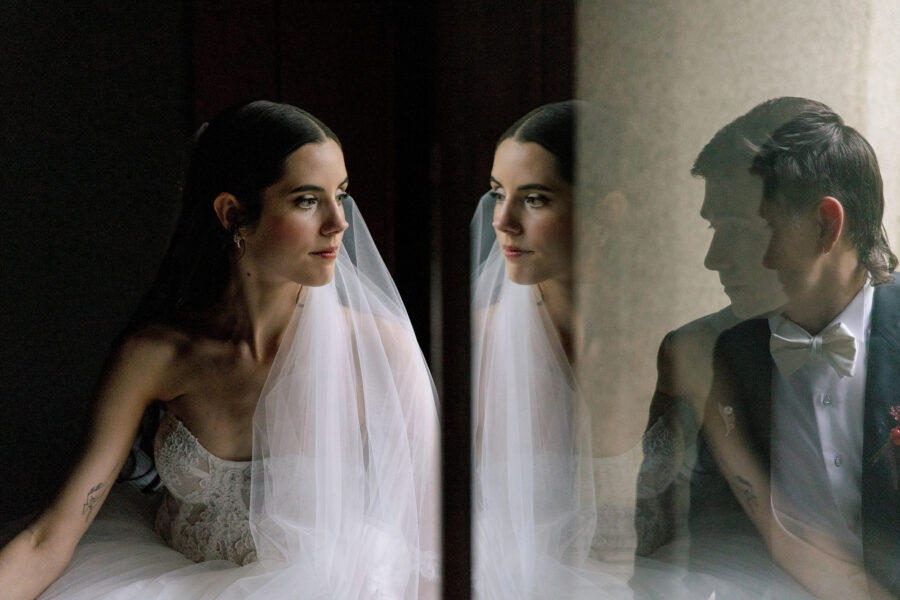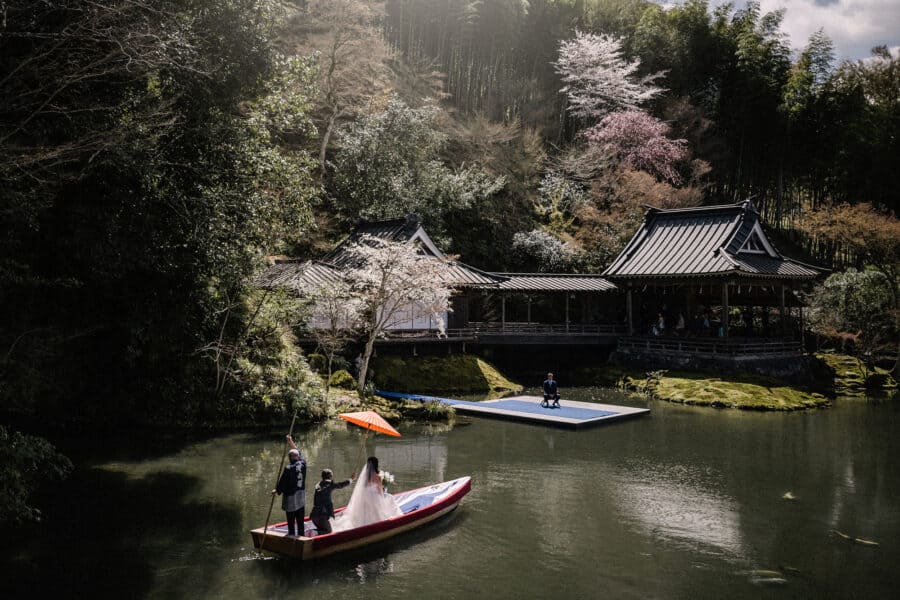
In Animal Crossing, the boatman who rows you out to the islands sings the whole way there. English-speaking players know him as Kapp’n. In Japan he’s Kappei, a name drawn from the kappa, the river creature of Japanese folklore, and for plenty of players he was the first kappa they ever met. At her Eneko Tokyo wedding, a bride from Portland walked down the aisle to his song, arranged as a wedding march.
It’s a good place to start, because it says nearly everything about this couple. They wanted a day that was distinctly Japanese without being a traditional one, and they knew from the beginning it would be a balancing act. Their Japan arrived the way it arrives for so many people their age, through Ghibli films and the games they grew up on, and that’s still Japan. An intimate wedding in Tokyo, for about twenty of the people they love most, let them hold both halves at once: sake shared from three cups, mochi pounded in festival coats, and a kappa singing the bride in.
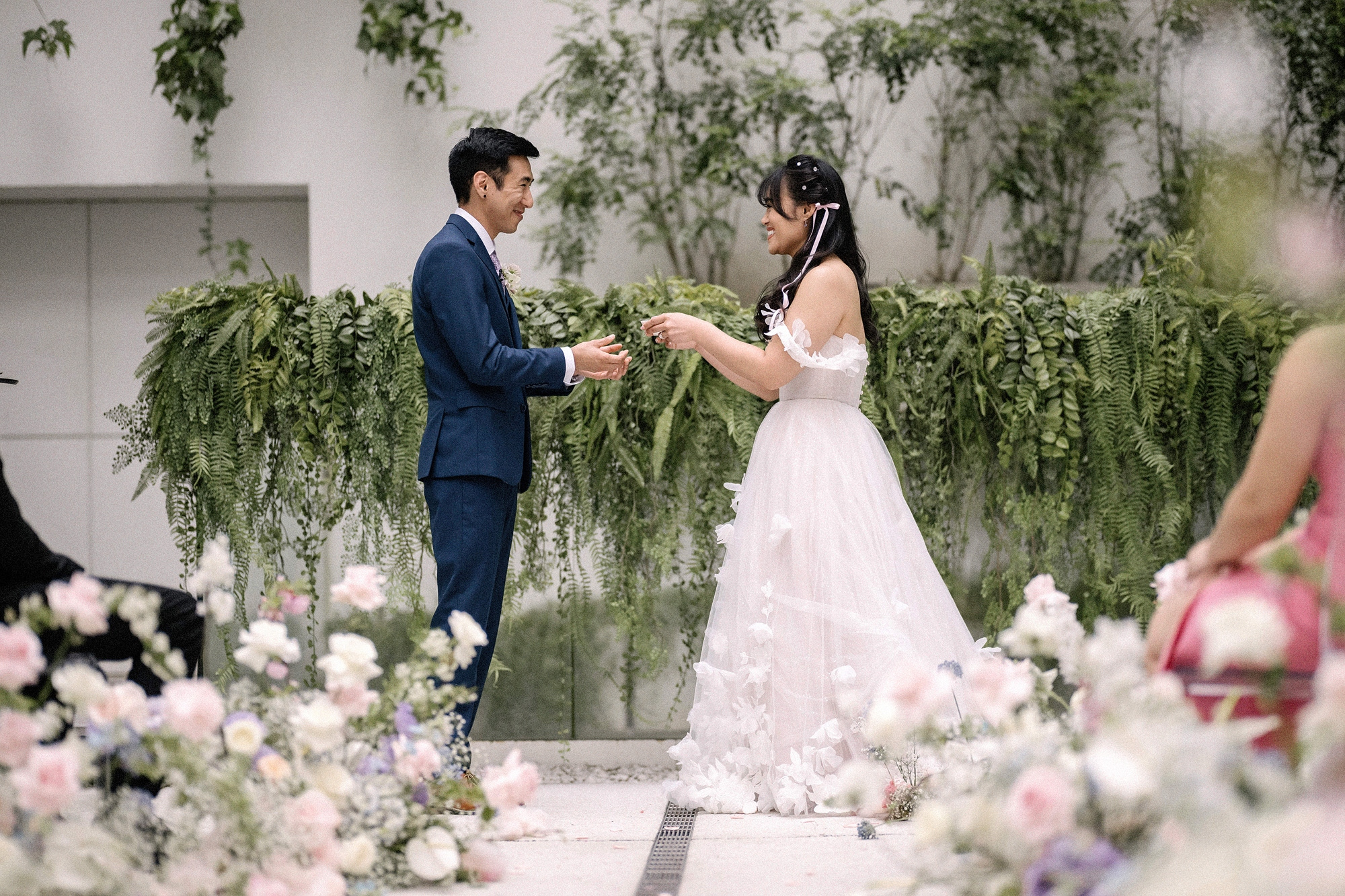
Their vows film is set to Porter Robinson’s Sweet Time, a song they chose themselves. A photograph can show two people holding hands in a courtyard. The film keeps what they said to each other, ten years in their own voices, and the faces of the friends who were listening. It’s the part of the day they’ll return to most often.


Ten Years, and a Bit of a Balancing Act
They met young, at 17 and 20, and by the time they married they’d been together ten years. The anniversary itself fell a month before the wedding, in the thick of the planning. They live in Portland, and they love things with a seriousness we recognised straight away: Ghibli, Zelda, Pokémon, Stardew Valley, Porter Robinson, Daft Punk, Taylor Swift. When they first wrote to us, after some research, they imagined a small ceremony under cherry trees, a Japanese-inspired dinner, and a night out on the town.
The first plan we made together was a ryokan in the hills, and the bride felt a real connection to it. A few months in, they found something truer. They wanted Tokyo: modern, urban, a little quirky, nothing heavily traditional. Moving a wedding from the countryside to the city is a bigger turn than it sounds, and it’s one we’d much rather a couple makes early, while every door is still open. They told us they both felt relieved. We did too. A wedding built on the wrong instinct can look lovely and still feel borrowed.
That’s most of what planning is, in the end: listening until the real brief appears, then narrowing. Tokyo can hold a wedding almost any way you ask it to, on the bay or in a garden hidden behind a wall. Dee and Sumika shortlisted the Tokyo venues that fitted this couple and walked them in person. The couple’s first reaction to Eneko Tokyo came in four words we still think about: “forest meets city vibe”.


The Days Before: The Sumida River and Shibuya Scramble
A destination wedding is never one day, and theirs began on the water. The Friday before, the whole group boarded a yakatabune at Azuma-bashi in Asakusa for a welcome dinner on the Sumida River. The bride had asked for a boat on the fun side, a bit rowdy, and it’s the right instinct for a first night. Tokyo’s yakatabune association traces these boats back to the Heian court, when aristocrats went out on the water to play music and recite poetry, and later to fireworks and cherry-blossom viewings held afloat. It’s one of the oldest ways this city has of giving people who’ve just met a floating world of their own for an evening. We like it on the first night of a wedding week, never the last, so that everyone arrives at the ceremony already a company.
On the morning of the wedding, the groom took his groomsmen to Shibuya Scramble, the crossing most visitors know from a screen long before they know it from the street, and then for a beer in a lantern-hung alley nearby. Meanwhile the bride’s friends saw her in her dress for the first time, in Eneko’s courtyard. The brief, split in two: the city, loud and public, for one half of the party, and the house, white and private and full of flowers, for the other. A wedding morning like this is planned around people as much as places. Each side got the setting that suited it, and nobody spent it waiting in a corridor.


Eneko Tokyo, a Basque House in Four Chapters
Eneko Atxa is the chef behind Azurmendi, on a green hillside near Bilbao in the Basque Country, and by his Tokyo house’s own account the youngest Spanish chef to earn three Michelin stars. Azurmendi is known as much for its conscience as its cooking; The World’s 50 Best Restaurants has named it the most sustainable restaurant in the world. His Tokyo house says you can taste his grandmother’s stews in every dish. ENEKO Tokyo carries that thinking to Nishi-Azabu, on the edge of Roppongi, in a building that was once a showroom and now wears interiors coordinated with Azurmendi’s own.
What makes it unusual as a wedding venue is that the house is written like a book. A wedding here moves through four chapters on four floors: Picnic, Ceremony, Cocktail, Party. Eneko’s own Japanese description says the whole thing should flow like a single piece of music. The picnic comes straight from the Basque hillside, where a meal at Azurmendi begins in the greenhouse, and here it means Joselito ham, txakoli and baskets of small things to eat. The ceremony takes place in a garden chapel at the centre of the building, ringed with olive trees, under a roof that opens to the sky. Dinner is upstairs, beside a green wall that runs all the way down to the ground and one of the largest open kitchens in Tokyo.
We think about pacing more than almost anything else when we plan a day, and a venue that already thinks in movements is rare. The couple had already found the words for the rest: forest meets city. White walls, hanging ferns and olive trees in the middle of Tokyo, with the city carrying on just outside. For a restaurant wedding in Tokyo, that’s the whole appeal. The house does the hosting, and the guests never have to leave the story to change rooms.
Only one thing gave the bride pause. The ceremony space looked a little too much like a chapel. So the courtyard was remade in flowers. She’d asked for something fairy-like and enchanted, and the answer was low drifts of pink, white and lilac along the ground, a winding aisle where a straight one would usually run, and no arch at all. With the flowers low and the walls hung with green, the room stopped reading as a chapel and started reading as a clearing. That’s the forest they’d seen in the photographs, finished.


A Kappa Sings Her Down the Aisle
The groom’s brother married them. Two friends went ahead of the bride as flower boys, with a plush from the game riding in their basket, and then came Kapp’n’s song.
The kappa has lived in Japanese stories for centuries, and the Sumida River has its own. In the Bunka era, as the shopkeepers of Kappabashi tell it, a raincoat merchant named Kappaya Kihachi spent his own money digging a drainage canal for the flood-prone streets near Asakusa, and the kappa of the Sumida River, moved by his kindness, came out at night to help him dig. He’s buried at Sōgen-ji, still known as Kappa-dera, and the street of kitchen-tool shops that grew up nearby is Kappabashi. That’s where the couple’s guest gifts came from: personalised chopsticks. A bride walking down the aisle to a kappa’s song, her guests going home with chopsticks from the kappa’s street, the welcome dinner on the kappa’s river. We didn’t plan the rhyme. We loved finding it.
We often say Japan should feel lived in, never worn like a costume. People tend to hear that as a warning about kimono rented for an afternoon. It’s also a defence of couples like this one. The Japan they grew up with included a game about a small village where you fish, plant trees and call on your neighbours, made in Kyoto and played on the other side of the Pacific. When they brought it back here and set it beside sake poured from three cups, they weren’t mixing a real Japan with a pop one. Both were made here, and both belonged to them.


Three Cups, One Mortar, and a Ring Through Every Hand
Before the rings reached the front, they travelled through every guest, threaded on a ribbon and passed from hand to hand. A ring relay only works at a certain size. With about twenty people, it means every one of them held the rings for a moment before the couple did. That’s the quiet case for a small wedding in Tokyo, or anywhere: nobody is an audience.
The sake was poured for sansankudo, the oldest Japanese rite they chose. Three cups, small, medium and large; three sips from each; nine in all. Its form was settled in the Muromachi period, in the etiquette of the warrior houses, and its numbers are odd because odd numbers have long been the auspicious ones. Sumika, our planner, led it.
Later, in orange happi coats, they pounded mochi in the courtyard with their friends. The groom had asked for it early in the planning. Mochi can’t be made by one person. Someone swings the mallet, someone else turns the rice between strikes, and the rhythm only holds when each trusts the other’s timing. Grains that were separate become one thing. It’s festival work, done in coats made for festivals, and it gave everyone a part to play. The rice they pounded came from Sumika’s own family farm.


Upstairs, the Fourth Chapter
Dinner was upstairs, in Eneko’s last chapter. Matsuzaka wagyu, their own choice. Then a Japanese dessert plate of mitarashi dango, matcha purin, yuzu jelly and monaka. The cake came from Eneko’s pastry chef, strawberries and cream under a sakura design, with a balloon above it that burst into gold confetti. Earlier, at cocktail hour, a guitarist and a saxophonist had played Ghibli and game music from the couple’s own list. A Basque kitchen, Japanese sweets, a Portland couple’s playlist: on paper it shouldn’t hold together. It did, because every choice came from the same two people, and the house was built to carry a night from one room to the next.
Their friends held up Japanese paper lanterns as they said goodbye. Their verdict came a few months later, in a note we’ve kept: “1,000,000/10. Stunning. Perfect. No notes!” And then, more quietly, that they could now look back on “the best day of our lives”. They’ve since celebrated a second wedding at home, and they’ve told us their honeymoon will be in Japan as well. That seems right. Japan was in this from the start.
The vows they made in that courtyard reached for something long, a promise meant for this life and the next, in every lifetime. A single day can’t hold a promise that size. What a day can do is show two people who they are together, in front of the people who know them best, in a place that understood them. That’s the work. The rest belongs to them.


Shimokitazawa, Eleven Days Before
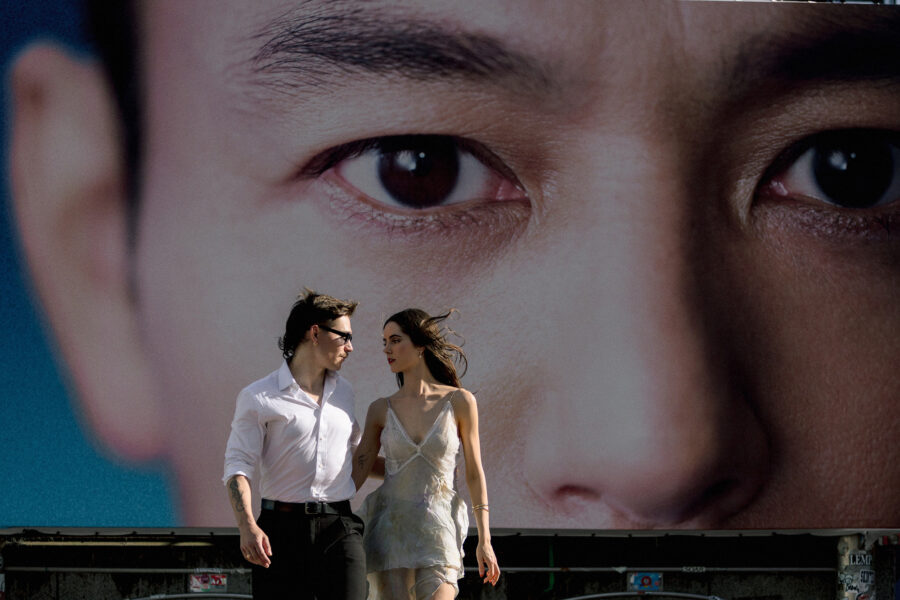
Their pre-wedding shoot was in Shimokitazawa, eleven days before the wedding. The brief was the bride’s, and it was wonderfully specific: a Tokyo take on the iconic 1980s Hong Kong pre-wedding photos, with vending machines, FamilyMart, gachapon and claw machines. They chose Shimokitazawa over Takadanobaba for its vintage feel.
Shimokitazawa is a neighbourhood that keeps things in use. Its streets are full of secondhand clothes and small shops, and where the Odakyu line once ran above ground, 1.7 kilometres of old railway land has become new streets, which the people behind them call a crossroads of culture. It was the right place for two people marking ten years: a district that makes something new out of what it already has, the way a long love does.