The groom had nothing written down. When the officiant asked for his vows, he turned to the woman he was marrying and said, “Thanks for showing up today.”
It’s the line you’d use on a friend who made it to your birthday. Sit with it, though, and it’s close to the whole of a marriage. It’s also the truest thing anyone can say about attending a wedding in Japan. At that onsen wedding, the bride’s grandmother had flown in from New York at 92. A great-uncle of 93 had taken the train from Kyoto on his own.
So here is the short version. First, know which kind of wedding you’re going to. At a Japanese couple’s wedding, there are customs every guest is expected to follow, from the money gift to the colour of your tie. At a destination wedding for friends from overseas, which is most of ours, follow the couple: their dress code, their wishes on gifts. Either way, arrive a day or two early. Expect your shoes to come off. Learn the bath before the welcome dinner. And if you possibly can, add days.
Everything else, someone will show you. This guide comes from our wedding planning in Japan. Each part tells you how Japan does things, then how we make it work for a room full of people from everywhere. If you’re the couple rather than the guest, our guide to the things to know before planning a wedding in Japan covers the decisions that should happen before invitations and travel plans begin.
Two Kinds of Wedding in Japan
Guests fly to Japan for two quite different weddings, and the etiquette depends on which one you’ve been invited to.
A Japanese couple’s wedding. When the couple and their families are Japanese, the customs are obligations, not suggestions. Guests give goshugi, a gift of money in a proper envelope. They follow a dress code that rules out white and a black tie. Speeches avoid certain words. Nobody hands you a list, because everyone in the room is expected to know. This guide explains them.
A destination wedding for friends from overseas. Most of the weddings we plan are this kind: a couple from abroad marrying in Japan, with guests flying in from everywhere. Here those obligations usually don’t apply. Do what you’d do at a wedding at home: follow the couple’s dress code and their wishes on gifts. Japan still shapes the days, with shoes off at the door, yukata at dinner, the onsen and whichever rituals the couple choose. There’s no goshugi and no Japanese dress rulebook unless they ask for one.
Not sure which you’re going to? Ask the couple. It’s the first question, and it settles most of the others.
A Wedding in Japan Is Rarely One Day
Many of the weddings we plan run over two or three days, and the first evening matters as much as the ceremony.
One autumn wedding began the evening before, at a ryokan in the countryside, under the maples: everyone at low tables, Japanese curry simmering in enormous pots, toasts rising into the mountain air, then a wooden mallet passed from guest to guest for mochi pounding. Strangers arrived that evening. Something closer to family went to bed.
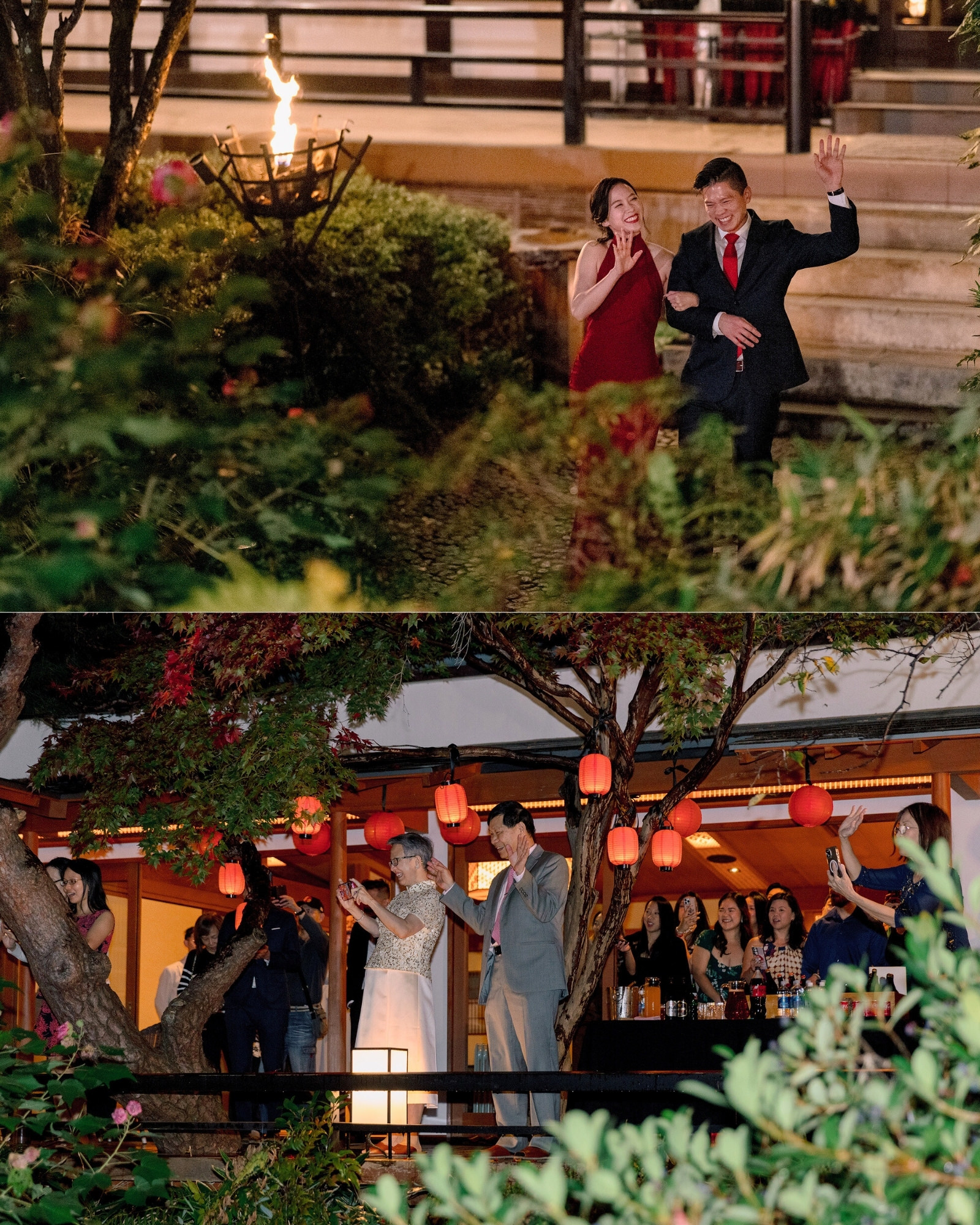
At a welcome dinner, families from different continents meet over food rather than across an aisle, and by the ceremony the room already knows itself. Our guide to the wedding weekend in Japan explains how the days fit together, and why ours often fall midweek.
So plan to stay. Nobody has to fly home the morning after, so nobody spends the wedding day watching the clock.
Travel and Arrival
Entry. Check what your passport needs with Japan’s Ministry of Foreign Affairs or a Japanese embassy before you book. Visit Japan Web, run by Japan’s Digital Agency, handles immigration and customs online before you land.
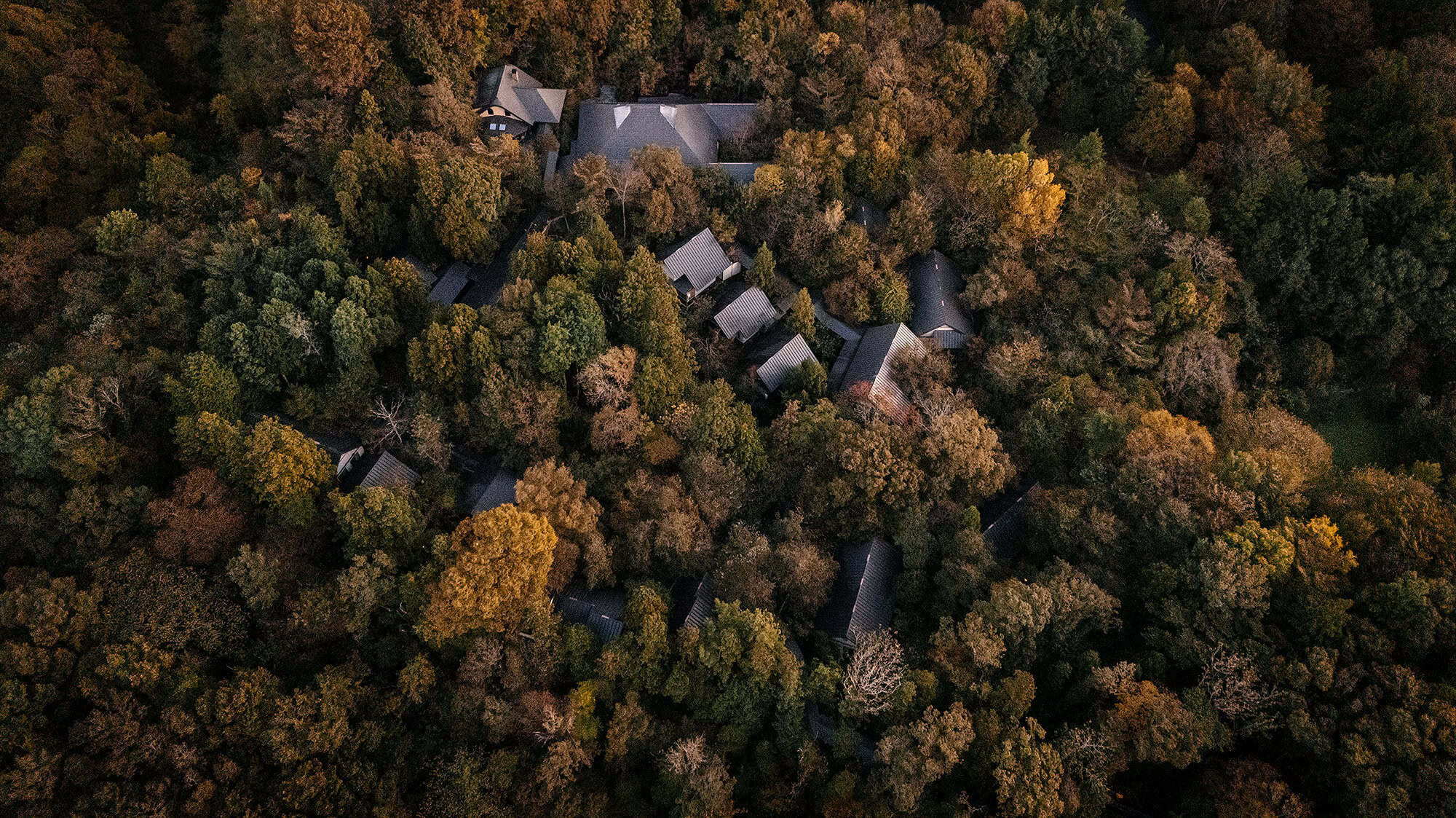
Luggage. Many of our venues sit outside the big cities: a ryokan in the Tanzawa foothills, a village in the mountains of Yamanashi, a forest onsen in the foothills of Zao. Bags can be forwarded from airport counters at Narita, Haneda and Kansai, from most major hotels and from convenience stores, for delivery the same day or on a date you choose. Send the big suitcase ahead. On the Tokaido, Sanyo and Kyushu shinkansen, a bag over 160 cm in total dimensions needs a reserved seat with an oversized baggage area.
Money. Japan still runs on cash more than most visitors expect, and smaller shops and remote ryokan may take yen only. There’s no need to tip.
Holidays. Near Golden Week, the national holidays at the turn of April and May, book early.
Out of town, we usually move the group together, and the local way can be part of the welcome. In the mountain village of Kosuge, where a hotel has made the old houses into rooms, the villagers themselves do the cooking and the driving. Read the itinerary before you book a car.
How Guests Are Looked After
A ryokan kitchen cooks to the season, and the sea supplies much of the menu. That’s the joy of it, and it’s why a dietary need has to travel ahead, in Japanese, well before anyone sits down. Tell the couple early. Our guide to wedding food in Japan explains how every guest is fed well.
That’s the part of wedding planning in Japan we care about most, and most of it is never seen. Each wedding runs on a timeline its guests never read, and every guest list gets a plan of its own: who arrives when, who needs a seat out of the wind, who should be on the first car back.
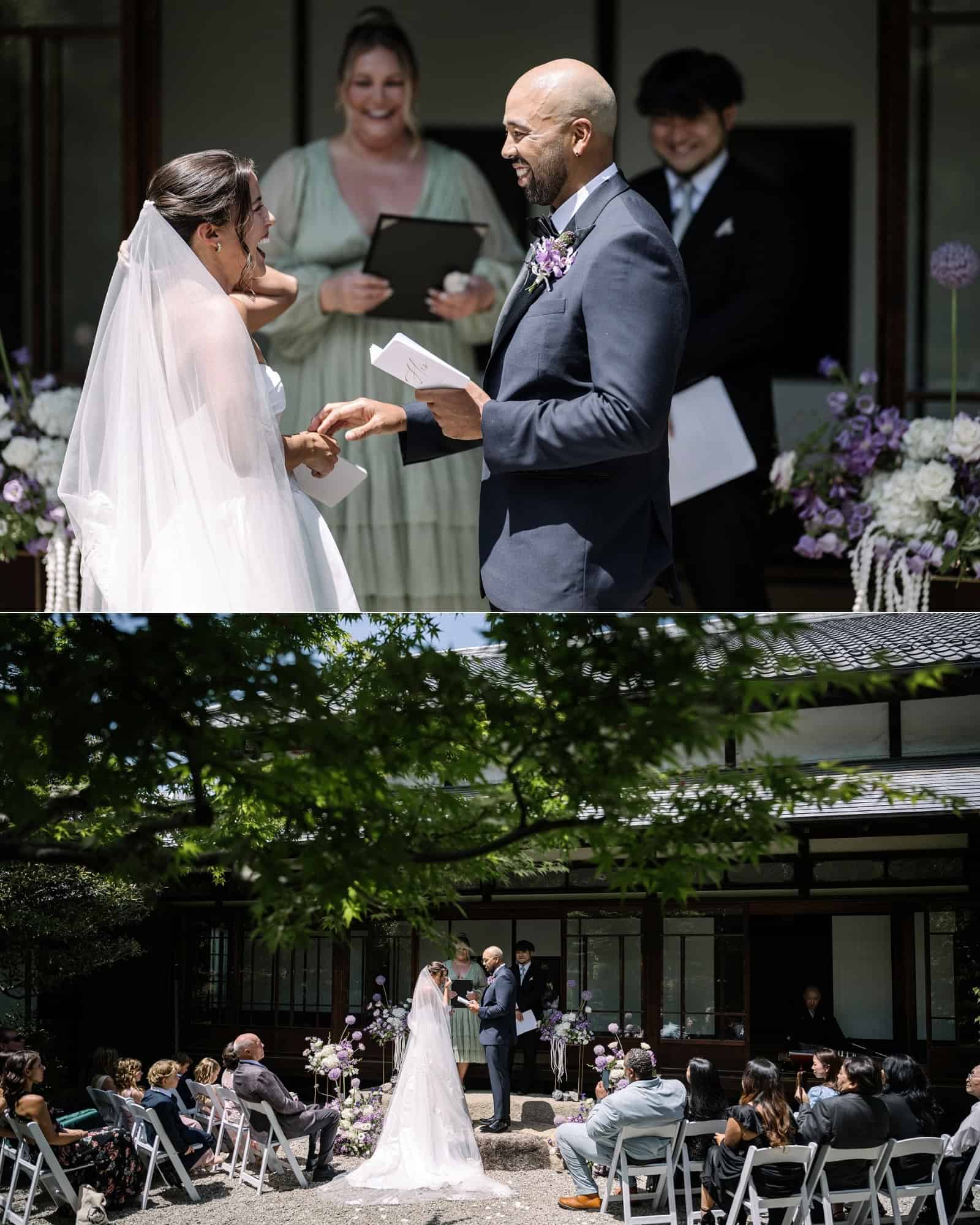
Language moves both ways too. At a garden wedding in Tokyo, two friends led the ceremony, one of them in Japanese, so a groom who spoke Japanese before English heard part of his own wedding in his first language, and both halves of the family got to feel like the home side.
What to Wear to a Wedding in Japan
At a destination wedding, the couple’s dress code is the whole answer. At a Japanese couple’s wedding, the dress code comes with expected customs, and every Japanese guest in the room will be following them.
At a Japanese wedding, guests don’t wear white. It’s the bride’s colour. Men wear a white or silver tie, because a black tie belongs to funerals. A black dress is fine, brightened with colour or jewellery. Fur is usually avoided, since it calls to mind the taking of a life. Daytime ceremonies lean modest, and formal shoes cover the toes.
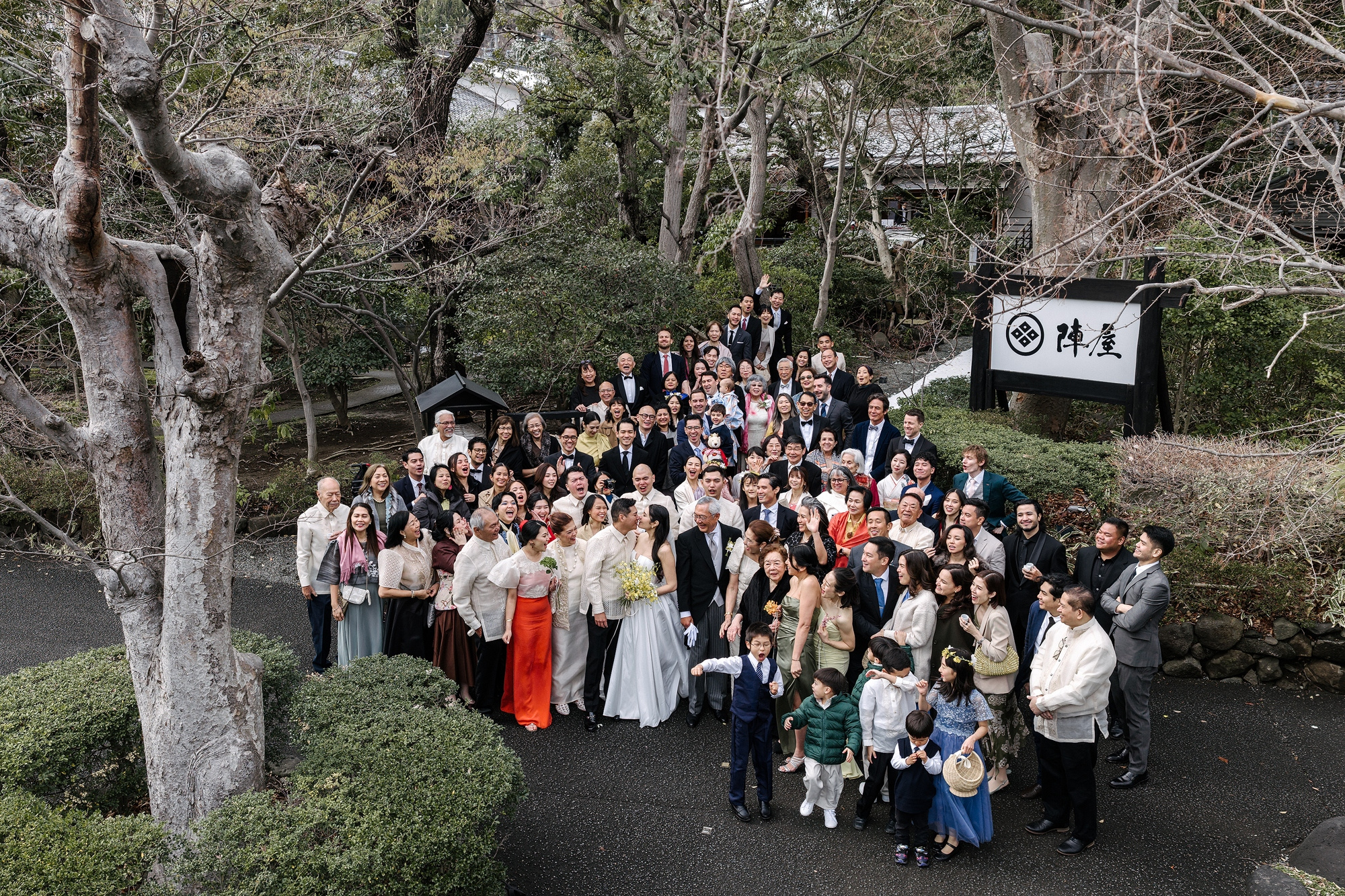
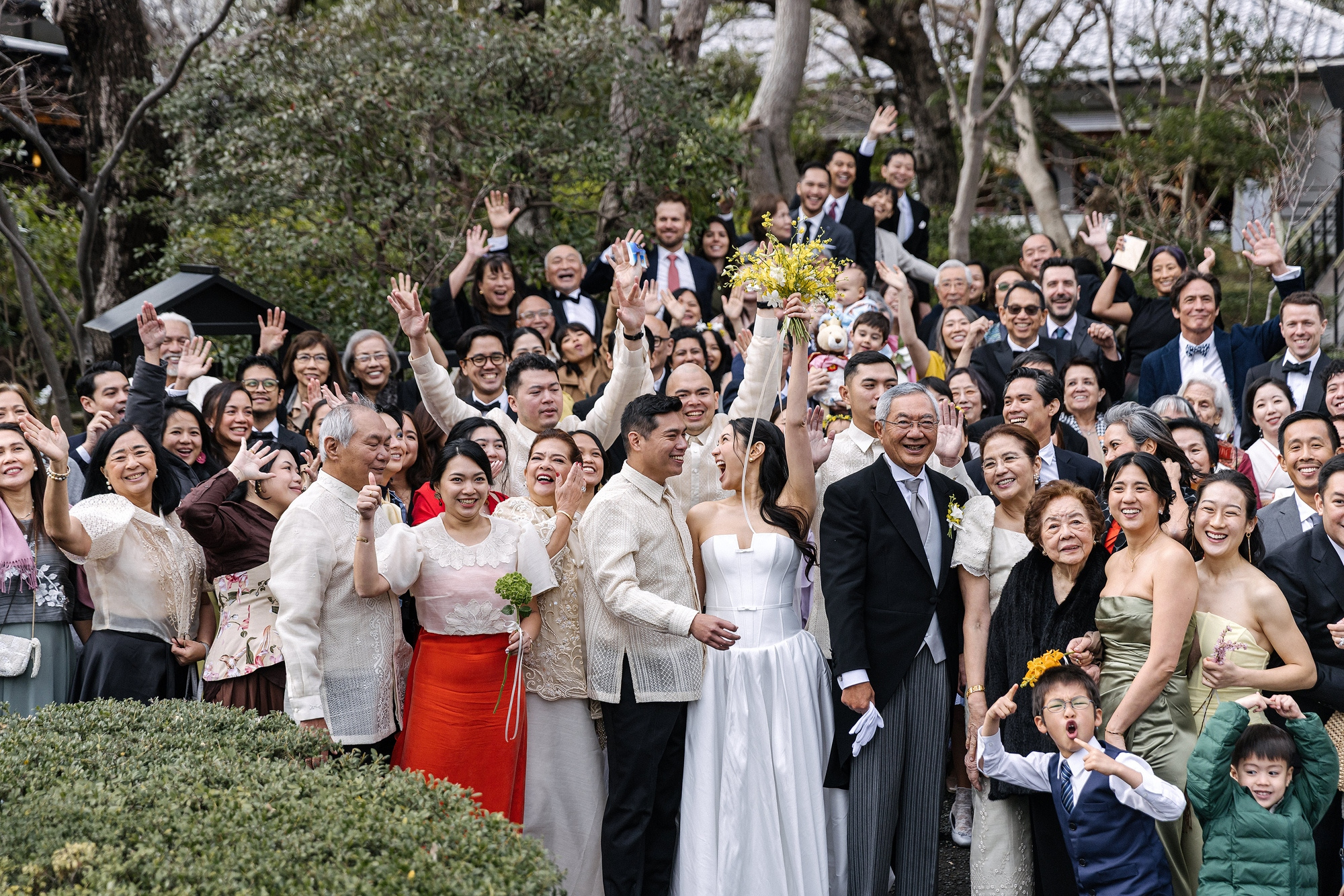
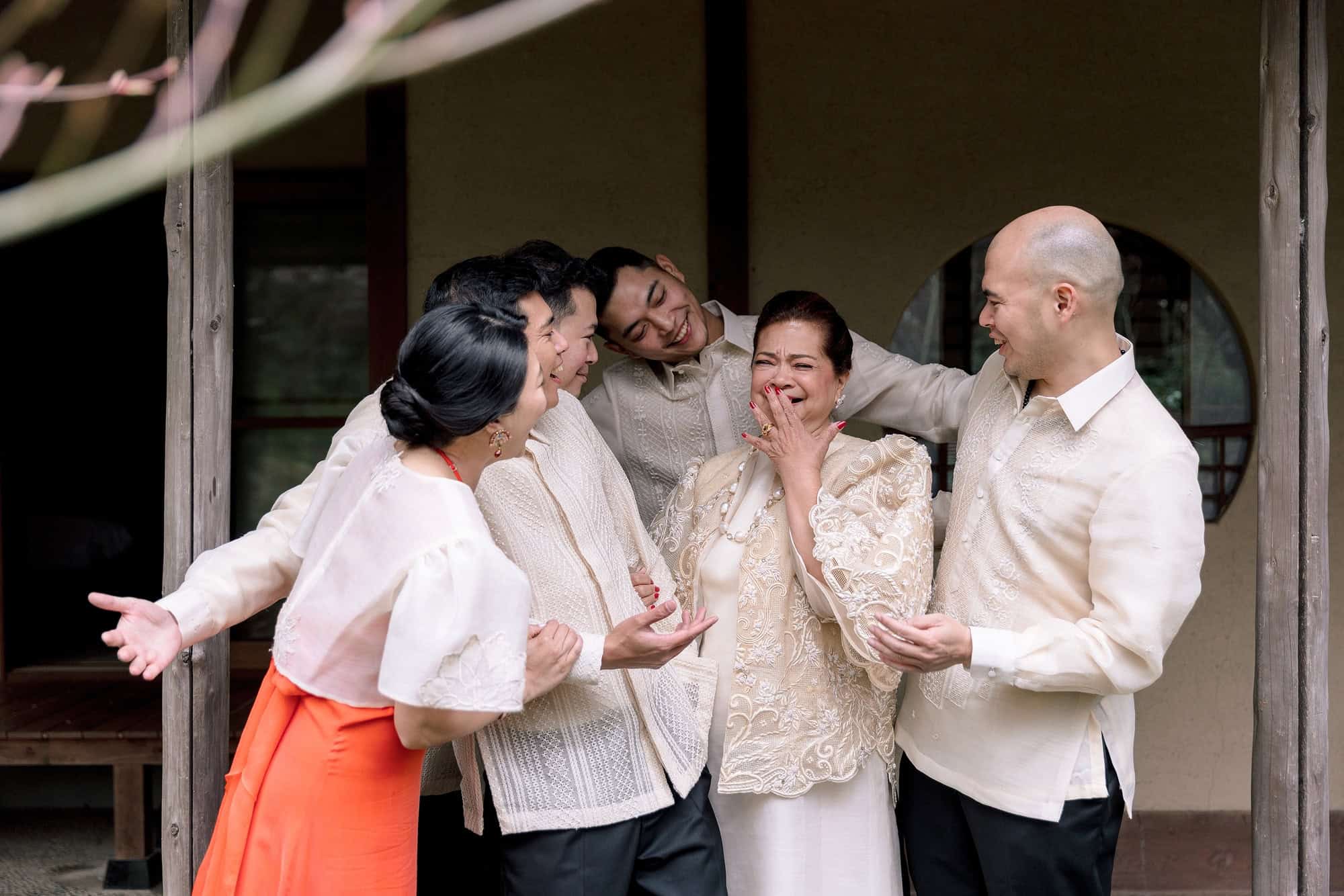
Within that, wear what’s true to you. At one black-tie onsen wedding, the groom and his groomsmen wore barong, the Philippines’ national formal wear, and the women of the family wore butterfly sleeves. Each family came dressed as itself, and none of it needed explaining. If you’d like to wear kimono, tell the couple early, so a dresser can be booked.
Dress for the season you’re actually in
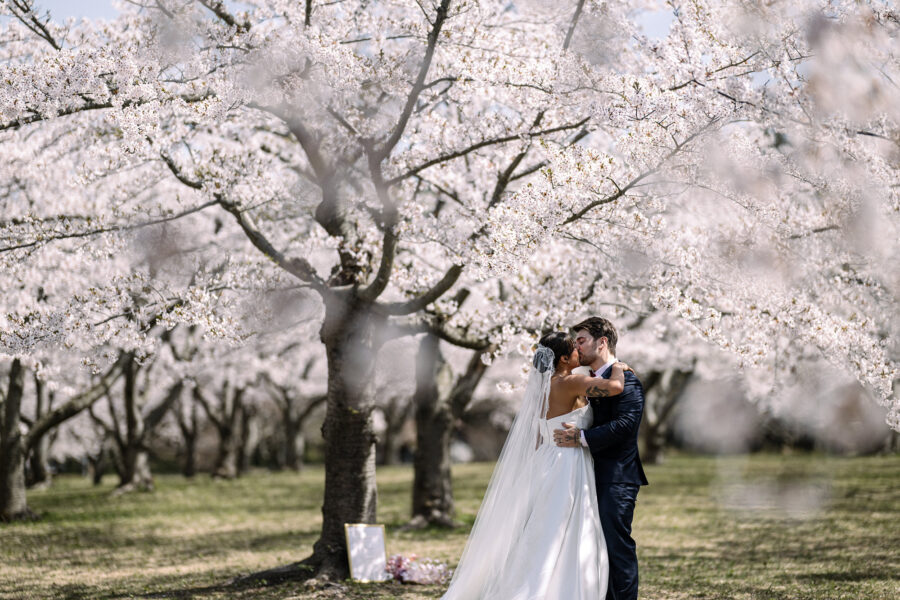
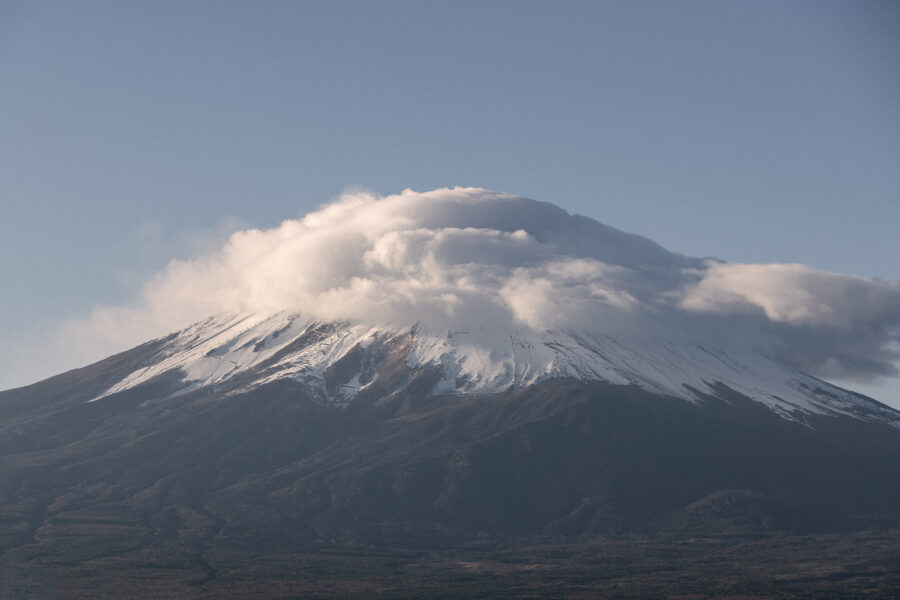
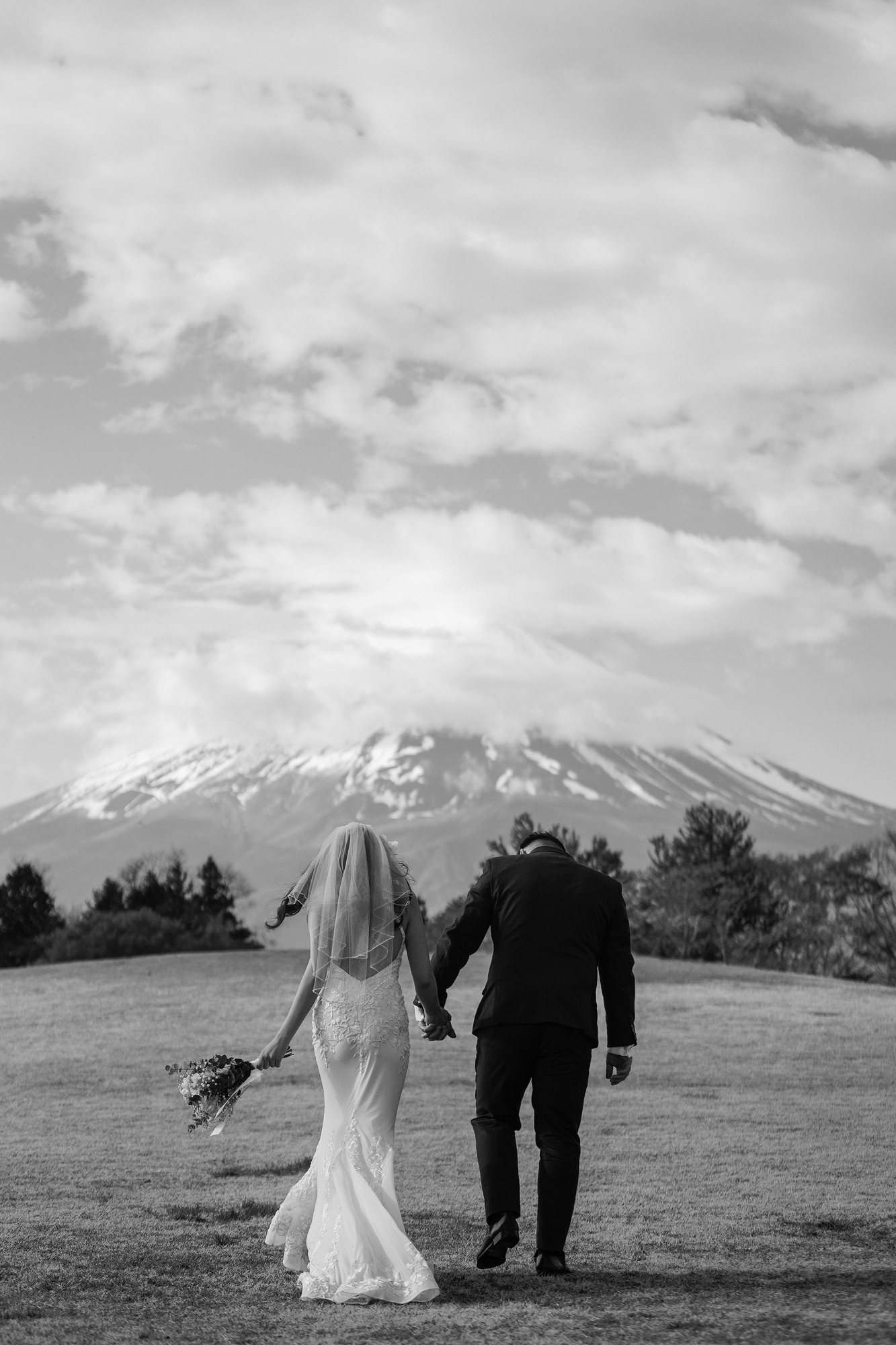
Rain can arrive in any month, and so can a cold snap. One spring elopement on an open lawn above a lake near Mt Fuji fell on a day a little colder than usual, the wind lifting the bride’s veil. Around Tokyo, the rainy season normally runs from about the 7th of June to the 19th of July, and the summer after it is hot and humid. Late autumn evenings turn cold: at a November wedding on Tokyo Bay the day was bright and dry, and by the time the boat was out on the water the bride had a coat around her. In winter, coats aren’t optional.
Shoes off, good socks on
In a ryokan, an old house and often a temple building, shoes come off at the entrance. Slippers usually wait inside, and those come off too before tatami. In an old Tokyo house we love, the timber floors have been polished by generations of socks. Wear shoes you can slip off without sitting down, and socks you’re happy for everyone to see.
At shrines and temples
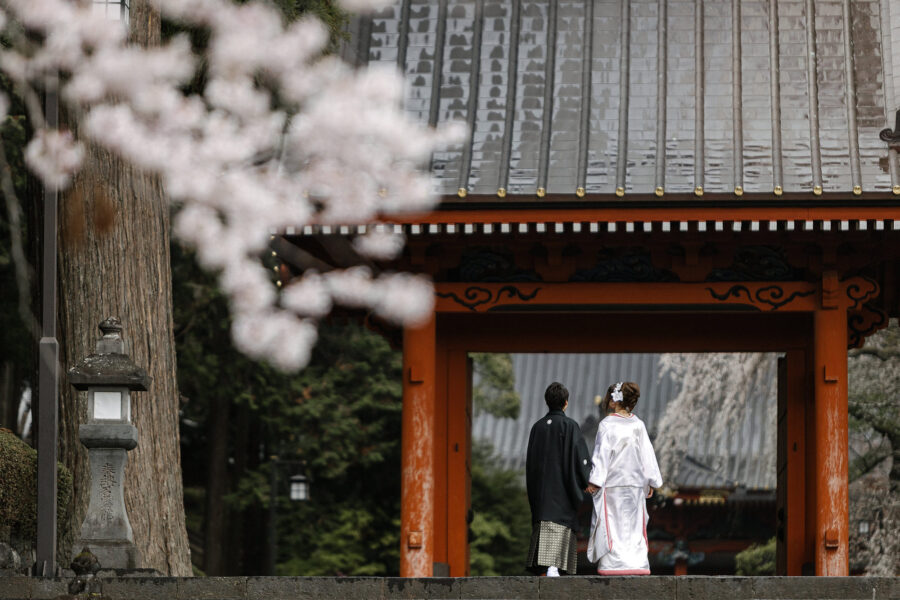
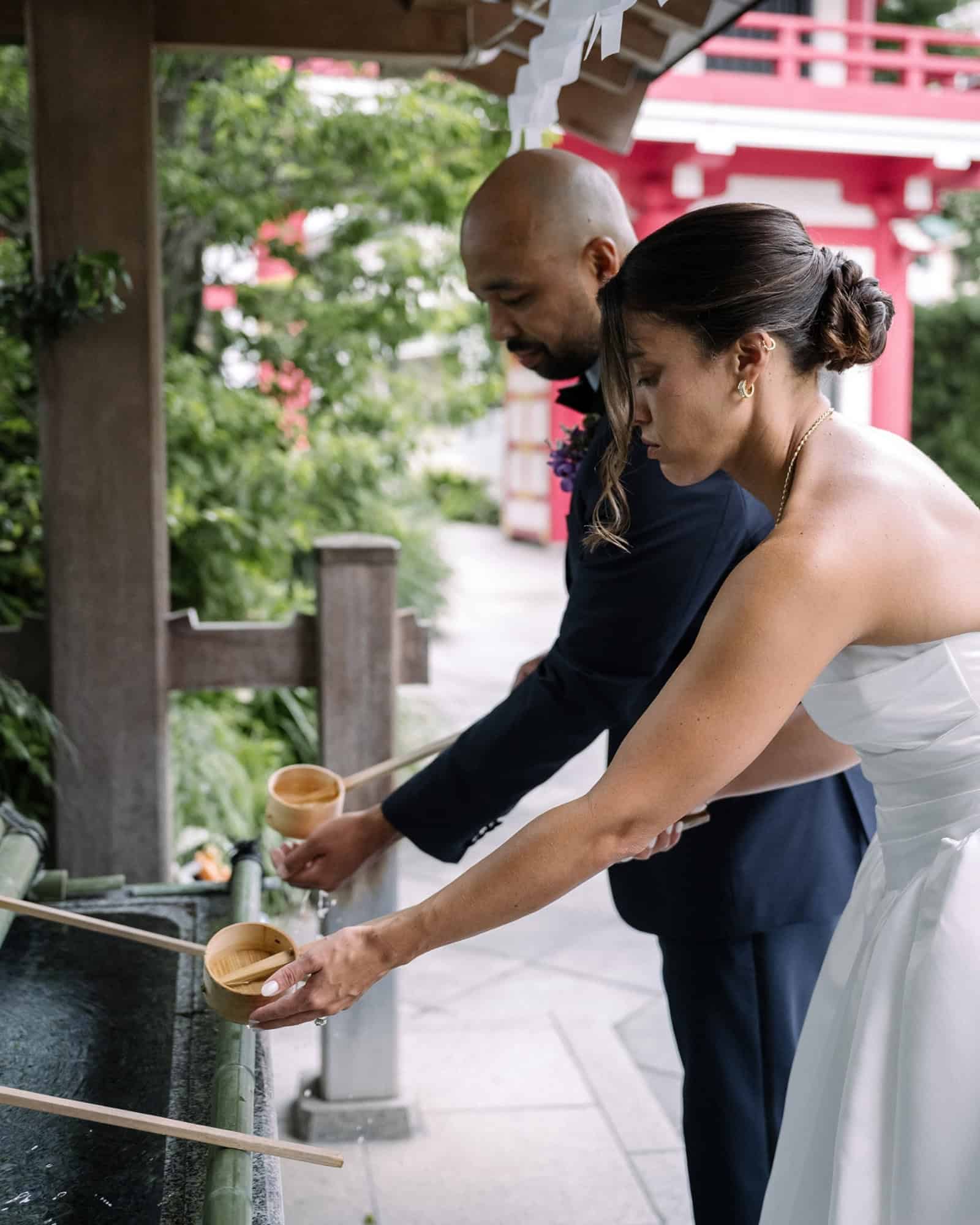
A shrine is Shinto, and you’ll know it by its torii gate; a Buddhist temple is entered through its main gate, the sanmon. Both are places of worship first. Bow once at the torii if you like, and avoid walking through its exact centre. At the water basin, rinse your left hand, your right hand, then your mouth. Keep your voice low, look for signs before photographing inside, and dress as you would for any place of worship at home.
Japanese Wedding Etiquette for Guests
You’ll be shown. At a Buddhist temple wedding at Taiseki-ji, a priest explained the ceremony in English as well as Japanese before it began, down to the red cup in front of each guest and where the prayer beads rest while you drink. Once you know what to do with your hands, you can pay attention to what it means.
Follow the person in front of you, and take part when invited. And put the phone away during the ceremony, so you’re in it rather than watching it through glass.
A shrine blessing is Shinto and a temple wedding Buddhist, but neither makes a marriage legal. In Japan, a marriage becomes legal when it’s registered at a city or ward office, and most of our couples do that part at home, which is why many are married by a friend or family member, in a garden or a hall.
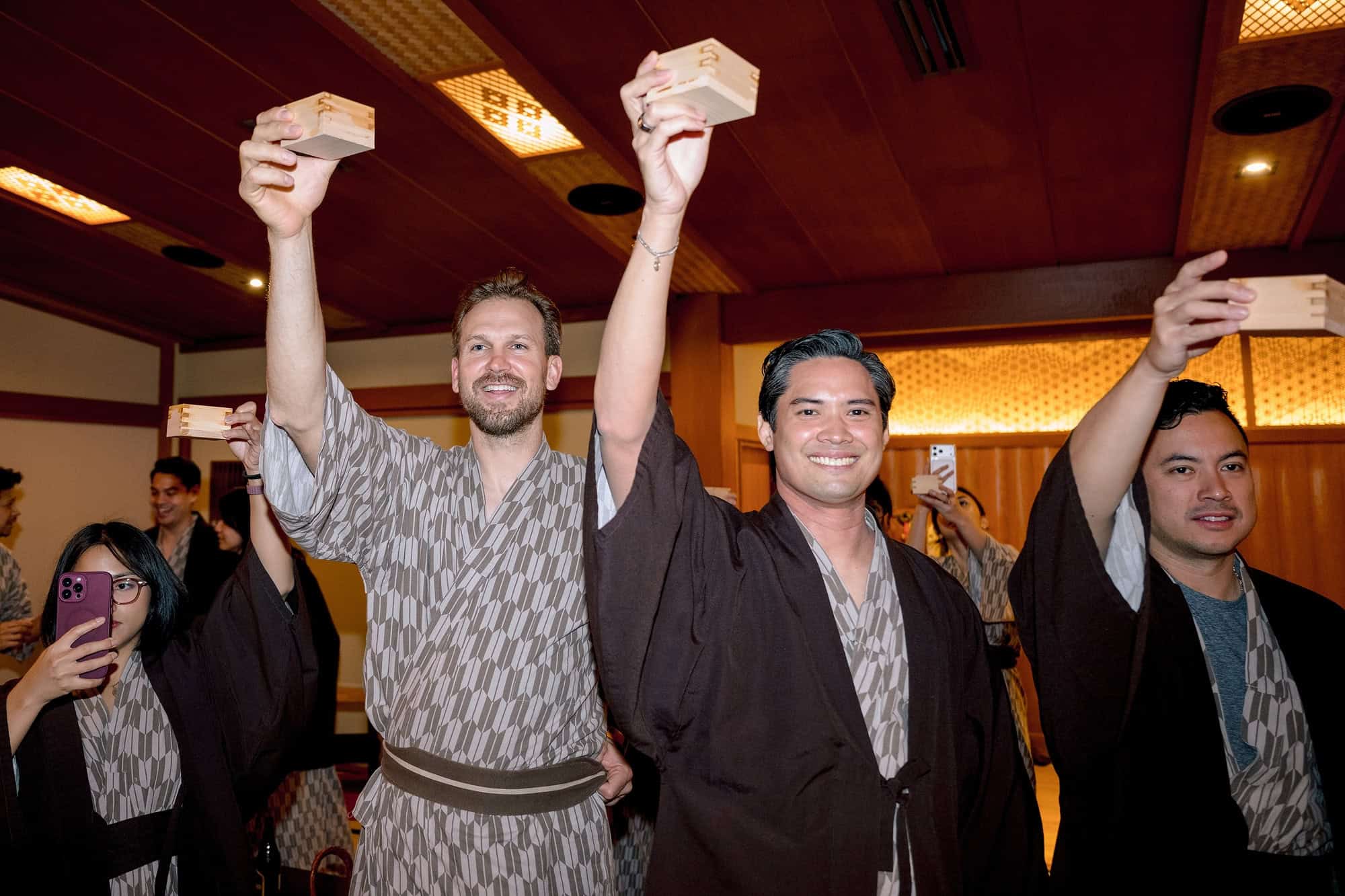
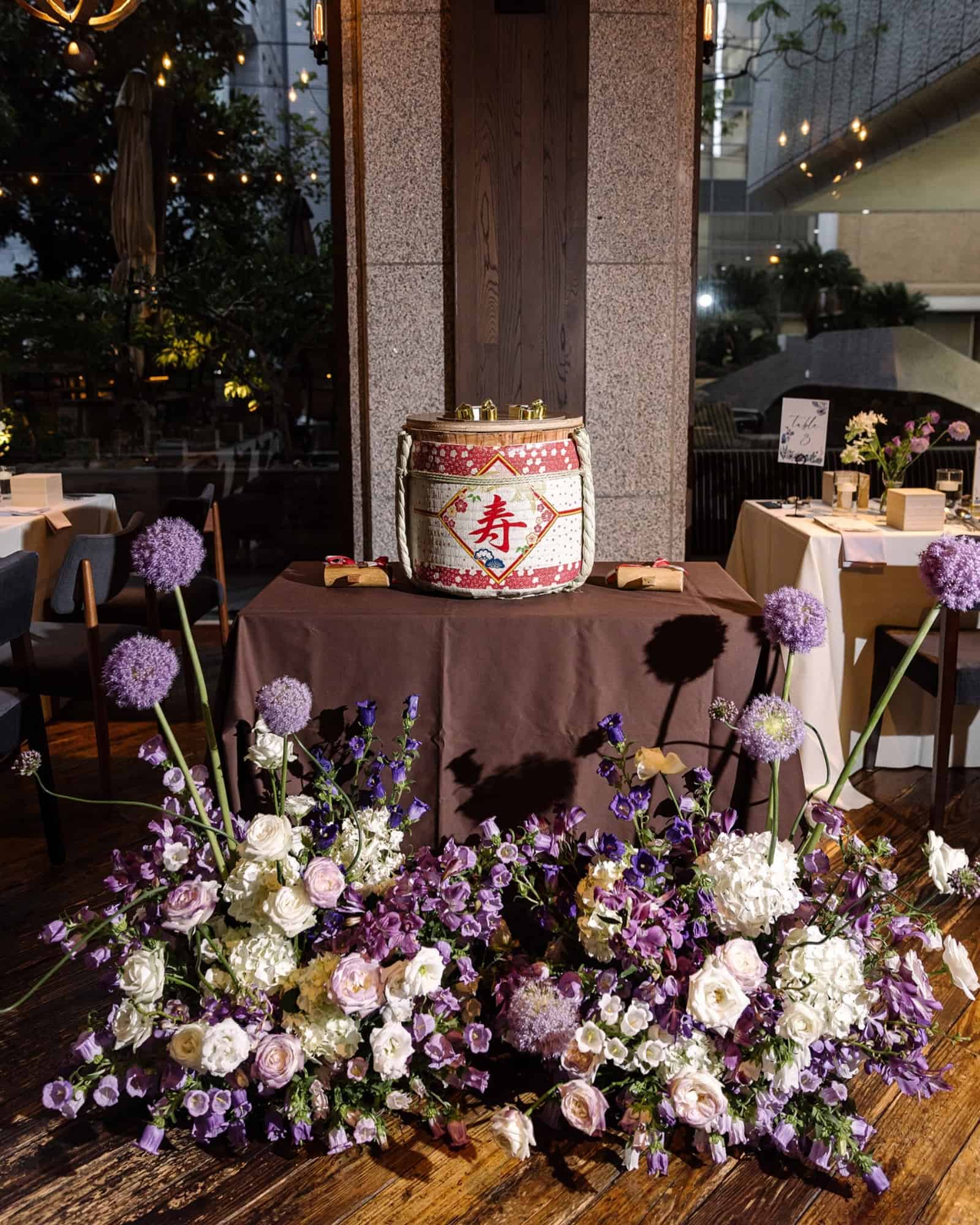
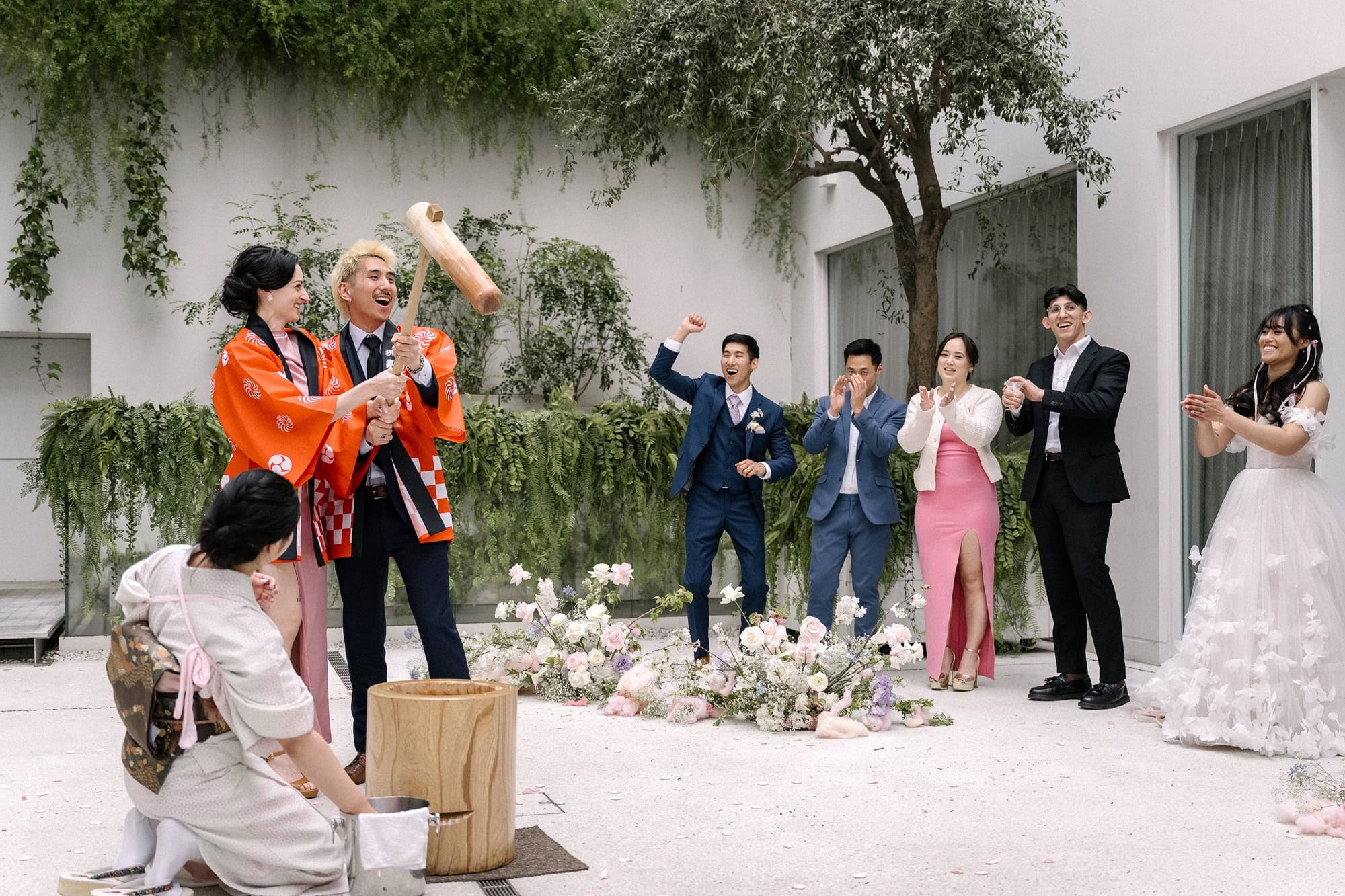
The rituals of celebration belong to everyone. San-san-kudo is three cups and three sips from each, and sometimes the couple invite the room to join in. Kagami biraki is the opening of a sake barrel with wooden mallets, never a breaking, for the same reason speeches avoid certain words (more on that below). Expect to practise a shout of “Yoisho!” first, often three times. Mochitsuki, pounding rice into mochi, takes two people in rhythm, one swinging the mallet and one turning the rice.
The words worth having
Omedetō gozaimasu is congratulations, and you’ll use it all night. Kanpai means, literally, drain the cup, and at a Japanese reception it usually comes before the meal, so wait for it.
Giving a speech? Japanese weddings avoid certain words, among them “leave”, “return” and “cut”. Even the end of the party has a kinder name: ohiraki, an opening. Talk about beginnings and you can’t go wrong.
Goshugi, gifts and the customs couples bring
At a Japanese couple’s wedding, guests are expected to give goshugi, a gift of money in a shūgi-bukuro, a paper envelope tied with mizuhiki cords. For a wedding the cords are tied in a knot that can’t be undone, the one used for things that should happen only once. The colours are those of celebration, red and white or gold and silver. The notes inside should be new. Crisp notes say you prepared for this day, and a new life deserves new money. Banks will exchange them.
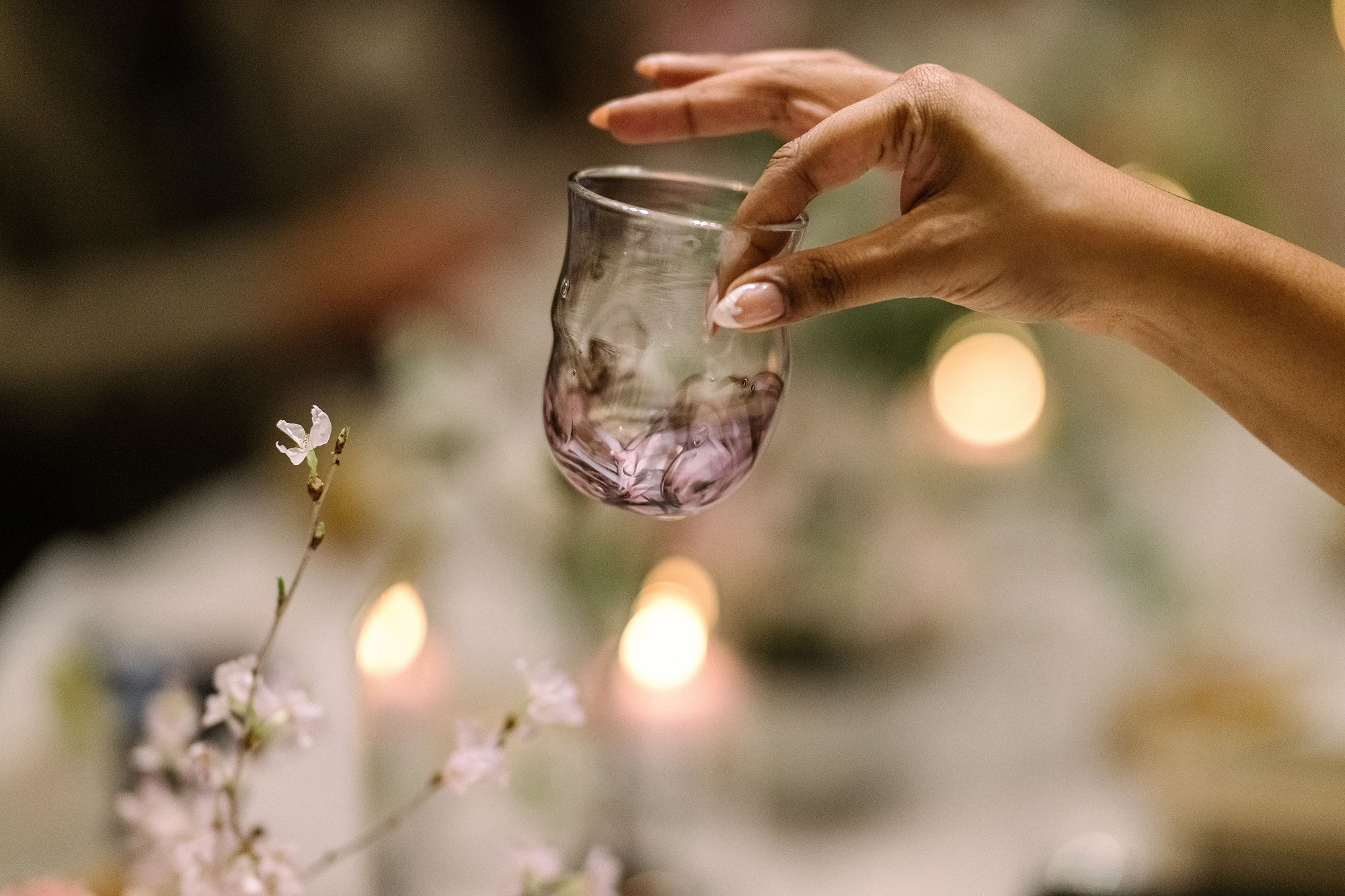
Gifts go the other way too. Hikidemono are the presents hosts give guests to take home. The name goes back to the Heian court, when a horse was led out into the garden as a gift. Our couples make their own versions: personalised chopsticks from Kappabashi, the kitchen-tool street near Asakusa; a glass cup at every place with a guest’s name on it.
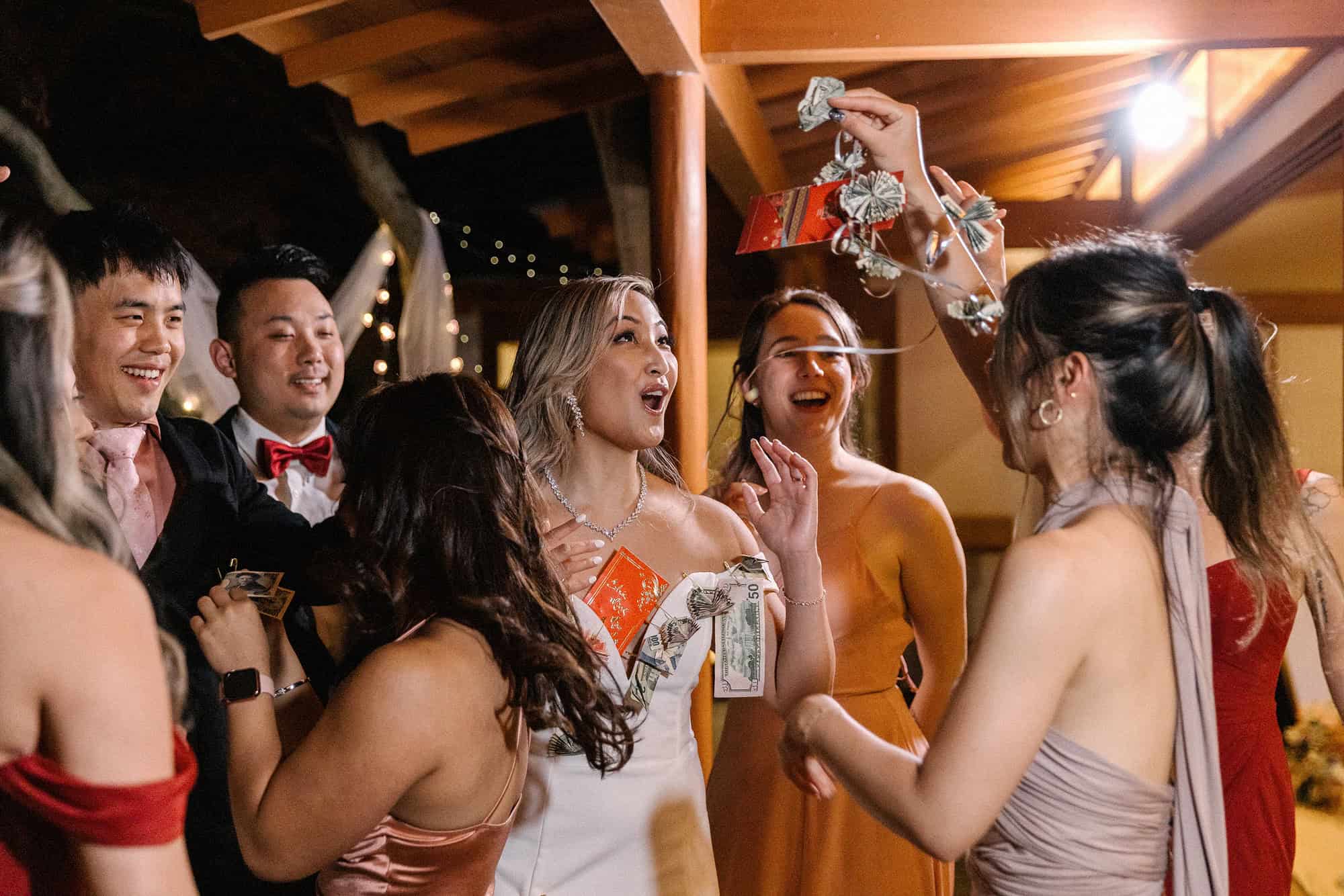
At a destination wedding, follow the couple. International couples bring their own customs: at one wedding, the money dance brought folded dollars, yen and a red envelope onto a wedding dress. If there’s a registry, or a request for no gifts, that’s the answer. Goshugi only comes into it if the couple asks for it or a Japanese family is hosting. We don’t suggest amounts; they depend on family, region and relationship.
Ryokan and Onsen Etiquette
Many of our weddings happen at a ryokan, sometimes with the whole inn given to one celebration. Staff will explain the customs, but here’s what’s worth knowing first.
Yukata. Wrap it left side over right, and keep the collar and hem neat; the other way round is how the dead are dressed, so it matters. Unlike a hotel, a ryokan is happy for you to wander in yukata and slippers, to the bath and often to dinner. When a whole wedding comes to the table in the same plain cotton robe, it stops mattering who knows whom.
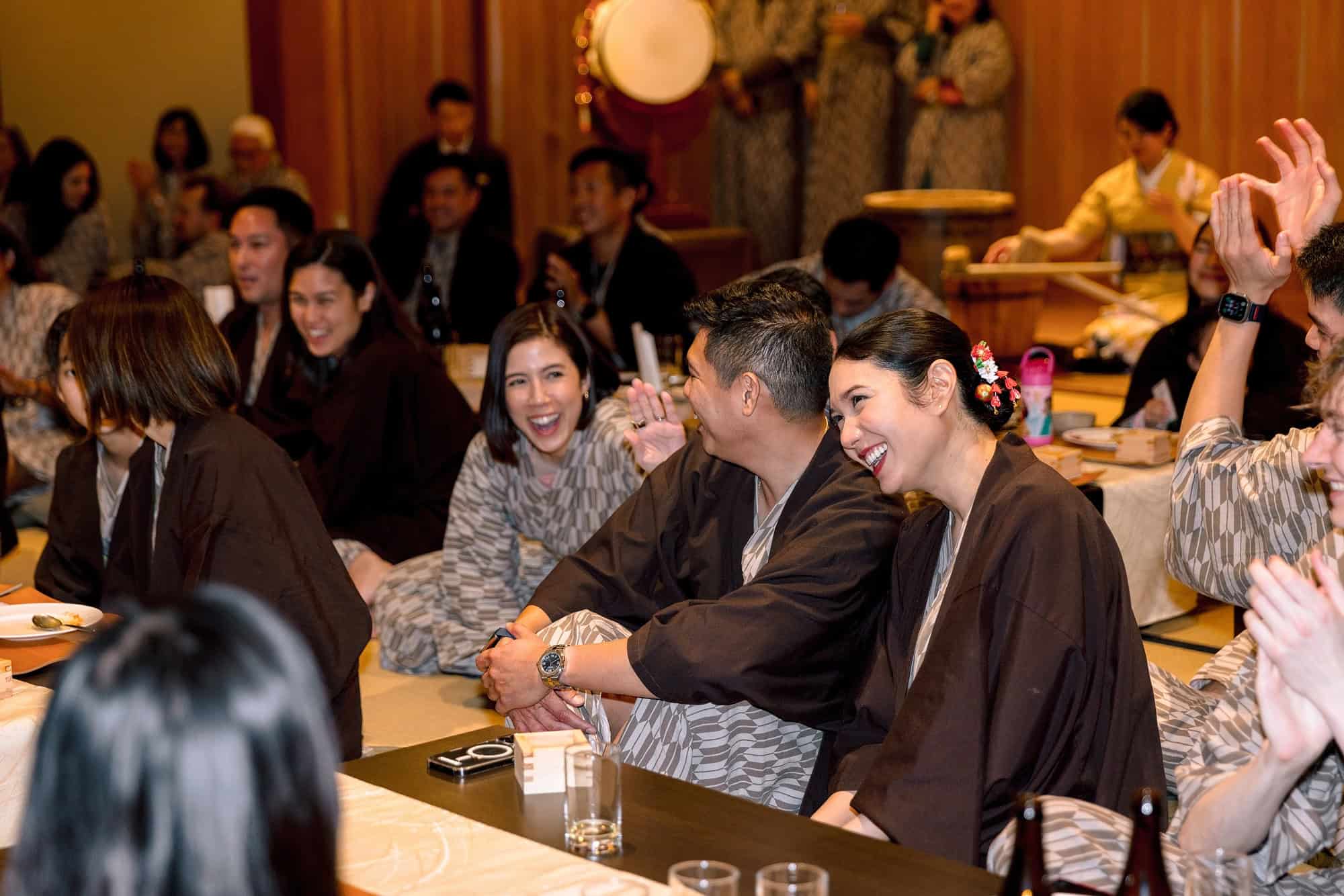
The bath. Wash thoroughly before you get in. Onsen bathing is done without swimwear. The small towel is for washing or covering yourself on the way, never for the water, and long hair should be tied up. Japan’s tourism board also advises against drinking before a bath, so if there’s a sake barrel at dinner, bathe first. Get it right and the bath becomes the calmest hour of the trip. On the morning of a rainy spring wedding at Jinya, the groom began in yukata and in the onsen, rain tapping on the stones around him.
Tattoos. Policies vary from place to place, and they’re changing. Some traditional onsen still turn away anyone with a tattoo; others don’t mind; some accept a small one under a skin-coloured cover patch. Tell the couple or their planner early, so the inn can be asked directly. Many ryokan also have private baths to reserve, or rooms with a bath of their own.
Japanese has a phrase for what happens in that water: hadaka no tsukiai, naked fellowship. Nobody arrives at an onsen as anyone but themselves, which makes it a good place to meet the other side of the family.
Give Yourself Time to See Japan
If we could ask one thing of every guest, it would be this. Add days.
The days around a wedding are the part we’d protect above almost anything. They’re when a guest list stops being a list.
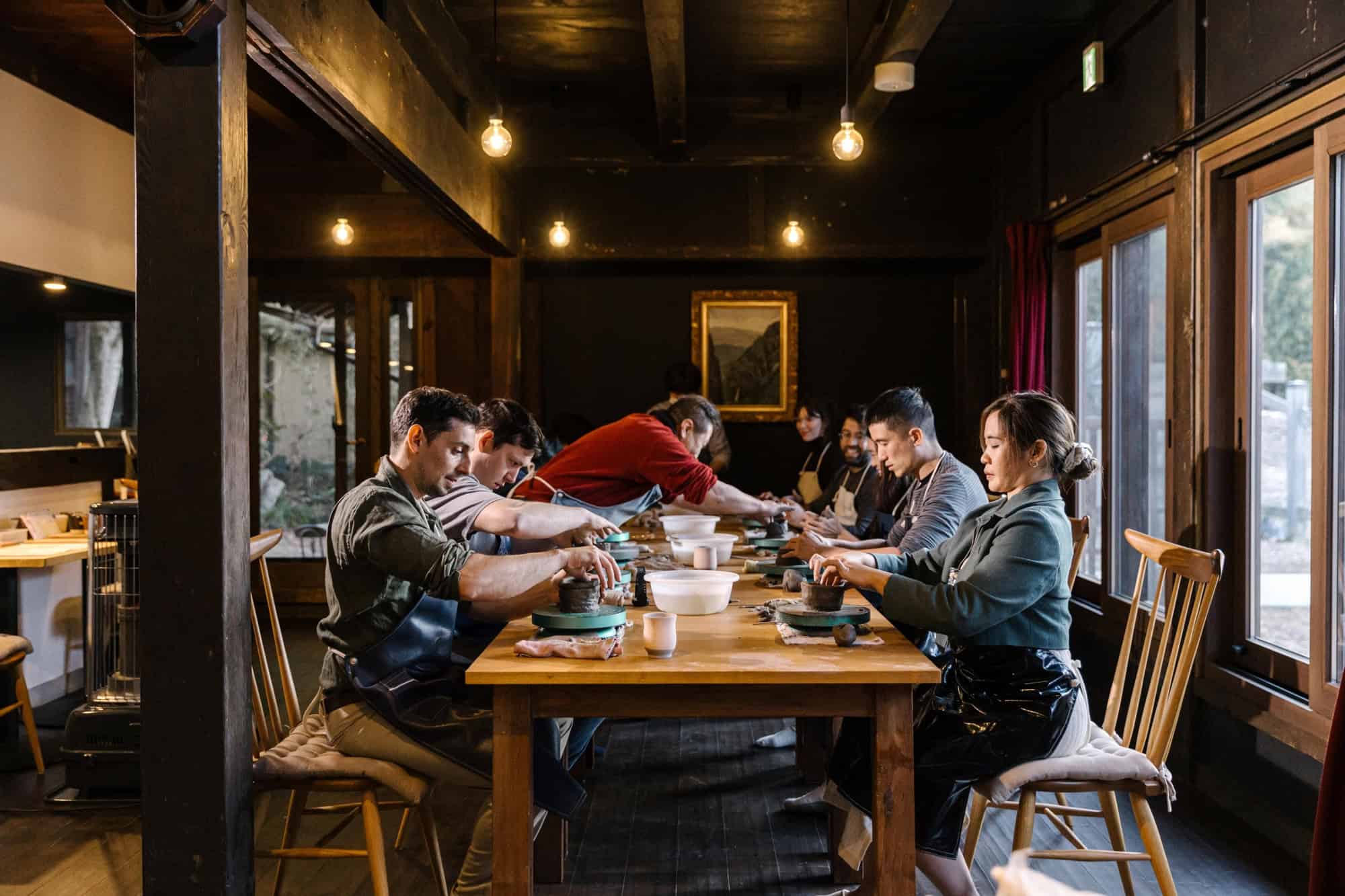
A couple who live in Perth wanted the journey to feel worthwhile for everyone. Their Nagano winter wedding began on the snow at Nozawa Onsen, moved through Matsumoto for soba and the castle’s black keep, and ended with a night under one roof at an old honjin, an inn built for travelling lords, with a pottery lesson and a long dinner. At that dinner, someone thanked the couple “for your vision to bring everyone together”.
For Couples: What to Send Your Guests
Send this guide, then add what only you know: the dress code for each event, how everyone gets to the welcome dinner and home, your wishes on gifts, and whether there’s an onsen.
Guests usually book flights somewhere between twelve and six months out, and our weddings often fall midweek, so settle the dates and the shape of the days early. Our wedding planning timeline for Japan shows when each piece falls into place.
The rest is what a wedding planner in Japan is for. We hold the itinerary, the transport, the rooms, the menus and the quiet explanations in the moment, so the couple can be a guest at their own wedding. It’s the heart of our destination wedding planning in Japan, with our photography and film beside us. It’s the Japanese idea of hospitality we learned living here: care that arrives before the question does.
Attending a Wedding in Japan: Quick Answers
What should I wear to a wedding in Japan?
Follow the couple’s dress code first. At a Japanese couple’s wedding, custom also expects guests to avoid white, which belongs to the bride, and men to wear a white or silver tie rather than black. At a destination wedding, the couple’s code is all you need. Either way, plan for shoes coming off, bring a layer for the evening, and pack for the season you’ll actually be in.
Can you wear black to a Japanese wedding?
Yes, with care. At a Japanese couple’s wedding, a black dress is fine worn with colour or jewellery so it reads as celebration, and men should choose a white or silver tie, because a black tie belongs to funerals in Japan. At a destination wedding, follow the couple’s dress code.
How much money do you give at a Japanese wedding?
At a Japanese couple’s wedding, goshugi is expected, and the amount follows the relationship and the region. There’s no single figure, and we don’t suggest one. At a destination wedding for friends from overseas, follow the couple’s wishes on gifts; goshugi only comes in if they ask for it. If it does, use new notes and a proper envelope tied with a knot that can’t be undone.
Can I use an onsen if I have tattoos?
Often, yes, but ask first. Policies differ from inn to inn and are changing. Some accept a small tattoo under a cover patch, some don’t allow tattoos at all, and many ryokan have private baths you can reserve. Tell the couple or their planner early, so the question reaches the inn before you do.
Do I need to speak Japanese?
No. At the weddings we plan, someone will always explain what’s happening and show you what to do. Two words go a long way: omedetō gozaimasu, congratulations, and kanpai, the toast. Bow if you like, follow the person in front of you, and let the evening do the rest.
Thanks for Showing Up
Nobody drifts into a wedding in Japan on the way home from work. Everyone in the room decided, months before, to be there.
So come early. Stay late. Take your shoes off at the door, wrap your yukata the right way and take your turn with the mallet. The couple will thank you for showing up. We’d add one thing. Make the trip count.