Dance music lives in the present tense. A house track is made to be played loud, in a room, for the people in it, and a good DJ never plays the same set twice. The koto and the shamisen come from the other end of time. One reached Japan as an instrument of the imperial court. The other learned to be loud on the roads of the far north, long before anyone owned a speaker.
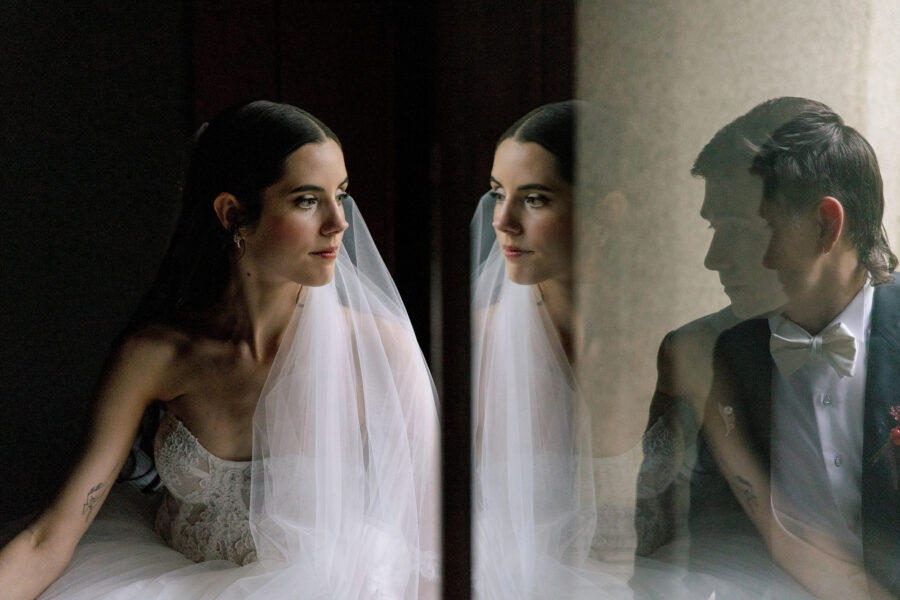
This couple asked those instruments to play their music, across a destination wedding weekend in Japan. They’re from the Bay Area, and they love electronic dance music, house above all. So a tsugaru shamisen worked dance music into her set on a Shibuya rooftop in the rain, and two days later the groom walked into his ceremony at Jinya to Avicii, played on thirteen strings. By their own account at the end of it, the weekend was exactly the experience they had wanted to give everyone.


Two People Who Try Everything
Ask the people who love them what they’re like, and the answers come back as a list of things they’ve tried. The bride’s sister-in-law, who has known her for thirteen years, counted them off in her speech: 75 Hard, ice skating, archery, board games, an app she was building, and, most recently, learning to DJ. She brings everyone along for the ride, her sister-in-law said, and that’s exactly what this weekend did.
The groom’s best friend met him at college orientation seventeen years ago and later shared a house with him in the Bay Area for eight years. He called him the best hype man he knows, a man of unshakable confidence who’s always ready for the next adventure, and he credited the bride with keeping all that confidence on the ground for everyone else. Their life together, as he tells it, is urban hikes, new restaurants, their dogs, game nights and every new hobby going. He and his wife had just moved back to the Bay Area, and couldn’t be happier to be close to them again. That’s the kind of pull these two have.


We loved planning for them because they knew precisely what they wanted their people to feel, and they said it plainly. For the reception they wanted a DJ and, in their words, “that club vibe going for as long as possible!” The do-not-play list was just as clear: nothing too headbang’y. Clarity about a feeling is a gift to a planner. It gave Dee and our team one question to ask of every Japanese element in the weekend: can this speak house music?
Shibuya, in the Rain
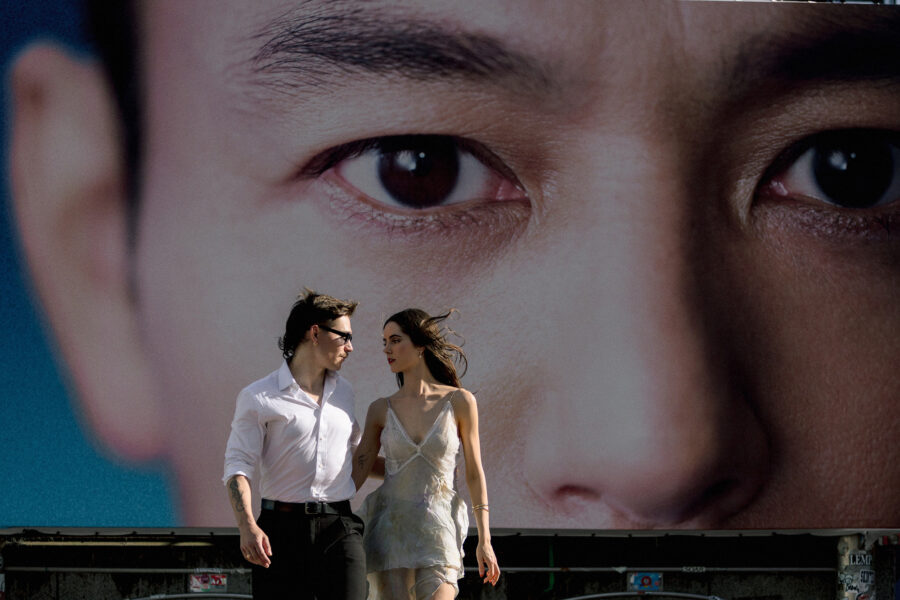
Shibuya has been Tokyo’s music neighbourhood for a long time. Tower Records opened its Shibuya store in Udagawacho in 1981, selling records imported straight from America, and its success helped turn the streets around it into a district of record shops. Hotel Indigo Tokyo Shibuya, a short walk from the Scramble Crossing, opened in 2023 with a selection of vinyl in every guest room, its own homage to that culture. For two people who love house music, it was the natural place to begin.


The plan was the rooftop terrace, with a way indoors if the weather turned. It turned. On the old calendar the weekend fell in kaminari sunawachi koe o hassu, the five days when thunder first raises its voice in spring, and the weather kept to the spirit of it. We’ve never minded rain on a first night. It brings everyone in under one roof, closer than a terrace ever would, and that’s where a weekend starts to belong to all of them. Fifty-nine people came in out of the weather, from friends of seventeen years to the youngest guests, and by the group photograph on the wet rooftop after dark they were one party.

Then the shamisen. Tsugaru shamisen comes from the far north of Honshu, in what is now Aomori, where it’s thought to have been developed in the late nineteenth century by travelling blind musicians who earned their living playing in the street. There were no microphones and no loudspeakers, so they had to be loud enough to stop people walking past, and they struck the strings with the plectrum as if beating a drum. The style that grew from it is fast, percussive and built on improvisation. Its classic pieces have been handed down without sheet music, and they change a little almost every time they’re played.


That’s a fair description of a good DJ set. We asked the player to work electronic music into her two sets, and she did, on an instrument whose whole history is about holding a crowd with nothing but rhythm and nerve. Music played that way happens once, for the people in front of it, which is about as close as music gets to ichi-go ichi-e.


Thirteen Strings at Jinya
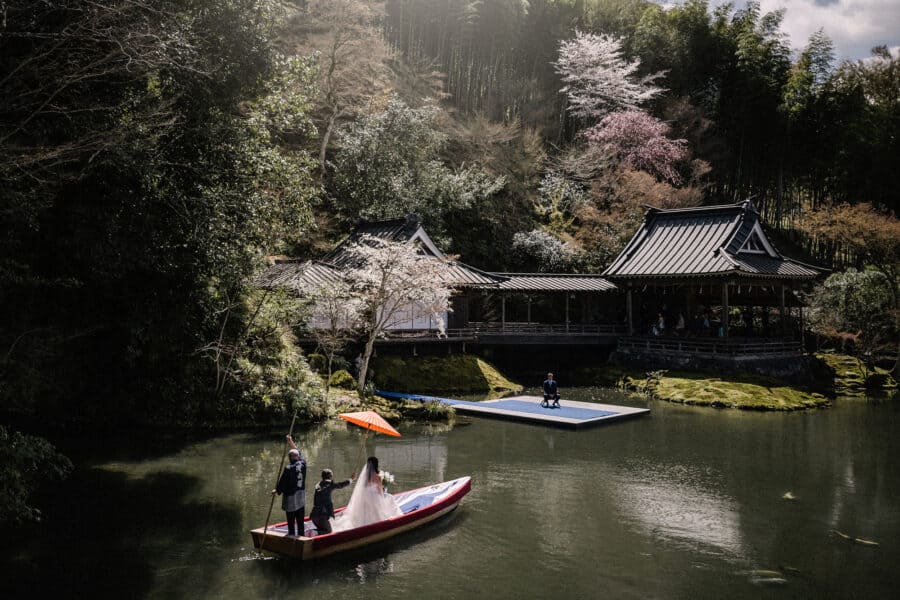
Two days later the weekend moved to Tsurumaki Onsen, in Hadano, at Jinya, and the ryokan was theirs alone for the day. A buyout changes a wedding morning more than people expect. There are no strangers in the corridors, so every room, veranda and stretch of garden can be set for one story, and two people getting ready in separate rooms of the same house can take their time, knowing the only people they’ll meet are their own.


The koto is thought to have come to Japan from China in the Nara period, as an instrument of gagaku, the court music of ceremony. Much of what we now hear as koto music was shaped in the seventeenth century by Yatsuhashi Kengyō, who lived from 1614 to 1685. Kengyō was a rank rather than a name, the highest in the guild of blind musicians. He devised hirajōshi, the tuning still at the heart of koto music, and he began writing pieces for the koto alone, with no voice at all.


The groom walked in to a piece for koto alone, though not one Yatsuhashi would have known: Avicii’s “Fade Into Darkness”. The couple chose it because, as they put it, it was “perfect for Koto sound”, and they were right. A song made for festival main stages arrived at a ceremony on an instrument that first came to Japan to play for ceremonies, and it sounded as if it had always belonged there. A good melody survives translation. So, it turns out, does a drop.


Her father walked her in, and her brother married them. A ceremony led by someone who has known you all your life needs no introductions, and every word in it carries the years behind it.


This is what we believe about Japanese elements at a wedding. A koto at a ceremony can be decoration, a pleasant sound that tells the guests which country they’re in. Or it can be translation: the couple’s own music carried into one of the country’s oldest voices, so what plays is unmistakably them and unmistakably here. The second kind takes more planning, more conversations with the musician and more trust from the couple. It’s the only kind we think is worth doing.
Why a Weekend
Sixty-six guests sat down to dinner at Jinya, and most of them had sheltered from the Shibuya rain together two nights before. That’s what a destination wedding weekend in Japan gives that a single day can’t. By the time the guests were gathered on the ryokan’s balcony for the group photograph, the college friends, the families and the plus-ones had stopped being separate tables. They’d shared a city and a downpour, and the wedding was something they were making together.


The sister-in-law put it best. The past few days, she said, were only a sliver of the people these two draw to them. Early April gave the afternoon the blossom, and the garden gave everyone room to wander, but it was the people who filled it. A weekend lets a wedding be lived rather than attended. Nobody has to fly home the morning after, so nobody spends the day watching the clock.


A First Dance That Became the DJ’s Set
The small things carried the same thinking. Every guest found a glass cup at their place with their own name on it, and a capsule toy machine stood waiting for anyone curious enough to turn the handle, with a chopstick rest or a snack inside each capsule. Gacha machines line station corridors and shopping streets all over Japan, and grown adults stop at them without a trace of embarrassment. At a wedding, one hands every guest a little of everyday Japan to take home, along with a reason to laugh at someone else’s luck.
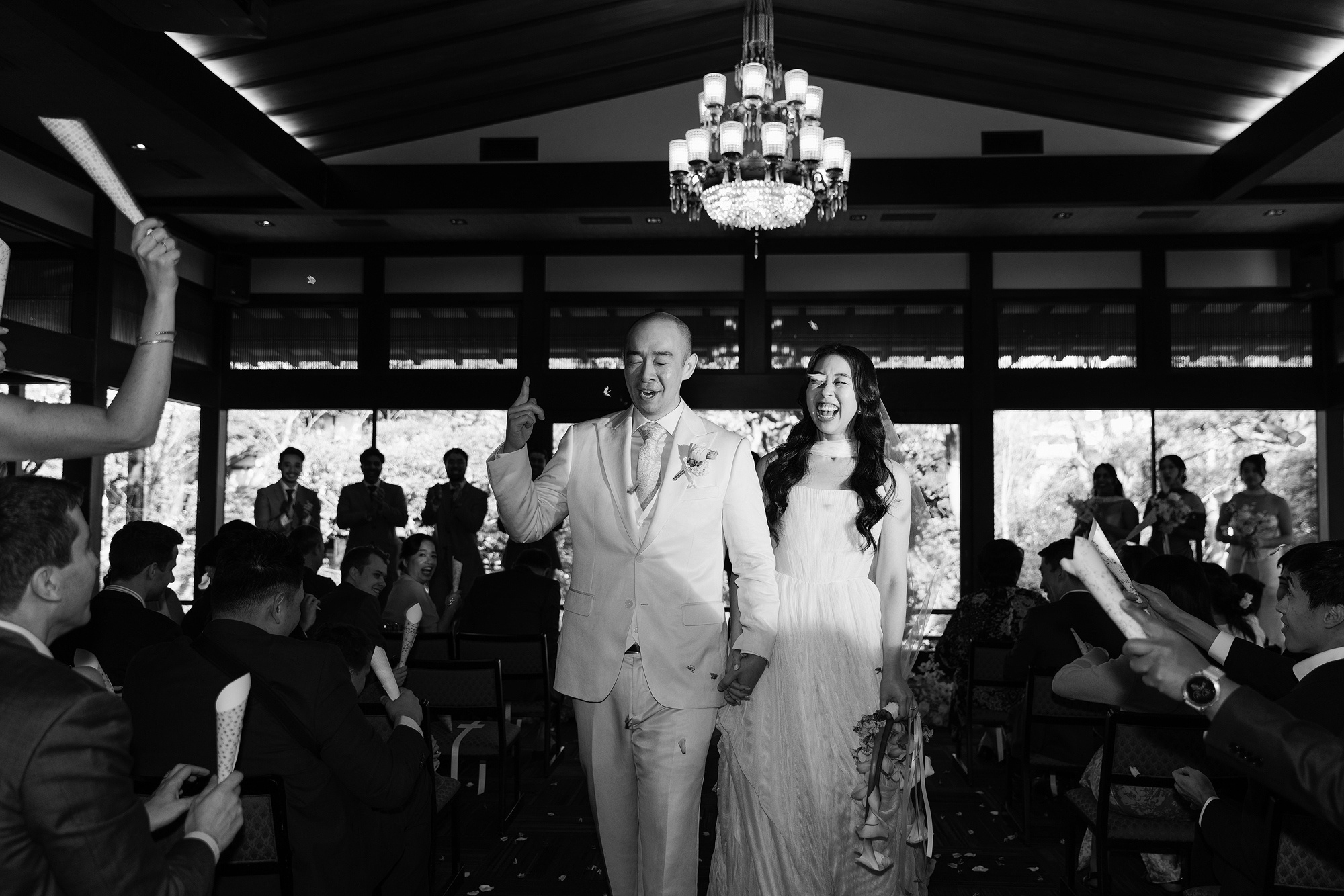
Japan’s celebrations also tend to hand everyone a job. The couple opened a sake barrel together with wooden mallets, and then the room took turns at the mortar for mochitsuki, pair after pair in happi coats. Pounding mochi takes two people in rhythm, one swinging the mallet and one turning the rice between strokes. For a room full of house music fans it made the perfect warm-up: it’s a beat, kept by hand, and it falls apart the moment anyone loses the count.


During the evening, one of them took the microphone and thanked everyone from the bottom of their hearts. This, they said, was literally the experience they had been trying to create by bringing everyone to Japan, and they hoped no one had a single regret about coming. Then they announced the after-party, and the floor answered.

They’d told the DJ what they wanted: dance music, transitions that never let the floor go slack, and the energy kept high. Their first dance turned into his set, which may be the most honest first dance two house music lovers could have. It didn’t end. It mixed into the next track, and the bride, who’d been learning to DJ herself, spent the rest of the night on the other side of the decks with everyone she loves.


Played Once, for the People in the Room
Music is the one art that only exists while it’s being played, and a wedding is much the same. Our photography and film keep what we can of it: the rooftop in the rain, the strings, the floor at its fullest. What this couple proved is that Japan’s oldest voices still have room for a new song, if someone takes the trouble to bring one. They brought theirs, and everyone they love came to hear it played.