Before he could pronounce them married, their friend explained, there was one more sacred ceremony to complete. It was the raffle. By this point in their June wedding in Japan, the garden at Jinya had already heard promises, watched the sharing of sake, and spent a considerable amount of time laughing. Two tickets were drawn. Matrimony could proceed.
The officiant wore a pink suit and knew the bride well enough to understand exactly how to hold this room, even though the room was a wooden deck beneath the trees. His opening had set the tone: “Dearly beloved, I suppose you’re all wondering why we’ve asked you to be here today.”
We have spent much of our lives watching people make serious promises. One of the things we have learned is how much laughter can belong inside that seriousness. It tells you something about the relationship, the friendships around it, and the life the couple intends to continue living together.
This wedding had a very clear sense of itself. By the end of the night, that sense would have travelled from a century-old garden inn to a Tokyo arcade, with the whole gathering coming along.
A June Wedding in Japan, in All That Green
Jinya is a ryokan in Hadano, Kanagawa, with the Tanzawa mountains behind it and gardens that have been welcoming guests for more than a hundred years. Early summer gives the place a particular fullness. Bamboo and maple leaves gather around the paths, koi move through the pond, and a red paper umbrella holds its colour against the raked gravel and green.

At dawn, a sea of cloud lay among the nearby forested hills. Later, the light stayed soft and overcast, bringing out the depth of the garden. The ceremony and the walk out afterwards remained dry.

That year’s rainy season was already underway, according to the Japan Meteorological Agency’s confirmed records. A season describes a broader pattern, while an individual day arrives with its own conditions. Here, June brought cloud, saturated green and a gentle light beneath the trees.
For a June wedding in Japan, we think about the whole experience a place can offer: gardens and sheltered rooms, the atmosphere of the season, the way people can move comfortably between spaces. We know Jinya in rain as well, and its character holds beautifully across those changes.
The garden has enough substance to reward attention in many kinds of weather. You notice the reflections in the glass corridor, the movement of fish under the pond’s surface, the way bamboo filters a pale sky. The place continues to offer something when you let your eye settle into the day it is actually having.
A Very Particular Kind of Elegance
In a tatami hall, the groom and his groomsmen dressed beneath a large lattice lamp, helping with cufflinks and laughing together. Black tuxedos, red bow ties, later sunglasses: the clothes were formal, the company thoroughly at ease.


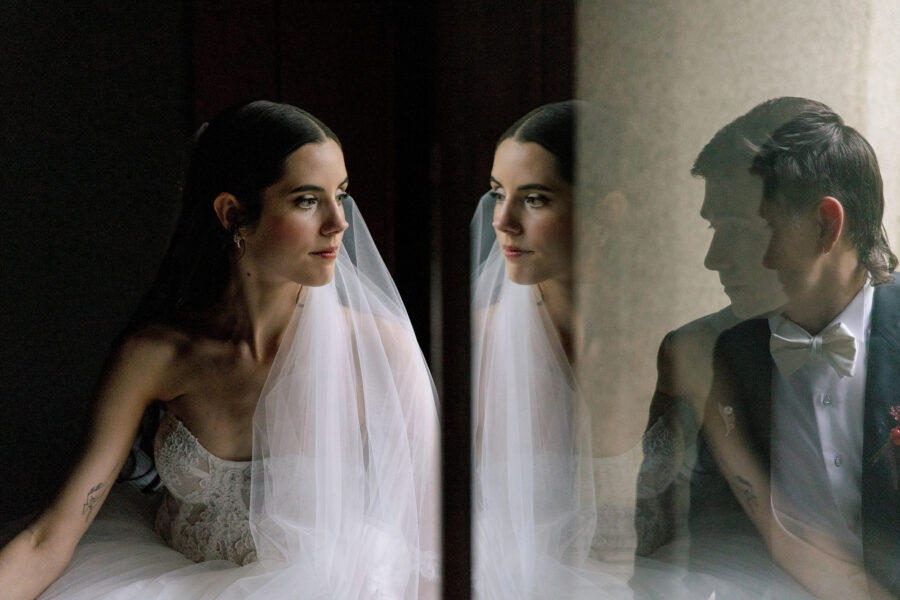
Elsewhere, rings and the ryokan’s round window made small, quiet images within the preparations. The bride wore a fitted ivory gown with a beaded neckline and a long veil. Her bouquet was made from long-stemmed white calla lilies, tied with orange velvet ribbon, an elegant shape against the green of the garden.


The long stems mattered to her. It is a detail we like because so much of making a wedding feel personal lives at precisely that scale: knowing which part of a flower arrangement someone has imagined holding, and remembering it when the flowers arrive.


Her portraits moved through the bamboo, the deeper green of the garden and the glass-walled corridor. Orange kept returning in ribbons, flowers and, later, the couple’s happi coats. It gave the celebration a thread of warmth that would feel entirely at home when the evening reached the neon.


On the veranda, a koto player made music before the ceremony. Beneath the trees, white paper fans and cranes sat among orange flowers and white roses, the garden deck ready for the guests. Careful design had given the place a shape for this particular gathering, while leaving room for its personality to arrive.

Sake, Promises and the Holy Trinity
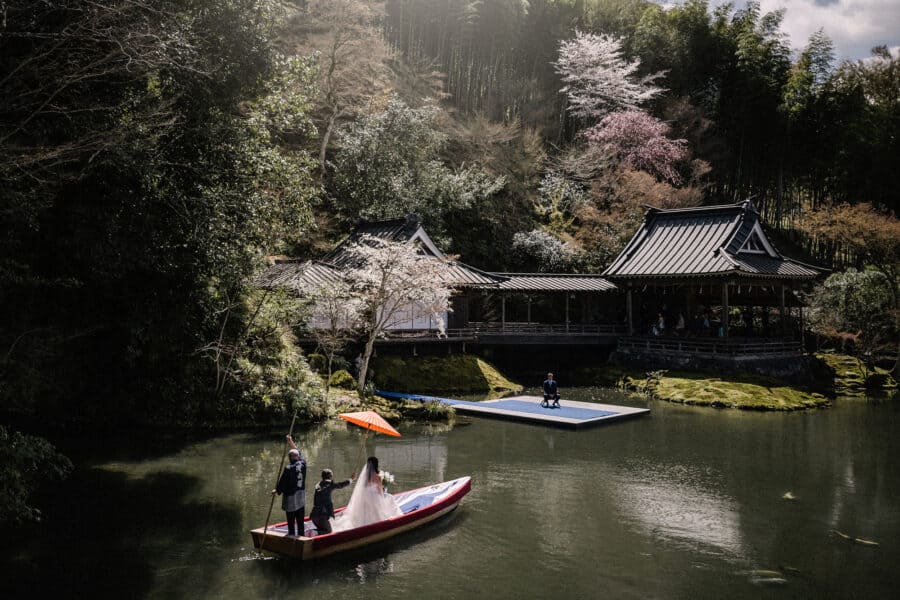
The guests had been asked to put their phones away and enjoy the ceremony. The bride came along the garden path, and her close friend in the pink suit welcomed everyone with a confidence that comes from knowing the people in front of you.

He returned throughout the ceremony to the fact that these two were “completely, utterly and fantastically in love.” Around that conviction, he allowed himself a considerable amount of creative freedom.
The first sacred moment was san-san-kudo. Sake was poured into three red lacquer cups, and the couple shared the ritual before making their vows and exchanging rings. The familiar concentration of a wedding ceremony settled over the gathering: people listening, watching, allowing the significance of the occasion to reach them.
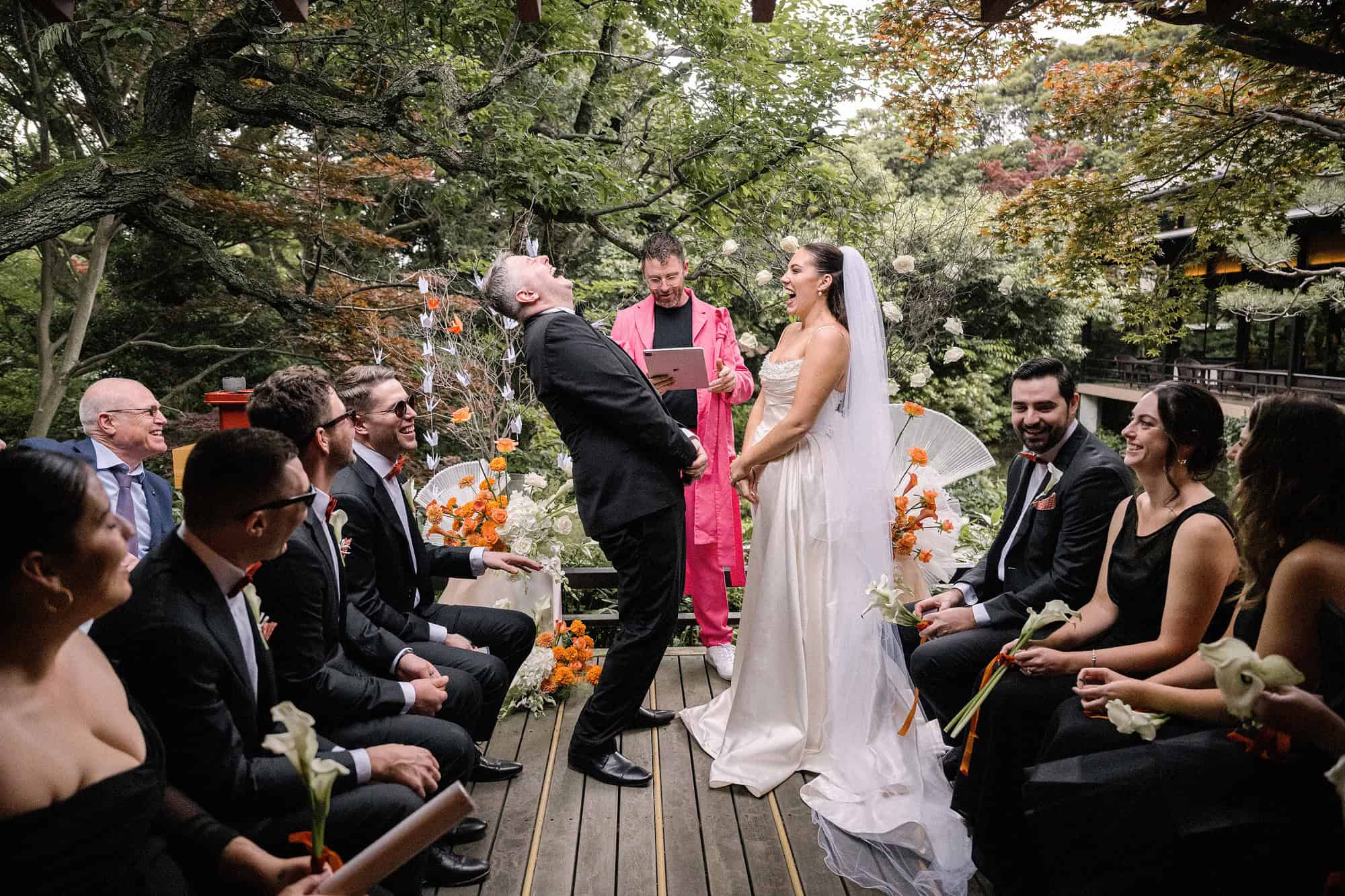
Then came the raffle. Two winners were selected from the guests, with further instructions concerning their prizes apparently still to follow. The photographs show the couple doubled over, the bride’s head thrown back, the garden fully involved in the joke.

And then the pronouncement:
“By the powers vested in me and in the name of the Holy Trinity, Madonna, Kylie and Dannii Minogue, I now pronounce you husband and wife and you can kiss the bride.”
The kiss arrived to a gathering that understood exactly whom it was celebrating. The humour worked because it belonged to the people, spoken by someone who knew how to use it with affection. The sake, the promises and the irreverence could all occupy the same ceremony because the couple’s relationship held them together.

We love being close enough to recognise that. A wedding gives people the opportunity to say, in public, something about how they intend to be in the world together. Here, tenderness and mischief were clearly going to remain in regular contact.
Joy Is Allowed to Spread
Bubbles filled the walk out through the garden. They rose around the couple and drifted between the guests, catching small points of light. One of those photographs has since found its way into our essay on celebrating existence, where its delight needs very little explanation.

Afterwards, the groom wore the bride’s veil for a while. Later they were beneath it together, then beside the koi pond. These small exchanges give a portrait session its own life, letting the couple’s humour remain visible within a setting of considerable beauty.


Inside, a long table waited under a great lattice lantern, orange flowers and tall branches continuing the garden’s colour through the room. For kagami biraki, the couple took wooden mallets to the sake barrel, and the phones that had rested during the vows returned with enthusiasm. Sake barrels, it seemed, were fair game.

There were toasts, hugs and tables full of laughter. Later, wearing orange happi coats, the couple took part in mochi pounding with taiko drummers beside them. The rhythm filled the wooden hall, giving everybody another way to enter the celebration.


We are always interested in the moment a carefully planned wedding becomes something its guests are making together. People begin to respond freely to one another. A joke travels, a rhythm catches, somebody’s laughter sets off the person beside them. The preparation allows that ease, and the gathering supplies its own energy.
By the time the bus left for Tokyo, there was plenty of it to bring along.
The Wedding Party at FamilyMart
On the journey to Shinjuku, the bus stopped at FamilyMart. Everybody got out, still in their wedding clothes, and the whole gathering assembled in the car park. The bride emerged from the shop with the officiant in his pink suit.

We are very fond of that photograph. A wedding party carries a kind of temporary permission to appear together in improbable places. Put formal clothes, flowers and people who have just witnessed a marriage outside a convenience store, and the ordinary location acquires an entirely different significance for everyone in the picture.
This is part of travelling with a celebration. Japan is there in the garden and the music, and it is also there in the familiar green and blue sign on a road stop. The day becomes personal through all of it, including the places nobody would have chosen as the official wedding venue.
The group photograph is full of the pleasure of continuing together. The ceremony was over, dinner had happened, and there was still a whole Tokyo night ahead. Nobody needed to decide whether to join the after-party. They were already on the bus.

Kabukicho Has Always Had an Imagination
Kabukicho was named in 1948 for a kabuki theatre planned as part of the district’s redevelopment. The theatre was never built, but the name remained. Over the following decades, entertainment gave the area the identity that the original plan had imagined for it in another form.
There is an older streak of invention in the word too. Kabuki emerged in early seventeenth-century Kyoto, with performances that borrowed from the unusual dress and movements of the kabukimono. The Japan Arts Council’s account of its beginnings describes a form that caught attention through character, costume and an appetite for the unexpected.
We would be stretching things to call a wedding raffle a contribution to theatre history. Still, this particular gathering was well prepared to appreciate a district with imagination in its name.
Their destination was Tokyu Kabukicho Tower, which opened in 2023, bringing hotels, performance spaces, dining and entertainment into one tall building. After the garden’s horizontal paths and low rooms, the city now extended beneath them from the terrace at JAM17.

At dusk, the bride was still in her gown as the lights of Shinjuku came on below. Later, leaf shadows crossed the portraits in the dark. There was a lovely continuity in that small return of foliage, even high above the streets.

The Evening Acquires a Jumpsuit
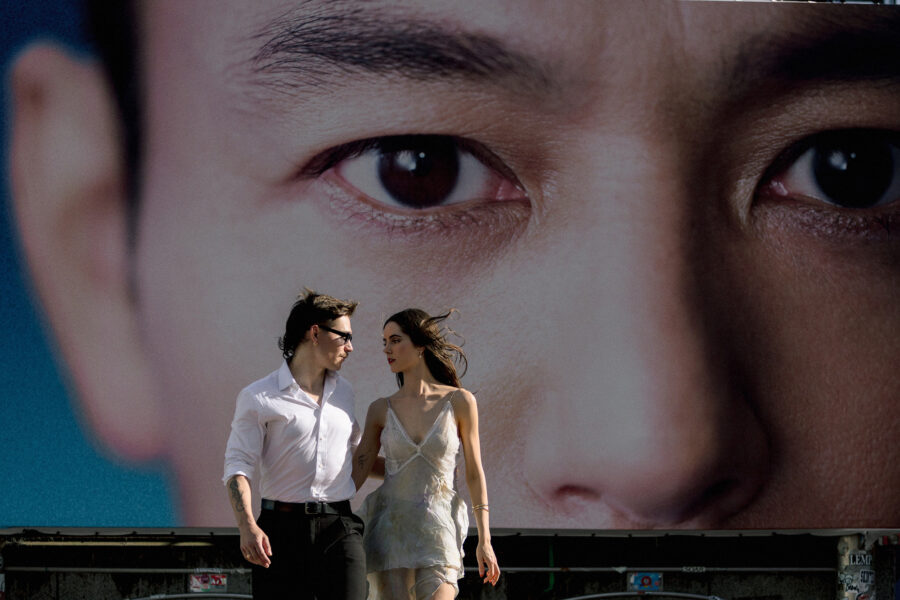
For Shinjuku Kabuki Hall, she changed into a white jumpsuit. He wore his orange happi coat over his tuxedo. Neon, red lanterns and a vast geisha mural gathered around them, the tower’s festival-inspired food hall offering a thoroughly different setting for the same celebration.

We love Shinjuku at night for the way people can occupy its light. Colour comes from several directions at once; a small turn changes what falls across a face. The couple could bring their own pace into a space already full of movement, and the photographs held both.

At namco TOKYO, friends joined them for kart racing, air hockey, claw machines and VR. There was a taiko drum game too, giving the day its second encounter with drumming, under rather different circumstances. On an LED stage, the couple danced in sunglasses.

Through the glass, Godzilla’s head watched from the neighbouring Shinjuku Toho Building. After the day this gathering had already had, his presence felt entirely appropriate.

The whole Tokyo after-party took place within the tower, but its atmosphere kept changing: open air above the city, lanterns and neon, the concentrated competitiveness of friends playing games together. A wedding can reveal a great deal about people once you let them race each other in formalwear.


The Garden and the Neon, Together
Their highlight film returns them to the softness of Jinya’s garden and the bright energy of the Tokyo night. The moving veil, bubbles in the air, the gathering around the table and the pleasure of playing together all belong to the same celebration. It holds the range of the day through movement, expression and place.
Dee and our planning team arranged the whole experience, including the journey and the evening in Tokyo, while we photographed and filmed it. The practical care behind a day like this creates freedom for the people inside it: freedom to enjoy the change of setting, stay with their friends and keep following the feeling of the celebration.
That is what we remember most about this June wedding in Japan. It allowed the couple’s full personalities to remain present, from the ceremony to the last games of the night. The elegance, affection, humour and appetite for a very good time all had somewhere to go.
Over years of doing this work, we have come to value that fullness more and more. People entrust us with occasions that will become part of how they remember their lives. We want the photographs to preserve enough of their humanity that they can return and recognise themselves: moved by a promise, laughing at a friend, slightly competitive over an arcade game, still reaching for the same person’s hand.
A wedding can hold all of that. This one did, generously. And somewhere between the sake cups, the sacred raffle and the neon, two people began their marriage surrounded by friends who knew exactly how to celebrate them.