A Small Wedding in Japan at Jinya, as the Cherry Blossom Opened

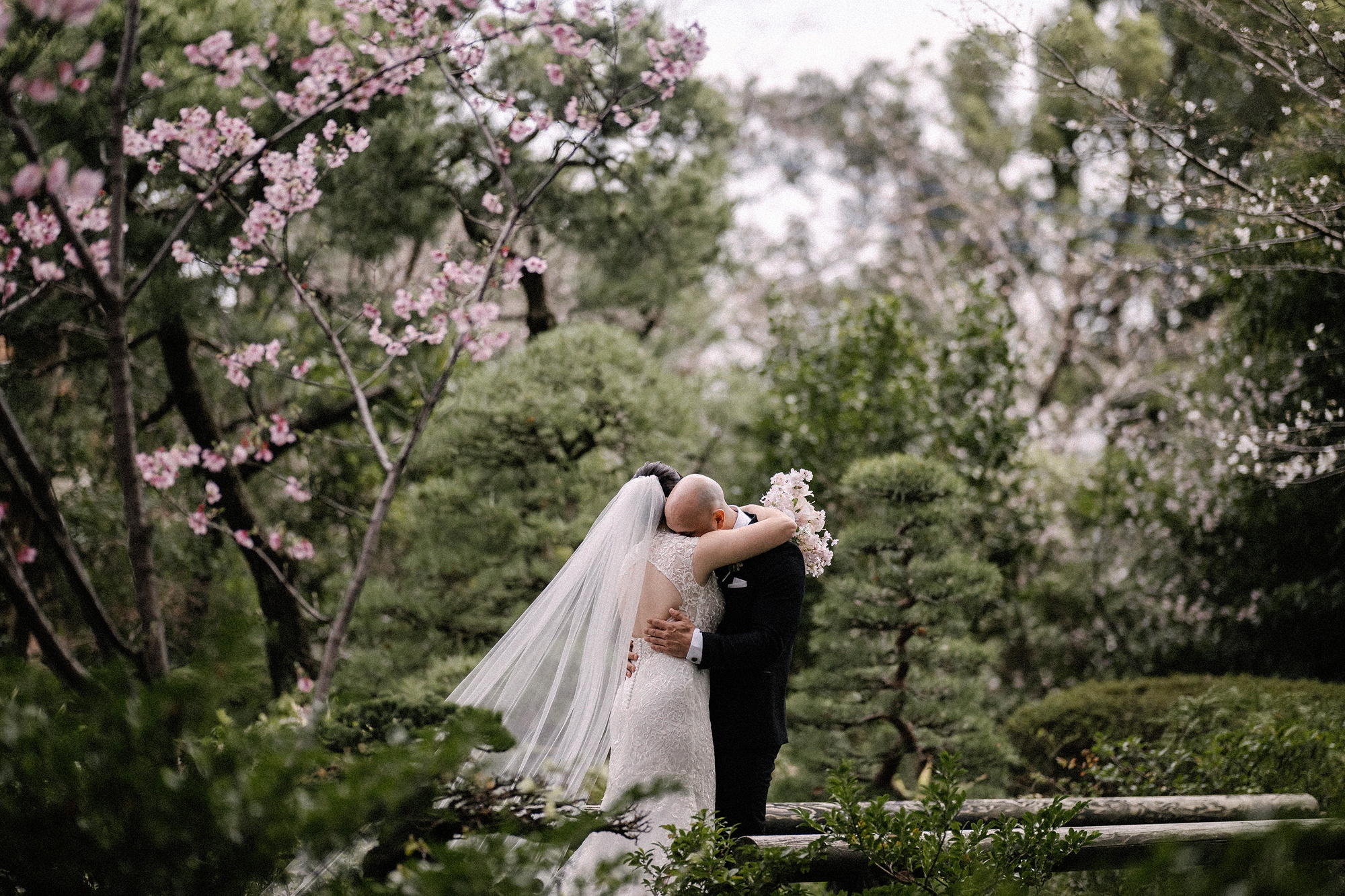
The bride and groom embrace in the garden after the first look, cherry blossom and pine around them at their spring wedding in Japan.

The old Japanese calendar divides the year into seventy-two seasons of about five days each, and gives every one a name. The season that covers the last days of March is sakura hajimete hiraku: the cherries begin to open. It isn’t named for the full bloom that people cross the world to see. It’s named for the start, when a few trees have committed and the rest are still holding back.

This couple’s small wedding in Japan fell inside those five days, at Jinya, the ryokan in Tsurumaki Onsen at the foot of the Tanzawa mountains, an hour or so from Tokyo. The early trees in the garden were in flower, the light was soft under cloud, and a strong spring wind ran through all of it. It was an intimate wedding in the truest sense: one long table, and around it the people who’d shaped their lives, from her grandmother to a baby of six months.

The bride holds a pale pink bouquet beneath cherry blossom as the wind carries her veil, in the garden of Jinya Ryokan in Kanagawa.
The groom kisses the bride's forehead under a pink cherry tree beside a dark timber hall, at their intimate spring wedding in Japan.

They live in New Zealand, and they first wrote to us more than a year before the wedding. Within two months the ground was chosen. Jinya, the bride wrote, was “just gorgeous.” The people they brought to its garden were the ones closest to them: her parents, her grandmother and her brother, an aunt and uncle with the cousins, his mother and his sister, and the two friends who stood beside them. The day before the wedding, Dee wrote to our team that it would be a small and happy team, and that the couple were wonderful. She was right on both counts, and it’s still how we talk about them.

Ground Chosen for Hot Water and Bamboo

Jinya means a camp, a garrison house, and the inn takes its name from the ground it stands on. In the Kamakura period this was the encampment of Wada Yoshimori, one of Minamoto no Yoritomo’s closest retainers and head of the shogunate’s samurai office, a post the inn’s own history compares to a modern police commissioner. That history also suggests why he chose this spot: hot springs welled up here, and arrow bamboo, the kind cut for shafts, grew in abundance.

Seven centuries later, in 1918, the Mitsui family built a villa on the site to receive the guests who mattered most to them. The camp became a house for welcome, and it has stayed one for more than a hundred years. One of its rooms, Matsukaze, was built in the Meiji era to receive the Emperor Meiji at the Kuroda family’s villa in Ōiso, then moved here, and Japan’s shogi and go masters have played title matches in it for decades since. Every guest still arrives along the same shaded walk to the door. The garden runs to ten thousand tsubo, about three hectares, and the water still rises from deep in the Tanzawa range, with calcium levels the inn counts among the highest in the world.

Bamboo still grows thick in that garden. Deep in it stands an old camphor with a very small sign. The family who own the inn are relatives of Hayao Miyazaki, who stayed at Jinya as a boy after the war and played in this garden with his cousins, back when the tree was small enough to climb. Today it’s known, quietly, as the Totoro tree. We like knowing the ground was first chosen for what it could hold: water, cover, the people inside the line. An intimate wedding starts with the same decision. You choose your ground, you choose who stands within it, and then you look after them as well as you possibly can. Jinya has had a long time to practise that second part.

A black and white view of the couple in the bamboo grove of Jinya's garden in Hadano, the long veil streaming out in the wind.
The bride and groom walk hand in hand through Jinya's Japanese garden in Tsurumaki Onsen, her veil trailing behind her on the breeze.
The couple stand embraced inside a round window at Jinya Ryokan, framed in silhouette against the garden beyond, in black and white.
The bride's veil lifts in the wind as the couple stand in the bamboo grove at Jinya, with early cherry blossom among the canes in spring.
  • The bride and groom cross a stone path below tall bamboo in the garden at Jinya, her veil sweeping out behind her, in black and white.
  • The bride's veil blows across the frame as the groom leans in close behind her, a black and white wedding portrait in a Japanese garden.
  • The veil swirls around the bride as she holds her bouquet in Jinya's garden, a black and white wedding portrait in spring wind.
  • The bride's veil fans out above her shoulders in the wind, her bouquet held low, in the garden of a Japanese ryokan wedding.
  • The groom kisses the bride's head on a garden path at Jinya while she holds her bouquet under the long veil, in black and white.
  • The bride laughs as the groom kisses her cheek, her veil drifting across the frame at their spring wedding in Japan.
  • The bride looks back over her shoulder at the groom as her veil lifts, in a green garden at Jinya in Kanagawa.
  • Seen from behind, the bride and groom walk hand in hand along a path through the trees of a Japanese garden at their ryokan wedding.
  • The bride and groom walk toward the camera along a garden path at Jinya, pink azaleas and old trees on either side of them.
  • The couple embrace at the foot of a tall stand of bamboo in Jinya's garden, with red spring leaves and early blossom around them.
  • The couple stand together in a round window at Jinya, the green garden glowing in the circle around them and the room dark.
  • The groom leads the bride by the hand through dense planting in a ryokan garden in Hadano, a black and white wedding portrait.
  • The bride smiles up at the light beside the groom, both in soft focus against the dark trees of a garden in Tsurumaki Onsen.
  • The bride and groom walk arm in arm through a timber hall of the ryokan, smiling at each other, a black and white wedding portrait.
  • A close black and white portrait of the bride and groom, cheek to cheek, showing one eye each and the texture of his beard.
  • The bride and groom walk away hand in hand down a lane lined with white cherry blossom and clipped hedges, her veil trailing.
  • The groom dips the bride for a kiss in a lane lined with white cherry blossom and trees, at their spring wedding in Japan.
  • A close view of white cherry blossom clusters on a dark branch in late March, at a spring wedding in Kanagawa.
  • Orange and white koi gather in a dark pond edged with stones and moss in the garden of Jinya Ryokan in Kanagawa.
  • Circular ripples spread across the water in an old stone basin in a Japanese garden, with fallen leaves at its rim.
  • Ferns, moss and broad green leaves cover the ground of the ryokan garden at Jinya, lit softly from above.
  • Fallen leaves lie scattered on dark gravel in a Japanese garden, caught in patches of light and shadow.

A Cherry and a Tachibana

The bride got ready in Tachibana, the suite the couple made home for two nights. The tachibana is Japan’s own wild citrus, and it holds one of the oldest addresses in the country. In front of the Shishinden, the hall of state ceremonies at the Kyoto Imperial Palace, two trees stand as a pair: a cherry on the left as seen from the emperor’s seat, and a tachibana on the right. They’re known as Sakon no Sakura and Ukon no Tachibana, after the guards of the left and right who took up their posts beside them during ceremonies. A tachibana has stood in that courtyard since the Heian capital.

Most families in Japan know the pair without ever having stood in that courtyard. The hina dolls set out each spring for the Doll Festival come with two small trees at the foot of the display, a cherry on one side and a tachibana on the other, modelled on the Shishinden. Doll makers explain both as old charms against misfortune, and the tachibana as a wish for long life. It’s a palace courtyard in miniature, unpacked on family shelves every March, a few weeks before the real cherries open. For a wedding that seated a grandmother and a six-month-old at the same table, it was a fitting name for the room where the day began.

The wedding dress and veil hang from a wooden rail in a tatami room at Jinya Ryokan, with her sandals on the floor beneath.
The bride getting ready at Jinya, seen through a window between timber posts and green leaves during her make-up.
The groom writes a letter at a wooden bench by the window on the wedding morning, the garden reflected over him in the glass.
Seen from behind, the bride's long veil falls over her lace dress as it is set in place, in black and white.
  • The engagement ring and wedding bands stacked together on a dark reflective surface, catching points of light.
  • Two gold wedding bands rest together on a dark surface with soft lights behind them, before the ceremony in Japan.
  • The bride's details laid on a veil over tatami: vow books marked his and her, sandals, earrings and a sprig of blossom.
  • Vow books marked his and her, the rings, a garter, perfume and a blossom sprig arranged on the bride's veil.
  • The groom's details on a dark table: a watch, a black bow tie, green cufflinks, a ring box and a cologne bottle.
  • The bride's hands, with her engagement ring and gold bracelets, hold a lace garter against the beaded lace of her dress.
  • The groom and his best man embrace in a timber doorway on the wedding morning at the ryokan, in black and white.
  • The best man smiles down at something in his hands as the groom watches beside him in a doorway at Jinya, in black and white.
  • The groom and his best man laugh together on a veranda framed by open shoji doors, with bamboo behind them.
  • The groom and his best man stand side by side on a veranda between shoji screens, bamboo filling the view behind them.
  • The groom and his best man hug on the veranda before the ceremony, trees and bamboo behind them, in black and white.
  • The groom stands looking at a pink cherry tree in the garden at Jinya before the first look, seen over his shoulder.

The two trees say different things. The cherry is the moment: everyone gathers for it, and it doesn’t stay. The tachibana is evergreen. When Japan created the Order of Culture in 1937, it shaped the medal as a tachibana flower, because, as the government still explains it, an evergreen’s permanence suits the permanence of culture.

A wedding in cherry blossom season holds both. The day is the cherry, and the garden at Jinya was only beginning to offer it, an early tree in full pink while the rest of spring was still on its way. The marriage is the tachibana, and most of it happens out of sight, long after the photographers have gone home. We think the best weddings are planned with both trees in mind: generous to the moment, and built for what has to outlast it.

The groom waits for the first look on a stone path in Jinya's garden, smiling, with a pink cherry tree in flower behind him.
At the first look the bride wraps her arms around the groom from behind, her bouquet over his shoulder, beneath cherry blossom at Jinya.
The bride and groom walk hand in hand in front of a timber hall at Jinya, smiling, with pink cherry blossom above them.
The wind blows the bride's hair across her face as she holds her bouquet beneath cherry blossom, her veil streaming beside her.
The groom turns toward the bride as she walks beside him under her long veil, a black and white portrait in Jinya's garden.
  • A branch of deep pink cherry blossom in flower in late March, on the day of a spring wedding at Jinya in Kanagawa.
  • The bride hugs the groom from behind at the first look on a garden path, her bouquet raised, beneath a pink cherry tree at the ryokan.
  • Seen from behind, the bride looks down at her bouquet, her long veil falling over the back of her lace gown, in black and white.
  • The bride's veil wraps around the couple as they embrace on a garden path in Japan, a black and white wedding portrait.
  • The bride lifts the edge of her veil as the wind takes it, the groom close behind her on a dark garden path, in black and white.
  • The couple embrace as her veil curls around them in the wind on a garden path at the ryokan, in black and white.

Two Places at Once

The couple asked for a livestream for their friends and family at home, so Dee set one up, and the vows were heard in two places at once: in Jinya’s garden, and on screens a long way from Japan. We don’t share vows. They were theirs, and the people at home heard them the moment they were said.

It’s a practical thing, and it changes what a small wedding in Japan can mean. Choosing a short guest list is choosing who will carry the memory in person. It doesn’t have to mean leaving anyone out. The people in the garden had the wind and the blossom; the people at home had the words, live, at the same moment as everyone else.

The ones who came gave it time, and time is what a destination wedding is really for. People deserve more than one rushed day. There was a long evening after the ceremony, and two families who’d come a long way finding out what it’s like to celebrate side by side. A day like that is built person by person, by everyone who turns up for it. The two of them didn’t hurry home, either. Three weeks later the bride wrote to us from the road: “We are having the BEST time, we love it here in Japan.” They were on their way to a pair of wedded rocks, for luck in marriage, and then on to Kanazawa.

A tall arrangement of pink and white roses, blossom branches and ribbon on a wooden stand at the garden wedding ceremony at Jinya.
Pink dahlias, cream roses, ranunculus and blossom with soft pink fabric trail along the ceremony space on a timber deck.
Guests watch the couple say their vows in Jinya's garden, beneath cherry blossom and a tiled roof, the maid of honour in pink beside them.
The bride and groom read their vows from small books at their intimate wedding ceremony in Japan, seen close at the hands.
The groom slides the wedding ring onto the bride's finger during the ring exchange at their intimate wedding ceremony in Japan.
The just married couple kiss on a timber terrace at Jinya beside the ceremony flowers, under the branches of a tree in blossom.
The bride and groom walk through Jinya's garden with the best man and the maid of honour in pink, under tall old trees.

A Table Set Around Them

Hospitality at this level is mostly invisible. A ryokan menu leans heavily on the sea, and this table had no seafood on it at all, because the couple don’t eat it. The groom is vegetarian. There were gluten-free and lactose-free plates where they were needed, and two cakes, one of them gluten-free, so nobody’s dessert had to be an exception. The measure of it is that no one at the table had to ask.

They love a good IPA, so Jinya sourced craft IPA especially for them, poured through the cocktail hour and again at dinner, beside the champagne and rosé they’d brought themselves. It’s the part of planning a wedding in Japan we care about most: the details that tell people they were thought of, before they’ve thought to wonder.

Then came the mochi pounding. Mochi has long been pounded for celebrations in Japan, and it’s never a solo act. One person swings the heavy wooden mallet, another turns the rice between strikes, and the rhythm only holds if each trusts the other’s timing. Watching the two of them take their turns at the mallet in front of their families, on the first evening of their marriage, is about as plain a picture of what they’d just promised as Japan has to offer.

A neon sign glows on a tree trunk above blossom and roses on the terrace at Jinya, set for the wedding reception in the evening.
The couple raise their hands as they enter the dining room at Jinya and their guests applaud from a long table, in black and white.
Champagne is poured into a glass at the wedding dinner, the long table set with peach flowers, blossom and rose-tinted glasses.
Two pairs of engraved wooden chopsticks in a gift box marked with the wedding date, a keepsake from their wedding in Japan.
The groom lifts the wooden mallet for mochi pounding with the bride beside him in a happi coat, at their wedding reception in Japan.
A white two tier wedding cake on a wooden stand in a ryokan alcove at Jinya, with branches of white blossom in front of it.

Under the String Lights

By night the terrace was strung with lights, and they had their first dance in the open air of the garden, with their people close by. Our photographs can keep the garden, the blossom and that wind. We make them as much for the people who watched from home as for the two who were there. In the same note from the road, the bride put the day in one line: “The day was nothing short of perfection.”

The calendar would turn within two days, to the five it calls kaminari sunawachi koe wo hassu, when thunder raises its voice. The blossom would come fully, and then it would fall. That’s what it’s for. The other part, the evergreen part, they took home with them.

The groom lifts the bride during their first dance on the terrace at Jinya, guests watching from the lit doorway, in black and white.
The couple hold each other close in their first dance under string lights in the ryokan garden at night, a lamp flaring behind them.
The bride and groom kiss in the dark garden at Jinya at the end of the wedding night, small lights glowing behind them, in black and white.
  • The bride and groom hold hands and laugh as they dance in the garden at night, string lights in the trees above them.
  • The couple embrace during their first dance in warm light, string lights and a bright lamp glowing in the dark around them.
  • The groom lifts the bride off her feet on the timber terrace at night, string lights in the trees, in black and white.
  • The bride and groom stand together on the terrace at Jinya at night under string lights, a paper lantern beside them, in black and white.
  • The groom dips the bride for a kiss on a garden path lined with small lanterns at night, a black and white wedding portrait.
  • The couple kiss in the night garden, lit from behind with small lights glowing in the trees around them, in black and white.