Japan’s current era takes its name from a dinner. In the first month of 730, Ōtomo no Tabito gathered his guests at his house in Dazaifu, and around the plum blossom in his garden they wrote thirty-two poems. When the era name Reiwa was announced in 2019, its two characters were taken from the preface to those poems. It’s a lovely thing for a country to name an era after: a garden, a table and a few people paying attention to the same tree. A plum blossom wedding in Japan still has the shape of that evening.
This one was at Jinya, in Tsurumaki Onsen, on the fourth Sunday of March, with the plum still out over the garden and the day before Tokyo declared its cherry blossom open. There were seven people in all: the couple, both sets of parents and the groom’s brother. There was no crowd to move from one place to the next. The day was built around a ceremony in the garden and a long dinner, and everything else was given room.
We’ve come to think the size of a wedding is really a decision about attention. At seven, nobody is an audience. Everyone at the table hears every word, and the day moves at the pace of the people in it.


A Plum Blossom Wedding in Japan, for Seven
They’re from Australia, and they first wrote to us well over a year before the wedding. A ryokan wedding on our Instagram and in our brochure had caught their eye. She’d been to Japan twice, in different seasons, and had still never seen it in blossom, so they asked for spring, knowing how short the season is and that the inn would be beautiful either way. They knew how the day should begin, too: “just us two from the morning until the ceremony.”
We described them to the inn as a couple who like to do things for themselves. People like that don’t hand a wedding over. They decide what it’s for, and then they let go of the rest with real grace. When it came to dressing the day, they left it to us: “We honestly love the idea of being surprised at our own wedding.”
What it was for was family, and only family. Keeping a guest list to the people who raised you is a decision with a clarity we admire. Nobody was there to make up the numbers. Every chair in the garden belonged to someone who’d known one of them all their life, or very nearly.
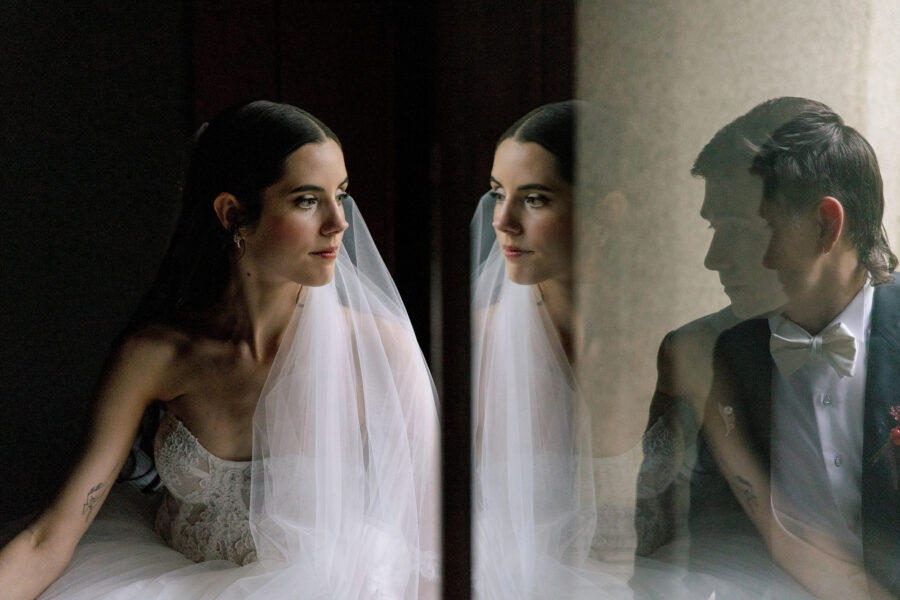
They saw each other first in private, in a quiet corner of the garden, with a letter rather than an audience. A letter is the choice of people who’d rather say the important thing slowly, and in their own words. It also means the words survive the day. Long after the flowers have gone, it still says exactly what needed saying that day.


Jinya, at the Foot of the Tanzawa
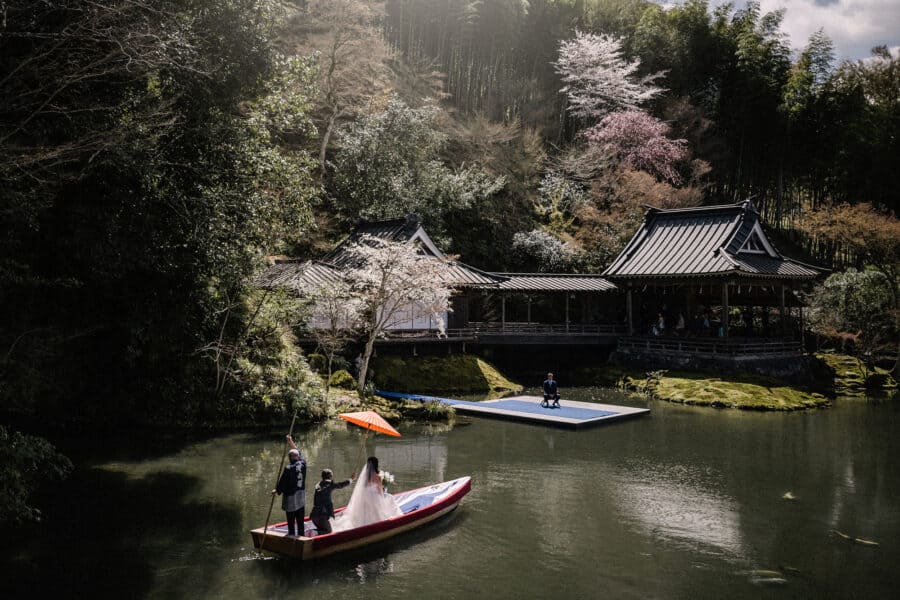
Jinya sits in Hadano, in Kanagawa, where the Tanzawa mountains come down to the plain and the ground is full of springs. The inn’s own history explains why anyone settled here at all. In the Kamakura period it was the camp of Wada Yoshimori, a close aide to the first shogun, and the inn believes he chose it for two things: the hot springs and the bamboo that grew thick enough to make arrows. In 1918 the Mitsui family built a villa on the same ground, a house for receiving important guests, and it became the ryokan that stands there now, with a garden of ten thousand tsubo, about three hectares.
Bamboo still grows in that garden. At dinner, the rice was cooked with shoots picked from it, noted on the menu in a single line. That’s how Japan tends to keep its continuities: quietly, on a plate, eight centuries after the reason for them.
They married on the garden terrace, under branches in blossom, with the inn’s benches carried out for seven. With so few people, a ceremony stops being something watched and becomes something shared at arm’s length. Their parents weren’t in rows behind them. They were close enough to be part of every word, and the photographs show what that closeness did.
The plum is a hardy flower to marry under. Chinese painters grouped pine, bamboo and plum as the three friends of winter, because all three hold through the cold, and the plum is the one that flowers while the trees around it are still bare. By late March it’s near the end of its season, and that’s its own kind of beauty for a wedding: the year only just turning, nothing at its showiest, everything still to come.
On the old calendar, their wedding fell in the five days called suzume hajimete sukuu, when sparrows begin to build their nests. It’s a modest season, easy to miss between the plum and the cherry. It suited a wedding made for family.


A Cask Named for the Mountain of the Immortals
They opened the sake in the garden, a small cask for kagami biraki, and poured seven cups. The sake inside was Zarusō Hōrai, from Ōya Takashi Shuzo in Aikawa, a Kanagawa brewery making sake since 1830 with water from the Tanzawa mountains. It’s the same range whose springs rise at Jinya, so the sake and the inn’s water come down from the same mountains. The name joins two places. Zarusō is the small district where the brewery stands. Hōrai is the mountain of the immortals, the island-mountain in the eastern sea that old Chinese stories filled with sages and the elixir that keeps them young.
Japanese weddings once put a piece of Hōrai on display. The shimadai was a decoration for weddings and other celebrations: a small island-shaped stand modelled on Mount Hōrai, set with pine, bamboo and plum, a crane and a turtle, and often an old man and woman, Jō and Uba, who have grown old together. Every piece of it was a wish for a long life together.
Nobody built one for this wedding. Read the day the way that stand was read, though, and most of it was there: plum in flower in the garden, old pines leaning out over the pond, bamboo from the garden at dinner, a folded paper crane on the dinner tray, and a cask named for Hōrai itself. Even the turtle came, painted on the cask’s wrapping beside a crane and a pine, under the character for celebration.
A shimadai put the wish on a table. At a wedding of seven, the wish doesn’t need a stand. The people who’ll watch this marriage grow were all within reach of the cask.


Dinner Was the Celebration
There was no mochi pounding and no cocktail hour. The celebration was dinner, a kaiseki of spring: junsai, the water shield gathered from ponds, grilled nodoguro, the rosy seabass, and that rice with bamboo shoots from the garden. Seating was free, which at seven simply means family sitting where they like.
The details were small and exact. The bouquet came from Hanatombo, and when the day before turned unseasonably warm, the florist asked the inn to lift the flowers out of their foam and stand them in water overnight. The cake was two tiers, raspberry and pistachio, from Queenie Cake, briefed as elegant and spring-like. Guests were surprised that buttercream could taste so light. None of that is the point of a wedding. All of it is how a wedding feels cared for.
Tabito’s guests didn’t watch a performance. Each of them made something, a poem about the same tree. A small wedding works the same way. With seven at the table, speeches turn into conversation, a thank-you is said to faces rather than a room, and the evening belongs to everyone in it. This is what we mean when we say people deserve more than one rushed day. The couple came the day before, walked the garden through a rehearsal and stayed on after, and when we plan a wedding in Japan, that’s the space we protect: time for a family to be in one place with nowhere else to be.


The Garden After Dark
Jinya’s garden keeps a different hour after dark. Its paths are lit low, at the height of a footstep, and a garden of ten thousand tsubo shrinks to the few metres of light around two people. The day had begun with just the two of them, as they’d asked. After the hours given to family, it was theirs again.
Tabito’s evening is remembered thirteen centuries on because of what a few people made of one tree and one night. A wedding of seven can carry that kind of weight. Its size is a decision about who gets to be close, and this couple made it with complete clarity: their families, a garden at the foot of the Tanzawa, and the plum still in flower. It’s the kind of day our photography and film exist for, one lived at close range, by people who knew exactly why they were there.