Her father told them they now had three homes: New York, Shenzhen and Cairns. At their Akiu Winery wedding, in the hills west of Sendai, that felt like a particularly generous way to describe a marriage. A life together could include more places to belong, and more people with a reason to welcome you.
The bride grew up in Shenzhen, the groom in Cairns. They met in San Francisco and now live in New York, with Japan becoming somewhere they kept returning to together. This was their third visit to the Zao area, a place they’d first found after hiking the Tateyama Alpine Route and looking for somewhere to unwind in nature.
Now they’d brought their people. There would be forest light at the ryokan, vows beside vines, a tented lunch, tea, sake and four wedding cakes. They had evidently considered the possibility of guests needing a little encouragement to enjoy themselves, and addressed it comprehensively.


The Light at Daikon-no-Hana
The day began at Daikon-no-Hana, a forest onsen ryokan in Togatta Onsen, in the Miyagi foothills of Zao. Its cottages sit among natural woodland, connected by paths and covered walkways. At sunrise, the roofs appeared within the trees, a small arrangement of human life inside the forest.

The groom got ready with his brother and friends in a wooden room, with the shoji open towards the greenery. His navy suit, grey waistcoat and patterned bow tie took shape in that light. Outside, the bride’s attendants, dressed in rust and orange, spread her long train across a deck among the trees.


Her gown was a strapless column, her hair short, with pearl earrings. The first look happened on a covered wooden walkway. We photographed them beside its rail, the forest close around them, and worked with the stronger light for two black-and-white portraits.


This was the speckled light we keep finding, and keep wanting to photograph: komorebi, sunlight coming through leaves. There is a physical detail about it we love. Small gaps in a canopy can behave like pinhole cameras, projecting tiny images of the sun onto the surfaces below.


The round patches can be pictures, made without anyone lifting a camera. Beneath the leaves, the forest has been doing a little image-making of its own. Knowing that makes the light more interesting to look at, and the brief patterns worth another moment of attention.


Photographing a couple in that setting asks us to work with something that keeps changing. A face moves, a patch of light shifts, the two people turn towards each other. The picture depends on recognising when those things briefly belong together.


That was part of the morning’s character. The place they had returned to was present in the photographs through the very light falling on them. Zao had become familiar enough to invite others into, while still giving us something new to see.

An Akiu Winery Wedding With Roots in Tohoku
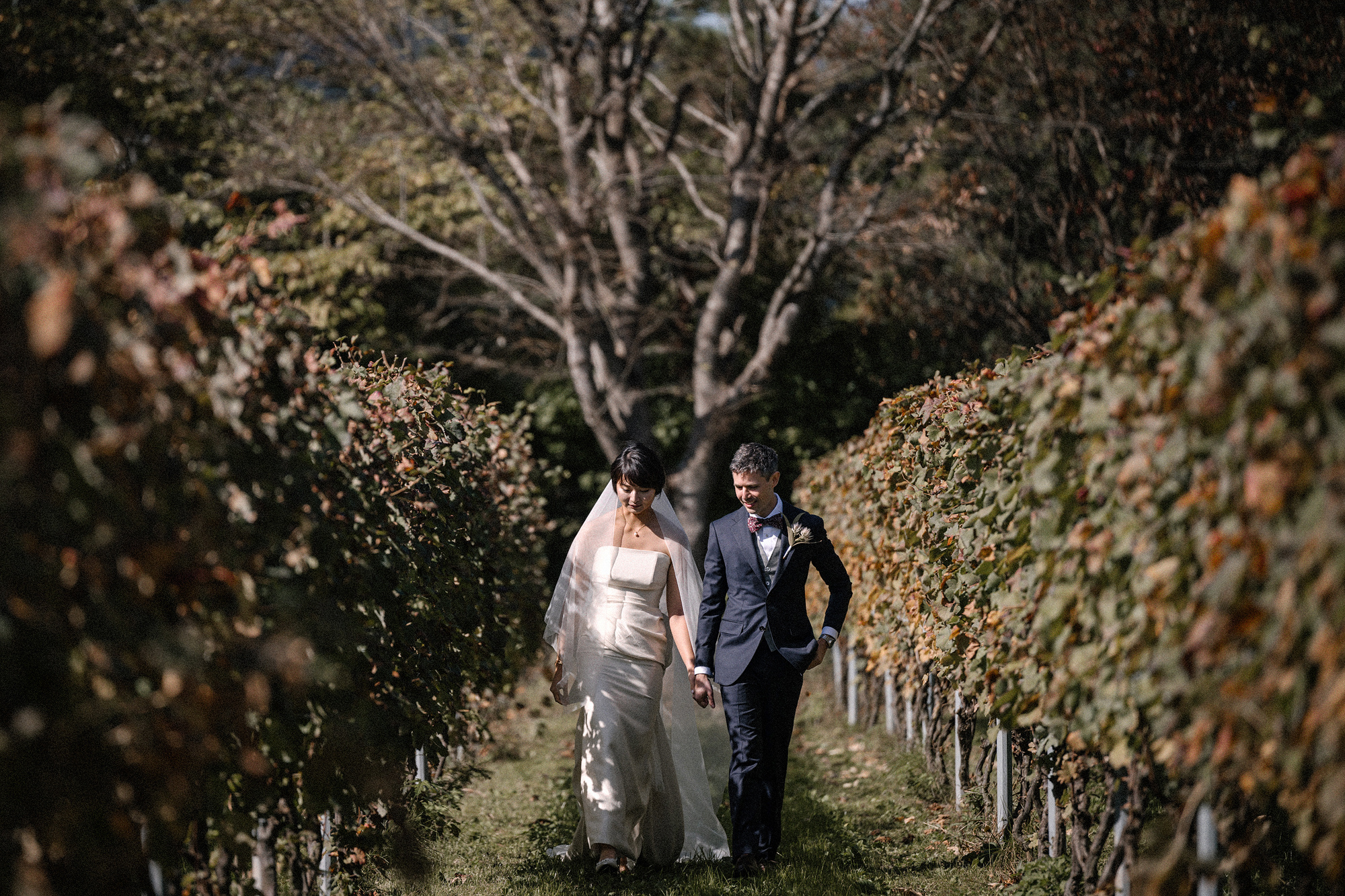
The celebration moved to Akiu Winery, where vine rows run towards wooded hills. The ceremony was set on the grass beneath a blue sky, with a white aisle, autumn grasses and pale flowers. Our stretch tent stood beside the vines, ready for lunch.


There is more to the winery’s beginnings than the view suggests. Its founder was an architect whose work on the coast had been damaged by the 2011 tsunami. Learning that Miyagi’s wine industry had also been interrupted, he began working towards a wine village as part of the region’s recovery, eventually opening Akiu Winery in 2015.
We learned that history after the wedding, and it reached us personally. Dee and I had spent months returning to the Tohoku coast as volunteers after the earthquake and tsunami. Those experiences remain part of who we are and how we understand the importance of showing up for people.
Finding this connection added something to a place we already knew through the celebration. The wine being poured beside the vines had come from a decision to build something here, involving growers, food producers and people willing to help. We were touched to discover another relationship with this part of Japan beneath the one we’d just photographed.
For the couple and their guests, arrival came with zunda: a sweet green drink made with edamame, familiar in Miyagi and a considerable hit with this gathering. It was a small, enjoyable introduction to the region. There would be plenty more of it on the table.
A Vineyard Wedding in Japan, With Three Homes Around It
Her father walked her down the aisle beside the vines. One of their guests led the ceremony, sharing parts of the life that had brought them here, before the couple exchanged their private vows and rings. Confetti followed the kiss, and the wedding party walked together between the rows, rust and orange against the vineyard.


Their two families had first met in Cairns the previous year. Record flooding had cancelled much of what they’d planned to do together, an unhelpful contribution from the weather to an already significant meeting. Here in Miyagi, they had another occasion to gather, with the ceremony behind them and lunch waiting under the tent.

One of the father’s stories was about a pressure cooker. The bride’s mother had wanted to teach her daughter how to use one from China; when her daughter found an excuse, the groom offered, “You can teach me, and I’ll teach her.” Her father said his wife had been very moved.
We understand why that was worth telling at the wedding. There was willingness in it, and respect for something her mother wanted to pass on. He’d made himself available to learn, with a practical answer that let the offer of care continue.
When people talk about bringing cultures together in a marriage, it can sound like a question of which traditions appear in the ceremony. There is also this quieter work, carried out in kitchens and conversations: taking an interest in how a family does things, allowing someone to teach you, making room for their knowledge in your own life.
That gives the father’s three homes a fuller meaning. The cities have names, but home becomes possible through what people do for each other within them. This vineyard wedding in Japan brought those relationships into one place long enough for everyone to see them gathering around the couple.
A Lunch That Gave Everyone Something to Do
Before the first toast, the MC rehearsed the call of “yoisho” with the guests. Three practices, then the couple struck the lid of the sake barrel for kagami biraki, and streamers exploded over the gathering. We remain very fond of those streamers; restraint had plenty of other opportunities during the day.

The winery team poured sake beneath the white tent. Lunch was prepared by a Sendai chef whose restaurant had earned a Michelin star in the Miyagi guide, with his whole team there to cook. It began with bento, including a Sendai beef croquette with the winery’s red wine salt, sea urchin on egg tofu and tuna sushi, followed by dishes arriving in rounds.


There was roasted Sendai beef, salmon, oden and onigiri, with warabi mochi to finish. The table arrangements stayed low, with grasses and flowers above rust-coloured runners. People could see the food, see one another, and keep the conversation moving across the table.


The back of the menu was a stamp card. Guests could taste three of Akiu’s wines from the wine truck, collecting a stamp for each, with non-alcoholic options included too. The winery’s own team presented the wines, giving the place a voice in what everyone was drinking.


A crossword about the couple waited on the lunch mats. Guests called out answers, contributing the bits of knowledge that came from their particular connection to the pair. It was a way for people who knew different parts of their lives to discover what someone else knew.
We like activities that give conversation somewhere to begin. A glass of wine, a question on a page or a green drink you haven’t tried before can be enough. People have something in common to respond to, and a gathering begins to develop its own ease.
There was room for speeches too, from both fathers and from friends. And then, because a single cake had apparently failed to capture the full extent of the occasion, there were four, each one painted with autumn leaves. We admire a couple prepared to give dessert that much consideration.


Tea, a Red Dress and the Late Light
Partway through the reception, the bride changed into her Chinese outfit, red with a mandarin collar and frog buttons. There was a tea ceremony, an idea her mother had brought to the day. Their wedding had room for something from her family alongside the experiences they were sharing in Japan.

What interests us about these choices is how personally they arrive. A mother asks for a tradition to be included; her daughter changes into an outfit connected to her own heritage; the couple make space within a celebration they are shaping together. The relationships give the customs their immediate importance.
We photographed them in the later light, moving along the rust-coloured vines with the hills beyond. The red outfit changed the colour of the pictures while keeping them connected to the morning’s autumn palette. Earlier, the forest had broken the light into small patterns; here, it stretched more openly across the rows.

Against the winery’s grey wall, everyone raised their arms for the group photograph. By then the guests had a day’s worth of common knowledge: the ceremony, the wines, the crossword, the cakes. The photograph held the people who could tell those parts of the wedding to one another without needing an introduction.

The gathering also had days around it, with time together at the ryokan and farewell drinks in Tokyo. We love what a longer autumn celebration can make possible. Conversations can continue after the wedding clothes come off, and the people who’ve travelled have time to become company.
For this Akiu Winery wedding, autumn in Japan brought colour at several different scales: the forest, the vines, the clothes and the food. The season was part of what everyone experienced together. It gave the gathering a particular place in the year.
The Places They Keep Returning To
Our planning team planned this Akiu Winery wedding, and we photographed and filmed it. The highlight opens above the autumn forest, moves through the ryokan and out towards the ceremony, then carries the guests, food, wine and speeches back into view. Set to “Tempest” by White Moth Black Butterfly, it returns at the end to the vine rows from above.
They had come back to Zao for a third time, but bringing their people changed what a return could mean. A place first discovered as two people became somewhere their families could remember as well. There were now more people with a reason to recognise its name.
The father had given them three homes in his speech. Japan had given those homes somewhere to meet, with their own customs and histories still present at the table. A mother’s tea ceremony, a groom willing to learn, friends contributing answers, and the people of Miyagi sharing what they make here.
Belonging can grow through such ordinary acts of welcome. A person offers to teach; another says yes. Somewhere between the pressure cooker and the four cakes, a family has become larger.