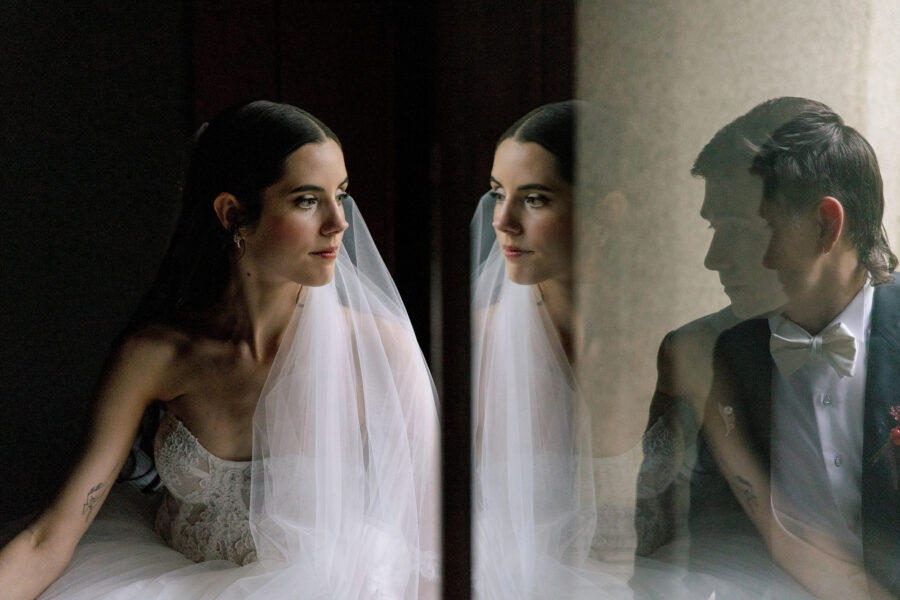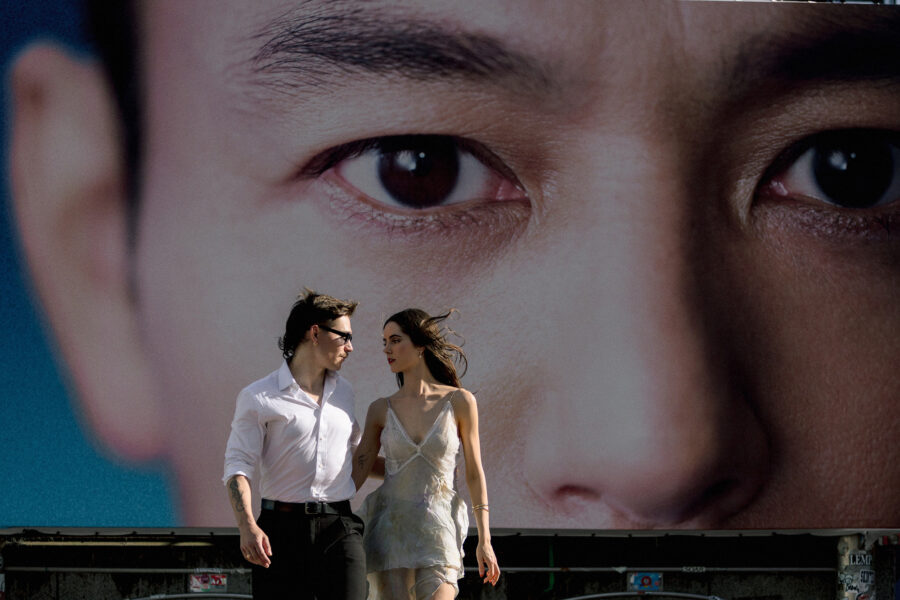
The groom at this onsen wedding in Japan had nothing written down. When the officiant asked for vows, he turned to the woman he was marrying and said, “Thanks for showing up today.” It’s the line you’d use on a friend who made it to your birthday, and he knew it, so he added that he meant it. In a world that makes it easy not to show up, he told her, she always does: for her patients, her friends and her family, for him, and for herself.
It’s a funny line. It’s also, once you sit with it, close to the whole of a marriage. Showing up ran through every part of this Japanese-Filipino celebration at Motoyu Jinya in Tsurumaki Onsen, a wedding that began, in a way, in another hot spring two years earlier. It was how he ended the night, too: thanking a room full of people who had flown in from around the world, for showing up.


Boston, Manila, and Everywhere in Between
She was finishing her medical residency in Boston. He was in Manila, where he and his best friend build houses and develop land. Relatives introduced them by email, and they met for the first time in Manila. Then came the distance: oceans, time zones and two careers that don’t bend easily. At the welcome dinner, her best friend from college, who’d found her on their first day there by overhearing her speak Japanese in a bookstore, gave them the line we’d keep: “may you never forget how hard the distance was and how easy loving each other has been.”
Her father is Japanese, from Fukuoka. Her mother’s side is Filipino, and she’d gone to the Philippines to immerse herself in that heritage. Manila is where the two of them first met. Her own map of Japan runs through Fukuoka and Okinawa, with years in Aomori. So the question was never whether it would be Japan, only how. Their brief was short and exact: “high-end, classy, private”, then “a mix of traditional Japanese/classy, and then a whole bunch of fun afterwards”. His family, she warned us, know how to party.
She already knew our work when she wrote to us. “I follow 37Frames as I’m such a fan of their work,” she told her guests. After our first call she thanked us for “re-instilling the joy in our wedding planning”, and he wrote that we’d given them “a new hope that wedding planning isn’t going to be all that painful”. Two people running demanding lives on opposite sides of the Pacific didn’t need more choices. They needed someone to hold the structure while they stayed in their own lives, which is most of what planning a wedding in Japan from abroad comes down to.


Straight to the Final Exam
His first trip to meet her family was to Fukuoka, and her family loves onsen. So his first proper meeting with her father took place in a hot spring near Fukuoka. His best friend told the story at the welcome dinner: “Straight to the final exam? No introductions, no practice, just full transparency from day one.”
Japanese has a phrase for what happened in that water. Hadaka no tsukiai, naked fellowship, is the companionship of the shared bath, and the dictionary defines its hadaka as having nothing concealed. Nobody arrives at an onsen as anyone but themselves. There are no suits to hide in, no titles and nothing to perform.
He passed. At the wedding her father gave the onsen some of the credit: that first experience, he said, must have left a deep impression, enough to inform their choice to celebrate at one. So a man who sat his final exam in a hot spring near Fukuoka came to stand in a garden in Kanagawa and thank his bride for showing up. At an onsen, showing up as yourself is the only way in.


Tsurumaki Onsen, the Water No One Was Looking For
Tsurumaki Onsen began as a disappointment. Sometime around the turn of the last century (Hadano’s tourism association gives both 1889 and 1914), villagers digging wells for drinking water found it salty and harsh: no good to drink and no use for the fields. So they bathed in it instead. The water turned out to carry calcium in quantities Motoyu Jinya describes as among the highest in the world. By the Taishō era, pilgrims bound for Mt Ōyama were riding out by horse carriage from Hiratsuka and stopping here to soak on the way.
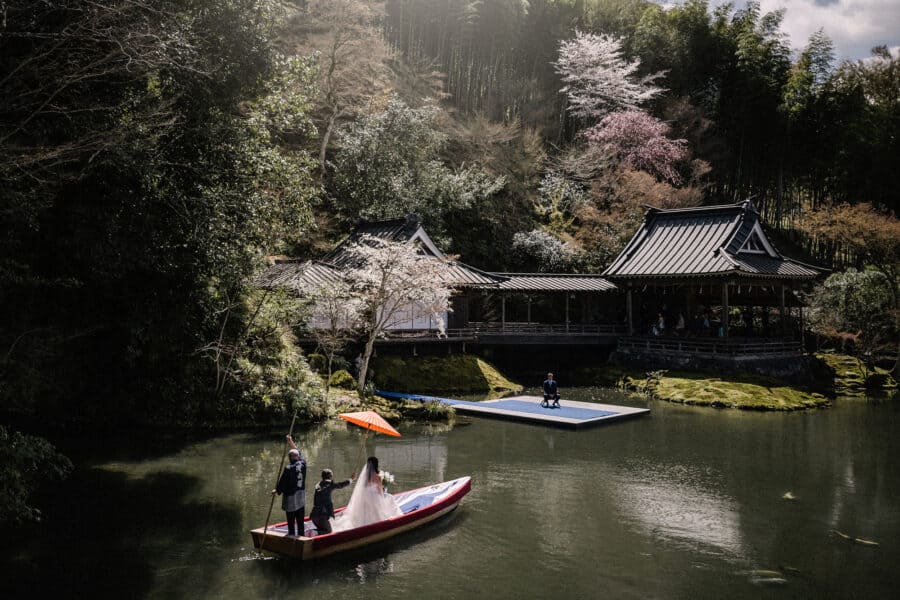
Motoyu, the first word of Jinya’s name, means the source spring, and the ryokan still fills its guest-room baths from the spring it calls Number One, long prized in Tsurumaki. For two days the whole of Jinya, its garden, its old wooden halls and its water, belonged to this couple and their people. They had asked for nature and water. He loves water; she loves the life of a garden. It’s hard to think of a better answer than a spring that was found by accident and has drawn people back for more than a century.
Showing up has a long history in Tsurumaki. Ōyama’s pilgrims came a long way to pray on a mountain and stopped here for the bath. A wedding guest flying in from New York, London or Manila makes a smaller pilgrimage, and the water at the end of it is the same.


Yukata, a Sake Barrel, and the Usu and Kine
The fun began a night early. Everyone came to the welcome dinner in the cotton robes an onsen gives its guests, and the yukata did what it always does: grandparents, doctors, builders and children, from two families and many friendships, all in the same plain robe at the same long tables. There’s no quicker way to turn a guest list into a household.
Both families gathered around a sake barrel for kagami biraki, breaking open its lid with wooden mallets for good fortune. The barrel wasn’t finished that night. It came back the next evening with clear instructions from the microphone: “tonight, this sake needs to be finished.”
Then the usu and the kine came out, the wooden mortar and the long mallet for pounding mochi. As it was explained to the room, the two of them stand for the couple, and the rice between them for the prosperity of the home they’ll make together. Rice ran through the whole weekend, if you looked for it: in the barrel, in the mortar, and at the very end, in two sacks for their parents.
The paperwork had been done months before, at a ward office in Fukuoka with both sets of parents there and the couple in Japanese dress. Jinya was for everyone else. That’s what the extra night is for: by the time the mochi was pounded, the families had stopped being two sides of an aisle.


Barong, Butterfly Sleeves and a Japanese House
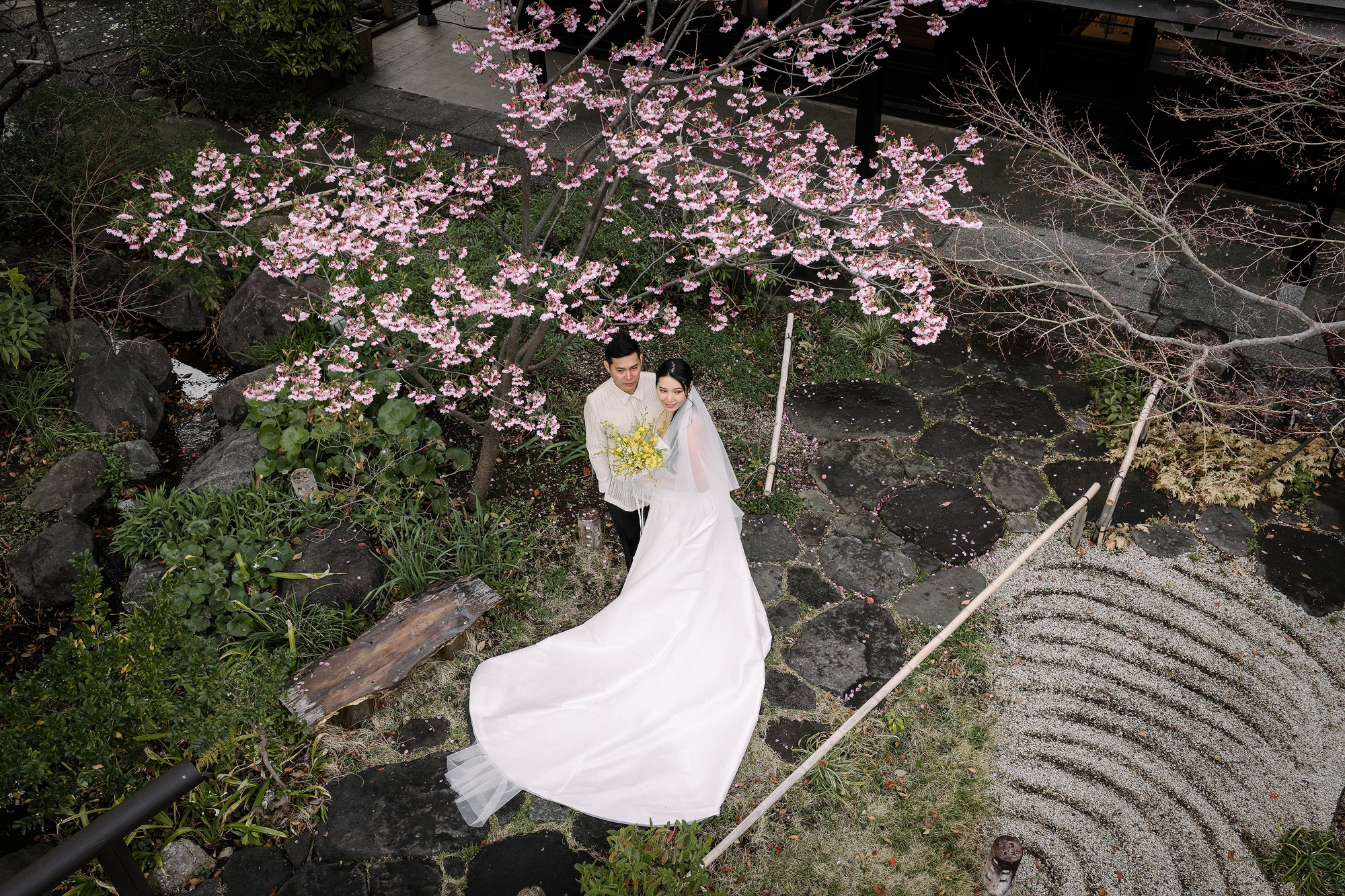
On the wedding morning the groom and his groomsmen dressed in barong, the embroidered, sheer shirt that is the Philippines’ national formal wear. It’s worn untucked over an undershirt and was traditionally made from pineapple or abacá fibre. The women of the family wore butterfly sleeves. Her father wore a morning coat, and she wore a gown with a distinctive bow and carried yellow orchids.
Nobody blended anything into a theme. Each family came dressed as itself into a Japanese house of tatami and shoji, and none of it needed explaining. That’s a kind of showing up as well: not leaving half of who you are at home because the wedding is in someone else’s country. A Japanese-Filipino wedding didn’t need a fusion concept. It needed room, and an old Japanese house had plenty.


They saw each other first in the garden, before anyone else did, under trees still wet from days of spring rain.


The Vows: “Thanks for Showing Up”
The ceremony was in the garden, in black tie, with cello and harp. He walked in with his parents to “Firework”, which his best friend will tell you is his all-time favourite karaoke song. The flower girls and the six sake boys came down the aisle to the theme from Jurassic Park on the harp, which you only choose if you trust your guests to laugh. She walked in with her father to Debussy and Bach.

Their officiant has known him since childhood, and brought a line in Japanese for the occasion: anata no soba ga watashi no okiniiri no basho, together with you is my favourite place to be. Neither of them had written vows. Hers was short: that she loved him, forever. His was the one about showing up.
Then came san-san-kudo, three times three sips of sake, the exchange at the heart of a traditional Japanese wedding. Both fathers poured, and when the third cup came round the guests were invited to drink too. They didn’t only witness the promise. They drank to it.


They married on the first day of sakura hajimete hiraku, the five days the old calendar names for the cherry blossoms beginning to open. After days of rain, the garden kept its side of the bargain.


Rice by Birth Weight
At the reception the couple stood up with two sacks of rice. “In the Japanese culture,” the groom explained, “there is a tradition that when you get married, you give your parents a sack of rice.” Each sack weighed exactly what one of them had weighed at birth, “so they remember where we came from and what they did to bring us where we are today.”
Taijū-mai, birth-weight rice, is a modern custom rather than an ancient one, a gift Japanese couples have taken to giving their parents as a wedding closes. It made sense on both sides of this family. Few things say home in Japan or in the Philippines as plainly as a pot of rice, and here was the weight of a newborn handed back to the people who once carried it.
Her father’s toast had already said where this was going: everyone in the room, he told them, was already part of the couple’s big happy family. The rice made it official.


A Whole Bunch of Fun Afterwards
The brief said traditional and classy first, then a whole bunch of fun, and the reception kept both promises. The bar card set calamansi from the Philippines beside shikuwasa from Okinawa. Flair bartenders worked the bottles. The sake barrel returned, as promised. A same-day edit played across three screens, so guests relived the morning before the night was over.
He stood up near the end and admitted he’s a control freak who doesn’t like surprises. “And today I was definitely swept off my feet,” he said. “Not just by my wife, but by all of you here today.” Then he tied it back to his vows and thanked everyone for showing up. After that it was the dance floor, and his family proved her right.
Afterwards he wrote to us that the wedding we’d planned was “too perfect”. Another note ended with a line we’ve kept close since: “Thank you for absolutely everything, you are magic.”


What Showing Up Asks
Showing up is easy to promise and costly to do. For this wedding it meant her grandmother, at 92, flying in from New York, and a great-uncle of 93 taking the train from Kyoto on his own. It meant her sisters coming from New York and London, and his family from the Philippines. It meant friends from every stage of two busy lives booking flights to Japan.
We think that’s what a destination wedding really asks of people, and what it gives back. Nobody drifts into a wedding in Tsurumaki on the way home from work. Everyone in that garden had decided, months before, to be there, and the two days at Jinya gave them time to make the trip count. He thanked his wife for showing up, and then he thanked everyone else for the same thing. It was the right vow for the right weekend.