By the time this Piedmont Driving Club wedding reached its ceremony, a storm had torn through the courtyard, the family had prayed for the waters to hold back, and the bride had played cards with her grandmother. Outside, an entire wedding was being put back together. At that small table, there was a hand to finish.
We’d come from Tokyo to photograph an Atlanta luxury wedding over two nights, with a family we’d known for many years. We’d first met them through family photography, long before we photographed the groom’s parents celebrating their marriage in Turks and Caicos. Now their son was getting married, his father was his best man, and once again we’d been invited to stand close.
That history changes what you see. The faces are familiar, but the relationships keep finding new forms: children become adults, partners arrive, a family makes room. You come back with an understanding of what came before, while knowing that the people in front of you deserve to be seen as they are now.
This weekend would give us a great deal to remember. First, it needed the rain to stop.
Before the Storm
Above Piedmont Park, the Midtown skyline rose behind the lake, the city gathering itself in the early evening light. The club sits at the park’s edge, with its white columns, inner courtyard and ballroom chandeliers. It feels established in a way that makes a temporary outbreak of chaos seem slightly impertinent.

There’s a pleasing detail in the history of the Piedmont Driving Club: the driving originally involved horses. In 1887, its members bought farmland beyond the city as somewhere to gather and exercise them. More than a century later, the groom’s family’s vintage white Rolls-Royce would bring the bride and her father to the wedding.
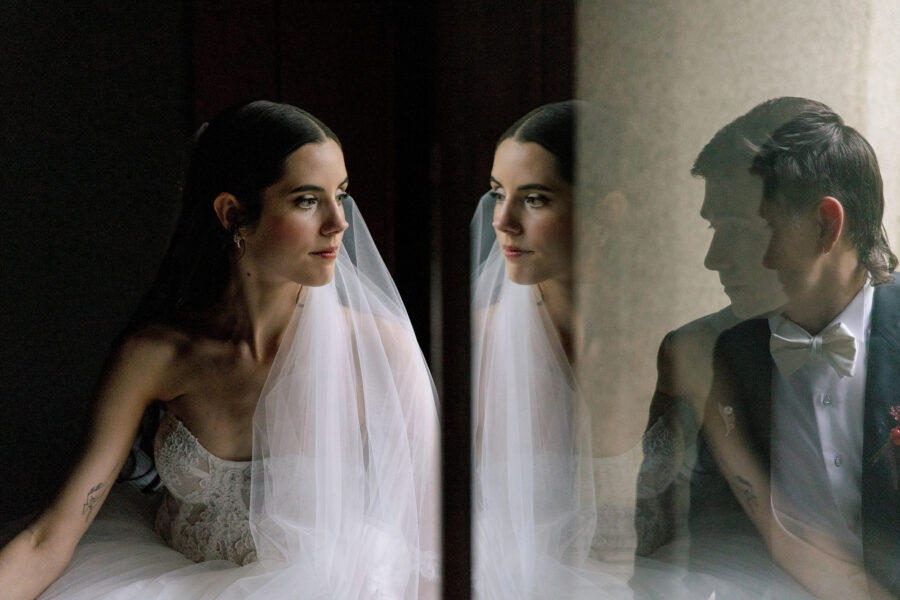
Preparations began at the Four Seasons Hotel Atlanta. The groom wore a white dinner jacket; his groomsmen, in black tie, filled a sofa with the particular disorder of men who are nearly ready. The bride’s lace gown hung by the window, and her bridesmaids gathered in pale blue.


Her father saw her in her dress there, before they left together in the Rolls. A long cathedral veil, the lace, the car waiting below: all the visible elements of an occasion taking shape. Inside those preparations were the smaller adjustments a family makes as something long anticipated becomes real.


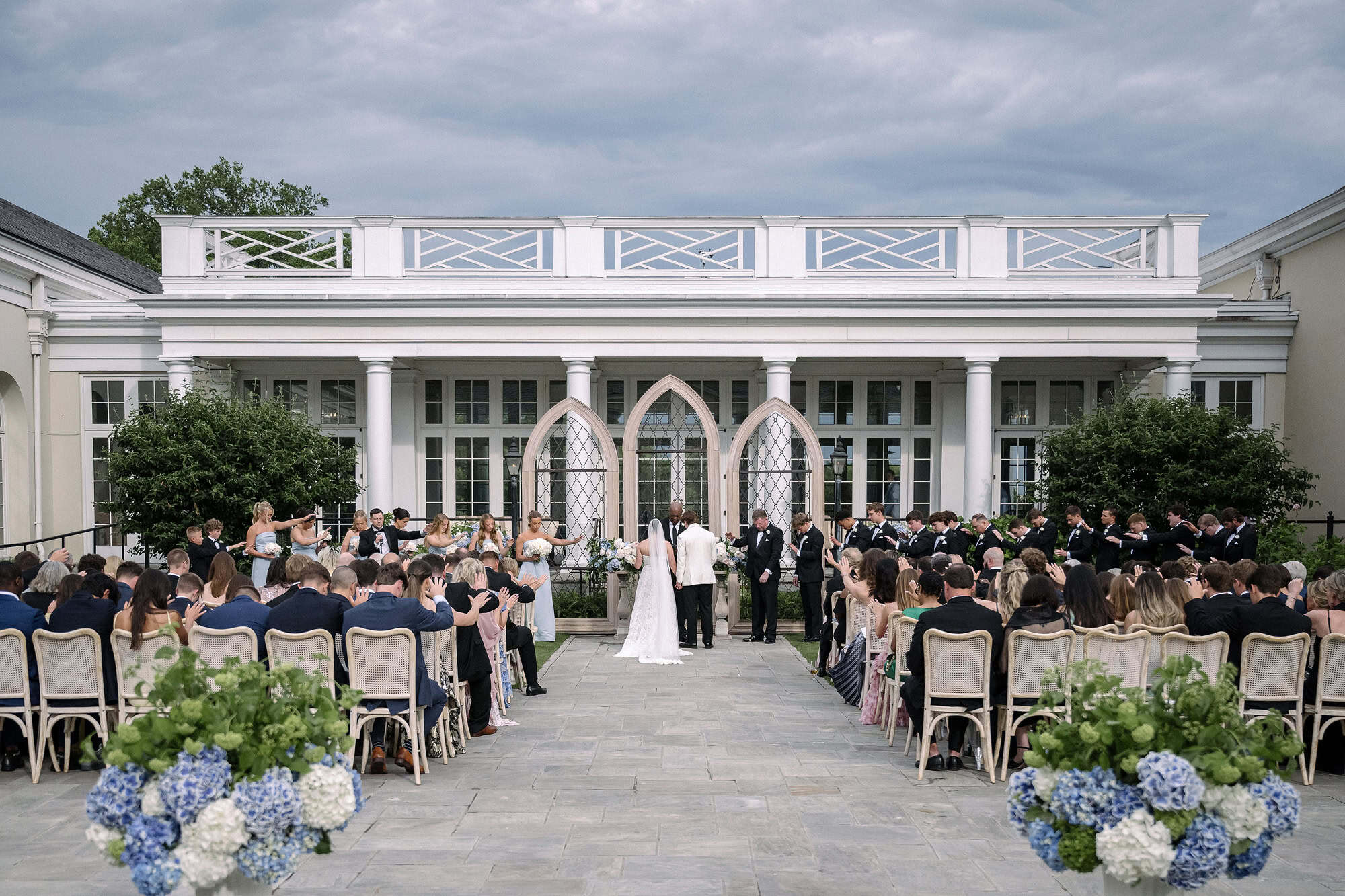
For this Piedmont Driving Club wedding, a crew was building the ceremony backdrop in the courtyard. Three pointed arches with diamond-leaded panes would suggest the stained glass of a church, with blue and white hydrangeas along the aisle. The setting had been chosen carefully, and the couple wanted to marry outside.
Then the weather arrived with considerable force. The groom’s mother would later tell the room that chairs had gone over and glass had broken. There was serious discussion about moving indoors, while the courtyard they’d imagined looked increasingly difficult to recover.
Her account of what happened next stayed with us. The groom’s parents gathered with him and the preacher who had come from Chicago to lead the ceremony. They prayed: “Dear Lord, hold the waters back.”
Meanwhile, the bride and her grandmother were laughing over cards. We keep returning to that photograph. There was so much happening around this wedding, so much work and anticipation and weather, and still these two had found a familiar way to be together.


Sometimes that is the family photograph you want most. A grandmother and granddaughter absorbed in something they already know how to do, while the rest of the day waits just outside it. The wedding gives the moment its context; their relationship gives it its weight.


A Piedmont Driving Club Wedding, Beneath a Clearing Sky
The rain stopped. Cloud remained, the stone paving was still dark, and clear umbrellas stood ready among the hydrangeas. But for the ceremony, the sky held.


After all the uncertainty, guests took their seats outside. The bridesmaids lined the courtyard in pale blue, the groomsmen in black, and the groom waited in white with his father beside him. The bride came down the aisle on her own father’s arm, beneath a sky everyone had been watching.


We remember the prayer and the clearing together because that is how the family experienced them. Their faith was present in the way they gathered, in the words they spoke, and in the seriousness with which these two understood what they were doing. The ceremony was sacred to them, and the people around them knew it.
The preacher gave the courtyard a voice. “Let the church say amen,” he said, and it answered. Later, another pastor invited those who wished to extend a hand towards the couple as he prayed over them, making the guests visibly part of the act of care.
The two of them repeated their traditional vows line by line. Under the arches, a communion table held a gilded cross and silver chalice. The bride served her husband, and the gathering joined in the Lord’s Prayer.

There was room for a little human fallibility within all that devotion. The preacher briefly lost his place in the prayer and acknowledged it with warmth. At dinner, he would return to the lectern with, “Let’s try that prayer again, all right?” and complete the task.
It was one of those moments that made the ceremony feel closer. The reverence remained, and everyone could recognise the person carrying it. Laughter belonged here too.
In his sermon, he’d spoken of praying together when storms rise. The courtyard hardly required an illustration. Around them were the arches that had been put back in place, the wet stone and the people who had helped bring the ceremony to this point.
After the kiss, the couple walked out with their arms raised. From above, the whole courtyard could be seen at once: its architecture, flowers and rows of guests surrounding two people who had just married. On the ground, it was all faces.

We had time for the family photographs on the steps. The bride’s veil spread beneath the floral arch, then lifted across the courtyard in the wind. Once everyone had moved inside, the rain returned.


What the Family Said
The ballroom held the first dance beneath its chandelier. Blue and white chinoiserie cloths covered the tables, with gold chairs, blue glassware and hydrangeas continuing the colours from the courtyard. The formal room had begun to acquire the sound of this particular family.

The groom’s father, serving as best man, explained that his wife had put him in charge of the groomsmen and the weather. “Well, clearly I failed,” he said, before giving thanks for the intervention he believed had made the evening possible. His guiding principle for a best man’s speech was equally concise: “Be brief, baby, be brief.”


Others supplied the history. The couple had met in their first weeks of college, both athletes, he playing football and she basketball. A friend remembered him leaving a basketball court because he had to go and see about a girl; by dinner, he was already saying he thought he would marry her.
Four years later, that friend had a very good reason to bring it up. Her coaches offered their own affectionate evidence, including the suggestion that matcha and a nap could fix anything. Her father spoke about the way her laughter could break up a whole room.
These details are what let us see beyond the formality. There was a bride in lace and a groom in a white jacket, and there were also two people known thoroughly by the people holding the microphones. Their habits, their humour and the beginning of their relationship were already part of other lives.
His mother spoke of her full heart and the love in the room, calling the marriage a “precious and sacred union”. A friend gave them a pocket watch he had stopped at the moment they kissed. Somewhere in the middle of this large celebration, someone had been paying attention to that precise instant.
We thought of ichi-go ichi-e, the care given to an unrepeatable gathering. The watch made the idea tangible. Its hands would stay at one moment while the marriage, and everyone who had witnessed its beginning, continued on.
There was a traditional white wedding cake, and there was also a football cake for the groom. The weekend had sufficient range to accommodate both. We rather liked that the football had survived the transition to black tie.
By the send-off, the bride had changed into a short white dress. Guests filled the entrance with white petals, and the Rolls waited outside with flowers on its bonnet and JUST MARRIED on the back. The car that had brought her with her father now carried the couple away, rain running over the windows.


The Photographs Were Needed Tomorrow
The next gathering would be larger: more than three hundred people at The Foundry at Puritan Mill, compared with roughly a hundred and fifty at the ceremony. The groom’s mother had an idea. Could photographs from the wedding be displayed so the guests who hadn’t been there could feel part of it?
It was an excellent idea. It also required finding printers, frames and easels on Memorial Day weekend, after finishing the first night very late, and having everything ready the following afternoon. Several people explained why this would be difficult.
Challenge accepted. Tracey found easels, Dee found frames, and the search for printers became a collective effort. Some of the black-and-white photographs were printed as many as five times because the blacks weren’t right.
That may sound like a small technical insistence. In a print, though, the darkness helps the light do its work: the depth in a jacket, the separation of a face from its surroundings, the room a photograph gives you to look. If these images were going to introduce people to a ceremony they’d missed, they needed to hold that attention.
By the time guests arrived, a long entrance tunnel was lined with large prints from the day before. Framed photographs stood on tables too. The wedding had barely finished becoming memory, and already people could stand in front of it together.

What moved us was the intention behind the request. The groom’s mother was thinking about the people who hadn’t been in the courtyard and finding a way to bring them closer. They could see the faces, the vows being exchanged, the family gathered around the couple, before entering a room where many of those same people were waiting.
It was a very immediate use for the work we do. The photographs had a job within the celebration itself: helping one gathering make room for another. The effort of the night before was there on the walls, but the guests were looking at their people.
Another Night at The Foundry at Puritan Mill
There had been Lewis Barbecue earlier in the day, another opportunity for everyone to eat together. Before the evening party, we photographed the couple in low light: her in a second lace gown, him in a navy suit with an open collar. A single shaft of light was enough to give those portraits a completely different feeling from the bright formality of the courtyard.


Their Foundry at Puritan Mill wedding reception opened into a room of brick, timber and flowers suspended overhead. Roses and peonies hung above pendant lamps. White sofas had pink cushions, and a sushi station sat beneath blossoms and paper lanterns.


The food deserves its own pause. There was meat that stopped conversations, sushi prepared to order, seafood on ice, and small tacos served on lime halves beside miniature margaritas. The family and Toast Events made sure our team was fed and cared for too, with a generosity we felt throughout the weekend.

The first dance was to a live “Georgia on My Mind”. Then came the dances with their parents, and the band took the room somewhere else entirely. A horn section, singers in gold sequins, and the sort of musical command that makes standing still seem like a regrettable use of your evening.

It was probably the best band we’ve ever heard at a wedding. We’ve tried to find a more measured way to say that, but it would misrepresent the situation. They were phenomenal.


There was a backflip. There was limbo involving a roll of toilet paper, which suggests a level of improvisation the printed invitation had wisely left unspecified. Light-up sticks, heart-shaped sunglasses and a packed floor carried the night forward, while the bride returned in a short white dress and joined the crowd.


We had watched this family pray with complete devotion. Now we watched them give themselves just as fully to the music. Both belonged to the people we knew, and both belonged in the photographs.
That is part of the privilege of staying for more than one day. You get to see people in a wider range of themselves. The person who held a hand during prayer is there again laughing on the dance floor, and the photographs can let those parts of a life sit beside one another.


Being Asked Back
Toast Events planned this wedding weekend in Atlanta. We were its photography and cinematography team, returning to a family whose lives had crossed ours long before this Piedmont Driving Club wedding. Our work has taken us from Japan to celebrations such as a wedding in the Florida Keys, but the invitation to return to people already known carries its own significance.
Towards the end of the party, the couple slipped away with everyone waving them off. The following morning they were headed to Turks and Caicos for their honeymoon, the same islands where we’d photographed his parents celebrating their marriage. That connection was theirs to take into the next part of their lives.

We left with the grandmother’s card game, the prayer in the storm, a father standing beside his son, and a band we’re still describing to anyone who’ll listen. Some weddings take a while to settle because there is so much within them that you recognise, and so much you are only beginning to understand.
We want to say this plainly, especially to the family. One blog post can’t do justice to what happened in Atlanta. We were there for a week, and everything about it was bigger and fuller than a page can hold: the generosity, the people, the faith, the food, the music, a family opening its arms to us all over again. What you see here is a fraction of what we lived. We’ll be talking about this one for the rest of our lives.
To photograph a family across the years is to keep meeting them at moments when their understanding of themselves is changing. We can bring the earlier photographs with us in our minds: who stood beside whom, who was small, who was waiting for their own life to begin. Then someone puts on a wedding suit, takes their place at the front, and the next photograph becomes possible.
When we look back on the life we’ve spent doing this, it will be full of other people’s days: the waiting before they walked in, the voices around their tables, the ways they held one another. We were there to make something for them, and each time something has stayed with us too. You cannot give this much of your life to paying attention without being changed by what you witness.
Their lives have helped make ours. Being asked back means we get to keep paying attention.