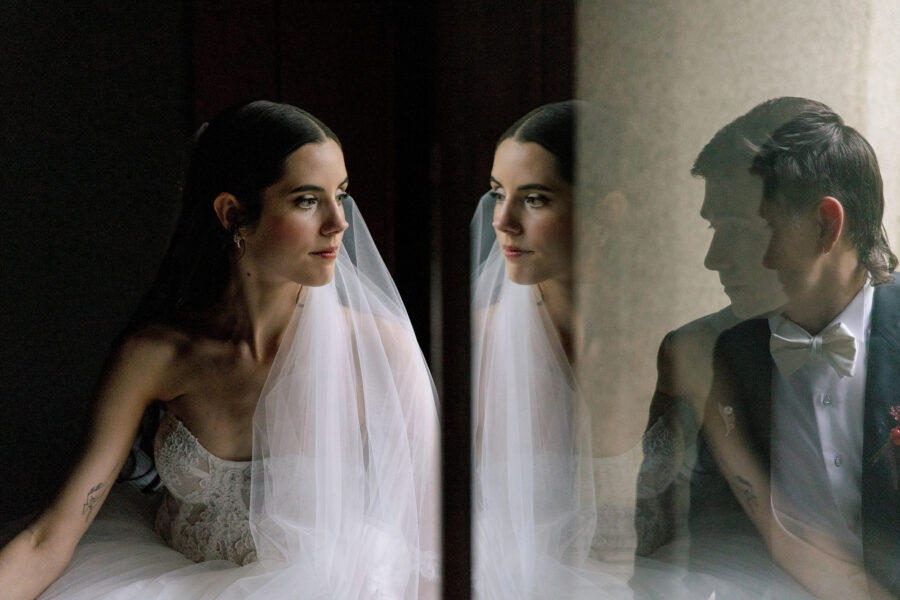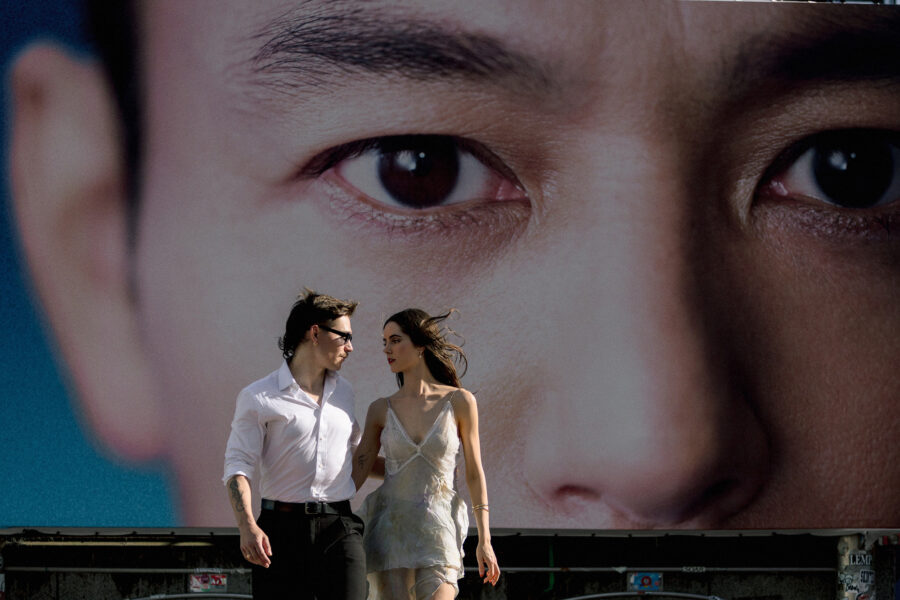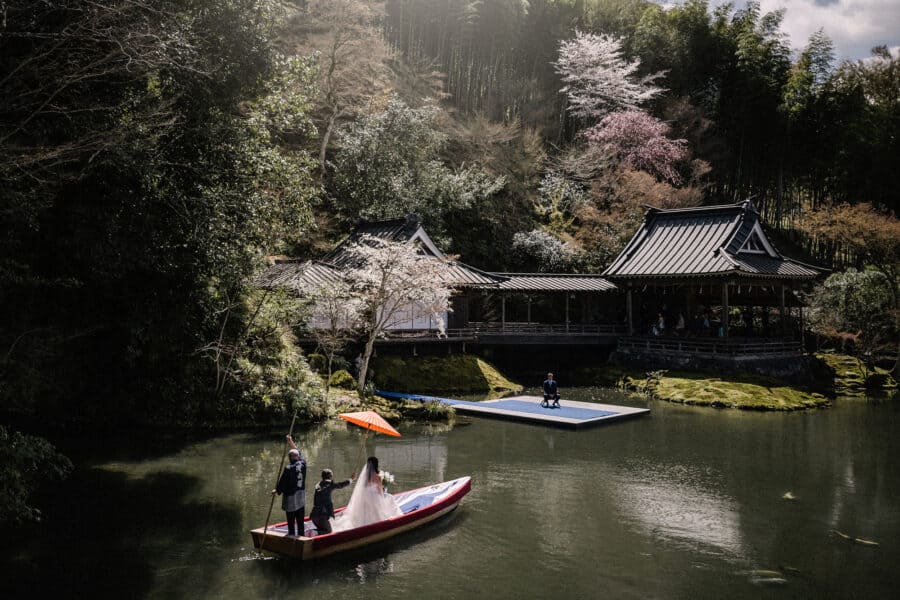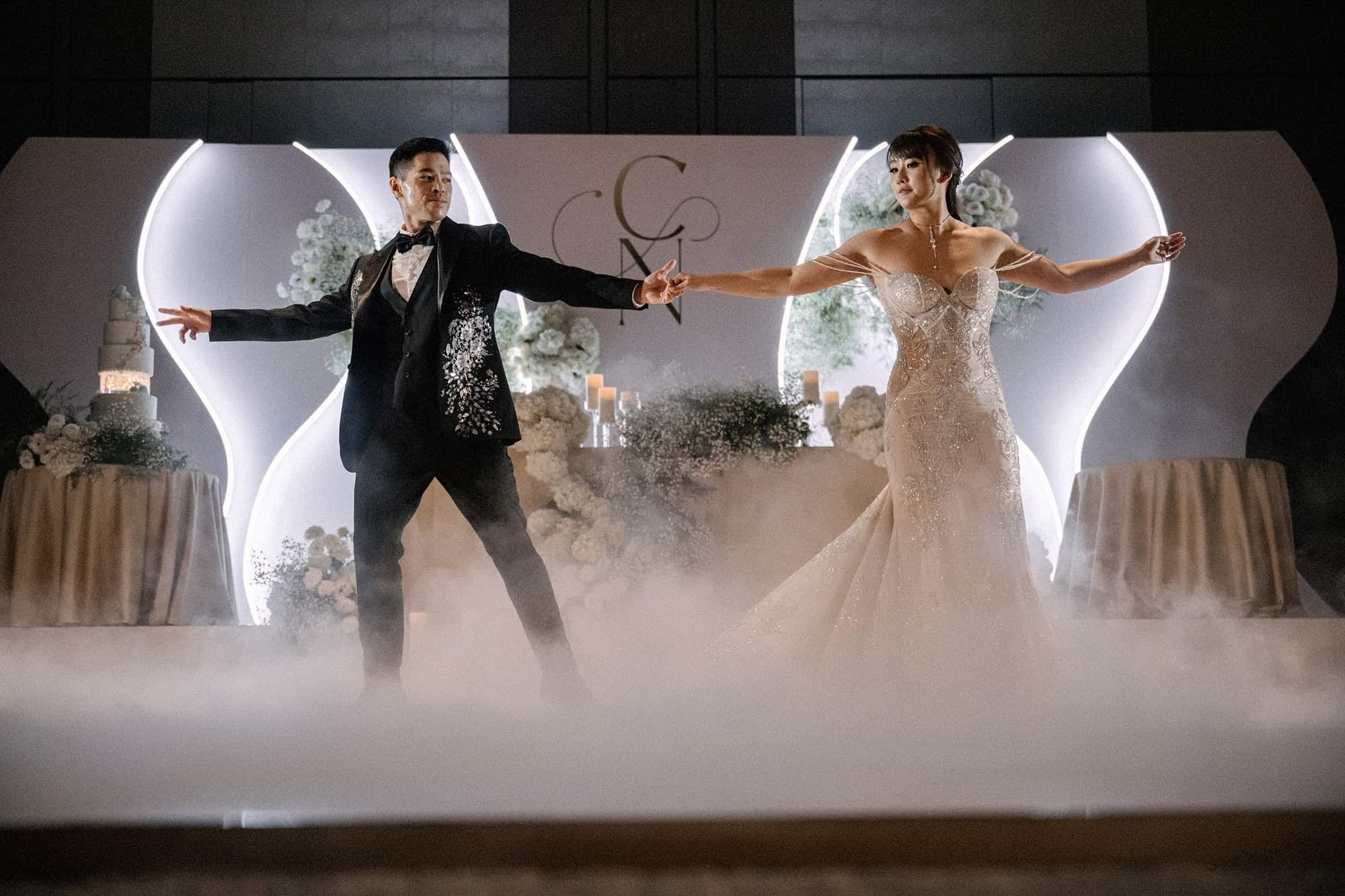
Nearly a decade before her wedding, the bride travelled through Tokyo with two of her oldest friends, one she’d known since elementary school and one since Grade 7. The cities we visit young tend to keep a version of us, and Tokyo kept that one. When she came back to marry, at a Four Seasons Otemachi wedding a few steps from the Imperial Palace, those same two friends came back with her, this time as her bridesmaids. A trip among friends had quietly become the reason for another.
They live in Canada, on the Pacific side, and they met by accident at a friend’s board games night. That friend went on to stand beside the groom as one of his two best men. He proposed in Vancouver in February, and the whole wedding came together in about eight months. Seventy-three people followed them to Tokyo, from Canada, Macau, London and beyond, and from the beginning the couple held on to one idea above the rest. The trip itself had to be worth it, for every person who made it: the city, the hotel, the food, the evening, Japan.


That’s the truest reason we know to marry far from home. When people give a celebration days instead of an evening, and cross oceans and a date line to do it, the wedding stops belonging only to the couple. Friends from one side of the world meet family from the other, and what everyone remembers is something they made together, one table and one conversation at a time. These two understood that before a single invitation went out. Their invitations were passports.


Otemachi, the Town Before the Gate
Otemachi takes its name from Ōtemon, the main gate of Edo Castle. Japanese dictionaries agree on the origin: this was the ground in front of that gate, and through the Edo period the great residences of feudal lords lined it. The castle grounds are now the Imperial Palace, and the lords’ houses have given way to the towers of Tokyo’s financial district, but the district still sits where it always has, at the threshold.
Four Seasons Hotel Tokyo at Otemachi opened in 2020 across the top six floors of a 39-storey tower. Its designer, Jean-Michel Gathy, brings guests up to a reception lobby on the 39th floor, behind a wall of glass with the city laid out beyond it. Then he does something unusual for a view like that. In front of the glass sits a rock installation on a shallow pond, set there, in his words, as a buffer because it “may be considered as discourteous to look straight down into the Imperial Palace.” The stones and water hold the foreground, so the eye travels out across the city instead of straight down. In the summer before this wedding, the Michelin Guide gave the hotel three Keys, its highest distinction.


It’s a building with manners. One of the great views over Tokyo, and the first thing the architecture does is quietly show you where not to look. We think about hospitality the same way. Most of it is care a guest never notices: the thought put in long before anyone arrives, so that what they meet feels easy. This wedding was full of that kind of thought, and the hotel was the right home for it.
When the couple were weighing up Tokyo’s hotels, they asked Dee where she’d go. Her answer was the Four Seasons at Otemachi, for the freedom it gives a couple to make a wedding their own and for the warmth of its wedding team. Knowing which venue will give a couple that room is half of planning a wedding in Japan. A destination wedding of this size has a great many moving parts: guests arriving from three continents, a tea ceremony and a Western one, an evening built like a festival, and a couple’s vision that has to survive all of it intact. That’s the work we know best. We were in it from the first cup of tea to the last song, holding the shape of the day while we photographed it.
Tea Before the Vows
Before the white dress there was red. The morning held a Chinese tea ceremony, the bride in a qipao embroidered in gold, the groom in a black Mandarin jacket. In a Chinese wedding, the couple serve tea to their elders, and the elders answer with their blessings. It’s a rite of gratitude, and it puts family first, before the guests and before the vows.


There’s a quiet history in pouring Chinese tea in Tokyo. Japan’s own tea culture crossed the sea from China. Eisai, the monk who brought tea seeds home with him, wrote Japan’s oldest book on tea in the early 1200s, and much of what the country later made of a bowl of tea grew from what travellers carried back. Eight centuries on, a family carried their own tradition the same way, across an ocean, to honour it here.
Japanese tea gave the world a phrase for a morning like that: ichi-go ichi-e, one time, one meeting. Every gathering happens once. These people, this tea, this city, in this order, would never be gathered the same way again, and the couple gave that gathering its own unhurried place in the day.


Vows in Front of Everyone Who Came
A hotel like this is built at the scale of a city, with crystal ceilings, long corridors and a grand ballroom. When we photograph a wedding of this size, we look for the opposite: two people, small and certain, inside all of it. That’s the truth of a big wedding. However grand the room, the reason everyone came is standing at the front.


Their ceremony was held in white and pale blue, the colours they’d carried through the day, from the bridesmaids’ robes to the hydrangea. What a photograph can only hint at is who was sitting in those rows. Every guest had made the same decision to come. Each had crossed something to be there, an ocean, a date line, days away from their own lives, and the vows were spoken to the two of them in front of all of it.
Her vows held something no one in the room had heard before. Months before the wedding, the bride had a song written for her vows, and she kept it to herself, the groom most of all. It stayed a secret right up to the ceremony, to the point that the hotel asked us not to share the day’s running order with the couple. When it played, he was hearing it for the first time, surrounded by everyone who’d travelled to be there. Vows are usually words, promised once and lived for years. A song written for one moment can only be heard for the first time once, and she chose to give that once to him.


An Evening Worth the Flight
The couple built their reception the way you’d plan a trip for someone you love, with something to discover in every corner of the room. Chefs broke down a whole tuna by hand in front of the guests, the kind of skill Tokyo usually keeps out of sight, in its markets and behind its sushi counters, laid open for everyone to see. There was a claw machine straight out of a Tokyo arcade, casino tables, two photo booths, a violinist, a live band and a DJ, and an aerial performer turning above the tables. A telephone waited to record guests’ messages for the couple to hear later.


At every seat sat a small wooden box with a guest’s name on it, and inside, a sake cup with the same name. It’s a small thing, and it’s the whole idea of the evening in one object. Each piece of the night answered the question they’d asked at the very beginning, whether the trip would be worth it, and answered it a little differently for each guest: a taste of Tokyo’s markets at the tuna counter, its arcades at the claw machine, and a cup with their own name on it to take home to Macau, or London, or the other side of the Pacific.
There was even a newspaper, The Wedding Post, printed for the occasion and thanking everyone who’d travelled near and far to be there. These are two people who think in things you can hold, and who wanted everyone they love to go home holding something.


What You Carry Home
Part of what first drew them to us was a magazine feel: the editorial look of our guide to weddings in Japan, its cover most of all. It fits that after the wedding they spent more than a year with us making a hundred-page album. A celebration they’d designed like an edition, with passports for invitations and a newspaper of its own, now lives as a book they can open.


A wedding worth travelling for gives everyone something to carry home. Theirs gave seventy-three people a sake cup, a passport, a newspaper and a few days of Tokyo they’ll talk about for years. For the bride and two of her oldest friends, it gave the city back to them, one more time, with a new ending.