The bride’s clearest wish for this Nagano winter wedding was that she would have enough time with their friends. In a planning email, she worried about the days feeling rushed; the more time they could have together, the better. They were bringing people from across the world to Japan, and she wanted to be properly there with them.
She’s from Singapore, he’s from the UK, and they live in Perth, where the oil, gas and mining industries draw people from all over the world. Their own circle of friends reflected that international life. Coming to Japan was another adventure for the group, with a marriage at its centre and two days in which to enjoy one another’s company.
We grew very fond of these two. There was so much curiosity in the way they approached the world, and such care in the way they wanted their friends to experience this part of it. Before there were rings to exchange or a ceremony to attend, there was the question of how to make the journey worthwhile for everyone coming.
The Mountains He Wanted to Share
He is a geologist who loves rocks and searches out the kind of backcountry trails most people never find. He had roped her into snowboarding too, so the mountains had become a place they knew through each other as well as through their own experience. This was where they wanted to begin: with an enthusiasm that had already travelled from one person to the other, and could now become part of the adventure they were sharing with their friends.


We began on the groomed slopes above Nozawa Onsen, in northern Nagano, with snow-heavy cedars and low cloud around them. Carrying their boards up together, they were bringing that part of themselves into the days they would spend with their friends. Snowboarding in Japan gave their wedding a beginning that already belonged to the life they enjoyed together.


There was a snowball fight, and he lifted her off her feet. They had the freedom to be this playful with each other on the way to something so significant. Getting married can bring unfamiliar expectations about how to behave; these two had brought along something they already knew how to enjoy.


Nozawa Onsen also makes winter an unusually intimate encounter with the earth. Above the village, it is snow and cold; down in the lanes, hot-spring steam rises between the buildings, with public bathhouses, or soto-yu, part of village life. After the slopes, they changed into camel coats and walked through that warmth rising into the winter air. For a couple drawn to the outdoors, the place offered a whole relationship with the season, extending well beyond the mountain.


A House Built to Receive Travellers
The group travelled on through Matsumoto, stopping for soba and visiting Matsumoto Castle, whose black keep is a National Treasure. They encountered people in samurai armour there, then continued towards a house with its own connection to the lords who once ruled from the castle. The city’s history would follow them into the place where they were to sleep.
Satoyama villa Honjin stands in Hofukuji, in Matsumoto’s Shiga district, looking across the basin towards the Northern Alps. It was the honjin of Hofukuji-juku, the official inn where the lords of Matsumoto rested while travelling to and from Edo. Those journeys formed part of sankin-kōtai, the system of alternate attendance that required feudal lords to spend periods in the shogun’s capital.

The earlier house burned in 1908. Rebuilt in its old form in 1913, the present building retains the scale and arrangement of a place made to receive travellers and their retinues. Its broad gable and massive zelkova beams give that history substance, while the kura storehouses and rooms around the great central space allow people to gather and withdraw, to be together without being constantly on display.


We love that this house is still being used to welcome people. Its history becomes more immediate when you sit down to a meal here and wake beneath its roof, taking part in the ordinary acts for which such an extraordinary building was made. For this group, who stayed together for one night, an old stopping place on the road to Edo became the address at which their separate journeys met.

That mattered to the wedding. Their friends could settle into the same house and remain part of one another’s company between the things we had arranged. A conversation could find its way from the pottery lesson to dinner and still have somewhere to continue the next morning.
The People Who Made the Welcome
That afternoon, a local pottery master came to teach the group at the wheel. Everyone made something different, each person discovering how their own hands responded to the clay. In a house whose existence depended on the judgement and skill of earlier craftspeople, there was something particularly fitting about spending time learning from someone who had devoted years to making things.


We wanted this Nagano winter wedding to bring the group into contact with the people who give the region its character. The pottery master, the chef who cooked dinner and the people who shared the food traditions were part of the welcome itself. Our planning work depends on those relationships, and on recognising how much another person’s knowledge and enthusiasm can contribute to a gathering.


At the long dinner inside the house, a chef prepared course after course for the group. Someone offered the couple a thank-you that reached directly into the purpose of the whole trip: “Thank you for your vision to bring everyone together.” We had heard the wish for more time during planning; now we were hearing what that decision meant to someone who had been invited.


Friends who live internationally become practised at maintaining closeness across distance, but there is a particular pleasure in having enough time to stop catching up. A long dinner can move beyond the account of what has happened since you last met into the easy, less purposeful conversation of being in one another’s lives again. With everyone staying at the house, the couple had made room for that possibility.
They had told us they weren’t romantic. We were happy to let the snowboarding, the dinner and the care they had taken over their friends explain what they meant. Later, beneath a bare tree lit gold against the night, we had a little time with just the two of them, within a celebration whose affection extended far beyond the couple at its centre.

A Nagano Winter Wedding With Time Around It
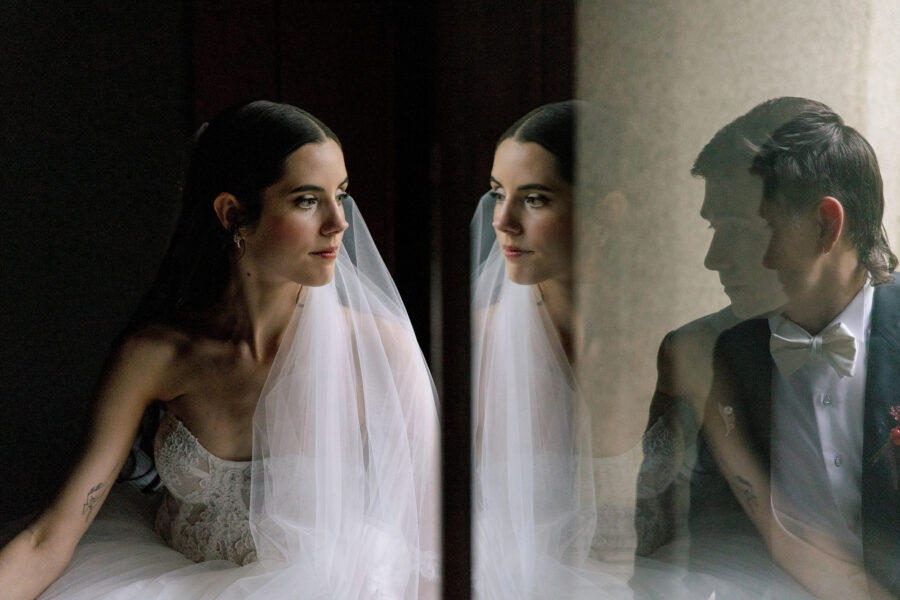
The next morning, they got ready in different parts of the house: his green suit and her long-sleeved lace dress belonged to a more formal part of the occasion now. We had already spent a day with the people inside those clothes. That familiarity matters to us, because the significance of seeing someone ready to marry grows from knowing a little of the person who has arrived at that moment.


Their ceremony took place outside beside the house, beneath a bare tree, with the Northern Alps beyond. Her best friend led it, and the long walk down the aisle brought the bride towards people with whom she had already shared the journey, the meal and the night under one roof. The gathering had a life together before it took its seats.


We felt the generosity of that. A wedding asks friends to witness a change in two people’s lives, and these two had given them time to feel involved in everything surrounding it. By the kiss and the confetti, the celebration already held a whole day of companionship that belonged to the guests as well as to the couple.


The landscape helped give the occasion its particular place in their lives. We have seen Nagano’s mountains in winter at Hakuba and the countryside around Matsumoto in spring, and each visit reveals different ways to spend time here. For these two, a wedding in Nagano could hold the exhilaration of snowboarding and the intimacy of an old house within the same celebration.
Winter Measured More Closely
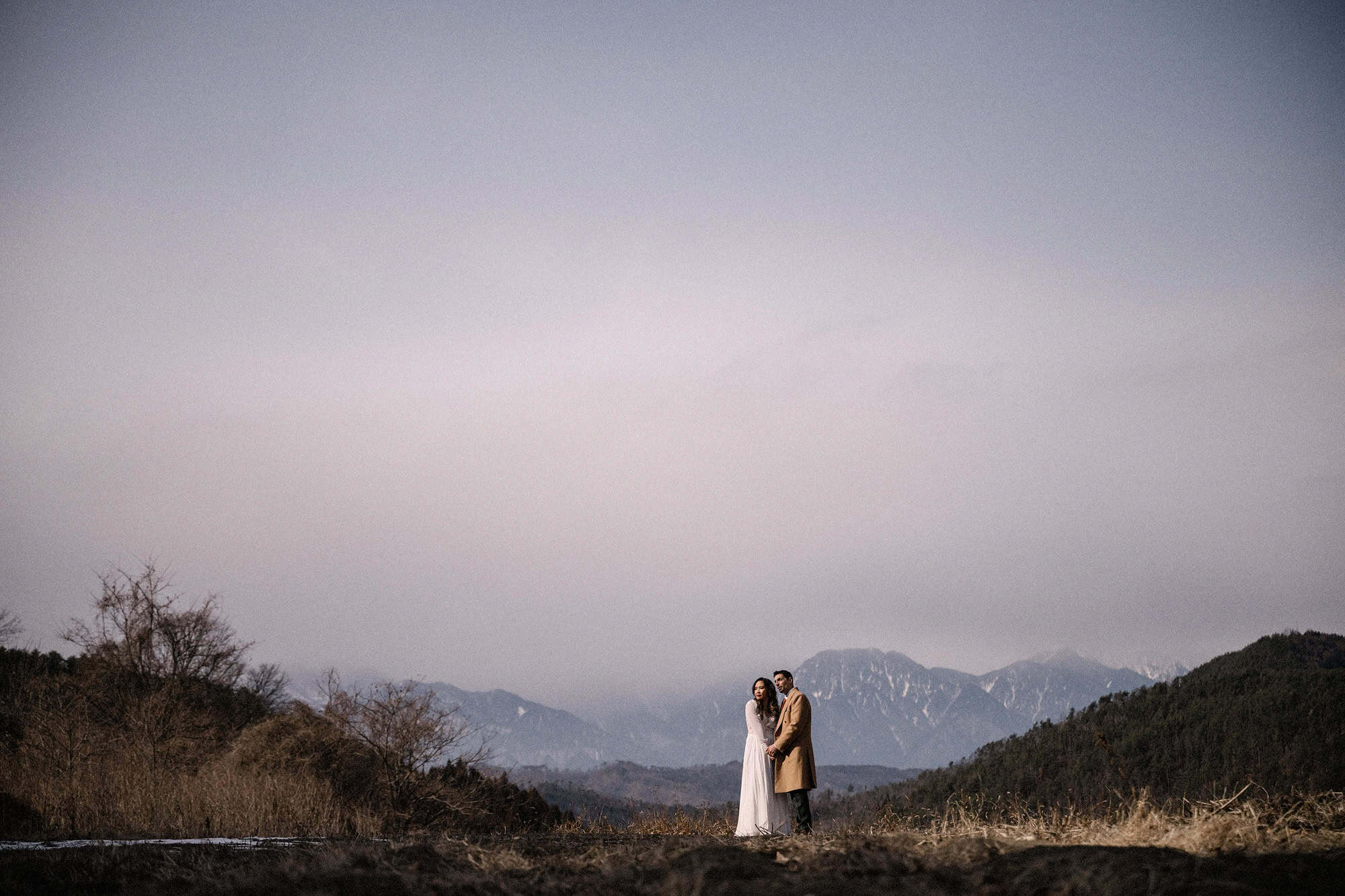
For a winter wedding in Japan, choosing the season means considering how you want to inhabit it. Their two days reached from the deep snow of Nozawa Onsen to mostly bare ground and dry grass beside the house, with the white peaks held further away. Coats were necessary; warmth became something people sought and shared.

Japan’s traditional calendar of seventy-two micro-seasons gives late January the name sawamizu kōri tsumeru, when ice thickens on streams. We are drawn to the attention within that description. It asks you to recognise a short passage of time through something happening close at hand, to give a few days their own identity within the much larger idea of winter.
His profession considers landscapes over immense stretches of time; this old house measures its history in centuries. Their friends had two days together here. Beside those longer histories, the visit was brief, yet it contained experiences specific enough to be remembered individually: the lesson at the wheel, the dinner, the wedding, the taste of something warm after being outside. We find that deeply reassuring in the work we do, this capacity for a short time to become a substantial part of someone’s life.
What They Shared Around the Hearth
After the ceremony came mochitsuki, pounding steamed rice into mochi with a wooden mallet, then eating it together. The couple took part side by side, guided by the people sharing the tradition with them. Afterwards, the bride wrote about how much she had loved learning about it and the enthusiasm with which it had been offered.

Sweet potatoes cooked in the irori, the sunken hearth, were handed around wrapped in foil, and there was sake. After the fine dining of the previous evening, this was another expression of being looked after, immediate and suited to the cold. The old house continued to offer the group ways to gather, now around food whose warmth they could hold in their hands.


One toast supplied a wonderfully human measure of how much company they had kept: “We can’t possibly make eye contact with all of us, so I think we made the eye contact already.” By then, attention had been given across a dinner table, during a lesson, out on the mountain and beside the ceremony. The wish she had written to us about had become something shared among the people in the room.

Returning to Their Two Days
We planned, photographed and filmed this Nagano winter wedding, and the film gives the couple a way back into the company they gathered. They can spend time again with their friends’ laughter, with the pleasure of learning something together and with the person they married enjoying a mountain long before the ceremony began. It preserves the familiarity around the occasion, the time they had been so determined to make for everyone.
Eventually, they all left the house and returned to lives that would put distance between them again. For a little while, though, their friends had shared an address in the Japanese mountains. They could remember the same rooms, the same meal, the same winter, and find one another there whenever the conversation returned to the wedding.

We keep thinking about her wish for more time. There was such affection in it, and such a clear understanding of what becomes precious when the people you love are spread across the world. In a house built to receive those who had travelled a long way, she and the man she married gave their friends somewhere to arrive, and enough time to feel they had.