The other half of Glasgow: a Brisbane footpath in 1982, a yellow suitcase from 2000, and the one room we crossed the world to stand inside.
The room we promised you at the end of the last post has a pool in it. But to understand why we crossed the planet for it, you have to start with Tracey, aged ten, on a footpath in Brisbane, more than forty years ago.
Her parents have just hauled all three kids out of the car at a red light. Quick, the Queen is coming. And she is: a royal car sweeps past on its way to the same Commonwealth Games the family is driving to, close enough to wave at. That day, in a packed stadium, Tracey watches a thirteen-metre mechanical kangaroo named Matilda do a slow lap and wink, enormously, at the entire crowd, then open her pouch and spill children dressed as joeys onto the grass. Six thousand schoolkids arrange themselves into a map of Australia and leave Tasmania off because it won’t fit. Tracey keeps the kangaroo and the wink for the rest of her life. What she can’t know, at ten, is that she’s already inside a story her family will take forty-four years to finish.
What the girl on the footpath couldn’t know
She couldn’t have known, on that kerb, what these Games would keep doing to her family. Eight years later, a girl who would become her sister-in-law, walked into a pool in Auckland at fifteen and walked out with an armful of gold: five of them, as a schoolgirl, at the 1990 Commonwealth Games. And two of those five matter more than we can easily say this week: the 200 metres freestyle, and the 4×200 freestyle relay. Because thirty-six years later, in Glasgow, Kai swims those exact two events, at the same Games, in the same colours. Her race, then his race. Her relay, then his relay. Sport keeps no archive half as good as a family does.
And Tracey, the girl from the kerb? She spent the time in between getting on planes, sitting in grandstands and standing on beaches on the far side of the world wherever the family was racing, and now a nephew who wasn’t born yet that night in Brisbane has pulled her back into the stands one more time, in Scotland, of all the places on earth. A child watched a kangaroo wink. Two aunts crossed the world to watch their godson swim. Same Games, one family, three generations deep: the parents who pulled their kids out of a car for a Queen, the kids who grew up into the grandstand shift, and now Kai in the water.
The suitcase
Just before we left for this trip, in the shuffle of storage that precedes six weeks away, we found our little suitcase. Yellow, battered, and stamped with its provenance: the Sydney 2000 Olympic opening ceremony, one of the little cases handed to every spectator in the stadium that night. We were in that stadium for one reason. Hayley was marching, her third Olympics for Australia, and we were there to scream for her. Afterwards the case became the family’s time capsule for the era, and then it was shut, and twenty-six years went past. We opened it upstairs. Inside were dozens of faded faxes, and every one of them was addressed to Hayley. A collection from Barcelona, Atlanta and Sydney. Now all in collective keepsake. Along with lots of swimming memorabilia.
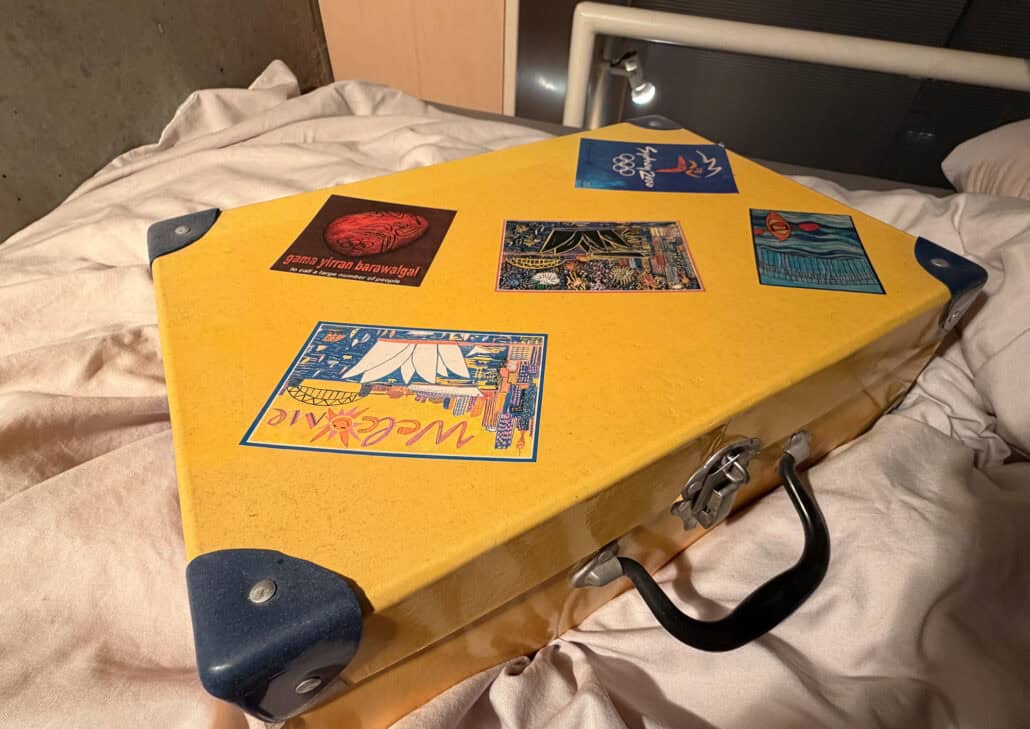
Bad handwriting. Family jokes. Encouragement in half a dozen different hands. Pride you can still feel through paper a quarter of a century old. In 1992, 1996 and even 2000, that’s how a family reached an athlete inside the bubble: you wrote your heart out longhand, fed the page into a machine, and it came out the other side of the country in an Olympic village. We read a few, put the lid back on, tucked the case away for safekeeping again. It’s a little family heirloom.
Then we sat down in a grandstand in Glasgow, twenty-six years later. And the suitcase opened itself again in our heads and would not shut. The words in those faxes haven’t changed. Only the recipient has.
The designated criers
We told you, last time, that the last opening ceremony we sat inside was a long way south and a long time ago. It was Sydney, in 2000, Hayley marching into the Olympic stadium with the Australian team while a hundred and ten thousand people made the noise of a nation pleased with itself. We were the designated criers. We have always held that post for our family. And we love it.
We’ve followed Kai to pools in the United States, in Melbourne, in Doha, in Fukuoka, in Paris. When he won two medals in Paris we sat down to try to write something about it and found we couldn’t. Every word we reached for made it smaller. So we said nothing, kept the feeling, and here we are two years later saying it sideways instead.
And somewhere across those years, the map of who we travel for quietly widened. Some of the swim parents told us this week that they’ll be disappointed if we don’t come to Budapest next year, and we understood, with a small shock of joy, what that sentence means: we have become a very small part of the extended travelling swimming family. Not athletes. Not coaches. Familiar faces who keep showing up, grandstand after grandstand, hopefully all the way to Los Angeles. The real privilege of all these air miles is being invited inside someone’s dream, and then asked back.
Because watching sport changes when one of them is family. We love sport the way the whole world loves it, for the gathering, for the air in the room. But when the body in the water is a part of your life, the watching goes somewhere past pride that we have never once found the word for. We don’t see what his mum and dad see: the alarms with a four in them, the years of dark-morning pools, the disappointments that never make the highlight reel. But as a family we know they happen. We know what was quietly paid, by a lot of people, into this one dream. And we have never really known what drives a person to ask that much of themselves. We only know we love the ones who did.
What the faxes weigh now
When we wrote those faxes we were young, and encouragement came easily, the way it does when you’re young. You’ve got this, we wrote, because we genuinely believed anything was possible, and mostly because we hadn’t yet learned the price of anything.
We’re older now, and the support has changed its weight, because life has been busy in the years between those faxes and this grandstand. We’ve built things we’re proud of and watched a few others wobble. We’ve loved people we’ve since had to say goodbye to. And we’ve had front-row seats to marriages that flourished for the plain reason that two people kept choosing each other, over and over. All of it taught the same lesson from different angles: the gap between dreaming and achieving isn’t talent. It’s endurance. So when we sit in an arena now, we’re not just cheering a race. We’re honouring everything it cost: every alarm, every selection that went the other way, every injury, every day an athlete chose to keep going with nobody watching. The younger versions of us celebrated the result. These versions celebrate the cost. That’s a different kind of pride. It weighs more, and we wouldn’t trade it back.
Because encouragement, we’ve also learned, rarely changes the outcome. Our faxes didn’t make anyone swim faster. Our flights don’t make Kai swim faster. What they change is how a person experiences the journey, which turns out to be the more important thing anyway. Every fax and every boarding pass this family has ever produced says the same single sentence: you don’t have to do this alone. The whole family is there for you.
The faxes themselves haven’t changed a letter. We have. That’s what time does. It deepens ordinary things until one day they stop being ordinary at all, and you find yourself in a grandstand in Scotland carrying thermal paper in your memory like scripture.
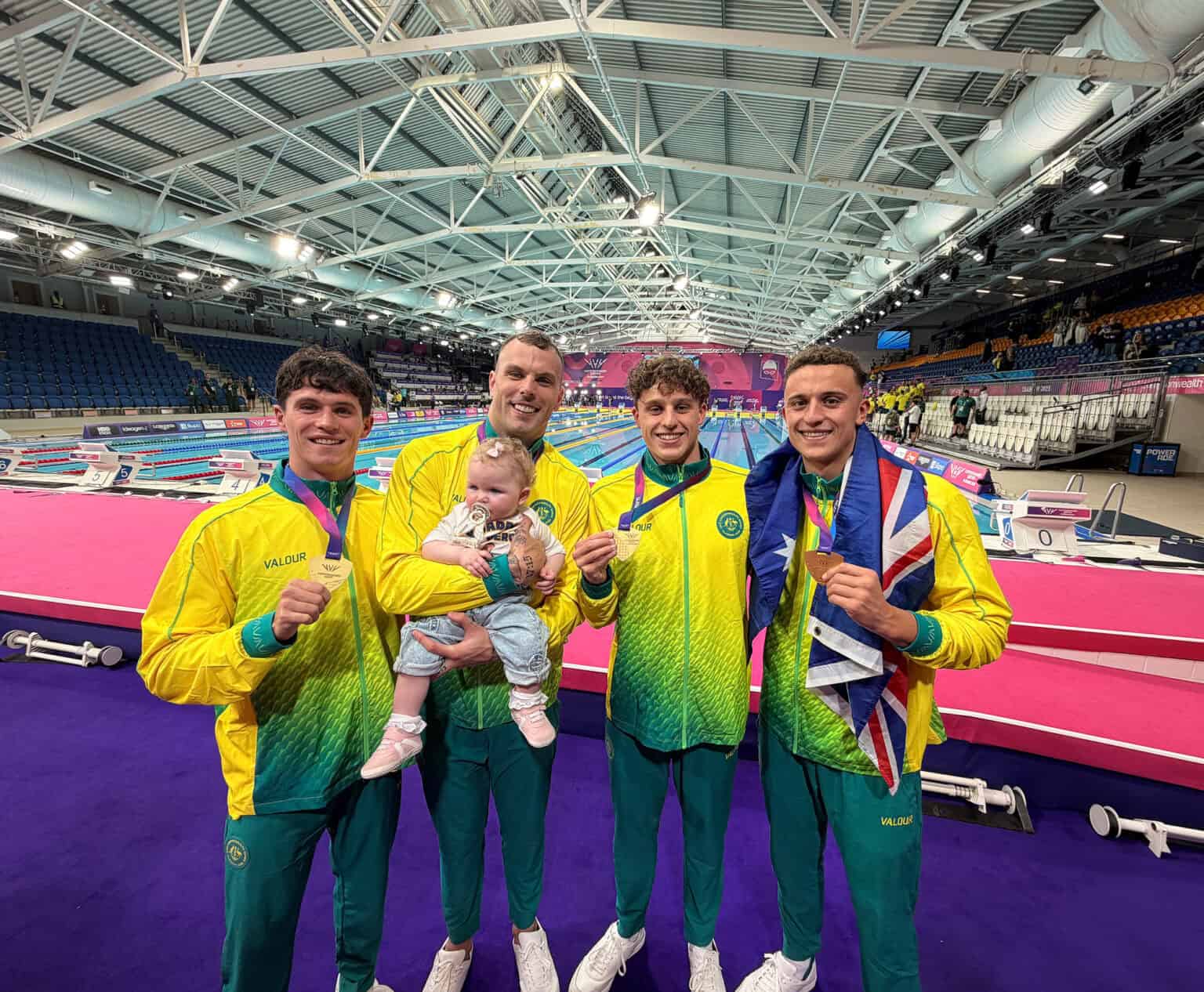
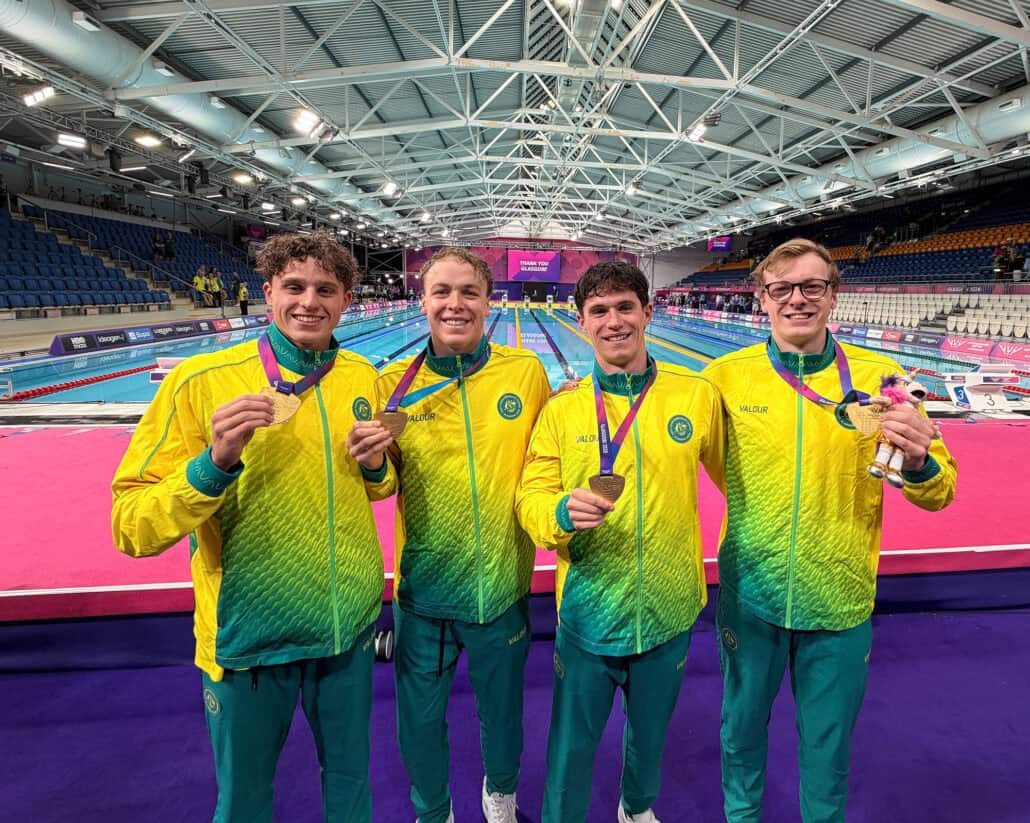
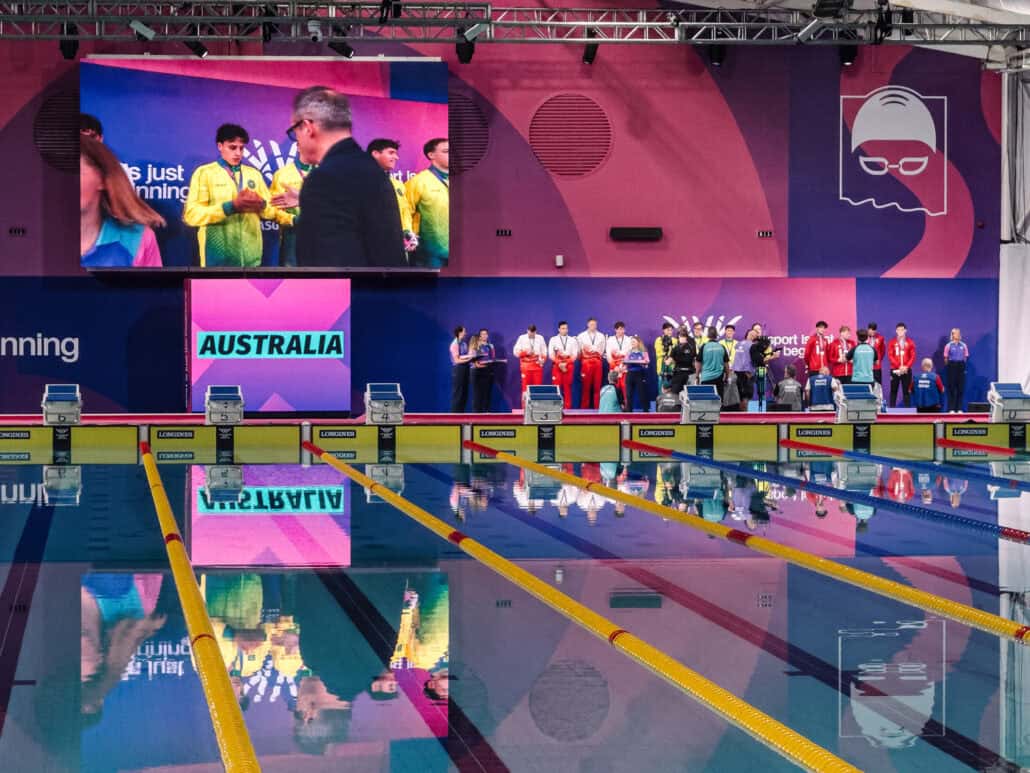
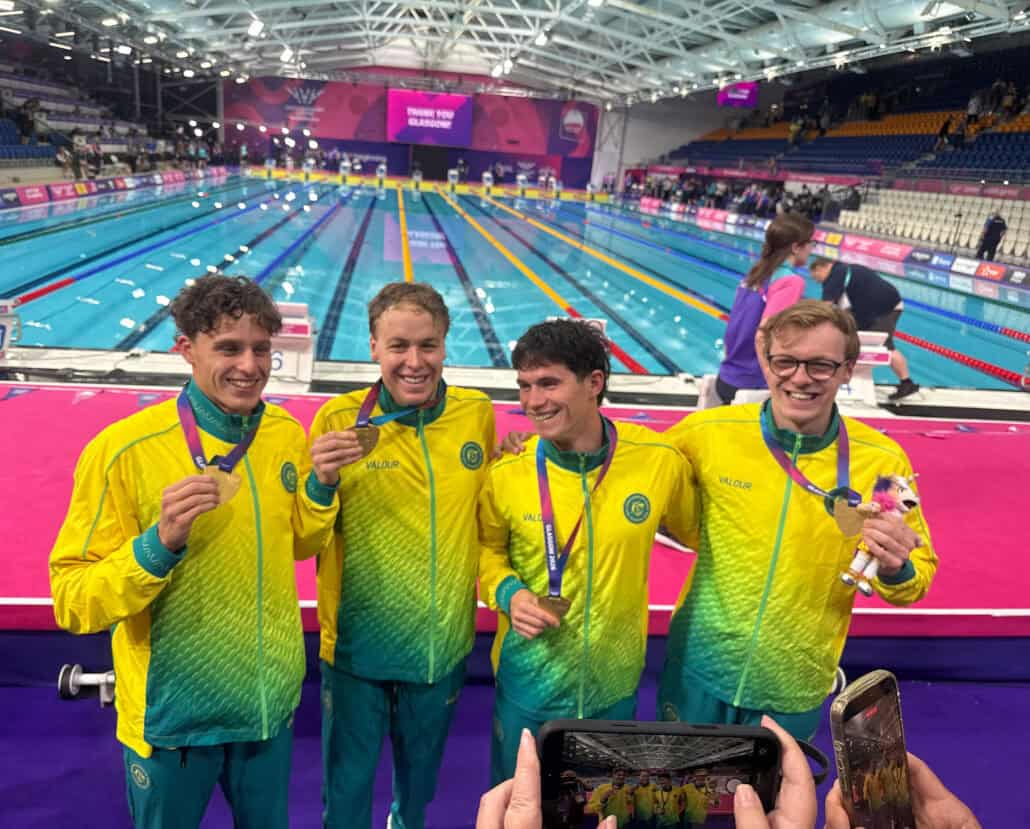
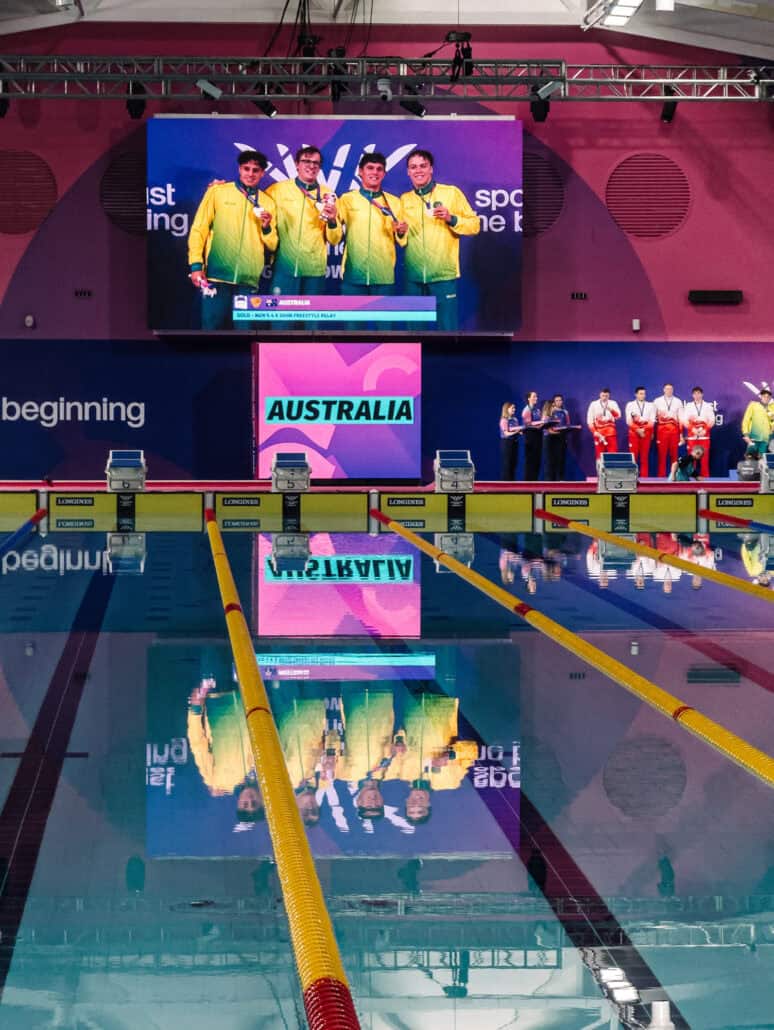
On the first night of finals, the world watched four young men stand on a podium: Kai, Flynn, Harrison, Kyle. Three minutes and nine seconds of work made visible at last. Sitting in that grandstand, what we mostly saw was a promise our family has been keeping for decades. The baton in this family was never medals. It was belief, passed hand to hand, one generation to the next, saying the one thing it has always said: we’re with you.
Three minutes and nine seconds
We had planned, in an earlier draft of this post, to keep every result off the page. The first final of the meet made that vow unkeepable, and we surrender it with joy.
Gold.
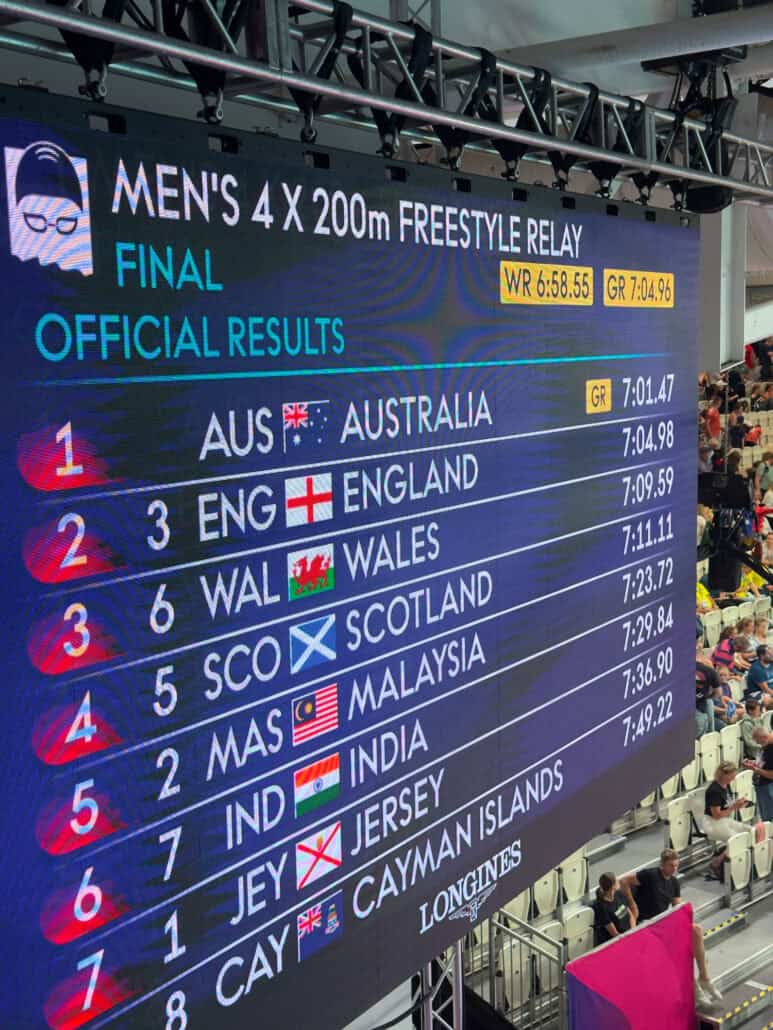
Australia won the 4×100 metres freestyle relay, and one of the four young men on the top step of the podium was family. Kai. Flynn. Harrison. Kyle. Three minutes and nine seconds of visible racing, built out of years that weren’t visible at all, and a night like that earns its scoreboard, so the scoreboard goes in, in full.
Flynn Southam led off in 47.09, a Commonwealth Games record for the lead-off hundred, taking down Kyle Chalmers’ old mark from Birmingham while Chalmers himself waited two legs behind him, which is the politest possible way to break a man’s record. Kai went second in 47.53, composed and in control, keeping clear water between Australia and everything England sent after him. Harrison Turner, in his first Commonwealth Games final, kept the momentum honest in 47.94. And then Kyle Chalmers did the thing Kyle Chalmers does: 46.93 on the anchor, the only sub-47 split in the entire field, the sixteenth relay split of his career under 47 seconds, bringing it home.
Three minutes, nine point four nine. Gold.
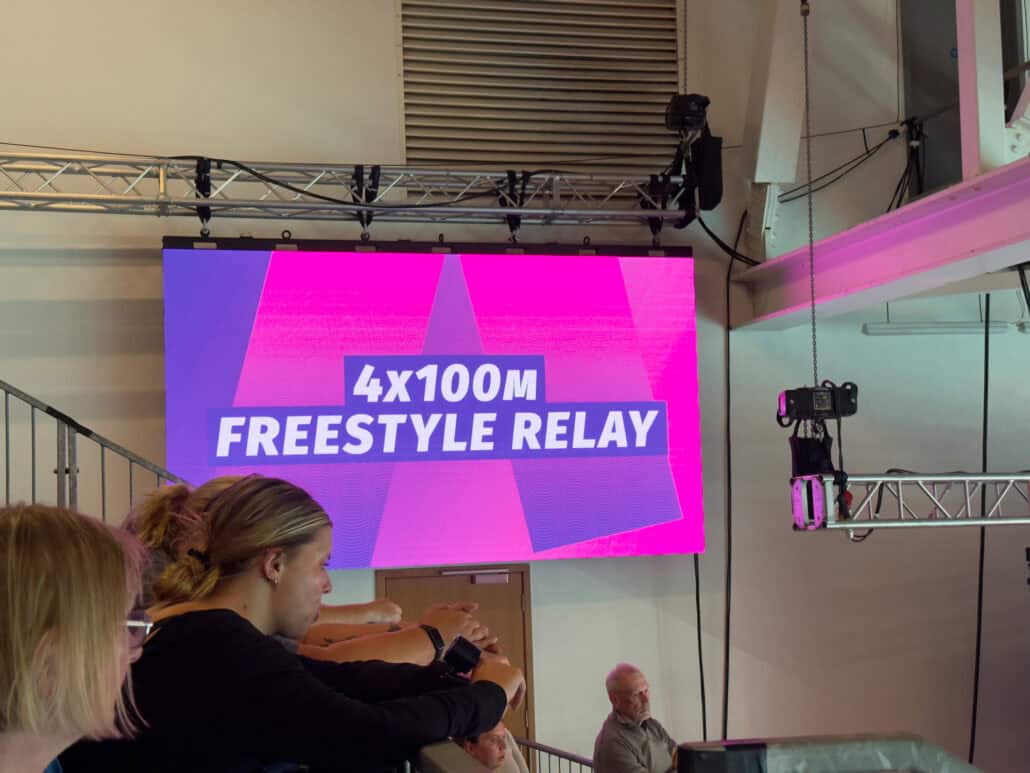
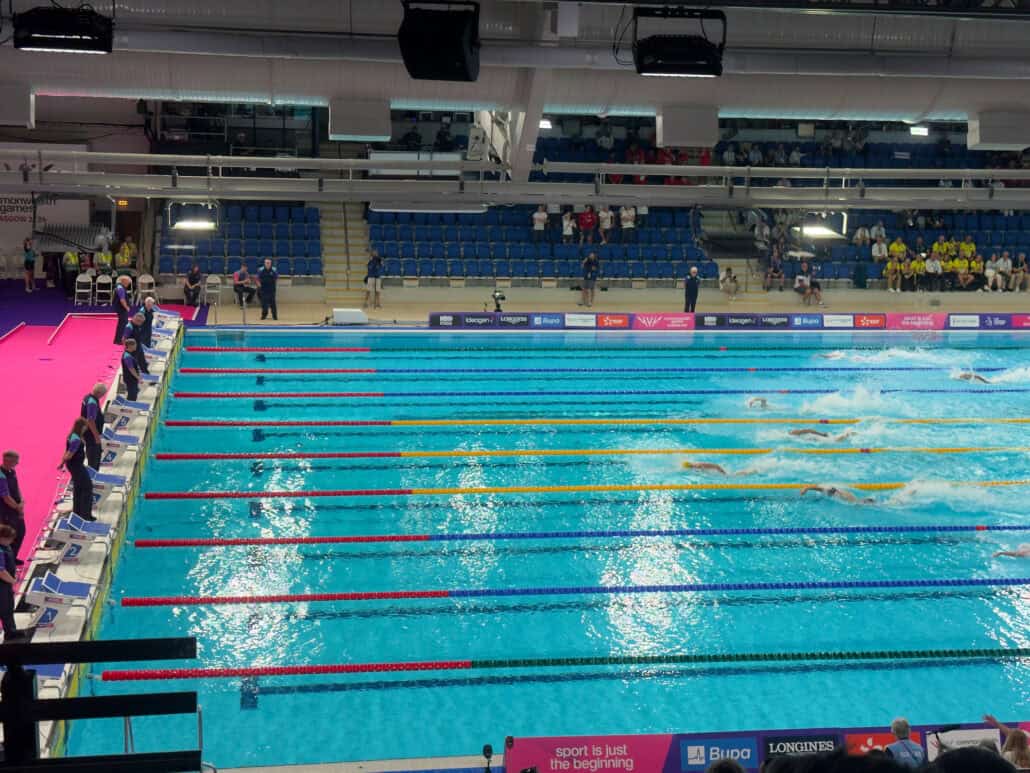
Numbers usually flatten a story. These ones are the story, because every hundredth of them was paid for long ago, in pools nobody was watching.
Now the night itself, because the numbers happened to people. We watched from a row that proved the whole thesis of the week: beside us, the aunt and uncle of one of England’s relay swimmers, up there doing exactly what we were doing in a different accent, and directly behind us, Flynn Southam’s parents. A relay is a team sport, and it turns out the grandstand runs relays too, rows of families passing the same nerves down the line, strangers until the gun, teammates by the first turn.
We jumped, and we hugged each other, and then we hugged Flynn’s family, and then we hugged the English, because at that point in a night like that the concept of opposition has dissolved completely. There is nothing on earth like the roar of a swim crowd over the last fifteen metres. Nothing.
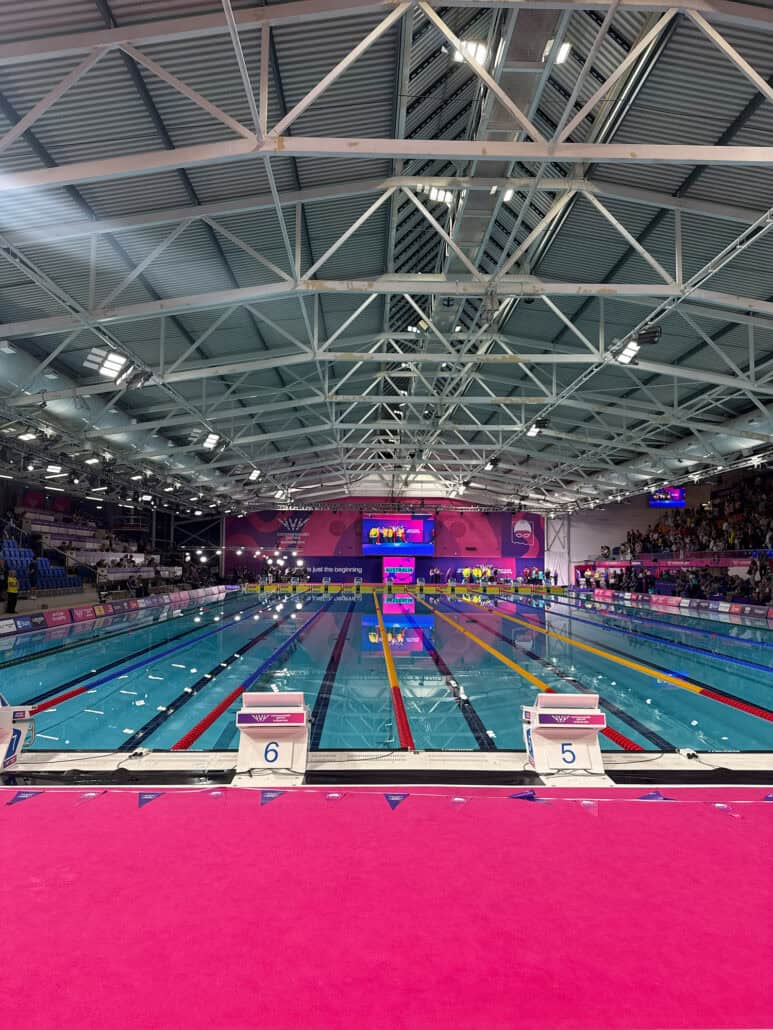
We should also report, in the interest of honest journalism, that Tollcross is hot. Excruciatingly hot, no air conditioning, possibly a drinks-sales strategy, and within half an hour of the gold the entire family section looked like it had swum the relay itself. It was not a pretty excitement. But it was fitting and felt very us.
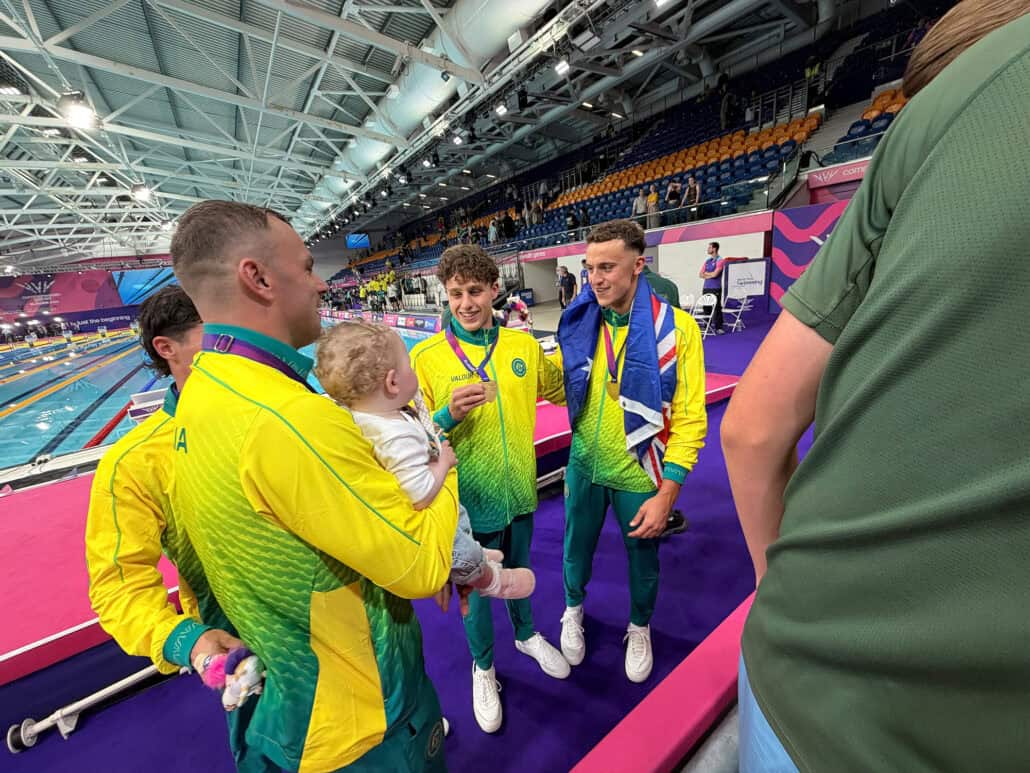
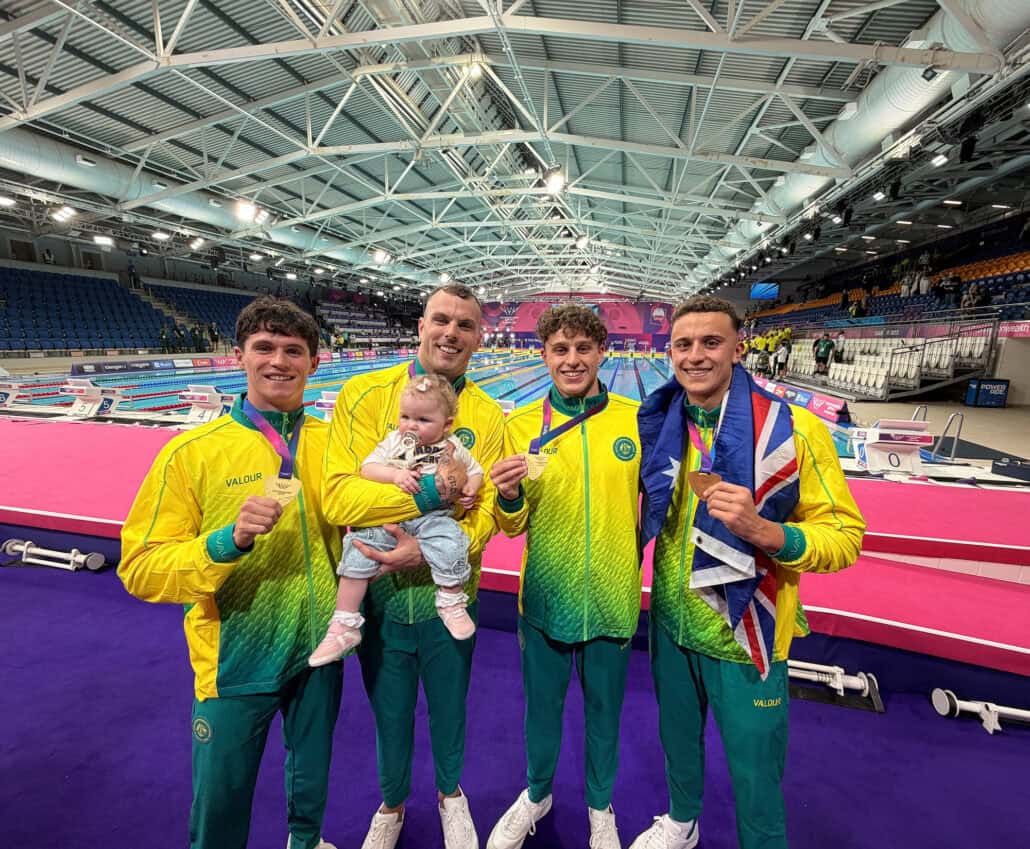
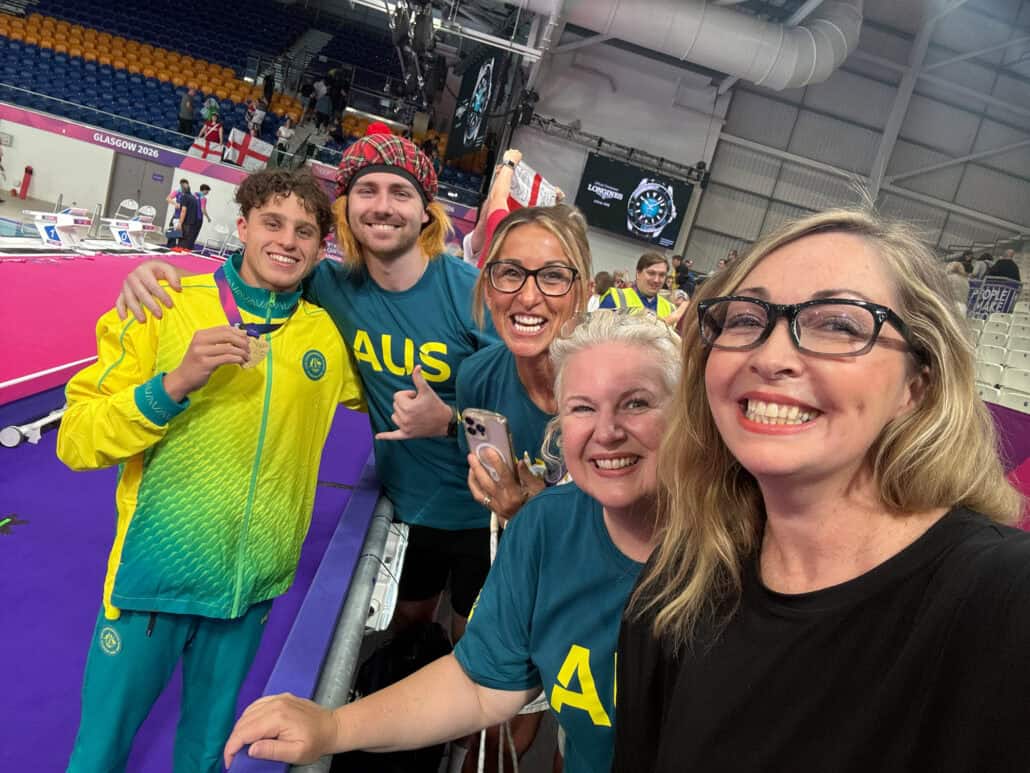
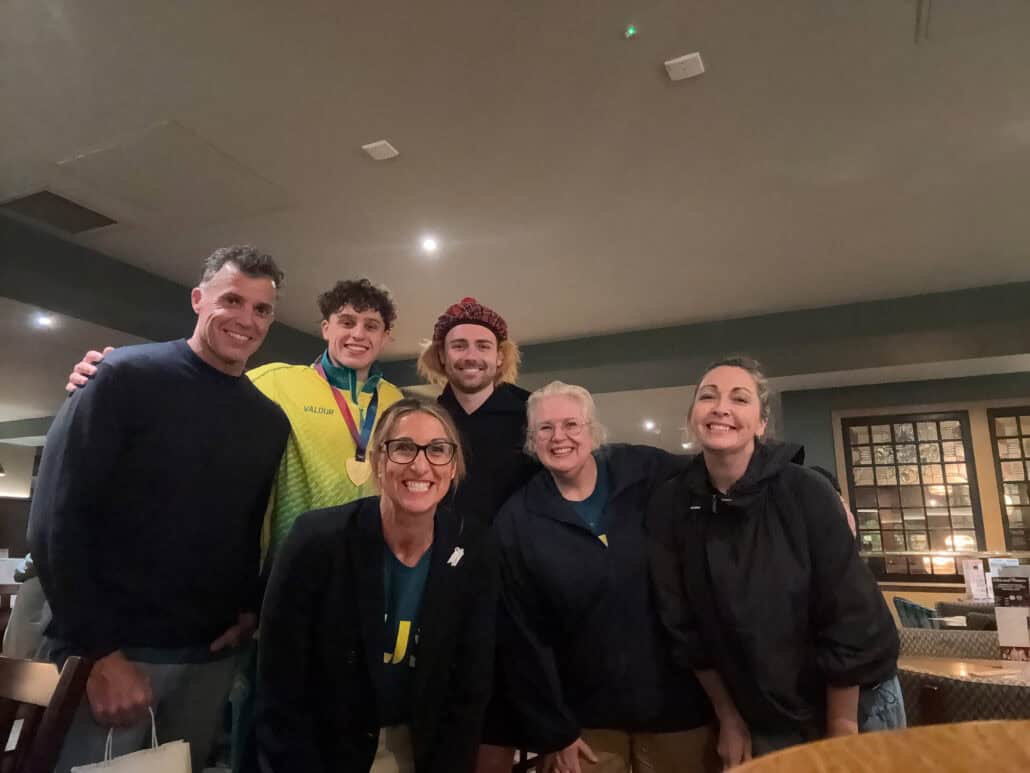
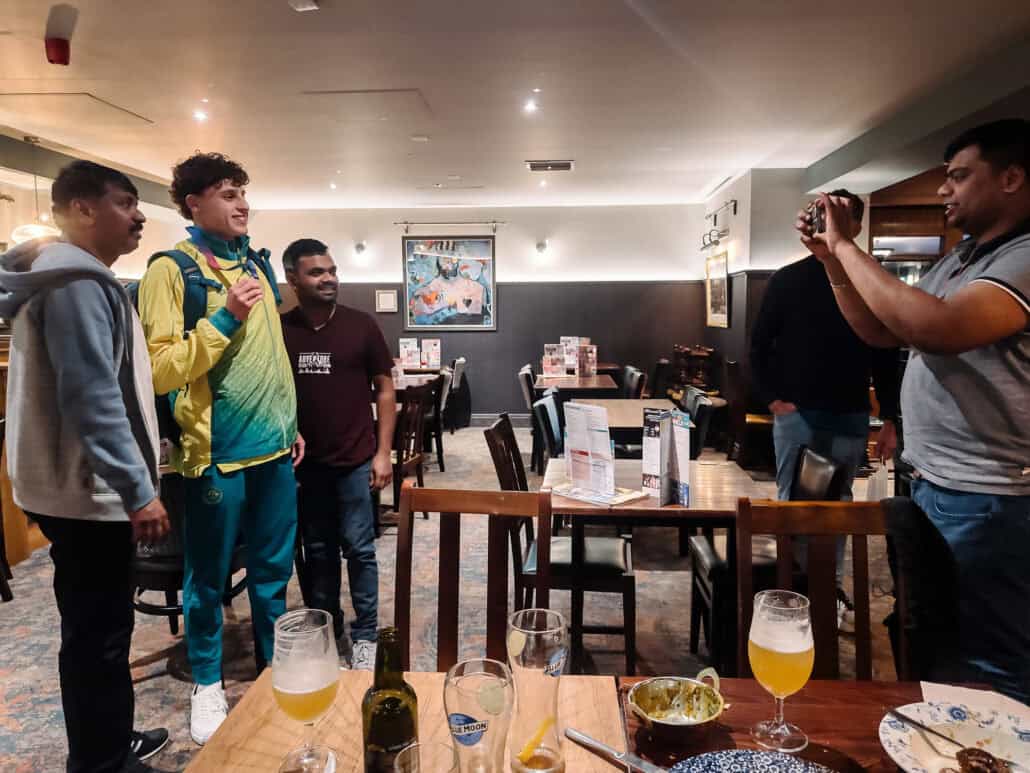
We moved sections to stand with Greg & Hayley. We had been singing the anthem all evening, because Australia kept winning things. But it wasn’t until the ceremony, until Kai and the flag were in our eyes at the same moment, that the tears came. And at eleven that night, eating late at a pub across the road from the team hotel, the door opened and there he was. Ten minutes of him, medal in his pocket, hugs all round. What he did say was that during the ceremony he’d looked up and seen all our faces together at the end of the pool, and that it mattered. We will be at every pool we can reach for the rest of our lives.
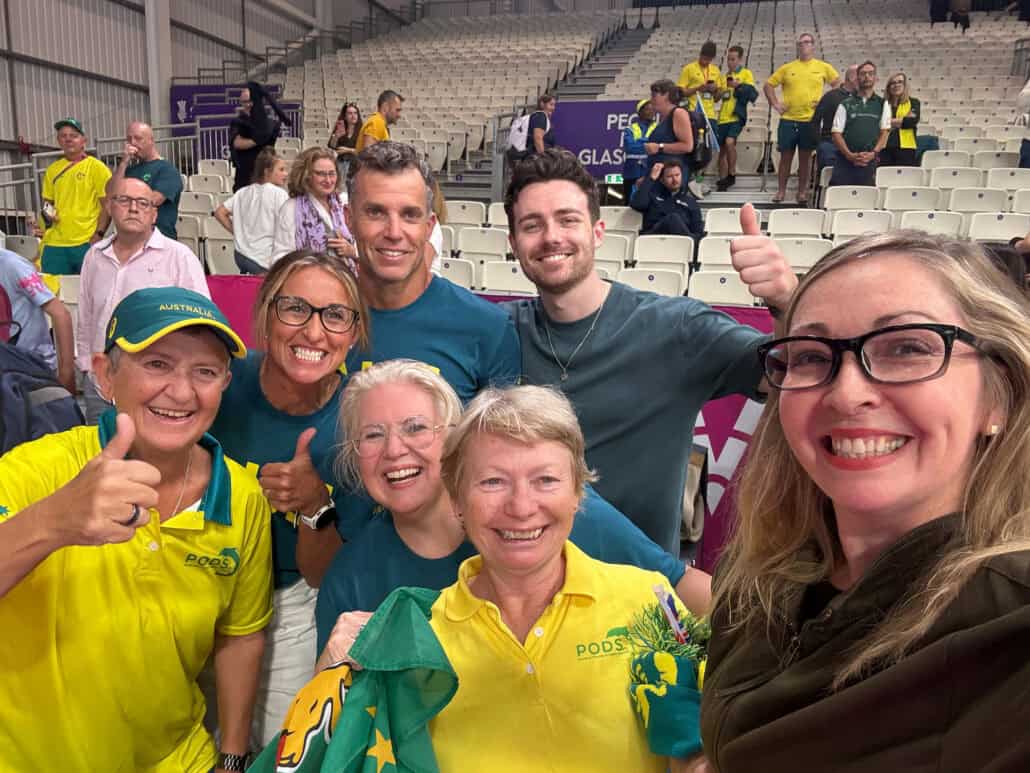
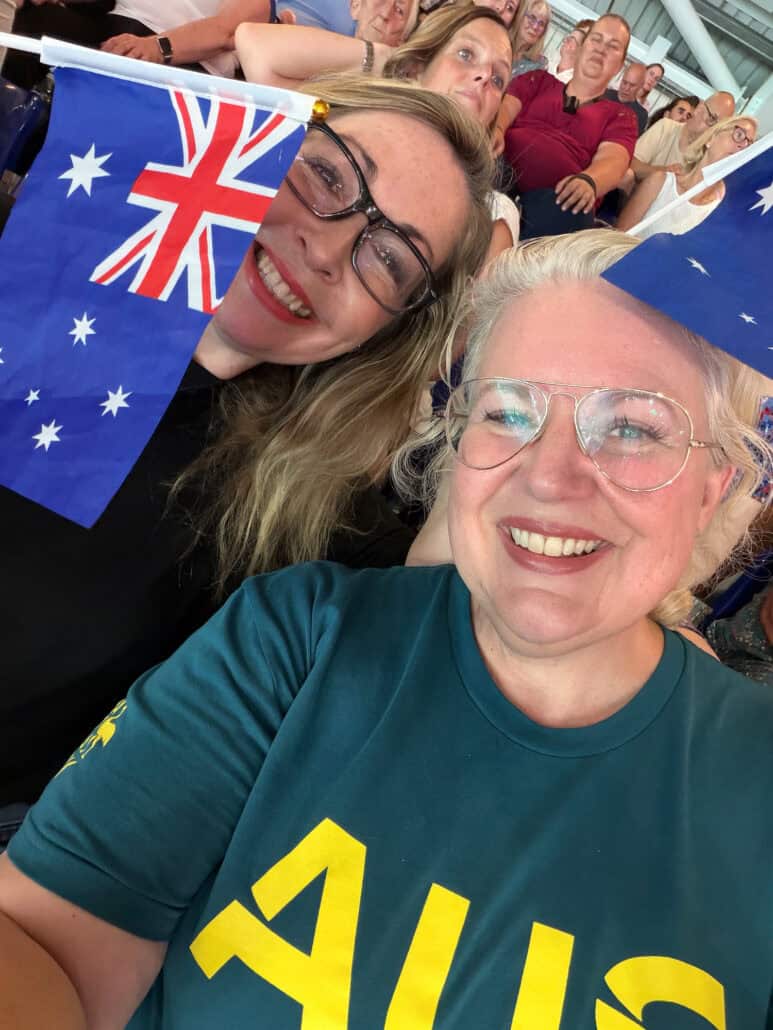
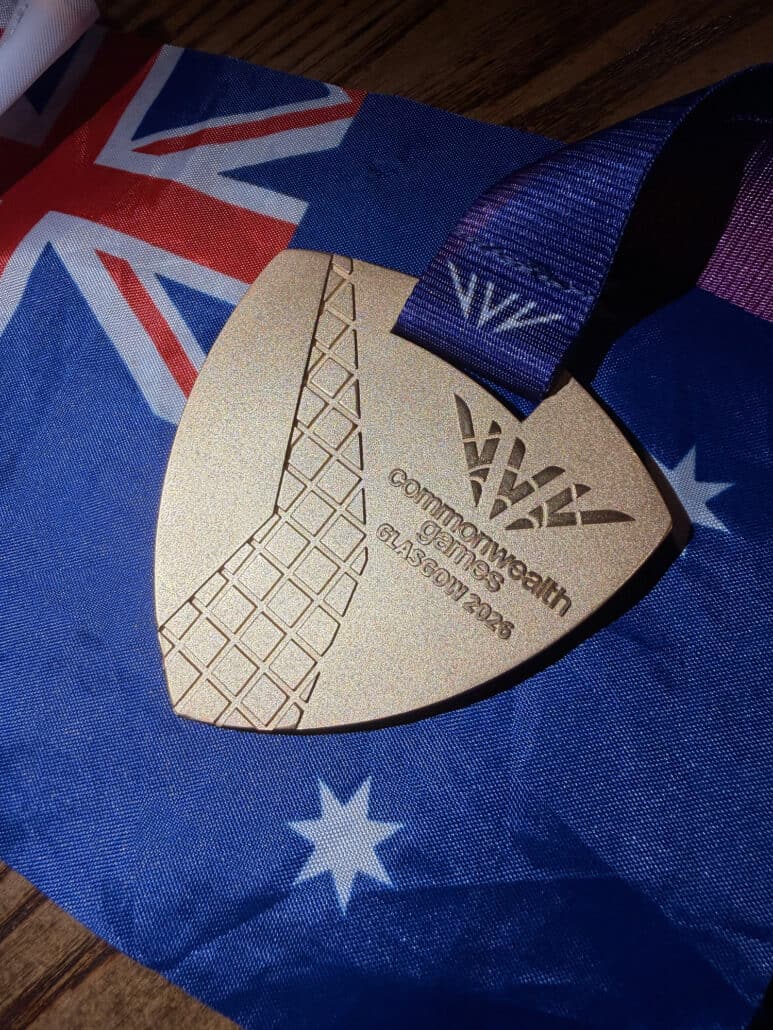
And the shortbread. We owe the record a correction on the shortbread. The baker’s instructions were explicit: give it to them before they race, and it’ll make them win. We regret to confirm that not one crumb of Crystal’s finest ever reached a swimmer. It reached us. All of it. And Australia won gold anyway, twice over, from which we can only conclude that the blessing works on contact with any Australian in the building, and that we were, in fact, load-bearing. We’ll be taking that interpretation to the grave, along with, apparently, the shortbread.
The gold he won at dinner
Between the relay nights, another medal arrived. Kai swam the morning heats of the mixed 4×100 freestyle, the team won the final that evening, and because he’d done his shift in the heats, the gold is his too, without his ever standing on a podium for it. We watched the final on our phones over dinner across town, and then came the lovely touch we’ll remember longest: at the ceremony, Glasgow read the heat swimmers’ names aloud to the arena. A city that honours the invisible shift deserves every kind word this series has said about it. Two golds inside two days, and one more night of relay swimming still ahead at that point. One gold won in lights, one won at nine in the morning. This post has been arguing all along about which kind counts. The answer is yes.
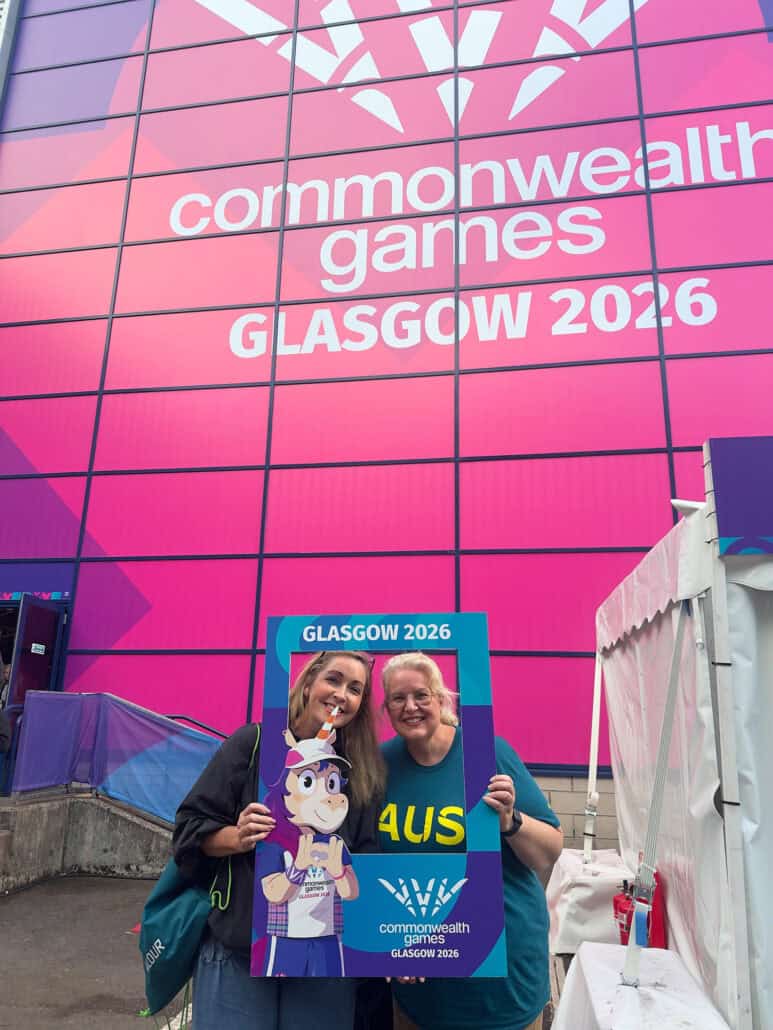
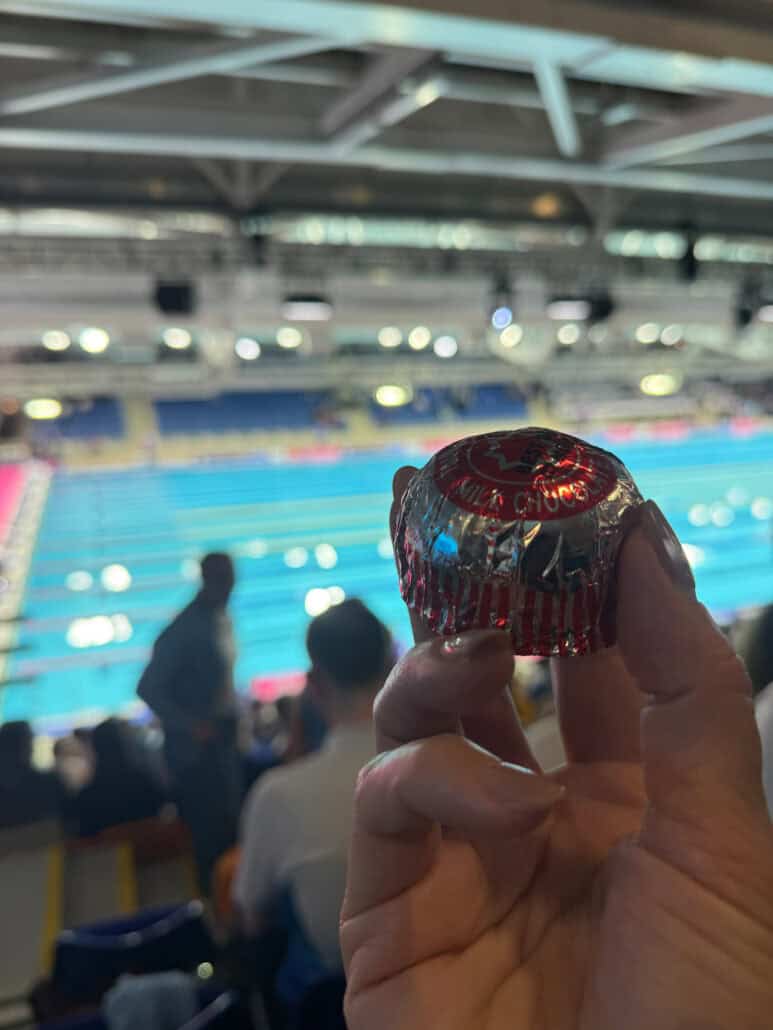
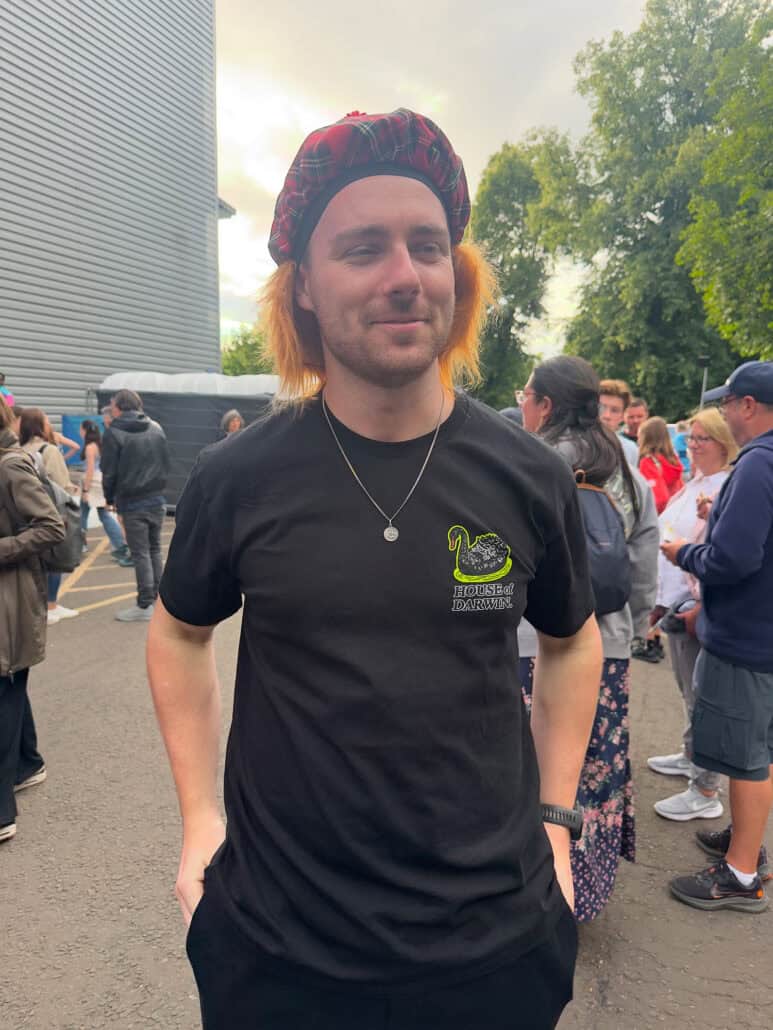
Seven minutes
On Sunday night the Australian corner of Tollcross became a village with its own postcode. For about seven minutes, the length of a 4×200 freestyle relay, a full arena turned toward eight hundred metres of water and did the thing crowds do, became briefly one creature, larger than the sum of everyone in it, and poured all of that down onto a few bodies in the water out of all proportion to their size. We wrote a whole post about that feeling. Here is the part we left out: one of the four bodies it landed on was ours.
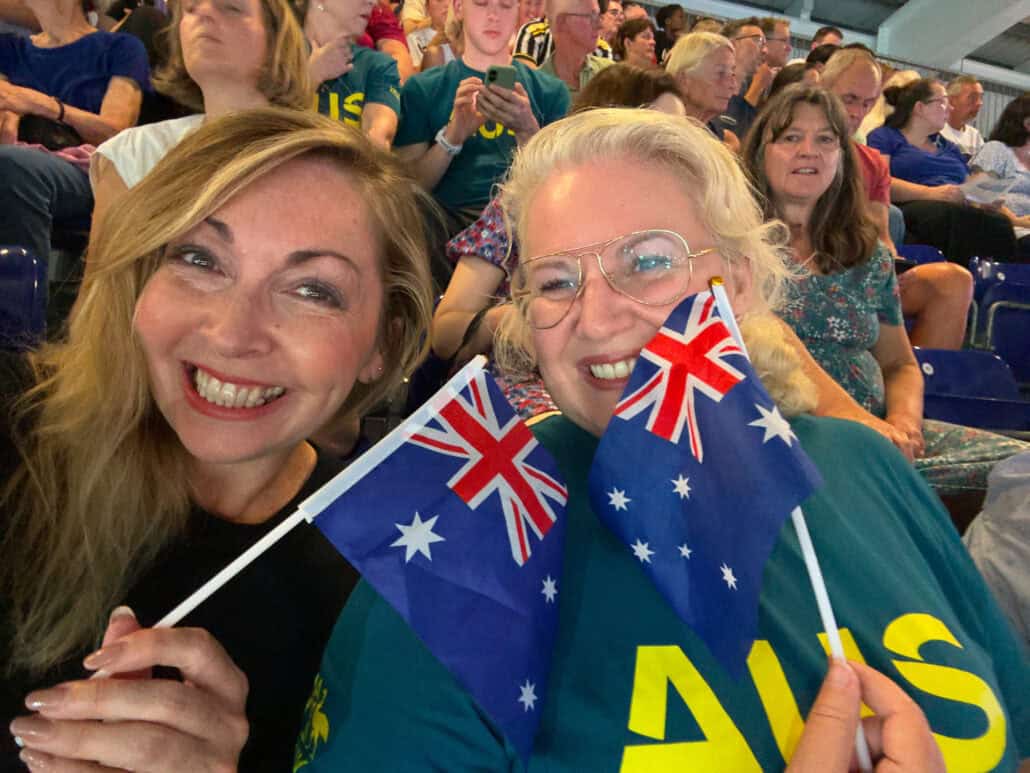
And this is where we broke the rule we spend our lives preaching. We make our living being calm with a camera at the most emotional minutes of strangers’ lives, and forever asking those strangers to put their phones down and just be there, because the footage of the moment is never the moment. On Sunday we took our own advice. There were professionals on the pool deck to make the pictures. For once there was no glass between us and the thing happening, no job to do, nothing to frame. We got to be all the way inside it, two aunts with no cameras and no composure, doing the oldest job a family has. We are, the pair of us, professional witnesses. This time we work for free, for the best client we have ever had.
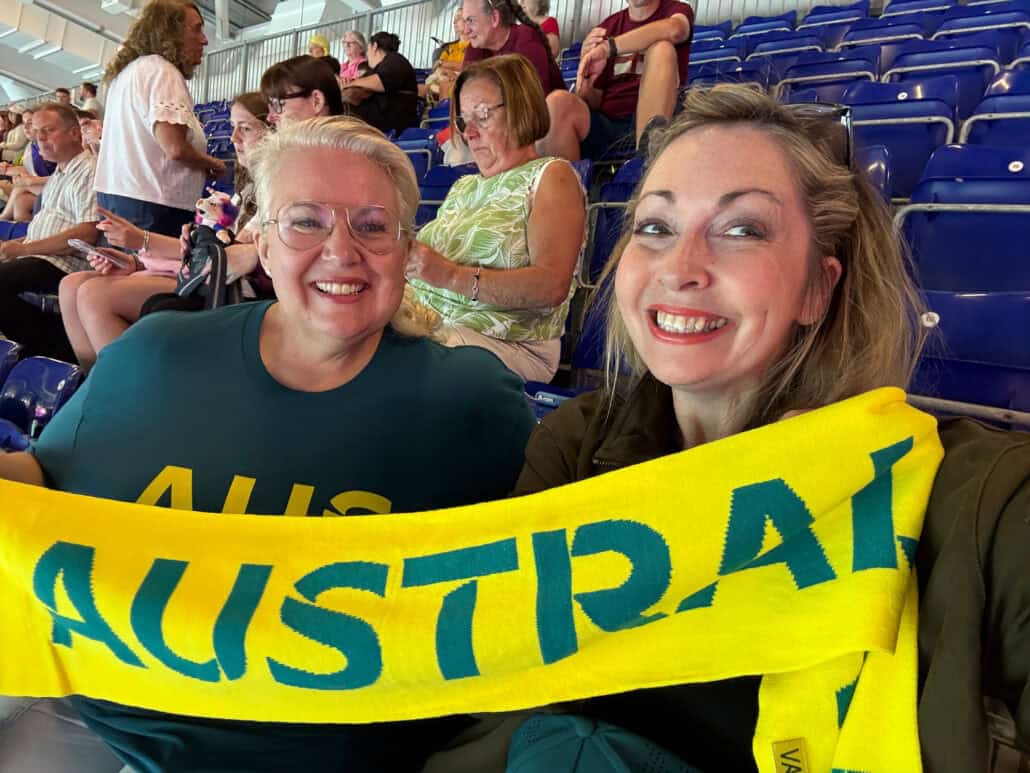
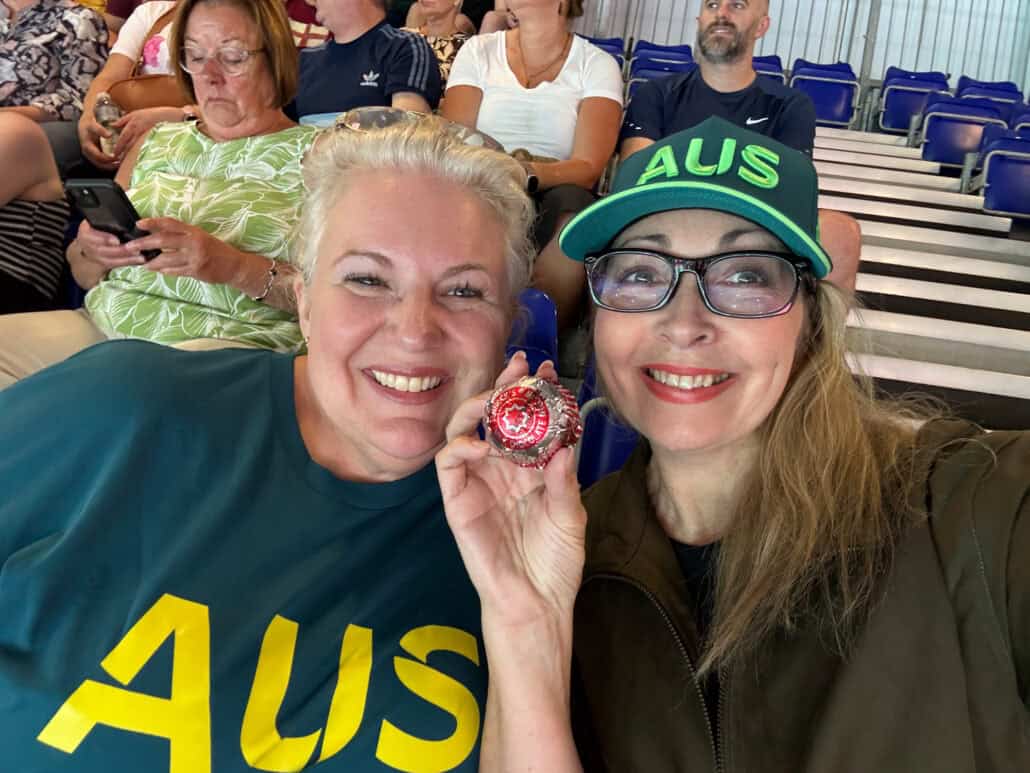
We are, the pair of us, professional witnesses. This time we work for free, for the best client we have ever had.
We weren’t the only ones holding our breath. Greg was doing the split-time arithmetic in his head, silently, decades after it stopped being his job. Hayley’s tears arrived on schedule, because some things are dependable, and this time it looked like they even recruited a couple from Greg, which is how you know it was historic. The grandparents weren’t poolside, but they were absolutely part of the roar, the way Jacob & Eloise and the cousins and the uncles and the aunts were part of it from lounge rooms and watch parties scattered across half a dozen time zones, all of them shouting at the same boy through different screens at the same second.
And then the race outran every version of it we had imagined.
At the final changeover, Australia was not winning. England’s James Guy, arguably the greatest British relay swimmer of his generation, had just produced a 1:44.03 split, one of the swims of the entire meet, and handed his anchor the lead. So the last two hundred metres of this family’s thirty-six-year story began with Kai diving into second place, with eight lanes of noise on top of him and a job to do. He had to hunt it down.
He hunted it down.
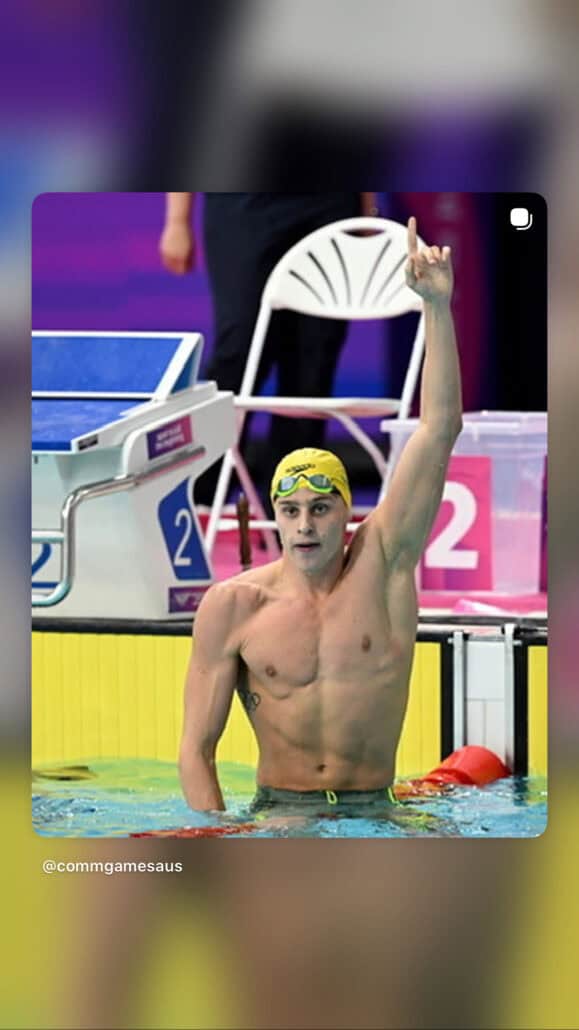
Kai ran down Max Litchfield stroke by stroke and turned the race completely around, and Australia touched in 7:01.67, a Commonwealth Games record, more than three seconds clear at the end of a race that had been England’s ninety seconds earlier. His split: 1:44.10. The fastest relay swim of his life by nearly half a second. The second-fastest split by anyone in the final, seven hundredths behind James Guy, and in this sport seven hundredths behind that man is a compliment with a decimal point in it.
The next morning the sport’s press did something the family noticed more than any number. Swimming World called it the anchor leg of his life and led not with the record but with him: Son of a Gun Claims Gold, the gun in question being his mother. SwimSwam wrote the final up as Guy against Taylor and called the two of them a class apart. And Commonwealth Games Australia’s recap of a five-gold day gave the relay one sentence: Kai Taylor swam an outstanding anchor leg to give Australia the win. He isn’t emerging anymore. He has arrived.
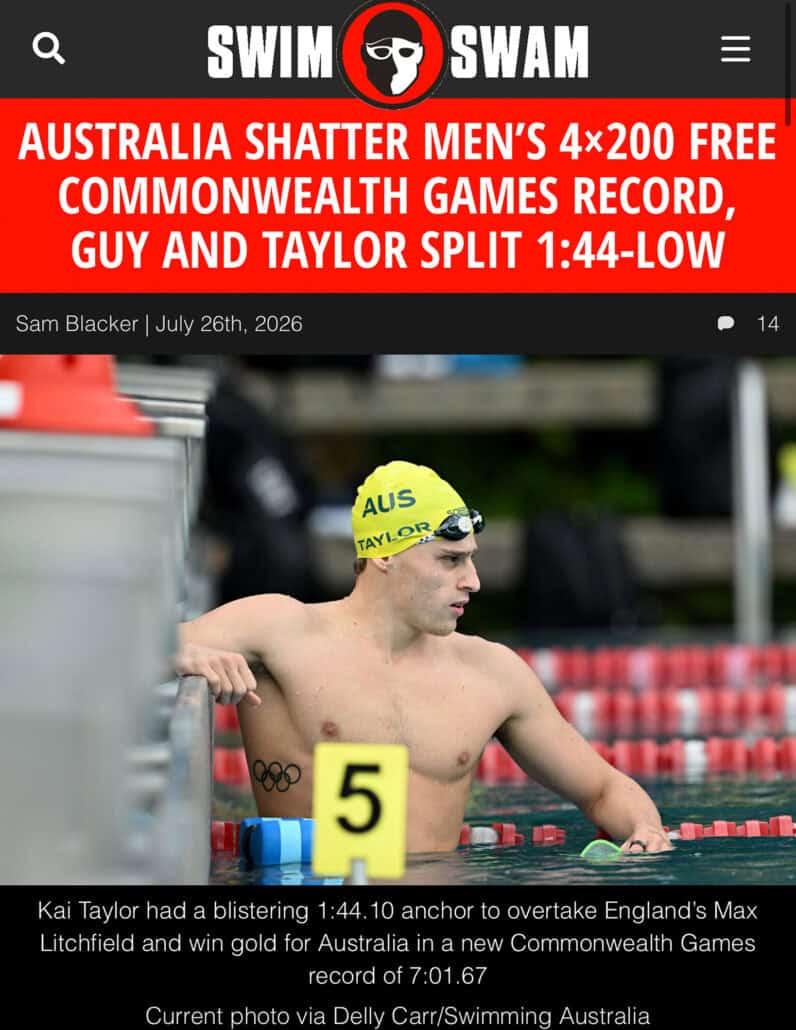
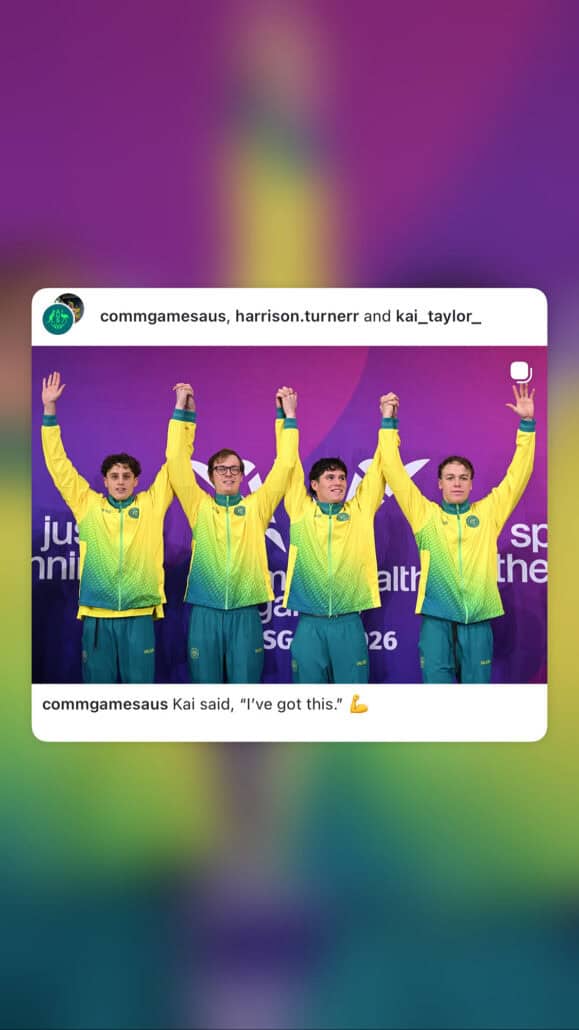
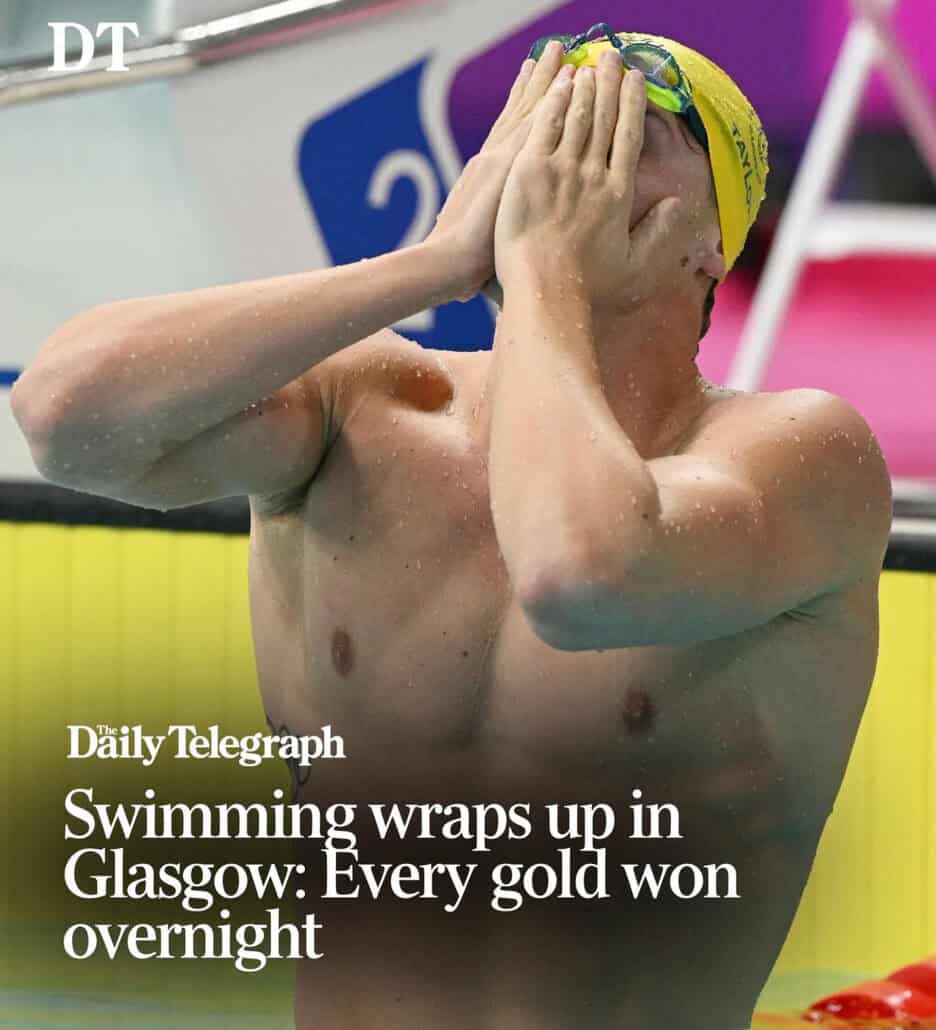
Australia put the anchor leg in Kai’s hands on Sunday night, against the best in the Commonwealth, and he justified every gram of their belief in him. That’s how relay reputations are built. We watched one get built in a minute and forty-four seconds, from close enough to lose our voices.
Some circles take a generation to close. This one closed in seven minutes and one second.
The hugs
We almost missed the hugs.
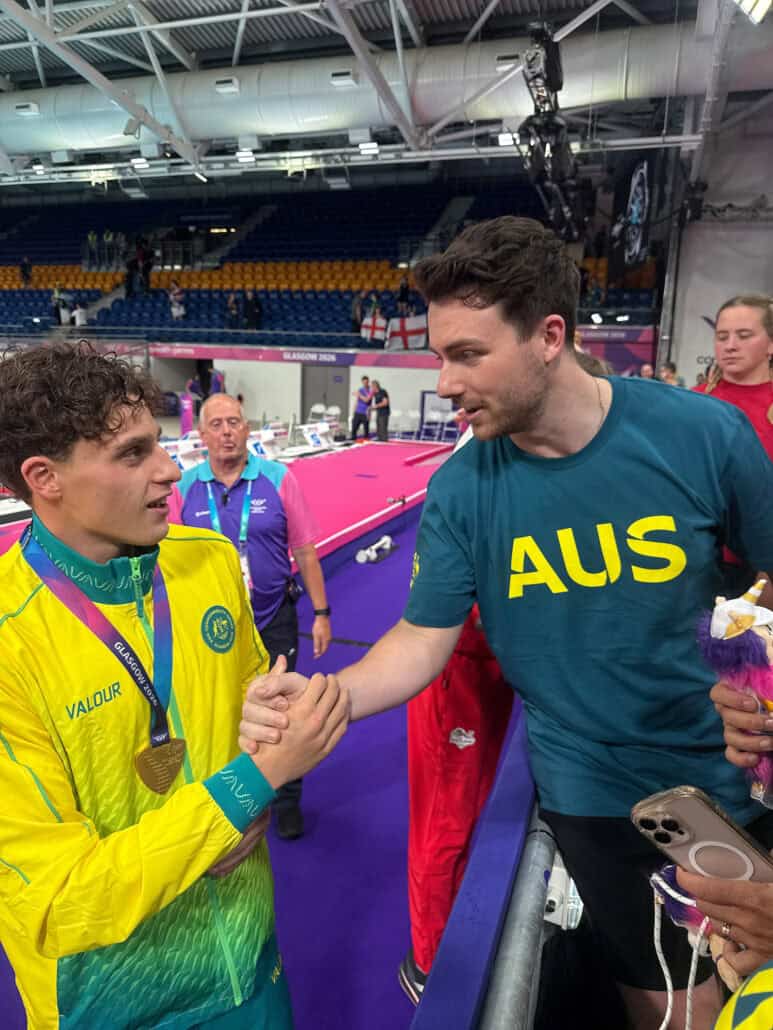
After the medal ceremony, the swimmers do a victory lap, and the families gather in a different section of the arena to steal a few precious seconds at the fence. A hug. A photo. Maybe a few words before the athletes disappear back into the machine. Simple enough, except that nobody seemed to know exactly where families were meant to go, and by the time we’d made our way around the arena we were standing outside locked doors with a handful of equally confused people, every volunteer pointing somewhere different.
Then a man beside us smiled. Come with me, he said. I’m family too.
As we walked, he asked the question everyone in that corridor asks. Who’s your swimmer?
Kai Taylor.
His eyebrows lifted, just slightly. And yours?
I’m James Guy’s dad.
Of all the people, out of thousands. The father of the man who had just traded the night’s two fastest splits with Kai, seven hundredths apart, the rivalry of the meet now standing beside us in a concrete corridor offering directions. At the entrance we were stopped again. More confusion, more sorry-you-can’t-come-through. James’s dad wasn’t having it. The three of us are family, he said, firmly. We’re going in. It took a few more anxious minutes, and then the doors opened, and he marched us straight to the family section as though we’d all arrived together. The rest of the family, it turned out, had staged their own separate arrivals. Hayley and Liam had talked their way through the accessible entrance on the strength of a limp Liam invented on the approach and committed to completely, giving the performance of the night thirty metres from the pool. And Greg had slipped down close to the deck to film the podium and the anthem, which meant that afterwards, with no fake limp of his own and no James’s dad to argue him through a door, he watched the victory lap on his own, phone up, filming it for all of us anyway. One family, one gold medal, four different doorways. We found each other eventually. Families do.
Minutes earlier, James Guy and Kai Taylor had produced the two fastest relay splits of the night, separated by seven hundredths of a second, one of the great relay duels of the meet. Now their families were standing shoulder to shoulder at a fence, waiting for exactly the same thing. Not medals. Not records. Just a hug.
Sometimes sport writes stories no scriptwriter would dare invent. This was one of them.
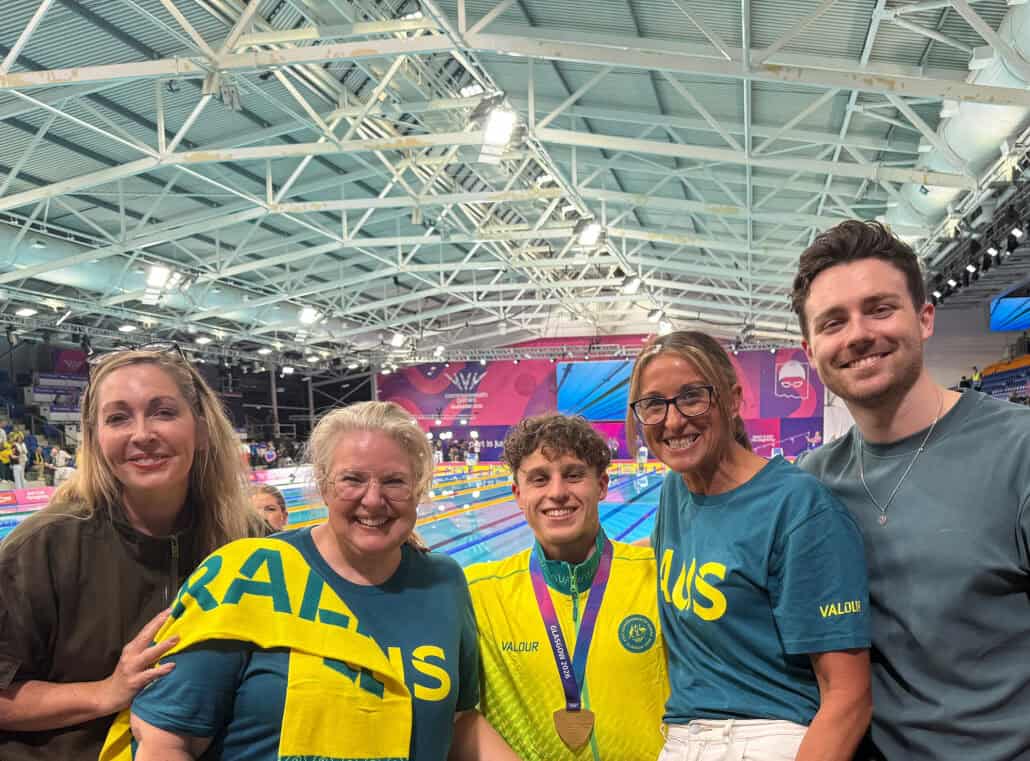
And the hug itself, when he finally reached us at that fence? What we remember is the smile. The hours they spend staring at the bottom of a pool, every day, for years, are for exactly this: not the medal in the pocket, but a young man standing at a fence, drenched and lit up and completely in love with what he’s doing. Seeing that smile is everything. The rest of the night was logistics.
The outside lane
And then, on the last Wednesday of the meet, he finished the story himself.
The men’s 200 freestyle final, the one race that was only ever his. He’d qualified seventh that morning in 1:47.23, which put him in lane one, the far outside edge of the pool, away from the favourites and half out of the television frame. The final was billed as a Battle of Britain: four British Olympic champions across three home nations, England’s last real chance at a swimming gold in front of their own crowd, and the defending champion already eliminated in the heats to make the point that nothing here was safe.
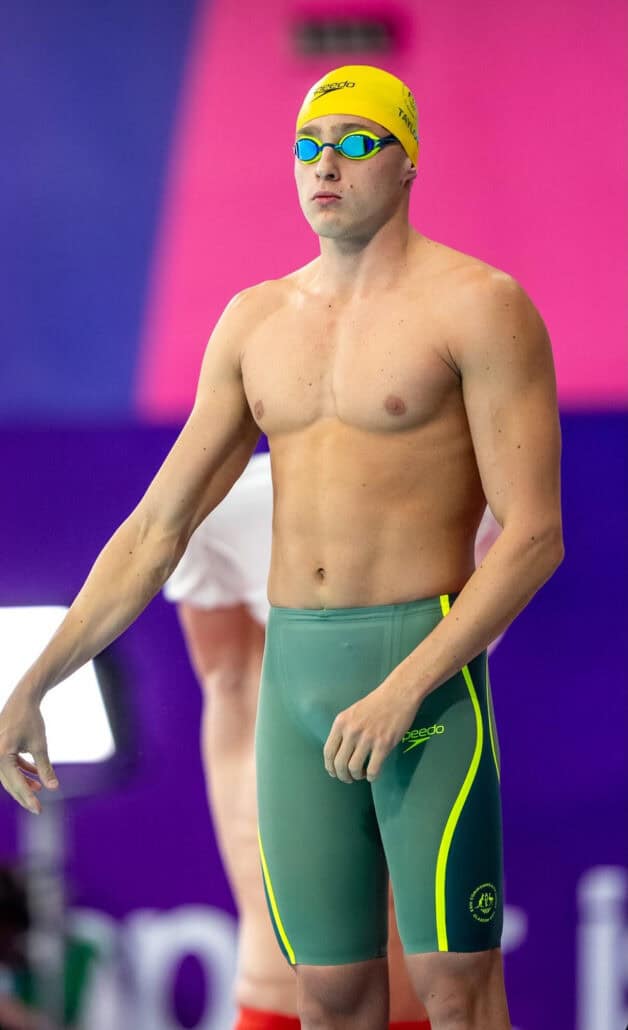
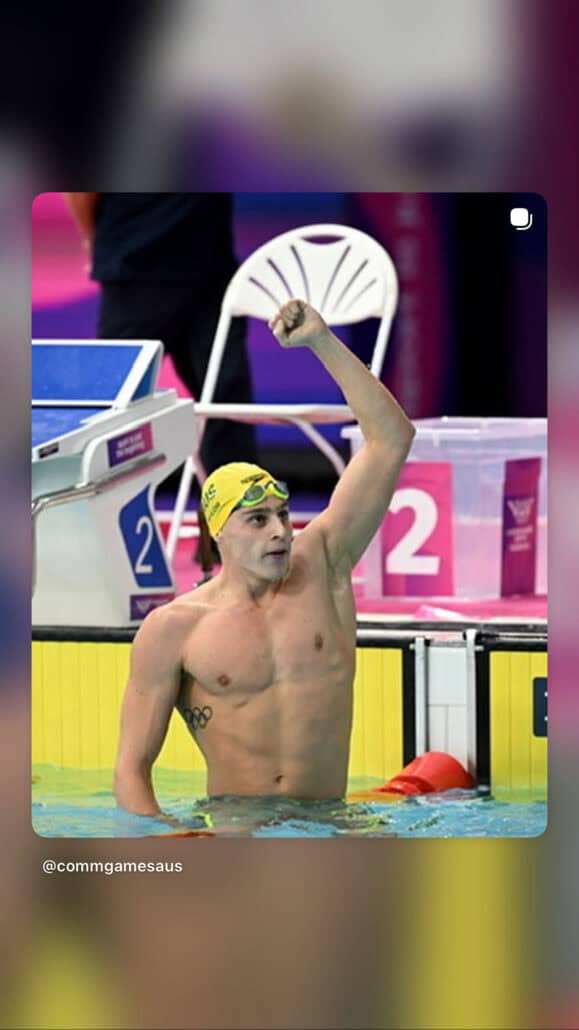
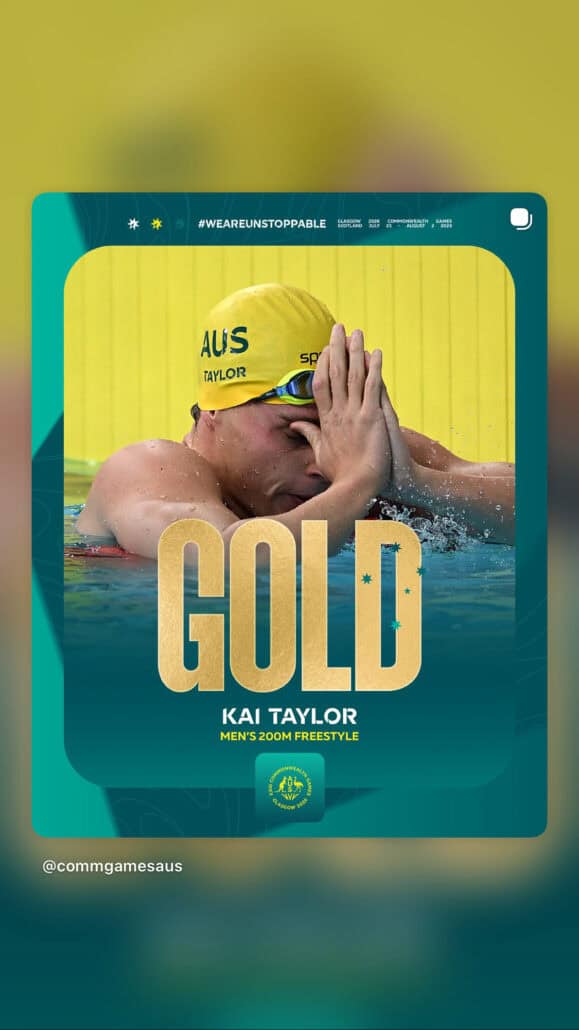
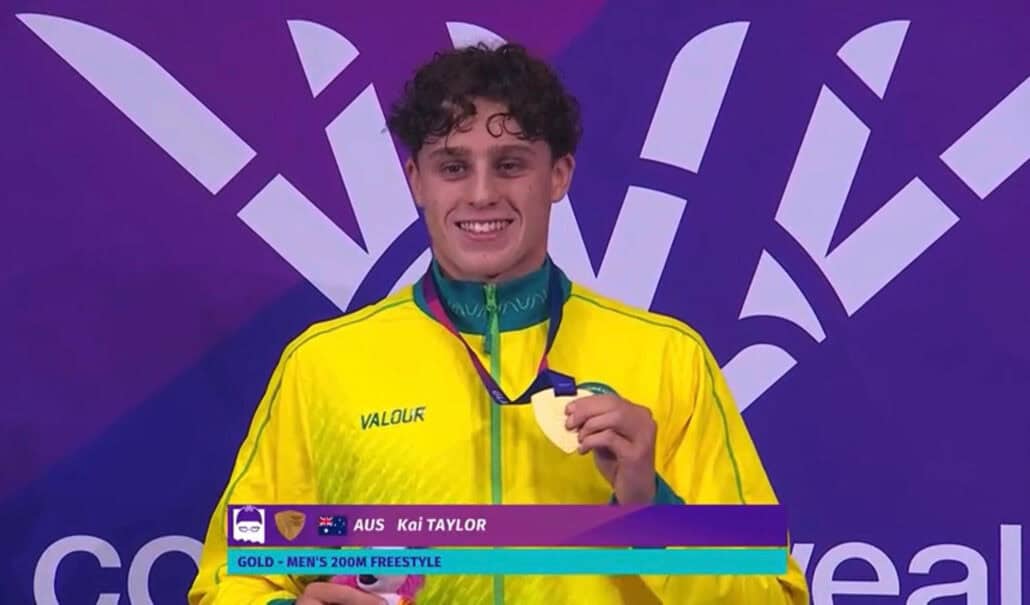
Kai swam it from lane one the only way lane one can be swum with intent: he went out hard, took the lead early, and front-ran the entire race, knowing the field would come hunting late and that the job was to go strong and hold on. He held. He touched first. GOLD! James Guy, of course it was James Guy, took silver. A brave, front-run win from the most difficult lane in the pool, with everybody chasing, on the night it mattered most. A Commonwealth champion, individually at last. Four golds.
The Australian press reached instinctively for the national scripture, Kieren Perkins winning from lane eight in Atlanta before Kai was born. The family reached further back still. And here is the part that made the grandstands of two hemispheres go quiet. In 1991, at the world championships in Perth, a teenager named Hayley Lewis won the 200 metres freestyle from an outside lane, running down the favourites late. Same event. Same lane draw. Different tactics, same address: she ran the favourites down late, he led from the gun and dared them to come. Thirty-five years apart, mother and son, both winning the 200 freestyle from the outside. Kai even won his national trials from lane eight once. In this family, the outside lane isn’t a disadvantage. It’s an address.
And one more strand in that DNA, because Kai’s origin story has two swimmers in it. Greg swam too: from childhood, well enough to make Australia’s target squad for the Barcelona Olympics, before choosing a different kind of swimming life, the pre-dawn drives, the poolside decades, the years of being the steady water everyone in the house pushed off from. He took the sport back for himself once the boys were grown, and just a month ago he crossed twenty-six kilometres of Swiss lake and touched Zurich second overall. Watch Kai’s anchor leg with all of that in mind. The anchor enters the water last, after everyone else’s work is already in it, and holds. His mother’s racing and his father’s holding, in the same stroke. Both inheritances were in the pool on Sunday night. Both touched first.
We called this post A Boy in Lane Four before any of it was swum, because lane four is where swimming puts its favourites. He spent the fortnight proving the title wrong in the best possible way: gold from the relay changeovers, gold from the nine a.m. shift, and now gold from the outside, where nobody was watching. Which, in this family, as this whole post has been arguing, is where everything worth having gets built. The relays, for the record, really did swim out of lane four, so the title kept its literal ground for two golds, and the third one improved on it. And when the media asked him afterwards about winning from lane one, Kai answered with the entire argument of this post in nine words: if you have a lane, you have a chance.
If you have a lane, you have a chance.
Enough
Before his individual races, we read the form the way everyone does. We knew the field, we knew the British swimmers who owned the 200 freestyle, we knew roughly where he sat among them, and we wondered, and we hoped for the breakthrough the people closest to him knew was coming. Then he went and made the form irrelevant from an outside lane. But every one of those conversations lands in the same place, which is that we just want him happy. The green and gold has always been enough. The first time we saw him wear it, the dream had already happened. Everything since, and this week there has been a great deal of everything, has been a bonus. And our feelings were never waiting on any of it, because the thing we are proudest of happened years ago: a boy we love grew into a young man who earned the right to those colours. Another medal would be wonderful. The memories have already outrun the count.
We could feel the question forming as we packed, so we’ll answer it straight: why leave before his individual 200m? Because we love the roar of an arena, but it has never been the only way we love to watch. And because home held the people who couldn’t make the trip, Tracey’s mum and dad, who are getting older, and being near them at this stage of all our lives is worth just as much to us as a stadium seat. The plan was tidy: the hundred watched from London, and the two hundred from their lounge room, watching their faces as much as the race. Kai had his own parents there in Glasgow. Trace wanted to be with hers.
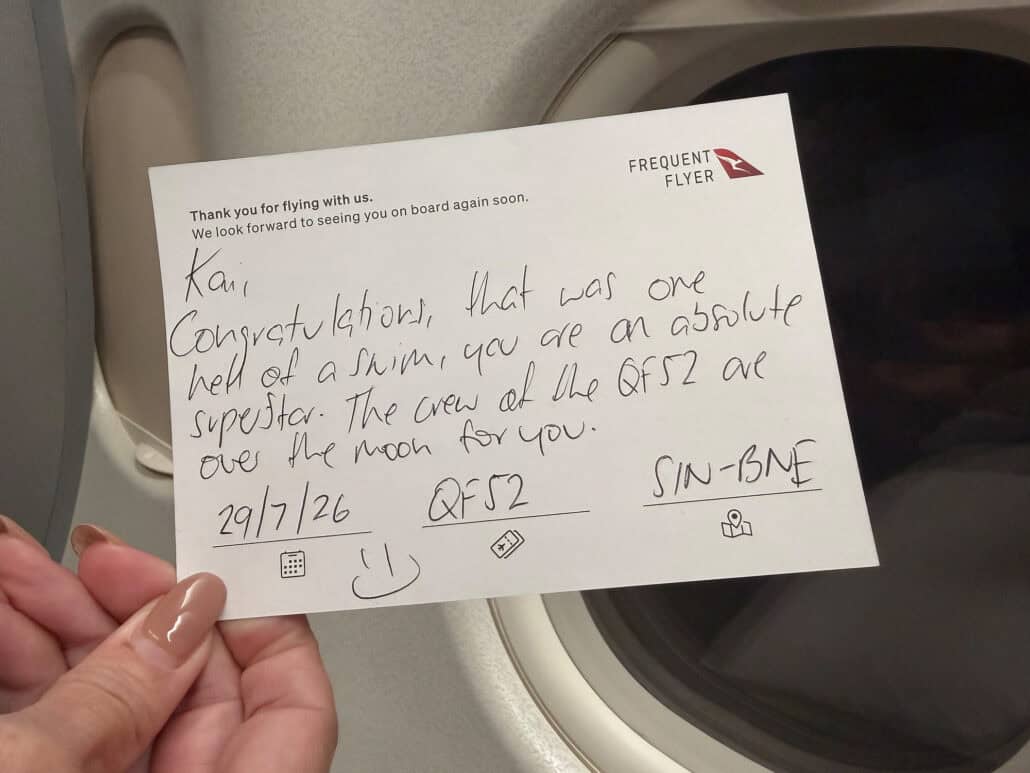
Then the plan met a delay, and we watched the 200 metres freestyle final from an aeroplane seat, somewhere over the ocean en route from Singapore, in a dark cabin where every other passenger was asleep. Just us, the flight attendants, and a boy in lane one on a screen the size of a postcard. The wifi held, which felt like its own small miracle. And Qantas rose to the occasion like they’d trained for it: when he touched first, the crew appeared with champagne and cake, and turned the breakfast lights on about five minutes after the race, as if the whole aircraft had been waiting on him. Then, on landing, a flight attendant picked up the intercom and announced that a short while ago, in Glasgow, Kai Taylor had won 200-metre freestyle gold for Australia. And the plane cheered. A cabin full of strangers, at dawn, cheering a boy they’d never met. The grandstand, the sky, the whole world on its way somewhere. Between us all, this family watched him every way there is to watch.
And the part that undoes us, as two people who document other people’s lives for a living, is this. There were a thousand cameras on Kai that night, on the pride and the colours and the podium, and that is exactly right. The achievement has earned every lens pointed at it. But the photograph we would give anything to take is the one nobody did: grandparents, half a world from that pool, watching their grandson win on a screen, the tears coming, and not a single camera in the room turned toward them. We weren’t there to take it; we were in the sky, holding champagne we hadn’t ordered. And we still wouldn’t have taken it. (Also, frankly, we wouldn’t have been allowed to. It was four in the morning in Brisbane and they were in their pyjamas, and there are rules in that house, gold medal or not.) The longer we do this work, the surer we are that the most important images are the ones no camera ever catches. The podium will be documented forever. A grandmother’s tears will not, and that is exactly what makes them the truest picture of the whole trip. Some love is only ever witnessed, never filmed, and we have built our whole lives around the difference.
We’ve told you now how all of it went, which is more than we once planned to. But the results were never going to be the truest thing about the week anyway. What we keep is not a number on a board. It is the seven minutes our whole family forgot to breathe at the same time, in a city that knows exactly what a crowd is for, for a boy who started as a kangaroo’s wink on a Brisbane footpath and grew into one of the swimmers other countries plan their races around.
Two stories in a yellow case
When we get home, the suitcase will go back into storage. Or perhaps it won’t. Either way, it holds two stories now: a young Australian swimmer we once faxed messages of support to, and her son, whom we flew across the world to watch. Some families pass down jewellery. Some pass down recipes. Ours, it turns out, passes down the quiet tradition of showing up for one another, wherever in the world the dream happens to be.
What we crossed it for
We chased light across Greenland and Scotland for the best part of a month, the ice and the empty roads and the glens and the long northern evenings that never quite went dark, and the light kept coming, all of it, more than two people could hold.
But we didn’t just cross the world for the light. We also crossed it for a boy in lane four. (And lane one it turns out!)
The light just kept coming anyway.
Read more Greenland/Scotland travel stories here:
The Night the Fjord Disappeared
Midnight Gold on the Ilulissat Icefjord