Their first dance took place beneath the stars, on a terrace scattered with petals. Behind them, their guests watched from the doorway; around them lay the gardens of Jinya, quiet after a day filled with people. This wedding in Japan had held two days of blossom, a roomful of friends, and a considerable amount of laughter. Here, for a few minutes, the two brides simply held each other.

We return to that photograph often. There is a particular kind of closeness that becomes possible when a couple feels completely at ease in the company around them. You can see the embrace, but you can also feel the people just beyond it, giving them room and staying near.
What makes the image stay with you is the feeling that these two can be fully themselves here.
The Blossom They Had Come For
They wanted cherry blossom. It was central to how they imagined celebrating in Japan, and that spring the season was taking its time. Bloom forecasts shifted, and the weather stayed changeable.
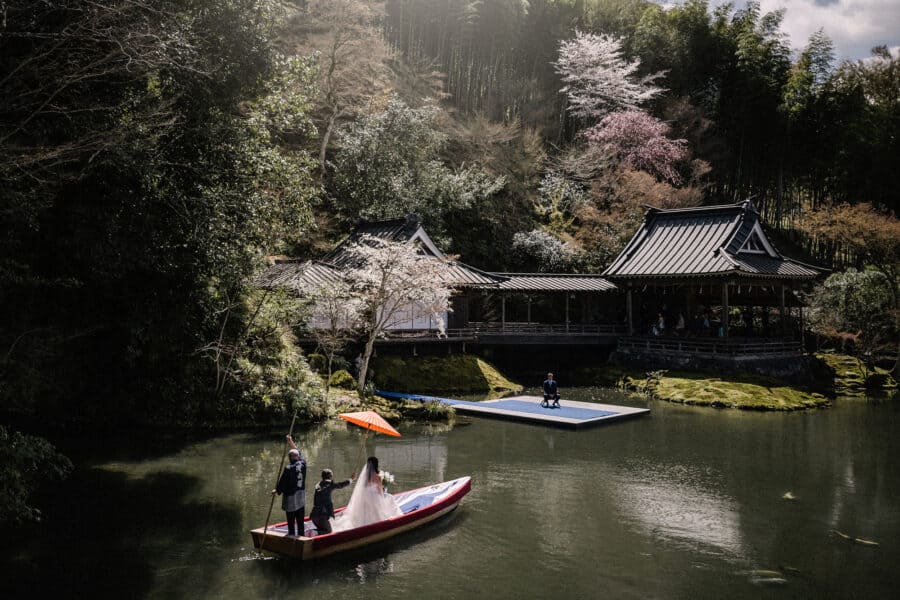
Dee and the florists designed the ceremony space at Jinya with real cherry blossom overhead and behind the couple, alongside white and blush flowers. The most important part of their vision had a considered place in the plans, while the surrounding gardens were free to arrive at spring in their own time.
By the two days of their celebration, the blossom was fully open.
We think a great deal about the relationship between planning and a place that is alive. People fall in love with a season because of how it feels: the pale light, the profusion of flowers, the way an entire landscape appears to soften. Helping them experience that requires an understanding of what can be arranged and what must be allowed to happen.
The couple should be able to stand beneath the branches and feel the blossom, with all the practical thought already held on their behalf.
For anyone considering spring in Japan, that distinction matters. A season is a living experience, and the best plans are made with enough understanding to welcome its variation.
Two Days Inside Spring
The old cherry trees were enormous, their branches carrying blossom above the brides as they walked beneath them. Beside a still pond, a great stone lantern and the two of them appeared again in the water.


Those reflections held a quieter version of the scene. Above the surface there were branches, movement, the texture of clothes; below it, the same things gathered into light. It was a lovely place to spend time together before the wedding, with the larger celebration still ahead.

That afternoon, pastel kimono brought a different shape and movement to the garden.


Japan rewards this kind of attention. You can stay within the same season, even within the same garden, and keep finding changes in what the light reveals. A doorway frames the landscape differently from a pond; the weight of a kimono changes how a person moves through it. The experience grows through these small differences.
Our hanami essay includes a photograph from their hillside portraits. It belongs there because looking at blossom is so often a shared act. The flowers give people a reason to stop, and the stopping gives them time to be together.
We have always loved that about the season. Something brief becomes an invitation to pay better attention to what is already beside you.
An LGBTQ Wedding in Japan, Shaped Around Two People
The small acts in the preparation for a wedding carry so much of its intimacy: someone helping you get ready to do something important, close enough to notice what you need.


We have made photographs of LGBTQ couples celebrating in Tokyo for years, and the work always begins with the people in front of us. The particular ease between them, the friendships they bring, the ways they show affection, the things they find funny: those details tell us how to see a relationship with care.


A photograph can acknowledge a couple with remarkable directness. It says: here you were, here were the people who came for you, here was the pleasure you took in each other. Given enough attention, it also holds something of how it felt to belong inside that gathering.


For this LGBTQ wedding in Japan, there was room for the full range of that experience. Two brides on a garden path with white and blush bouquets. Bridesmaids in burgundy and red. A banquet hall of family and friends. The quiet concentration of getting ready, followed by the considerable joy of everyone being ready at once.


The wedding has its own personality in the photographs because the people do. Our job is to recognise it and give it space.

From the Hillside to the Garden
Above Hadano, the cherry trees covered a hillside near the mountain’s summit. Their long veils spread across the ground beneath the blossom, pale against the landscape, while clouds held Fuji out of view.


We know this mountaintop in another season, when an autumn couple watched Fuji appear at sunset. In spring, its character was entirely different: flowers close around the brides, mist and cloud beyond, the sense of being held within the hillside rather than looking out across a vast distance.

Back at Jinya, the lantern-lined entrance path carried them towards the ceremony in the garden. That approach has a lovely effect on a gathering. People move through trees and light before reaching the place where they will sit together, and the transition gives them time to arrive emotionally as well as physically.
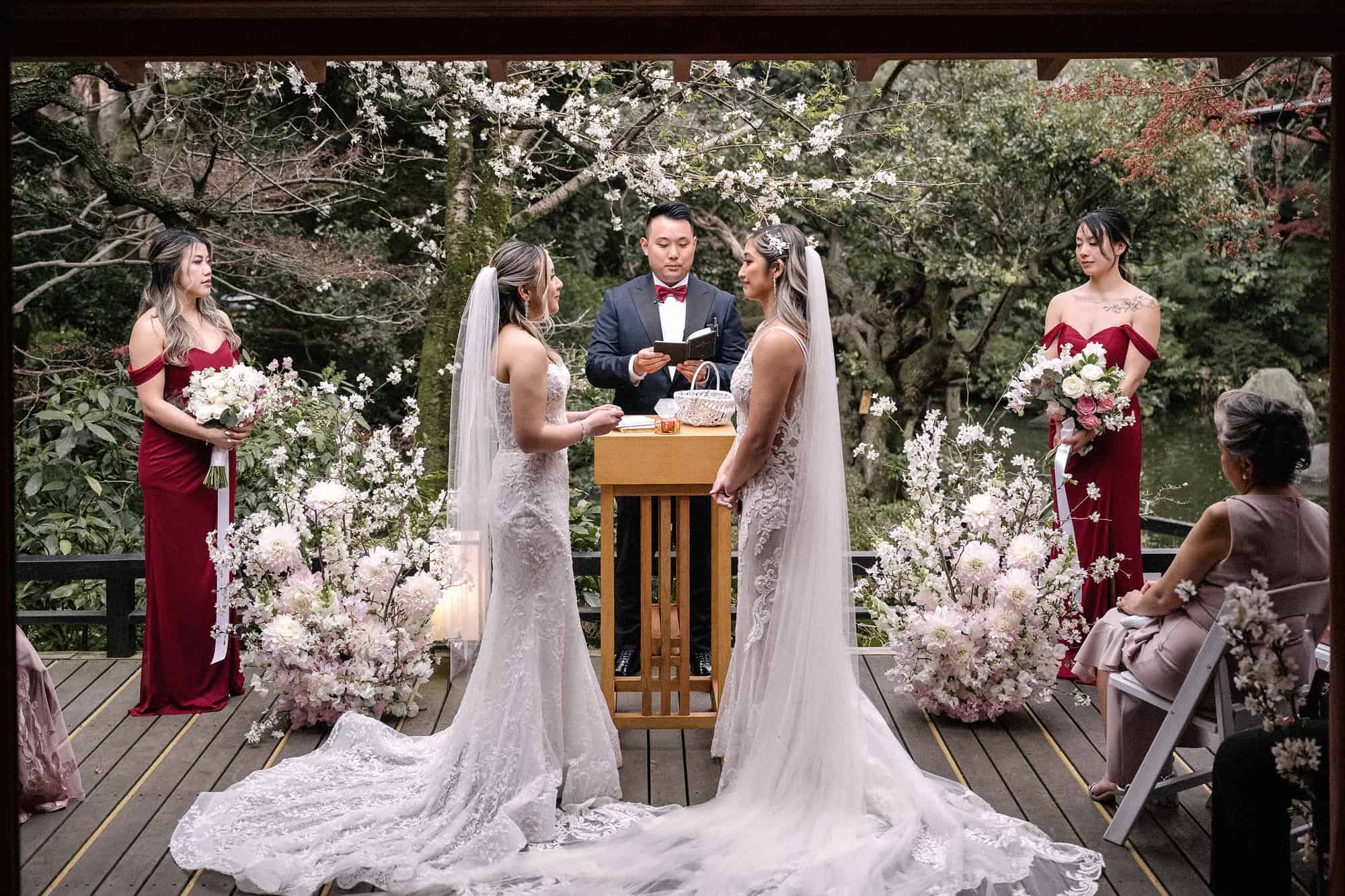
On the wooden deck, the real cherry branches extended above and behind the brides. A violin duo played, their bridesmaids stood beside them, and each bride read from her own small vow book. The kiss belonged to a ceremony whose scale felt generous enough for the whole gathering and close enough for the two people at its centre.


Afterwards, long white streamers crossed the air. They walked out hand in hand into the sort of cheering you can almost hear in a still photograph.

A Table That Became a Party
Inside the tatami banquet hall, big lattice lamps hung above long tables. Cherry branches, pink roses and sweet peas sat low enough for people to see one another; the menus carried blossom, and a wooden masu waited at each place.

The brides opened a sake barrel together for kagami biraki, the sound of the wooden mallets marking another beginning inside a day already full of them. Friends stood to speak, a video brought the room together around the screen, and one of the brides offered her own words.
We like a wedding table that can change character as the evening goes on. It begins as something carefully composed, every flower and glass in its place. Gradually, the people make it their own: chairs turn, conversations cross, someone reaches for somebody else’s hand. The design has done its work when the life around it becomes what you remember.
There was plenty of life here. Guests made an arch of arms for the brides to pass beneath, and the money dance brought folded dollar bills, yen and a red envelope onto a wedding dress.

The pleasure was in everybody joining in. A full wedding gives friends and family many ways to show their affection, from a pearl necklace fastened in a quiet room to a dance floor that leaves no doubt about how pleased they are to be there.
When the Garden Grew Quiet
Later, there were candles along the garden path, and the two brides returned to the trees in the dark. The night gave the same place another intimacy. Beyond the candlelight, much of the garden rested out of sight.
The first dance on the terrace held that feeling too. Guests stayed in the doorway while the brides held each other beneath the stars. After the speeches, streamers and celebration, the photograph became quiet without losing the presence of everyone who had helped make the day what it was.
That is what stays with us about this LGBTQ wedding in Japan. Its joy had many forms, and there was time for each of them. Blossom in the morning, kimono in the garden, friends gathered close, laughter over dinner, an embrace that needed very little around it.
Dee and our planning team shaped the celebration, and we photographed and filmed it with those different kinds of closeness in mind. A beautiful setting offers possibilities; knowing how people are together helps us recognise which of those possibilities belong to them.
Spring continued around Jinya. Petals would fall, leaves would open, the gardens would take on another colour. For these two, though, there would always be a particular version of the place: the one in which everyone had come, the blossom was out, and they had danced beneath the stars as wives.