Her father closed his eyes when he held her. In the old house where this intimate NIPPONIA Kosuge wedding was about to happen, his daughter stood in her wedding dress, wrapped in his arms, and for a moment there was very little else to photograph. We stayed with them.

Then her mother came close, and the three of them put their heads together and laughed. It is one of the things we love most about being allowed into these days: how quickly a face can change, how tears and laughter can arrive almost on top of one another. The photograph you thought you were making becomes another one while you are still looking.

We have returned to this first look in The Things We Carry, because some moments keep giving you more to think about. A father meeting his daughter in her dress is happening now, in front of you. The relationship that makes it matter has been growing for her whole life.
The bride and groom were both chefs, Americans living in Hong Kong at the time, and extraordinary at what they do. Their celebrations took us from Shinjuku to a mountain village in Yamanashi, then back to Tokyo for a dinner we could happily devote another post to. There was exceptional food, naturally. There were also people whose work is to care for others, sitting down and letting themselves be cared for.
An Old House in the Headwaters
Kosuge village sits in the headwaters of the Tama River, surrounded by forest. Nipponia’s main house was built around a century and a half ago by a family whose prosperity came from silk farming. Today it forms part of a hotel spread through the village, with local people involved in keeping it running, growing its food and welcoming its guests.

We have told more of Nipponia’s history in another wedding here. What matters for these two is how readily the house accommodated their people. A small wedding can occupy it without having to fill it, and the gathering can move between its rooms and garden with the ease of being somewhere that belongs to you for a while.


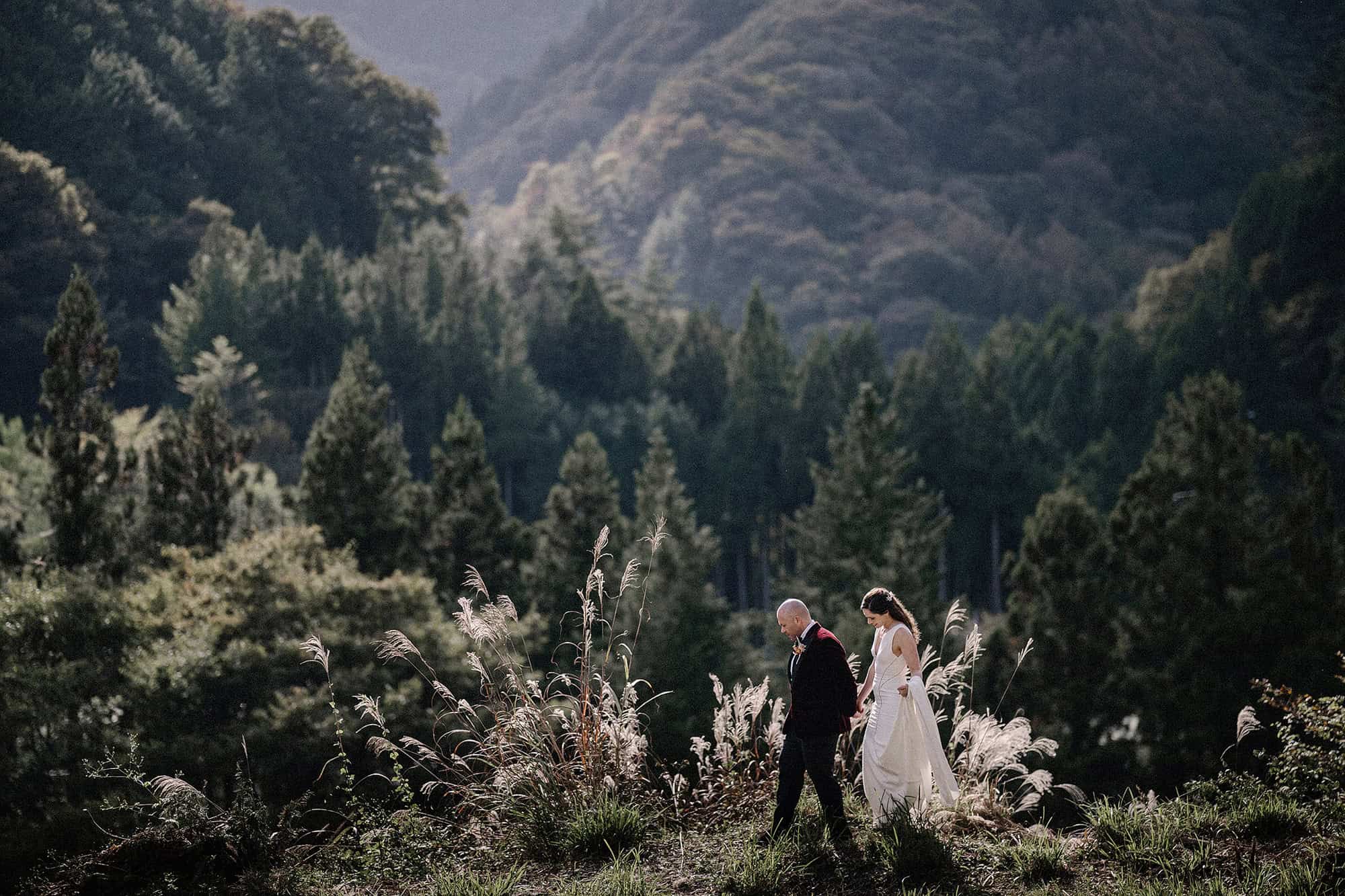
Up in the forest, October had only begun to show itself in the leaves. Most of the hills were still green, with the first yellow coming through and susuki, pampas grass, lifting pale plumes towards the ridges. Anyone considering autumn for a wedding in Japan should leave room for this part of it too, before the full colour arrives. There is plenty to see while a season is still making up its mind.
Inside, her dress hung against dark timber. Later, its long train spread across the old floorboards between the paper screens, the room giving it space without needing anything added. Elsewhere, the groom was getting into burgundy velvet, laughing with four friends around him, before a quieter moment by the paper windows with a glass in his hand.
We do have a weakness for these old Japanese houses. Beautiful window light, worn timber, people we’ve grown fond of filling the rooms. After all these years, that combination still makes us ridiculously happy.


The house held all these different moods at once. We could move from a room full of laughter into a still one, then out towards the garden where he waited for her first look. She was already laughing as she came up behind him. Whatever he was about to do with his face, hers had decided.


Getting to Know the People Who Make Things
Before Kosuge, we had spent time together in Shinjuku. We moved through a packed crossing, along a lantern alley hung with paper autumn leaves, and beneath a vermilion shrine gate. Tokyo gave us movement, colour and people everywhere; the mountain village would give us a very different setting for the same two people.


Having that time together matters to the work. Our planning team had been helping shape the wedding, while those of us making the images were building our own understanding of the couple. Conversation outside the wedding day lets a relationship develop without everyone else waiting for the next thing to happen. We get to see how two people occupy a place together, and they get to know the people who will be standing close to them during something intensely personal.
We loved that these two were chefs. We have a particular affection for people who care this much about what they make, and we recognise the slightly unreasonable amount of pleasure in getting one small thing exactly right. A chef may spend years developing the judgement behind a decision that takes a second at the stove. We know that feeling: experience becoming instinct, then meeting something you have never quite encountered before. It’s lovely to spend time with people whose work is so different from yours and still think, yes, we totally understand each other.
But being good at making something doesn’t remove the desire to be understood when someone else is making something of you. These two deserved photographs with the same care and particularity they bring to their own work. We wanted the family, the humour, the tenderness and the landscape to remain recognisably theirs, even as we brought our own way of seeing to all of it.
A Nipponia Kosuge Wedding in the Garden
Outside the house, the landscape kept drawing us further in. There was a small red torii above stone steps in the woods, a rocky mountain stream below, and a hillside of pampas grass facing the forested ridges. We followed those changes in scale: the intimacy of a narrow path, then the space of the hills opening out in front of them.


Back at Nipponia, an acoustic guitar accompanied the ceremony in the garden. Her father walked her in past the dark timber of the house, towards the groom waiting among rocks, pines and maples. The people closest to them were close enough to see each other’s faces.

At one point, her brother leading the ceremony invited them to join hands and “take a moment to breathe in this incredible view.” It was a generous instruction. After all the decisions and the travel, here was permission to stop and notice where they had arrived.
They had written their own vows and read them to each other. There were rings, a kiss, and then the familiar expansion of a gathering when the ceremony ends: people moving towards the couple, arms reaching around shoulders, drinks raised in the garden. Inside, a cake was cut; outside, there was still the house, the green of the hills and a small group of people with nowhere else they needed to be.
This Nipponia Kosuge wedding had a lovely proportion: the place felt expansive, and the company stayed close. You could go out into the landscape together, then return to a celebration where everyone was part of the conversation.

Chefs at Someone Else’s Table
Dinner at Nipponia is always something we look forward to. For this wedding, there was the added pleasure of watching two chefs receive the work of another kitchen. Someone else was managing the plates. A very welcome division of responsibilities.
Nipponia’s everyday approach to food follows the old calendar of twenty-four solar terms, drawing on the village’s growers and producers. Its kitchen works with the changes happening locally, with river fish, wasabi and produce connected to the surrounding land and water. That tells you something about the attention behind the meal: the season is close enough to enter the kitchen while it is still happening.
For us, the connection between cooking and photography is there in the choices. Flavour, texture and temperature can change how a dish feels; light, distance and timing can change what a photograph allows someone to see. In both, technique gives you possibilities, and judgement determines which of them belongs in this particular piece of work.
Someone could make a beautifully composed image of a room and still miss the most important thing happening inside it. The father holding his daughter might be at the edge of the light we had planned to use. Experience helps us recognise that the photograph has moved, and go with it. All the knowledge has to remain available to the person in front of us.
We love being around people who have given themselves so fully to a craft. You understand that what someone receives at the end contains far more work, thought and feeling than they will ever be able to see. The care becomes part of the experience, even when its workings stay out of sight.
Julia, and a Different Way of Beginning
The night after the wedding, the couple sat at the chef’s table at JULIA in Tokyo. We LOVE the food here. Chef Nao and her sommelier husband, Kenichi, are two of the most talented people working in Tokyo’s restaurant world right now. And in Tokyo, that is saying a LOT.
JULIA is selected by the Michelin Guide, which describes a kitchen shaped by Japanese produce and wine, with many ingredients coming from Ibaraki and fruit finding its way into combinations with fish and vegetables. For two chefs celebrating their marriage, there was something especially lovely about sitting down together and letting Nao and Kenichi take care of the evening. We were very happy to have this particular dinner in their celebrations.

The chef’s route there is unusual. In her account of how Julia began, she describes working in restaurant PR and service before meeting her future husband at a hotel in Okinawa. When they decided to open a restaurant together, she also decided to become its chef, beginning without kitchen experience. Years of learning and experimentation followed that decision.
We find that kind of commitment deeply interesting. Choosing to make something with your life asks more of you than having an idea for it. You have to return to the work, keep developing your taste and judgement, and eventually offer what you have made to people who arrive with expectations of their own.
Her method begins with the wine. She tastes it first, then builds a dish in response to its aroma, texture and flavour, sometimes seeking agreement and sometimes contrast. A rather persuasive reason to begin with a glass, although the amount of work that follows is considerable.


That starting point feels familiar to us. We arrive with experience, intentions and ideas, but the people and the light have something to say before we decide what the image will become. Paying attention can take the work somewhere we would never have reached by insisting on our first idea. It is one of the reasons a real wedding continues to challenge and excite us.
At Julia, the bride and groom could sit on the other side of that process, watching small courses take shape at the counter. The evening ended with them laughing in the kitchen with the chef and her team, joining the restaurant’s custom of a photograph with its guests. After days of being photographed for their wedding, here was another gathering worth keeping.


A Restaurant Named for a Packed Lunch
There is more to Julia than its method, and this is the part that stays with us. The name was the nickname of the sommelier’s mother. Working in a factory, she noticed foreign workers eating a single rice ball at lunchtime to save money for their families back home, and began packing lunches for them.
His parents had hoped to open a small restaurant themselves. They died before they could, and their son eventually made his restaurant a tribute to them. Their remaining photograph hangs inside. The restaurant tells that history in its own words, and it is worth spending time with.
The photograph is part of a room where people are still being fed. We find that quietly moving: an image keeping company with the work that grew out of the people in it. A meal offered to someone who needed one has reached further than the woman packing those lunches could have known.
It also gives this wedding’s two dinners another connection. There is the skill on the plate, which deserves all the attention it receives, and there is the impulse to make someone feel looked after. The best meals can stay with you through both. So can the people who made them.
And the food at JULIA is absolutely incredible.
The People We Take With Us
Back in the garden at Nipponia, after dark, the lanterns were on and everyone stood close while the bride danced with her father. She cried against his shoulder. We had seen him close his eyes around her earlier; now she leaned into him, with the rest of the day between those two embraces.

That dance became the photograph in The Hug That Says I See You. We don’t need to know every memory passing between them to understand the closeness. Their faces and the way they held each other were enough to ask for our full attention.

She danced with her husband too. Later, the two of them stood beneath the noren at Nipponia’s door for their last portrait of the night. The old house had held the getting ready, the first looks, the ceremony, dinner and the dancing, and there they were at its entrance, married.


We planned this Nipponia Kosuge wedding, photographed it and made the films. The highlight begins and ends with dawn over the ridges, returning to the landscape that was there before the house filled with people. Watching it, we know what is about to happen below, and that gives the quiet a different feeling.
This wasn’t our first wedding at Nipponia, yet we still find ourselves thinking of it as theirs. Certain people alter your memory of a place. You come back through a doorway and remember a father standing there, or look towards the garden and see the dance again.
The couple have since returned to the United States to open their own restaurant. Nori & Oak. We can’t wait to sit down at their table, to see what they have made together and be on the receiving end of their work. We will arrive knowing something of the people who stood around them in that mountain garden.


They will have carried those days home in ways we can photograph and ways we can’t. Somewhere in the life they are building, there will be a meal for friends, a family gathering, a reason to pull another chair up to the table. And perhaps our photographs will be somewhere nearby, keeping a little of what it felt like when everyone came all that way to be there for them.