Jun’ichirō Tanizaki believed a Japanese house begins with its roof. In his 1933 essay In Praise of Shadows, he wrote that the builders of old Japan opened the roof like an umbrella, cast a patch of shade on the earth, and made their homes in the half-light underneath. We thought of him all day at NIPPONIA Kosuge, a 150-year-old house in the mountains of Yamanashi, where it rained from the cedar ridges down to the garden stones and this couple’s intimate wedding in Japan gathered under that umbrella.
Tanizaki was practical about it. Without brick, glass or cement, a house had to keep out rain driven in sideways, so the eaves ran deep and the rooms stayed dim. Nobody chose the darkness, he admitted, but the people who lived with it learned to find beauty in shadow, and then to arrange their lives around it. A house like that is most itself on a wet day. The timber darkens, the rooms go quiet, and the light arrives low and sideways through paper and glass, the way the house was always built to receive it.

They had already slept here once before they married here. The year before the wedding, they were travelling through Japan, a country they already loved, looking at the places where this day might happen, and the night at NIPPONIA Kosuge was Dee’s idea. As a planner, she asks couples to trust us with their vision, and most do, from the other side of the world. But when there’s a chance to come and stand in a place first, she always says take it. Nothing replaces the feeling of connecting with somewhere in person, and not everyone can make that trip. When a couple can, and also trusts us to suggest the places we know match what they see and dream of, that’s the best of both, and you can feel it on the day.
By the following February he had just taken his place playing trumpet in The President’s Own, the United States Marine Band, a role he is rightly proud of, and the question was no longer whether they liked Kosuge. They wanted to come back with their families. What began in the language of an elopement became something just slightly larger: the two of them, both sets of parents and a sibling each, eight people in all, travelling in from across the United States, her family from Texas. We loved them for knowing exactly who belonged in the room.
Their film opens with cloud moving over the cedar ridges above the village and keeps the weather in every scene that follows. Watch it for the rain as much as for the two of them. It’s hard now to imagine this day in sunshine, and harder to imagine it would have been better.
From Elopement to Intimate Wedding
The word has travelled a long way. In English, “elope” first meant simply to run off, and by the nineteenth century it meant running away to marry in secret, usually in defiance of your parents. Today people use it for something closer to a size and a feeling: a wedding small enough to stay about the two people at its centre. Many couples who write to us about eloping in Japan still want someone standing beside them. A mother, a brother, the friend who introduced them. We’re careful with the words, because each one asks for a different kind of planning. An elopement, to us, is the two of you. Add the few people you can’t imagine the day without, up to about twenty, and it becomes an intimate wedding. Here in Japan, where the most beautiful places are small, thirty guests is already a full wedding, and it’s planned as one. The word used to mean leaving your family out. These two began there, and chose exactly who came in.


An intimate wedding in Japan asks for a different kind of planning than a wedding of a hundred. With so few people, nobody is in the background. Every seat is a front-row seat, and every face belongs in the story, which is why this family sat under the eaves of the old house, dry and close, with the ceremony a few steps away in the garden. When we plan an intimate wedding, the family’s day is designed as carefully as the couple’s: where they sit, when they move, how they stay out of the rain. They’re there to watch, and to be seen watching. Nobody should spend a day like this managing anything.
A Village at the Source
Kosuge is a village of about six hundred people in the northeast of Yamanashi, almost entirely forest, in the headwaters of the Tama River. NIPPONIA took the whole village and made it a hotel, in its own words a village of 700 becoming one hotel: rooms in old houses across the valley, the lanes as its corridors, the villagers as the people who cook, drive and look after you. The main house, the Ōya, was built about a century and a half ago by a family who made their fortune raising silkworms. We’ve told more of its story elsewhere on the journal, and every celebration we’ve had here, the chefs’ autumn wedding among them, has been completely its own.

What most visitors don’t know is who else looks after these hills. In 1901, worried about the state of the forests its water came from, Tokyo Prefecture took over some 8,140 hectares of imperial forest in Kosuge and neighbouring Tabayama, two villages in another prefecture, and began to manage them itself. By the mid-1920s the slopes of Mt Kasatori, near the river’s first spring, were bare hillside, and they were replanted. Today Tokyo’s waterworks keeps about 26,000 hectares of forest in the upper Tama, the largest held by any water utility in Japan, and it calls that forest a green dam. Rain soaks into the soil, is filtered on its way through, and reaches the river slowly. The Kosuge River runs out of the village into Lake Okutama, the reservoir Tokyo finished in 1957, and on towards the city as the Tama.

The waterworks named its website for this place: mizufuru, from mizu no furusato, the hometown of Tokyo’s water. So the rain on their wedding day wasn’t only weather. It was a city of millions being looked after, more than a century into a promise, falling on two people as they made theirs.
Two Houses, One Village
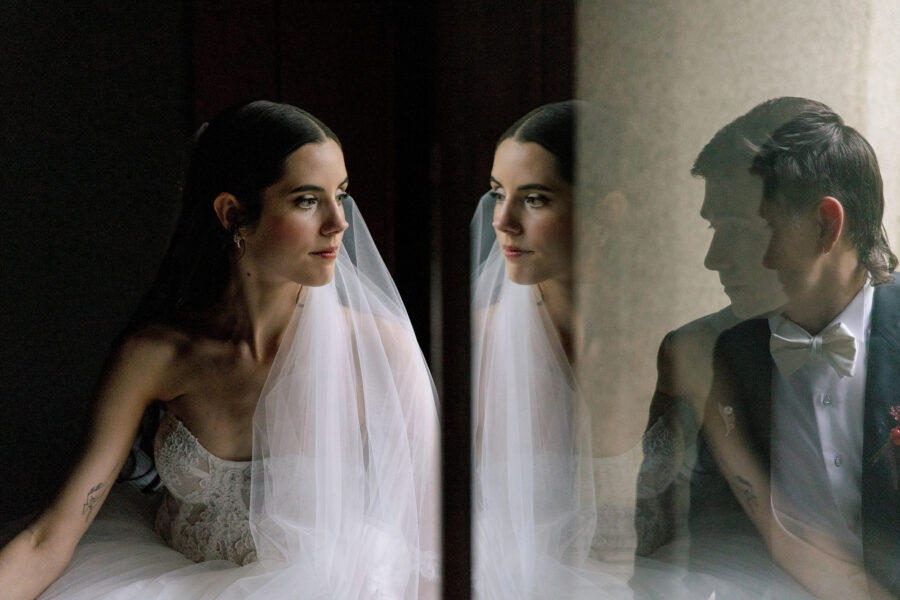
A hotel spread across a village changes the shape of a wedding morning. In a single building, the two of you get ready a corridor apart. In Kosuge, the space between you is the village itself, its lanes and its hillsides, and a first look means finding each other across a real place. She got ready in the Ōya, the old house the silk farmers built, while he and his brother were a little way off at NIPPONIA’s Cliff House, two old buildings that once clung to a slope above the valley, rebuilt with windows that face nothing but mountain. The hotel’s own people say that from inside you can watch rain fall into the forest and rise again as mist. On this morning, it did exactly that.


The bride got ready in the Ōya, in rooms that have been receiving the people of this village for a very long time. The villagers’ own name for it, Ōya, the great house, is a nickname, not a sign on a gate. It has always been the house where people gather. On a morning like this one, that was all it needed to do.


A Roof Like an Umbrella
Tanizaki thought the beauty of a Japanese room came almost entirely from its gradations of shadow. You understand him inside the Ōya on a grey day. Nothing needs adding to rooms like these. The work is to wait for the little light that comes in and let the rest stay dark, which is why so much of this day ended up in black and white. The house had already made the decision for us.


Outside, the umbrellas were clear. The vinyl umbrella is a Tokyo invention: after the war, the head of a family business that began as a tobacco wholesaler in 1721 had the idea of fixing vinyl straight onto the frame, and during the 1964 Olympics an American buyer learned of them and introduced them to New York. It has since become one of the most ordinary objects in Japan, sold in convenience stores across the country. On a wedding day it does something no other umbrella can. It keeps the rain off without hiding a single face.


Cold Dew and the Returning Geese
They married on the first day of kanro, cold dew, in the five days the old calendar calls kōgan kitaru, when the wild geese arrive. It’s a season named for water settling on the grass and for birds coming back to places they know. We can’t think of a better one for a family that travelled so far to stand together in a wet garden in Kosuge village, around two people they love.

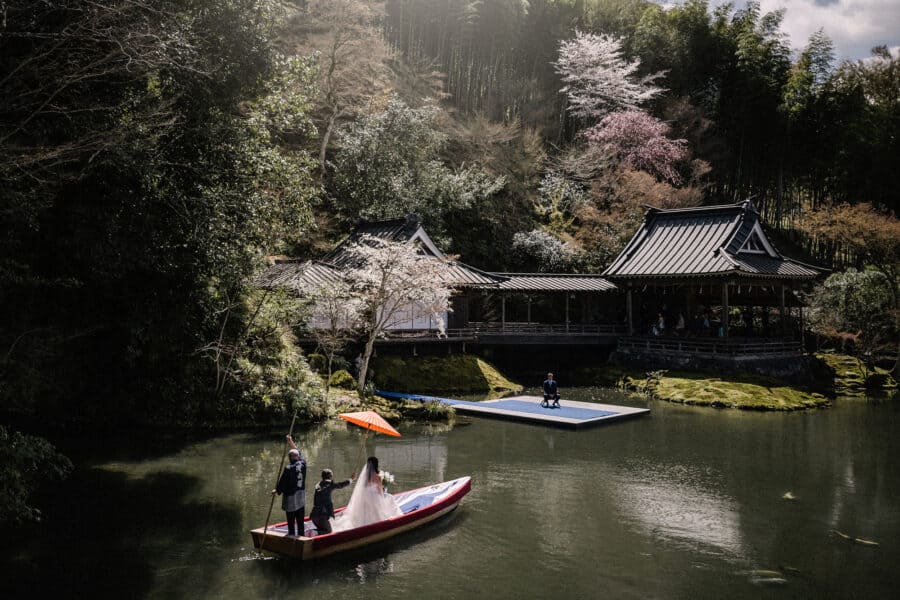
The ceremony took place in the Ōya’s garden under a round arch of flowers, with the stone lantern and the pines beside them and the family a few steps away under the eaves. It was close enough to hear everything and small enough that nobody had to perform. The rain, if anything, made the circle tighter. People lean in when the weather comes down.
After Dark
The rain grew heavier as the light went. One photograph from that night already leads our essay on why we get to know our couples before we work together, and it says what that essay is about better than the words around it do: the weddings we remember most are the ones where we fell a little in love with the couple too. We did with these two, and this is the frame that says so. Several frames from this day later won at the AsiaWPA awards.


This is what our photography and film are for on a day like this one. Nobody will remember the forecast. They’ll remember who was under the eaves, and what it sounded like when the rain started again.
A wedding is only ever as large as the shelter you can hold over it. Theirs fitted under one roof in the mountains, in the rain, and nobody who mattered was left outside.