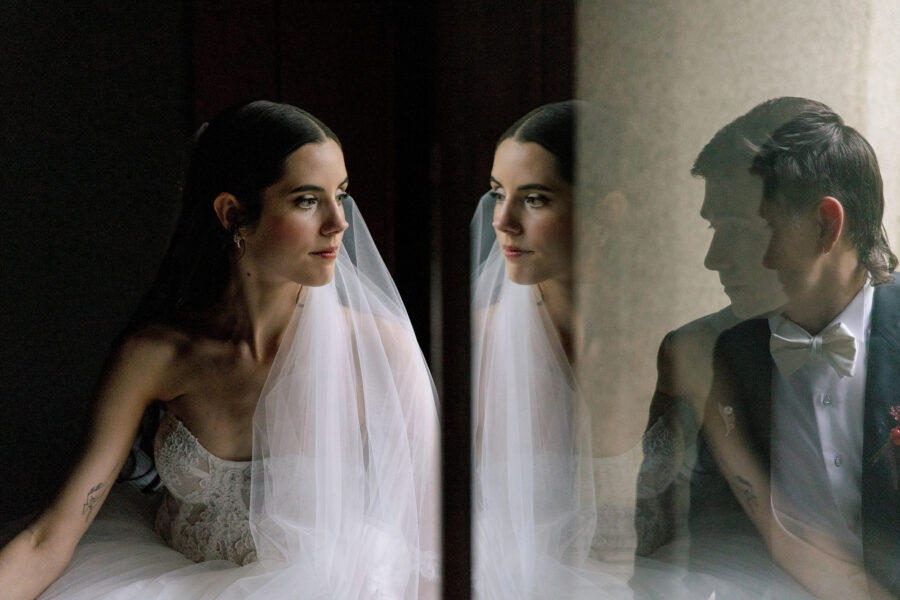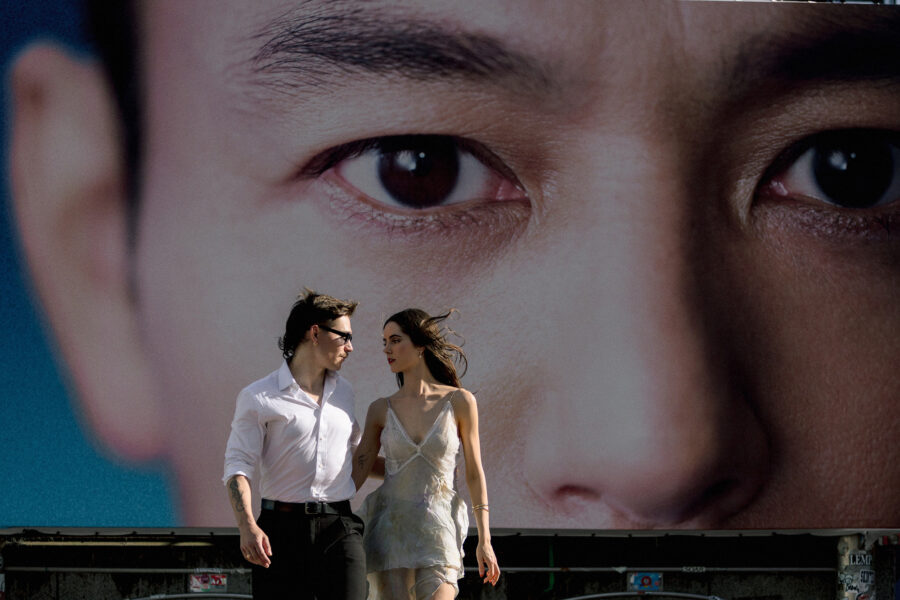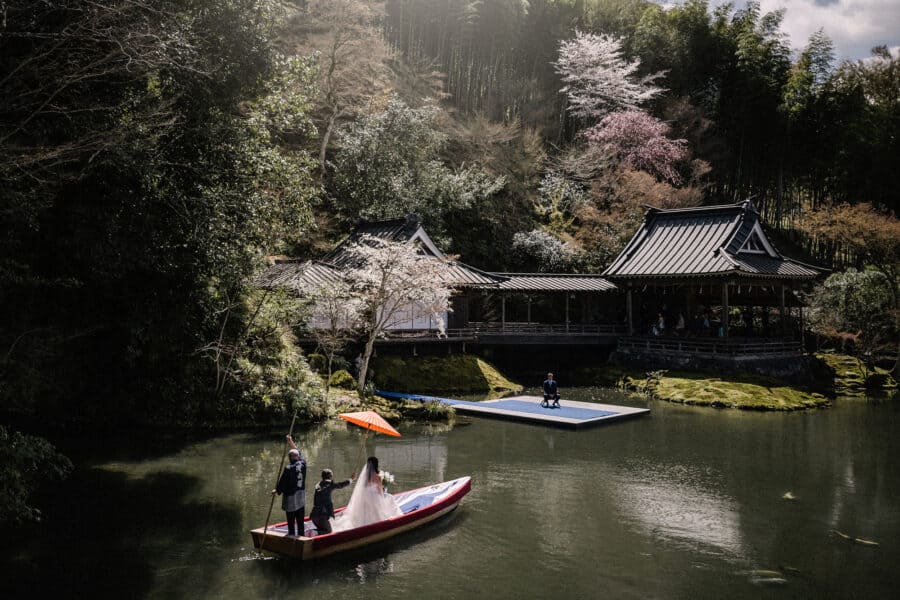
This spring a couple from Florida came back to Japan on their honeymoon, not quite five months after their wedding, and spent an afternoon with us in the cherry blossom. On paper it was a post-wedding photoshoot in Japan. To us it felt like a reunion.
Japan first met them in winter: just over two years ago, he proposed in the snow at Mt Fuji, two days after a rare snowstorm turned Tokyo white. Last November we flew to the Florida Keys for their wedding on Little Palm Island, where the wind barely dropped all day. The weather has a way of finding them.


We’ve known this marriage almost from its first sentence. She wrote to us about a photoshoot in Tokyo; he wrote separately, with a different plan entirely. Since then we’ve stood beside them on a frozen Fuji morning and on a private island in the Keys, where they married in a ceremony that brought Catholic and Jewish traditions together. They’re quick to laugh and easy with each other, and every chapter we’ve photographed shows it.
That week our team was working at Jinya, the ryokan in Hadano, so they came down to us. When their honeymoon plans changed and brought them to Japan earlier, he was glad to keep the date anyway: “a full-circle moment to close out our entire engagement, wedding, and honeymoon chapter together.” It happened to be Dee’s birthday. We couldn’t have asked for a better present.


Thunder Raises Its Voice
Japan’s old calendar divides the year into seventy-two small seasons of about five days each, every one named for a small change in the natural world. Their afternoon fell inside the one called kaminari sunawachi koe wo hassu, thunder raises its voice. It closes the spring equinox, the days when the year’s first distant thunder is expected and the weather turns unsettled.
For this couple it would have been fitting: a snowstorm for the proposal, a hard wind for the wedding, thunder for the reunion. Instead the sky over the hills near Jinya stayed a clear spring blue, and Mt Fuji, the mountain that had watched him propose, showed itself faintly through the haze beyond the valley. After the snow and the wind, Japan seemed to want to show them its gentler side.


A Cherry Blossom Photoshoot With Nothing to Prove
Little Palm Island can only be reached by boat or seaplane, so their wedding ran to the water’s timetable: a ceremony held steady in the wind, and a last boat at the end of the night. We plan for days like that, because a structure someone else is holding is what lets a couple stay present inside it. But it means every wedding photograph is, in part, a photograph of an occasion.
A post-wedding shoot has no occasion to serve. Nobody is waiting at a reception, there’s no running order to keep, and the two people in front of the camera already know us and how we work. What it records is a marriage in its first months: how two people stand together once the event is behind them and the life has begun. That’s the version of a couple we’re always most curious about, and it’s the one our photography is built to find.


Nanohana, the Flower That Once Lit Japan’s Nights
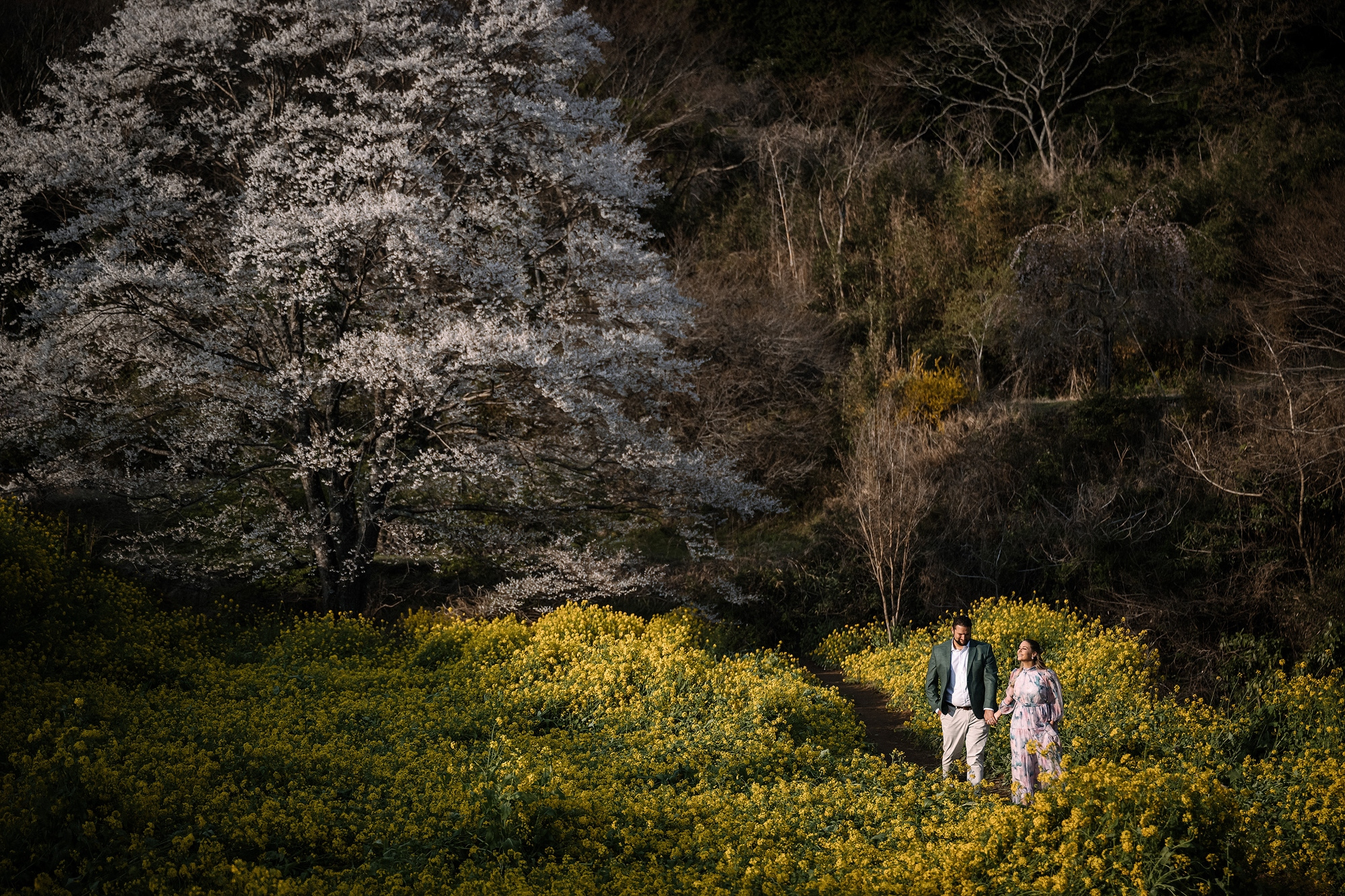
Late in the afternoon the light dropped low over a valley of nanohana, the yellow rapeseed blossom of a Japanese spring, with one great white cherry standing over it. Today nanohana is grown to be looked at, and eaten. For much of the Edo period it was grown for light. Rapeseed oil became Japan’s main lamp oil, burned in the paper-shaded andon of ordinary homes, and the history kept by Tokyo’s oil wholesalers credits it with opening a brighter night to people far beyond the temples, the shrines and the court. Even then light was scarce: an andon gave perhaps a fiftieth of the light of a sixty-watt bulb.
In the spring of 1774 the painter and poet Yosa Buson visited Maya-san, in the hills above what is now Kobe, where rapeseed was grown for its oil, and wrote one of the best-known haiku in Japanese: na no hana ya / tsuki wa higashi ni / hi wa nishi ni. Rapeseed blossom; the moon in the east, the sun in the west. Those who’ve since checked the date say the full moon couldn’t have stood in the east that evening. Buson put it there anyway. The poem keeps the feeling of the field rather than the almanac: a stretch of yellow wide enough to hold both of the sky’s lights at once.


We thought of it in that valley. This couple’s story has always been told across two horizons, an engagement in Japan’s snow and a wedding in Florida’s sun, and here, at the end of a clear spring day, both halves of it seemed to sit in one frame. Photographers spend their working lives chasing the last hour of light. It felt right to find it in a field that was once grown to make it. After a first look through the gallery, she wrote to us: “Truly the most iconic day (and tree!)”


Coming Back
Some couples we photograph once and think about for years. A few come back. This one has now stood in front of our cameras in a Fuji snowfall, in a November wind in the Keys, and on a hillside of cherry blossom on Dee’s birthday, and each time the distance between us has been a little shorter. The photographs get closer because the people do.


We don’t believe a wedding should be the last time a couple is photographed with this much care. A marriage goes on long after the last boat leaves the island, and if they’ll have us, so do we. “Japan will always have a special place in our hearts and we will most certainly be back!” he wrote to us afterwards. Summer is the only season they haven’t brought us yet.