The Way In Became the Aisle: A Wedding at Jinya, Tsurumaki Onsen

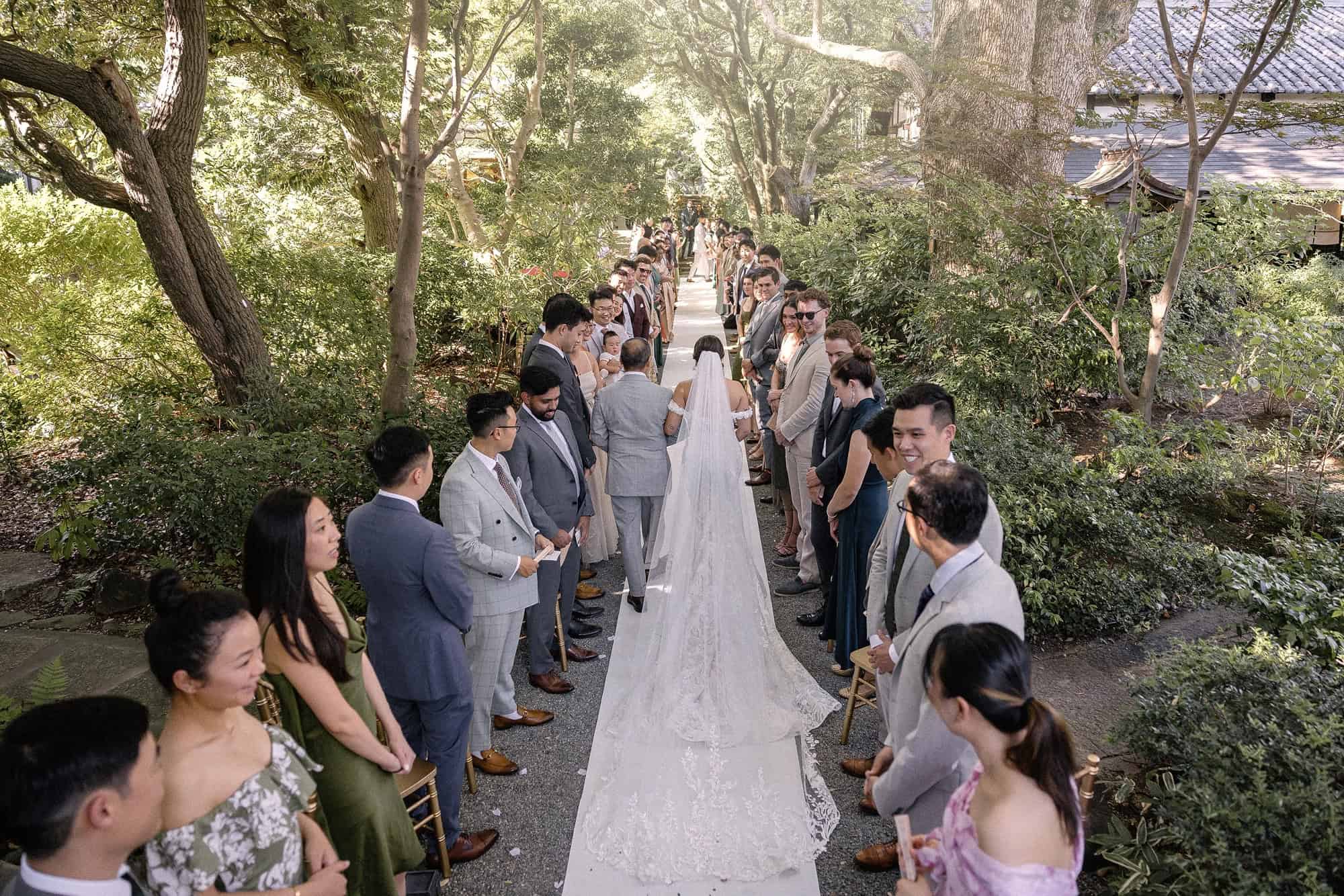
Guests line a white aisle under green trees on the forest walkway at Jinya for a destination wedding ceremony in Japan.

Jinya was built for arrivals. In 1918 the Mitsui family made it a villa called Hiratsuka-en, a house at the foot of the Tanzawa mountains for receiving important guests, and more than a century later that’s still the work it does best. This is the story of the first couple to marry on the path those guests arrive by, at Jinya Tsurumaki Onsen. Everyone who comes to Jinya comes the same way, along a long, shaded walk through the trees to the door, where the inn still sounds a drum for the people it welcomes.

For years, Dee walked that path and saw an aisle in it. She kept the idea the way you keep a sketch you haven’t shown anyone, and said she’d pitch it when the right couple came along. This couple were the right couple. They married on the walkway with their guests seated inside the forest rather than looking out at it, and every walkway ceremony we’ve designed there since began with them.

We loved them for many reasons, and this one is near the top: they said yes to something no one had done at Jinya, on the strength of a planner’s sketch. Couples like that change what a place believes it can be.

Looking down the walkway aisle at Jinya from the floral arch, guests seated on gold chairs under the trees at an outdoor wedding in Japan.

Jinya, Tsurumaki Onsen: A Camp Below the Tanzawa

The name is older than the villa. A jinya is a camp, the place an army stations itself and makes its base, and long before the Mitsui arrived this ground was the camp of Wada Yoshimori, a close aide to Minamoto no Yoritomo, the first Kamakura shogun. The inn’s own history suggests why he chose it: hot springs rising at the foot of the mountains, and plenty of the bamboo used to make arrows.

Water, materials, shelter. The reasons anyone makes camp are practical, and so are most of the reasons a wedding lands where it does. What turns a camp into something more is who stays. A destination wedding asks the people you love to leave home and settle somewhere unfamiliar with you for a while, and this couple’s people came a long way to do it: more than eighty of them, from Canada and further afield, the United States, Europe and Sri Lanka.

Jinya sits in Tsurumaki Onsen, in Hadano, between Tokyo and Hakone: close enough to the city for everyone flying in, far enough out for the trees to take over. For one September wedding it became their camp, and they held it together.

The bride and groom cross a small bridge in the garden at Jinya ryokan in Hadano, wrapped in deep green September trees.
The bride and groom kiss far down a gravel garden path under tall trees at Jinya in Tsurumaki Onsen, Kanagawa.

Between the Mountain and the City

In the days before the wedding they met Japan at both ends. One evening, on their visit to Jinya, they stood on Koboyama, the hill above Hadano, with Mt Fuji on the horizon. Two days later they were in Shinjuku, under the red lanterns of a yokocho and the painted kabuki faces of Kabukicho. Fuji barely changes, and Shinjuku rebuilds itself by the season, yet on a clear day you can see the mountain from the towers. Seeing both before you marry is a good way to understand the country you’ve chosen: it keeps its oldest shapes and its newest ones within sight of each other.

He first came to Japan in 2016 and fell for it at once, and when he got home he told his mother that when he married, it would be here. Years later, on another trip to Japan together, the two of them realised they wanted to spend their lives together. They’re Canadian, they’d been back many times, and they wanted to share the country they loved with the people they loved, somewhere outside Tokyo that felt lived in rather than visited. They had married legally at home that summer; this was the wedding with their people. When the search for a venue reopened, she wrote to us in capitals that they had always loved Jinya, and Dee wrote back that she thought it was the one, because it would be all theirs.

What we can say is what their day chose to say. Its details pointed every guest straight at where they were: a koto before the vows, sake cups of hinoki with a Japanese knot beside their initials, a noren at the reception door. None of it was costume. It told everyone they loved, in small and exact ways, that this wedding belonged to this place.

The couple stand close on a grassy hillside at sunset with Mt Fuji on the horizon, days before their wedding in Japan.
The couple laugh together in a narrow Shinjuku yokocho alley under red paper lanterns and hanging maple leaf decorations.
  • The couple look out from between two trees at a wide valley and Mt Fuji under a soft evening sky, with birds overhead.
  • The couple hold each other close at sunset on a hillside in Japan, her face buried in his shoulder, the sky pale behind them.
  • The couple laugh as they walk hand in hand through long grass under trees, her in a green floral dress, before their wedding.
  • The groom hugs the bride from behind as she laughs with her eyes closed, her green floral dress bright against the evening meadow.
  • A black and white portrait of the couple laughing in a meadow, the groom pressing his face to her cheek from behind.
  • The couple laugh as they hurry through a lantern-lit Shinjuku alley lined with small bars and red and orange decorations.
  • The bride glances back through a busy Shinjuku crowd, bright shop signs overhead, on an evening walk before the wedding.
  • The couple cross a crowded Shinjuku street among commuters and neon restaurant signs on an evening before their wedding.
  • The couple walk and laugh among passing crowds on a Kabukicho street in Shinjuku, faces blurred in the foreground.
  • The couple laugh face to face in a narrow Tokyo alley as low sunlight glows behind them between the buildings.
  • The groom in a checked suit stands in front of a bright Welcome to Shinjuku mural with a masked wrestler and a dragon.
  • The groom stands beside a huge painted kabuki face mural in Kabukicho, Shinjuku, on an evening before the wedding.
  • The couple lean together laughing against a painted kabuki face mural in Kabukicho, Tokyo, the bride in a white dress.
  • A black and white frame of the groom and friends in suits standing in a haze of smoke in a dim Tokyo bar at night.
  • The couple kiss at night against blurred Tokyo city lights, the bride in a short veil and the groom in a checked suit.

Rooms Made for Receiving People

A house built for guests is built for anticipation: the room ready before you arrive, the view arranged before you look. That suits a wedding morning, which is anticipation from the first hour to the last. Jinya’s rooms, with their shoji, tatami and one round lattice window, were made for exactly that kind of waiting, and on this morning the guests of honour were the two of them, in separate rooms, getting ready for the same path.

A black and white silhouette of the groom sitting in the round lattice window of a ryokan room at Jinya on his wedding morning.
A black and white frame of the bride hugged by laughing friends in yukata in a tatami room as she gets ready for the wedding.
The bride in a white robe smiles as a woman in dark green holds her shoulders beside the lace wedding dress in a ryokan room.
A black and white view of the bride standing in a doorway of a tatami room at Jinya, her long lace train spread on the mats.
The bride stands in a glass-walled ryokan corridor holding her bouquet, her lace train pooled on the polished wooden floor.
The groom stands among laughing groomsmen in blue, grey and cream suits in the green garden at Jinya before the ceremony.
  • A watch with a green dial, cufflinks and a chain rest on a dark table on the groom's wedding morning at a ryokan in Japan.
  • The groom in a cream waistcoat sits in a dark ryokan room holding a drink to his lips as he gets ready for the wedding.
  • A black and white frame of the bride's hair being styled at a mirror in a ryokan room, a haze of spray catching the light.
  • The groom adjusts his collar beside shoji windows in soft side light while getting ready at Jinya ryokan.
  • The groom buttons his cream waistcoat in the corner of a wood-ceilinged ryokan room lit by a shoji window.
  • The groom sits on the sill of an arched lattice window in a ryokan room, drinking from a cut glass as he gets ready.
  • A close portrait of the groom in a cream waistcoat and navy tie, drinking from a cut glass beside a wooden screen.
  • The groom sits with his hand at his chin, looking out of frame, in a warm dark room at Jinya on his wedding morning.
  • A calm portrait of the groom in a cream waistcoat, white shirt and navy tie, looking straight at the camera in a ryokan room.
  • The bride in a white robe looks up at her lace wedding dress hanging from a beam in a tatami room at a ryokan in Japan.
  • The bride in a white robe stands beside her hanging lace mermaid gown in a ryokan room with shoji and a wooden floor.
  • The bride in a white robe smiles up at her lace wedding dress hanging beside a paper lantern in a ryokan room.
  • A woman in dark green helps the bride into her off-shoulder lace gown in a glass-walled corridor at the ryokan.
  • Hands fasten the back of the bride's off-shoulder lace gown as she looks down over her shoulder, pearl earrings catching light.
  • The bride's long lace train spreads over the tatami as a woman in dark green fastens her gown by a window onto the garden.
  • A black and white frame of the bride in a close embrace with a woman in a dark dress by a window full of garden leaves.
  • The bride looks down at her bouquet of white roses and greenery in a glass corridor at Jinya ryokan on her wedding day.
  • The bride smiles and looks aside in a glass-walled corridor at Jinya, her bouquet held low against her lace gown.
  • A detail of the bride's lace gown and long train on a polished wooden floor, her bouquet of roses and berries at her side.
  • Groomsmen help the groom into his checked jacket in a covered walkway at Jinya, one of them in sunglasses.
  • A black and white view of the bride from behind in a tatami room, her veil and train spread towards a bright garden window.
  • The groom and groomsmen in a line of suits stand in a covered wooden walkway at Jinya ryokan before the ceremony.
  • The bride looks back over her shoulder in a narrow ryokan corridor, her bouquet in hand and train trailing behind.

They saw each other first in the garden, away from everyone, before the path filled up. A walkway aisle is long and very public, and those few private minutes gave them something to carry down it.

The groom smiles as he sees the bride in her veil for the first time in the garden at Jinya, leaves soft in the foreground.
The bride leans back into the groom with her eyes lowered against a warm plaster wall before their wedding ceremony.
  • The groom rests his head against the bride's as she smiles with closed eyes beside a timber post at Jinya.
  • A black and white close portrait of the groom holding the bride from behind, her eyes lowered, in soft window light.
  • The bride lifts her lace hem to show blue jewelled shoes on stepping stones set in pebbles at a ryokan in Japan.
  • A black and white frame of the groom laughing with his groomsmen in suits under the trees in the garden at Jinya.
  • The groom in his waistcoat holds the bride from behind in a dark wooden doorway, her veil falling over her shoulder.
  • The bride rests her head on the groom's chest as he holds her close in a warm wooden doorway at Jinya ryokan.
  • A black and white frame of the bride laughing with friends in long dresses who clap around her before the ceremony.
  • The groom looks down with a smile in the garden while the bride stands softly out of focus behind him before the ceremony.
  • A detail of the bride's bouquet of white roses and wild greenery held against her lace gown, her veil falling either side.

The Path Built for Arrivals

Most ceremonies turn their guests to face something: an altar, a view, a wall of flowers. On Jinya’s walkway the guests sat inside the forest, either side of the aisle, and the bride came in along the path every one of them had taken to arrive. The way in became the way forward. Very little was added, because very little was needed: chairs, a white runner, flowers set into the trees, an arch at the top of the stone steps where the path narrows and climbs, and a koto playing before anyone walked. For an outdoor wedding in Japan, it asks remarkably little of the place and gives back everything the place already has. The ryokan’s staff told us afterwards they had never seen anything like it.

An aisle usually carries a couple away from their guests. This one ran through them, so the first steps they took as a married pair passed within reach of everyone who had travelled to be there. We still think it’s the most generous shape a ceremony can take.

After their vows they exchanged garlands of red and white flowers, the maalai of his Sri Lankan Tamil heritage. His sister, who led the ceremony, told everyone what they mean: accepting each other as partners for life, accepting each other’s families, and a willingness to work things out together for as long as the marriage lasts. In Japan, red and white together, kōhaku, are the colours of celebration, so for a moment on that path two traditions were wearing the same colours.

A koto player in a black kimono plays before the wedding ceremony at Jinya, the ryokan's dining room glowing behind him.
The bride's long train follows her up a white aisle between standing guests under the trees at an outdoor wedding in Japan.
The bride smiles as she walks down the aisle on the arm of a man in a light grey suit past guests on the walkway at Jinya.
The bride reads her vows into a microphone facing the groom in dappled forest light at their ceremony at Jinya.
The groom wipes his eye as he listens to the vows beneath a floral arch of white roses and dried grasses.
The groom places the ring on the bride's hand beneath the floral arch as the officiant in dark green looks on.
The bride places a garland of red and white flowers over the groom's head beside the officiant at their ceremony in Japan.
The bride and groom in red and white flower garlands walk back up the aisle through cheering guests and falling petals.
  • Guests stand either side of the aisle as the bride's veil and train move away up the walkway towards the floral arch.
  • Bridesmaids in green and rust dresses stand along the aisle while the bride walks up the forest walkway behind them.
  • The groom watches the bride arrive through a gap in the leaves, her veil in the foreground at the ceremony at Jinya.
  • A black and white frame of the bride smiling in dappled light beneath the white roses of the floral arch.
  • The couple stand with the officiant under the floral arch at the top of the walkway, guests seated on both sides below.
  • A black and white frame of the bride looking down in dappled light as she faces the groom during the ceremony.
  • The bride holds her bouquet in dappled forest light as she faces the groom at their ceremony on the walkway at Jinya.
  • The bride listens to the groom's vows, her veil lit by patches of sun through the trees in the garden at Jinya.
  • The bride smiles at the groom in soft forest light during their outdoor wedding ceremony in Japan.
  • The bride looks up at the groom with a small smile as sunlight falls across her shoulders during the ceremony.
  • Guests seated on the walkway watch the couple exchange vows beneath the floral arch at the top of the aisle.
  • The bride reads her vows from a card into a microphone, the groom's shoulder in the foreground, in the garden at Jinya.
  • A black and white frame of the groom smiling through the leaves as the bride reads her vows beside the arch.
  • A close frame of the groom slipping the ring onto the bride's finger, her lace sleeve and veil at the edge.
  • The bride's long lace train fans across the gravel as she faces the groom beneath the floral arch among the trees.
  • A black and white frame of the officiant reading between the bride and groom under the flowers of the arch.
  • The bride and groom kiss wearing red and white flower garlands beneath the floral arch at their ceremony in Japan.
  • The officiant raises her arm in celebration as the bride and groom in flower garlands smile beneath the arch.
  • The couple walk back through their guests wearing flower garlands as petals fly and guests cheer on the walkway.

Mid-September keeps Jinya’s garden in deep summer green, a couple of months before the maples turn, and the afternoon light comes down through it in pieces. It’s a season that gets less attention than autumn here. We think it deserves more: the garden at its fullest, the summer heat only starting to ease.

The bride waves with her bouquet beside the groom under the floral arch at Jinya, her lace train spread over the stone steps.
The bride leans back into the groom with her eyes closed as he kisses her forehead under the arch of white roses.
The groom wraps his arms around the bride from behind as she smiles, a red wagasa parasol blurred in the garden behind.
  • The bride and groom stand under the floral arch at the top of the stone steps at Jinya, her long train across the stones.
  • The bride and groom share a kiss beneath the arch of white roses and dried grasses in the garden at Jinya ryokan.
  • The bride touches the groom's face as they stand under the floral arch among tall trees after their wedding ceremony.
  • The groom kisses the bride's head as she smiles with her bouquet beneath the floral arch in the garden.
  • The bride leans into the groom as they laugh on a garden path at Jinya ryokan, trees and a low wall behind them.
  • A black and white view of the couple sharing a kiss among tall trees and shrubs in the garden at Jinya.
  • The bride and groom laugh together on a leafy garden path in Japan, her lace gown bright against the green.
  • The groom hugs the bride as she laughs with her head tipped towards him on a green garden path at Jinya.
  • The groom holds the bride close from behind, cheek to cheek, with a red parasol and garden trees softly blurred behind.
  • A black and white portrait of the groom embracing the bride from behind as she lowers her eyes in the garden.
  • The bride throws her head back laughing as she walks through the garden hand in hand with the groom.
  • The bride and groom embrace in the middle of a tree-lined gravel path at Jinya, a red parasol off to one side.
  • The couple stand close by a wooden railing in the garden at Jinya, the ryokan's lit building glowing behind them.
  • The bride and groom walk hand in hand through dense green trees in the garden at Jinya ryokan in the late afternoon.

A Knot That Tightens When Pulled

In Japan a noren is more than a curtain across a doorway. It carries a house’s name, and the word has come to mean the house’s standing, the trust it has built over years. When a long-serving apprentice was allowed to open a business of his own under part of the old name, it was called noren-wake, dividing the noren. So there’s something right about walking into your first evening as a married couple beneath a noren that carries your names. It’s the sign of a new house.

Between their names hung a knot. Dee designed the noren in three panels, carrying their own wedding identity and the mizuhiki across all three, and it was made here in Japan. The awaji musubi is one of the knots of mizuhiki, the paper cord tied around gifts, and it’s chosen for weddings because it’s hard to undo once tied, which makes it right for a celebration meant to happen only once. Pull on both ends and it grips tighter. The same knot was marked on the wooden masu cups beside their initials, cups the couple, Jinya and our team developed together, with each guest’s name engraved on their own. Of all the images a couple could choose for a marriage, a knot that holds harder under strain is one of the more honest.

Later came mochi pounding and a sake barrel opened with mallets. Neither is a ritual you watch from a chair; both ask the whole room to lean in, and this room did.

A black and white frame of the couple kissing beneath three white noren with a knot design at the reception entrance at Jinya.
A hinoki masu sake cup engraved with the initials M and A, an awaji knot and Japan 2023, set with eucalyptus leaves.
The bride and groom swing a wooden mallet into the mortar together at a mochi pounding at their wedding reception in Japan.
The couple kiss beside a sake barrel after the kagami biraki at their reception, flowers and dark timber behind them.
  • A black and white frame of the bride and groom waving as they enter their reception beneath white noren curtains.
  • The bride in a satin evening dress and the groom wave and laugh as they make their entrance to the reception at Jinya.
  • A black and white frame of the bride and groom laughing together at the top table behind a line of flowers.
  • The groom raises a wooden mallet as a woman in a patterned yukata cheers beside the mortar at the wedding reception.
  • The couple hold a wooden mallet together over the mortar as a taiko drummer plays behind them at the reception.
  • The groom swings a mallet above the mortar while a woman in yukata turns the rice and the bride laughs behind him.
  • The couple laugh as they bring the mallet down together while a woman in yukata leans in to turn the mochi.
  • The bride and groom stand at the wooden mortar with the mallet raised in the dark timber hall at Jinya ryokan.
  • The groom in light-up glasses cheers with both hands up as the bride raises her arm beside the flowers at the reception.
  • The bride raises her arm as the couple cut a strawberry-topped cake on a silver tray beside tall flowers at the reception.

Lanterns on the Way Out

The inn says its drum both greets guests and sees them off. Here the goodbye is part of the hospitality, not an afterthought. At the end of the night their people lined a garden path with paper lanterns and sent them through. A day that began with guests arriving along one path ended with those same guests standing either side of another, holding the light.

That’s the part of a destination wedding we find hardest to describe and easiest to see. By the end of a day like this, nobody on either side of that path is there as an audience. They’re the ones holding it up.

On the old calendar they married in tsubame saru, the five days when the swallows leave Japan for the south. It’s a season named for departures, and it suited a night that ended in a send-off. Then the DJ took over, and the camp became a dance floor.

Guests hold glowing white paper lanterns on sticks over the couple as they walk through the garden at night.
The bride and groom smile as they walk through a tunnel of guests holding lit paper lanterns at their wedding in Japan.
The bride in a satin evening dress and the groom dance on a crowded dance floor at the ryokan, drinks in hand.
A black and white frame of the couple kissing at night in the garden at Jinya, lit by small lamps along the path.
  • Guests lift glowing paper lanterns in the dark garden as the couple walk through them at the end of the wedding.
  • Guests in evening clothes line a garden path holding paper lanterns overhead as the bride and groom walk between them.
  • The groom and the bride walk through cheering guests holding paper lanterns on sticks along a dark garden path.
  • The bride and groom smile surrounded by dozens of glowing white paper lanterns held up by their guests at night.
  • The couple look out from among dozens of glowing paper lanterns held by guests during their wedding send-off.
  • The groom and bride walk forward through a crowd of guests holding glowing paper lanterns in the garden at Jinya.
  • Guests cheer and raise paper lanterns as the couple walk hand in hand through the garden at the end of the wedding.
  • The couple walk under an arch of glowing paper lanterns held by their guests, both smiling, in the dark garden.
  • A black and white frame of the bride and groom walking out beneath paper lanterns held by guests at night.
  • A DJ bends over turntables in a dark timber doorway at the ryokan as the wedding party begins after the send-off.
  • Guests dance under a chandelier and warm ceiling lights at the wedding party inside the ryokan's timber hall.
  • The bride in a satin slip dress dances and laughs among friends on the crowded dance floor at the wedding party.
  • A black and white frame of guests leaning in with raised glasses for a round of shots at the wedding party.
  • The groom dances with friends under purple light, glass in hand, as the wedding party fills the room.
  • Seen from below, a circle of wedding guests raise their glasses together under a chandelier in blue and red light.
  • The bride dances with raised hands among cheering guests under warm ceiling lights at the wedding party.
  • The bride laughs with a glass in hand and a green glow light at her neckline on the dance floor under a chandelier.
  • A black and white frame of the bride and groom dancing close among guests in the dark timber hall of the ryokan.
  • The bride and groom dance face to face as streaks of red and gold light pass through the frame at the wedding party.
  • A black and white close frame of the groom and bride dancing, smiling at each other in the half dark of the hall.
  • The couple dance cheek to cheek in blue and gold light, guests blurred behind them at the ryokan wedding party.
  • The bride cheers with arms raised among a group of friends on the dark dance floor of the ryokan at the end of the night.

What Started Here

Since that September, other couples have walked Jinya’s path, and each walkway ceremony we’ve designed there has been its own. But an idea at a venue doesn’t become real because a planner can see it. It becomes real when a couple is willing to walk it first, in front of everyone they love, with no photograph of anyone else doing it to reassure them.

That’s a particular kind of trust, and it’s the kind we plan weddings in Japan to deserve, with our photography and film made as part of the same work: we hold the structure, so the couple only has to walk. This couple walked first. Every couple who takes that path now is walking a little way behind them.

Their own path kept going. After the wedding we flew to New York, where they had moved, to photograph them again, this time with a baby on the way. They live in London now, and we can’t wait to catch up with them there for the next chapter.