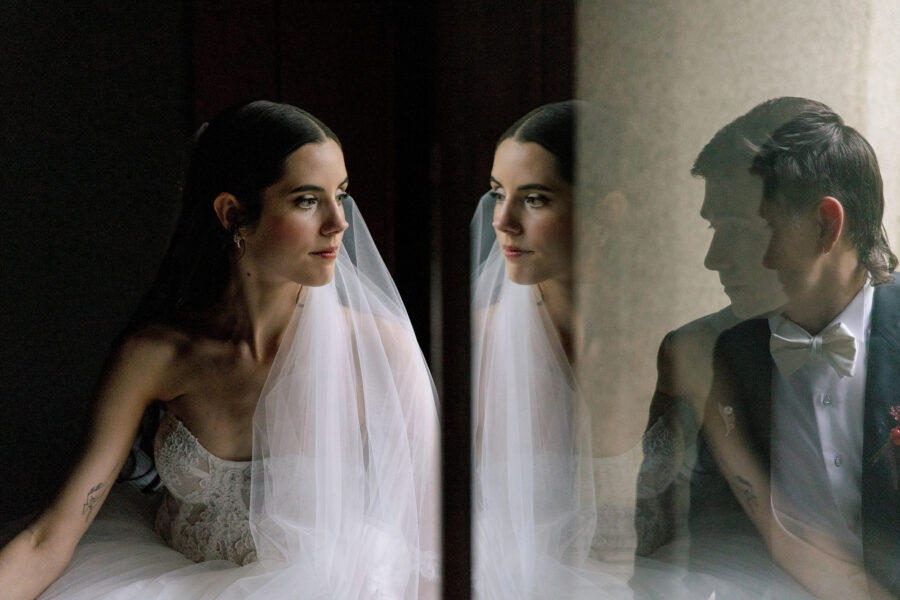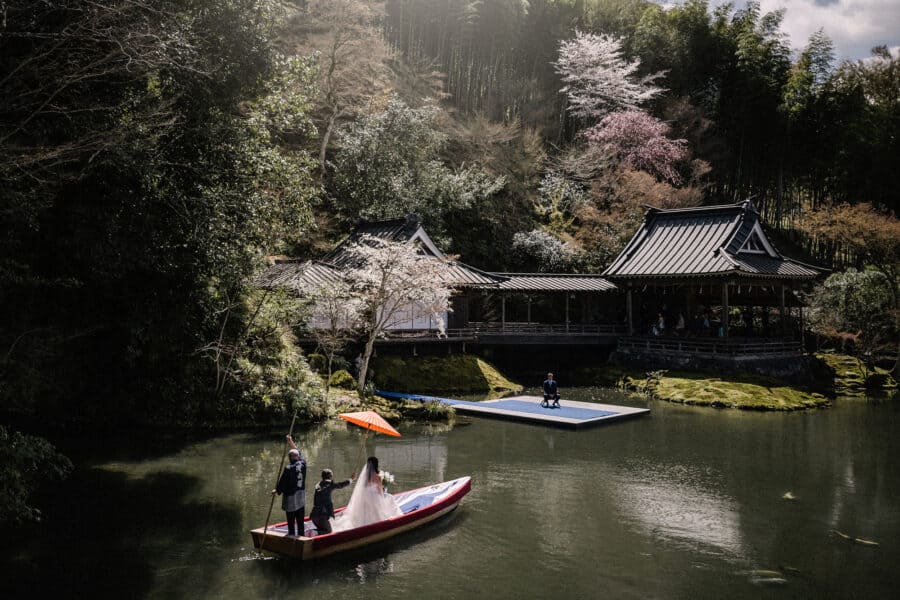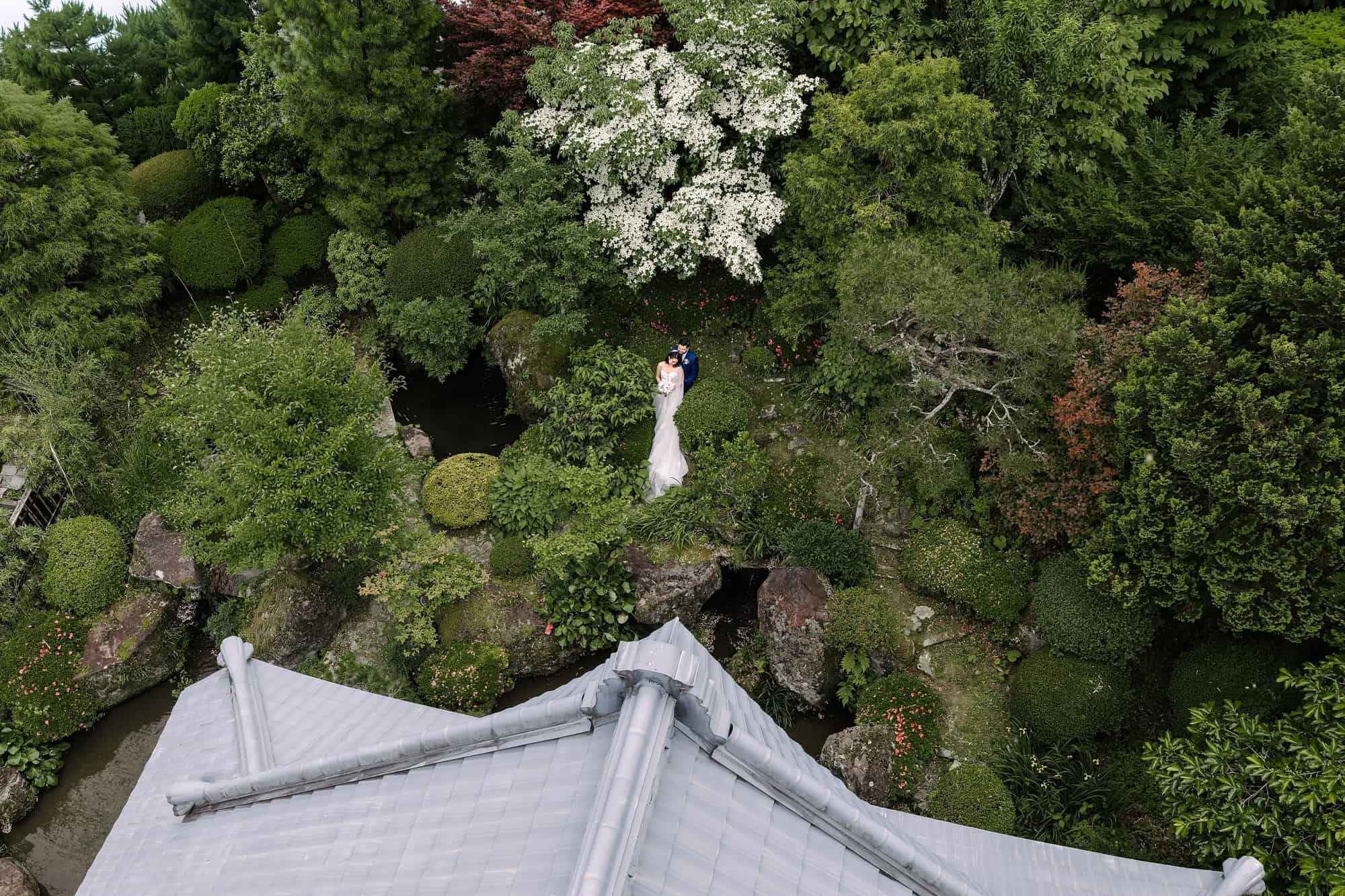
Coming from Hawaii, they told us, you get used to people reminding you that you live in paradise. Japan was the one place that felt “both completely foreign and like home at the same time.” We live here, and we’ve rarely heard this country described better. It’s also the truest description we know of NIPPONIA Kosuge, and of what a Nipponia elopement can be: an old house in a mountain village, about as far from the familiar as two people can get, that somehow lets them feel entirely at ease.

They’re from Honolulu, and they’ve been together since 2018. A month after they got engaged they made their first trip to Japan, and the next year they came back. By the time they found us, through a search on Google, they knew exactly what they were asking for. They wanted the day “to be just us, in a place we loved”, somewhere “deep in nature, quiet, and completely still”. There was no guest list to weigh up and no room to fill. There was only the question of where two people could step out of the world for a day and come back to it married.
We loved them from their first email. People who can name the stillness they want usually know how to stand inside it once they find it, and these two did. It was an elopement in the truest sense we use the word, just the two of them and our small team, in the mountains of Yamanashi in the middle of June.
Their film begins before anyone in the village was awake, with cloud lying in the valleys below Kosuge and the first sun finding the ridges. It holds what a still frame can only point towards: the mist moving, the water running through the gorge, the unhurried pace of a day with nowhere else to be. After they’d watched it, they wrote to tell us they would never forget any of it. That’s exactly why our photography and film are made as one piece of work.
Enveloped in Nature, Still and Secluded
When Dee sent them a long list of possibilities, a dozen places across Japan from old ryokan to a bamboo farm, they ranked their top three. Yamanashi came first, because all three seemed, in their words, “enveloped in nature, still, and secluded”. Then came a line we’ve thought about ever since: “We’re drawn to being immersed in a setting and just existing in it.”
Just existing somewhere is harder to arrange than it sounds, and Kosuge is one of the few places that makes it easy. The village sits in the northeast of Yamanashi, in the headwaters of the Tama River, inside Chichibu-Tama-Kai National Park, and about 95 percent of it is forest. Around six hundred people live there. NIPPONIA has made the village itself into a hotel, with rooms in old houses spread along its lanes and the villagers as the people who cook, drive, guide and keep the gardens. To stay here is to live for a few days inside a working mountain village, not to look at one from a window.

Kosuge becomes a different village with every season, and every couple who marries here finds their own. We’ve written about May, when the old poets watched its peaks show and hide, and about an October day of rain under a deep old roof. Each of those days belonged entirely to the people in it. This June belonged to these two.
A Garden Kept for Two
NIPPONIA’s main house, the Ōya, was built about a century and a half ago by a family of wealthy farmers who raised silkworms. Its largest room, OHYA 1, the garden view suite, opens onto a broad engawa, and the house says its garden looks as if someone had cut a piece out of the village’s own nature and set it there. We suggested that suite for one reason. With it, the garden is private, and on the day of their Nipponia elopement it would belong to the two of them and no one else.


That one decision did more for the day than any styling could. An elopement is fragile in a particular way: it depends on the feeling that nobody is watching. A shared garden, however lovely, keeps you very slightly on show. A garden that’s yours lets two people stop performing altogether.


They kept the ceremony to what mattered most. “Just the vows and rings feels just right to us,” they told us, and the only thing they asked to add was a first look beforehand. So the day turned on very few moments, each given all the room it needed: the vows read from cards, to one person, in a garden of moss and stone. We’ve come to believe the most personal ceremonies are often the shortest. Nothing in them is there for anyone else.


The Plum Rain: A Nipponia Elopement in June
They’d hoped for summer. Spring was already spoken for, as it usually is well in advance, so the middle of June became theirs. We tell every couple the truth about June in Japan. It’s tsuyu, the rainy season, and that year it had settled over these mountains about a week before they arrived. What it gives, if you let it, is a green no other month can match and a mist that makes a remote valley feel more remote still. Which is to say, almost exactly the place they’d described to us in March.

The Japanese name is worth knowing. Tsuyu is written with the characters for plum and rain, and the dictionaries explain why: these are the rains that fall as the plums ripen. (They offer a less romantic reading too, the season when everything grows mould.) The old almanac is more precise still. It divides the year into seventy-two short seasons of about five days each, and their elopement fell on the first day of ume no mi kibamu, the plums turn yellow. Five days earlier the almanac had marked nyūbai, written with the characters for entering and plum, its formal start of the rains. They had been engaged for the better part of two years. They married in the week the fruit comes good.
The garden kept its own calendar. The trees in white flower above the moss were yamabōshi, the Japanese mountain dogwood, which blooms in the rainy season. The name means mountain monk. The round flower head at the centre was likened to a warrior monk’s shaved head, and the four white bracts around it, which look like petals and aren’t, to the white hood he wore. A government field guide to the trees of Mt Rokko says that from a distance a yamabōshi in full flower turns so white it looks like a cloud floating. In Kosuge in June, the clouds come down to meet it. At first light on their wedding morning the clouds lay in the valleys below the village, and by afternoon there was a cloud in flower over the garden where they made their vows.


Until the Moss Grows
In the afternoon we took them out into the corners of the valley we’ve come to know: under a small red torii on a green path, down to a river gorge where every boulder wears moss, to a forest shrine among cedars wrapped in it, and finally up to a high meadow facing the ridges.


Moss is the plant June was made for. It has no true roots, only fine threads called rhizoids that hold it in place, so it drinks through its whole surface, straight from rain and mist and dew. When the air dries, it curls tight and waits. Give it water and it opens again before your eyes, green as if nothing had happened. In the rainy season, the forest around Kosuge is as awake as moss ever gets.


Japanese poets have been measuring good wishes in moss for more than a thousand years. In the Kokinshū, the imperial anthology presented in 905, the book of celebration poems opens with an anonymous wish for someone’s long life: may it last a thousand ages, eight thousand ages, until a pebble grows into a boulder and moss covers it. It’s a wish counted not in years but in moss, the slowest clock in any forest. Standing in a gorge where the stones have been green for longer than anyone can say, two people a few hours into their marriage were looking at proof that such things happen.


An Audience of Two
Back at the house, they opened a small sake barrel for kagami biraki. The name means opening the mirror: the round wooden lid of the barrel is the kagami, and because the word for breaking is avoided at celebrations, the lid is said to be opened, never broken. It’s usually done in front of a room, with a count and a cheer. Theirs had an audience of two, and it lost nothing.


Then the fire. The house lit the fire pit on the deck by the pond early for them, so they could sit beside it while there was still light in the garden, a small kindness from a village that runs its hotel on its own people. When we plan an elopement in Japan, this is the part we care about most: we hold every detail of the day so that, by evening, there’s nothing left for the two of them to do but sit by a fire and be married.


People sometimes ask whether an elopement is simply a smaller wedding. We don’t think it is. It begins with a different question. Not who should be there, but where you want to be when it happens. These two answered it with a garden that was theirs alone, a forest that keeps time in moss, and a fire by the water at the end of the day. Nothing was missing.
Both completely foreign and like home at the same time. We think that’s what a Nipponia elopement should feel like, and what an elopement in Japan does best. A house older than anyone either of them has known, in a village of six hundred people on the far side of the Pacific, held the two of them as though it had been expecting them. They flew home to Honolulu married, and we suspect the plum rain will call them back.