Most of our couples meet Japan first and marry here later: a trip, a feeling, a decision to come back. This couple did it the other way round. Their Kyoto elopement was the first time either of them had set foot in Japan, and by then the country had been part of their story for fifteen years.
They met as teenagers in 2010, two high school students who connected over the same dream: to see Japan one day. Seven years into dating, he proposed, and where to marry was never really a question. They wanted to elope in the country that had been there from the very start.
They’re from Orlando, and before they flew they held a send-off at home for their family and friends, a proper goodbye with everyone they love. Japan they kept for the two of them. It was an elopement in the truest sense, just the two of them and our team, in a private garden in the hills of north Kyoto with the maples at their height. We loved them quickly: warm, funny, deeply devoted to each other, and so ready for this country that every hour of the trip seemed like something they’d been saving.
There’s a particular gift in meeting a country and a marriage in the same week. Nothing has to compete with an earlier memory. Every gate they walked through, every bowl of tea and every street in Kyoto was a first, and every one of them belongs to the wedding for good.
The film opens on a cover of “We Are!”, the first opening theme of One Piece, which is exactly the right overture for two lifelong anime fans marrying in the country they’d dreamed about since high school. It keeps what still frames can’t: their voices under the torii, the laughter over the sake cups, and the moment the formal part was over and the city was theirs to play in. Our photography and film are made as one piece of work for days like this, when the sound of a place matters as much as its colour.


A Garden Kept for the Two of Them
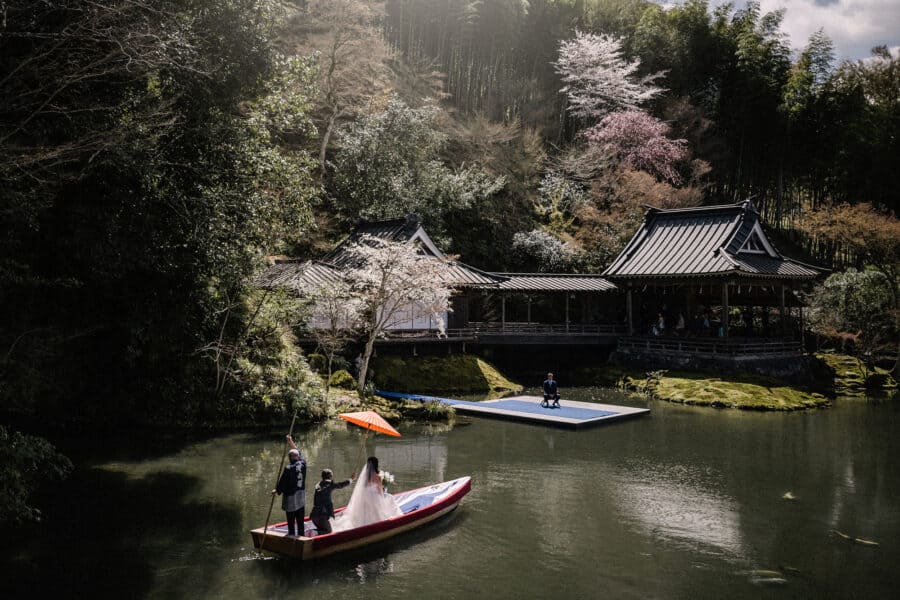
The garden where they married sits in the hills of north Kyoto, a world of cedar, moss, stone lanterns and maples. It’s a garden we know well, and one we can hire privately for intimate gatherings, which is how, at the height of Kyoto’s autumn colour, it belonged to the two of them for the morning.
In Kyoto that kind of privacy is rare. Late autumn is when the whole city turns out for the leaves, and the famous gardens fill shoulder to shoulder. A morning among the maples with no one else in sight isn’t something a couple can find by searching. It comes from relationships built over years, and from knowing which doors open, and when. For two people who’d carried a dream of Japan for fifteen years, it meant the morning they married held no one but them and the few of us looking after them.


Dee planned the morning around the light. In early December the sun drops behind the mountains well before it sets, and the garden falls into shadow early, so the vows came first and the rest of the day followed the sun down into the city. When we plan an elopement in Kyoto, that’s the kind of detail that shapes everything else.


A Kyoto Elopement Through the Torii
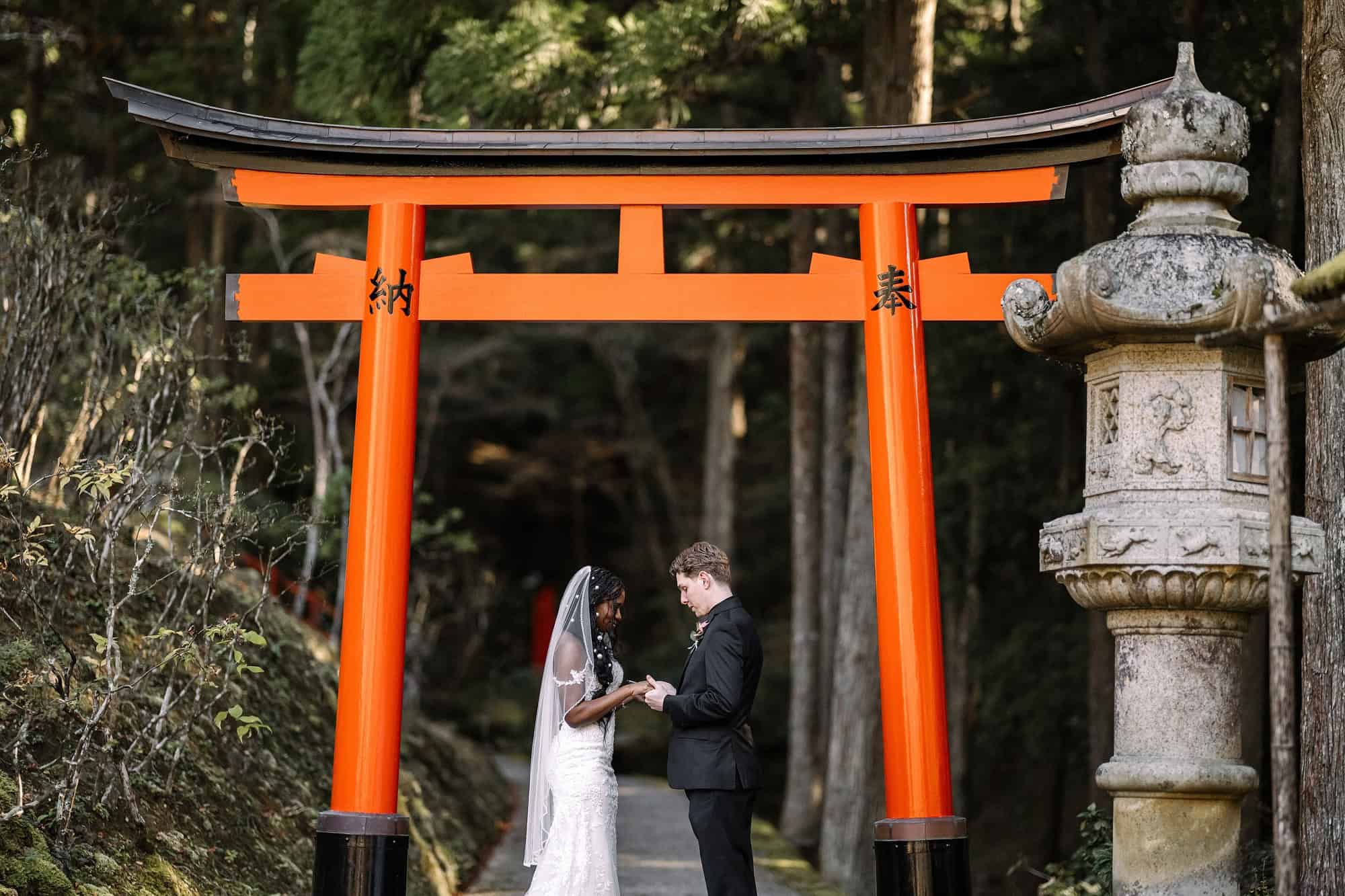
Dee, who planned the day and led the ceremony, chose the garden’s vermilion torii as their altar. She told them why months before they arrived: she loved that it’s a linear space, “transitioning from the regular world to the sacred.”
That’s what a torii is for. Shinto’s own shrine association describes it as a kind of gate at a shrine’s entrance, marking the boundary between the sacred ground of the kami and the world of people. This one stands among cedars and stone lanterns. Two characters are painted on its pillars, 奉納, hōnō: dedicated as an offering. A torii marked this way is a gift to the gods, usually given in thanks or in hope.
For two people standing in Japan for the first time, it was the right threshold. They’d crossed an ocean for this country, and the last few steps took them through a gate built for exactly that kind of crossing.


Their ceremony held more than one tradition without any strain. They asked us for vows, rings and a formal sake exchange, and for a prayer after the rings, because faith is part of who they are. So san-san-kudo, three cups and three sips each, sat beside a prayer of their own beneath a Shinto gate. Nothing in it was borrowed for effect. All of it was chosen.
The bride calls herself a passionate writer, and they wrote their own vows and read them to each other. Those words stay theirs. We’ll only say that neither of them reached the end of the ceremony with dry eyes, and both said so out loud.


Hearts, Read the Old Way
Look closely at old Japanese woodwork and you’ll find hearts cut into it. In Japan the shape is far older than the valentine. It’s called inome, the boar’s eye, and Hasedera, the great temple in Nara, describes it as a charm used throughout traditional Japanese architecture to ward off evil and invite good fortune. Only lately has it come to be read as a heart, and now it turns up on ema and amulets for love. A shape that began as protection seems the right one to frame two people in the first hours of their marriage.
The cake they shared beside the old pavilion was a small portrait of them both: raspberry for him, pistachio for her, because those are their favourites. Then tea, in a tatami room open to the maples. In Japan, tea carries the idea of ichi-go ichi-e, one time, one meeting: no gathering ever happens in quite the same way again. A bowl of matcha on your wedding morning, in a country you’re seeing for the first time, is about as close to that idea as anyone gets.


Autumn in Kyoto, at Its Height
They chose late autumn for the red maples. When they first asked, Dee told them the honest version: in October Kyoto is still mostly green, and the colour peaks at the end of November and into early December. So they waited for it. In the city, early December is when the maples reach their fullest, and they married right in the middle of it.
On Japan’s old calendar of 72 seasons, their wedding fell on the last day of a five-day season called tachibana hajimete kibamu, the tachibana begins to turn yellow. The tachibana is Japan’s native wild citrus, and there’s been one in front of the Shishinden, the ceremonial hall of the Kyoto Imperial Palace, since the capital moved to the city at the end of the eighth century. That afternoon the colour around them did the same thing the season’s name describes, moving from deep red maples into a long grove of gold.
For a couple who’d waited fifteen years for Japan, a few more weeks for the colour was easy. A Kyoto elopement in peak autumn asks for a little patience with the calendar, and repays it in full.


Formalities Done, Now the City
Kyoto came late in their planning. The first idea was a countryside ryokan. What changed it was street food. They wanted to finish their vows and walk out into a city in their wedding clothes, and the groom loved the feeling of the formal part being done and the playing beginning. The bride didn’t want to lose the maples or the privacy. Kyoto gave them both: a garden in the hills in the morning, and the old city in the afternoon.
So the afternoon went to the willow-lined Shirakawa, the white-walled lanes and a dagashi bar. Dagashi are Japan’s penny sweets. In the Edo period they were called one-mon sweets, after the coin they cost, made from cheap grains and coarse sugar rather than the rice of finer confectionery. The da in the word refers to a packhorse, the kind that carries loads rather than riders. By the Shōwa era, the neighbourhood dagashi shop was where children gathered after school. A dagashi bar keeps that childhood room and opens it to grown-ups.
Two people who first dreamed of Japan as teenagers spent the afternoon of their wedding in a room built from Japanese childhood. Then the Kamo River at sunset, on its stepping stones, and a 7-Eleven in a wedding dress, because no first trip to Japan is complete without one.


Japan was the thing that first brought them together, fifteen years before either of them saw it. Now it’s also where they married, and it will always be the country of their first visit and their first hours as husband and wife. At the torii, Dee gave them a line in Japanese: anata no soba ga watashi no ichiban suki na basho desu. Together with you is my favourite place to be. Kyoto came a very close second.
Before Kyoto: Three Days Earlier in Tokyo
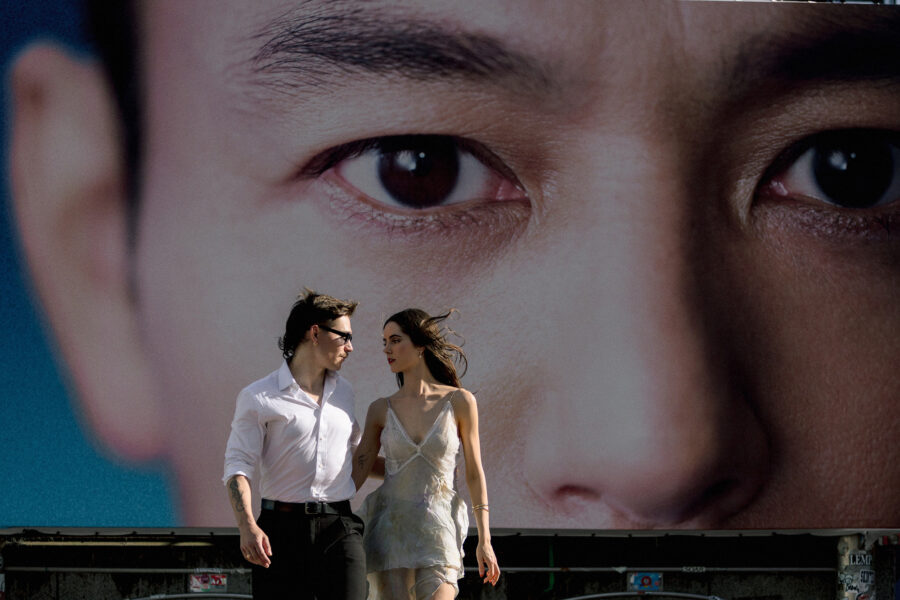
Before Kyoto, they spent an afternoon with us in Shinjuku, dressed as themselves: he in a One Piece racing jacket with the Straw Hats across the front, she in a Sailor Moon one. Sailor Moon is a Tokyo story. Naoko Takeuchi set it in Azabu-Jūban, across town from the ginkgo where they stood. The Straw Hats are a crew who set out across the sea after a dream, which is about the best company two people could keep in Tokyo, having crossed the Pacific after theirs.