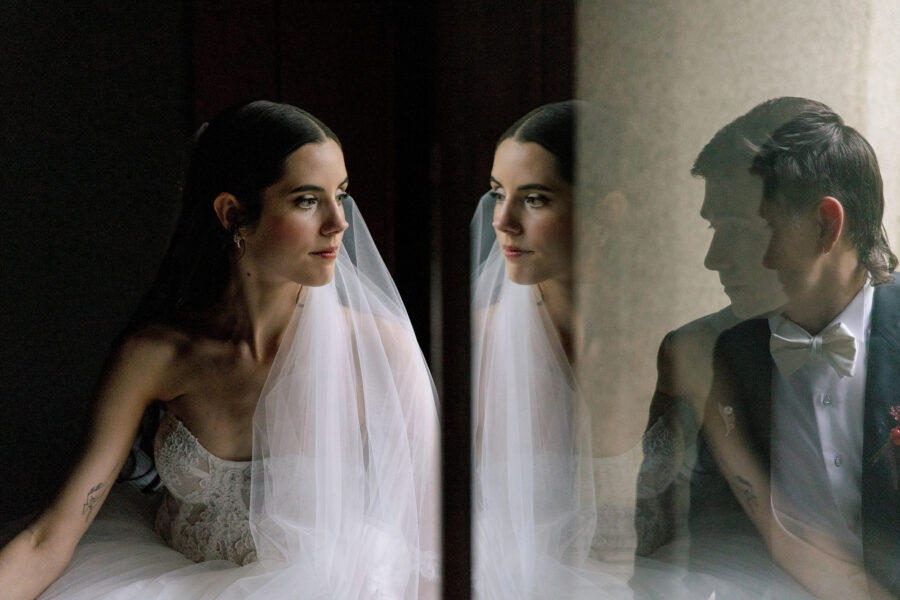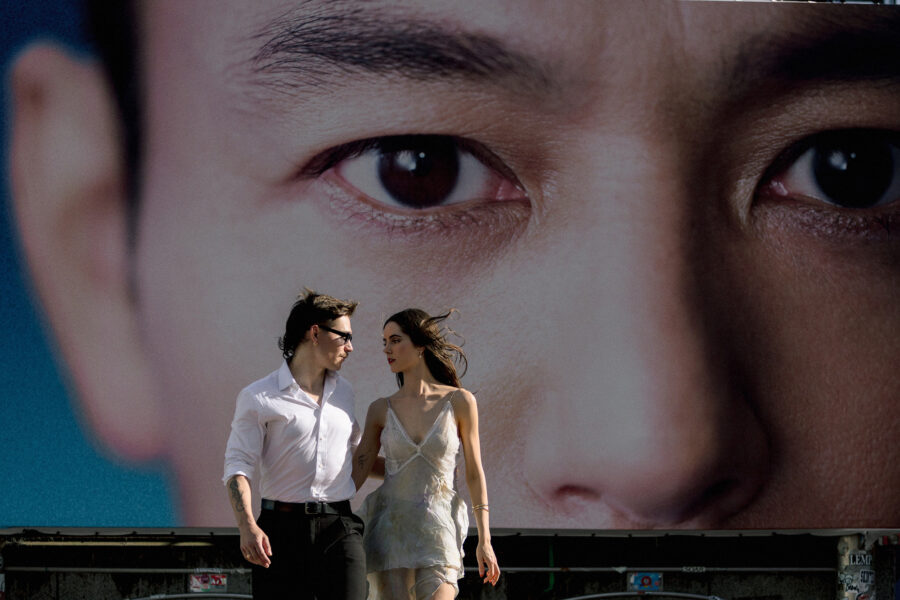
Andaz is a Hindi word, and it means personal style. Hyatt named a whole family of hotels after it, and in Tokyo the name sits at the very top of Toranomon Hills, on the tower’s highest floors. When this couple first wrote to us, they asked for photographs that were “modern, romantic, moody, and fashion-forward”. For an Andaz Tokyo wedding, the name on the door had already said half of it.
They live in Jakarta, and by the time they reached Tokyo they were already married. The first wedding had happened at home. Tokyo was the second chapter, and a second chapter has a freedom the first rarely does. The promise had been made. What was left was the chance to say, as clearly as they could, who they are, in a city that takes style as seriously as they do.
They said it in a couture gown at the top of Toranomon Hills, in a custom two-piece late that night, and in green at a Meiji-era hall the evening before. They said it with an entrance to “Take On Me” and a song from Spirited Away on harp and violin. And afterwards they wrote us the line we’ve kept ever since: “we truly felt seen.” They began with four words and finished with four more.


Personal Style, From Jakarta and Taipei
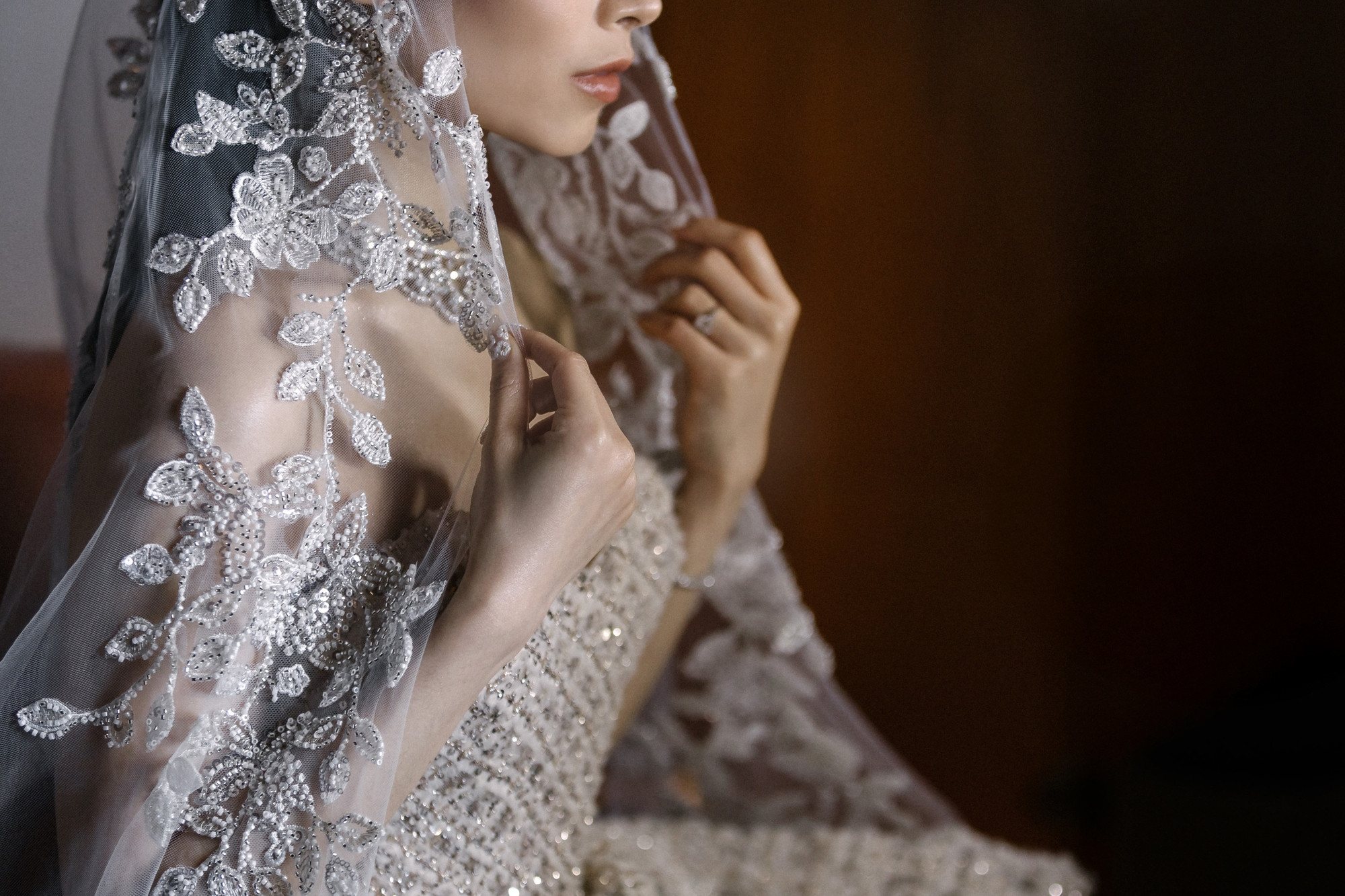
Her wedding gown was by Nicole + Felicia, the label two sisters conceived in San Francisco and brought to life in Taipei. With the Jakarta couturier Yogie Pratama’s work at the welcome dinner and again for the second look, her wardrobe for the weekend came from Jakarta and Taipei and was worn in Tokyo. That feels true to how people marry now: across borders, by people who know exactly what they love.


There’s a difference between fashion and costume, and couples who care about clothes always know it. Fashion is chosen to say something true about the person wearing it. With a brief like theirs, our job is to photograph the choice as well as the dress: the room it belongs in, the light it was made for, and what it lets the person inside it be.


Toranomon Hills, Where Tokyo Refused to Choose
Toranomon Hills is the answer to a problem Tokyo carried for 68 years. The road beneath it, a stretch of Loop Road No. 2, was planned just after the war and nicknamed MacArthur Avenue, then stalled because the land couldn’t be secured. The answer was to stop treating the road and the building as rivals. The road runs through a tunnel under the site, a 52-storey tower stands over it, and the Andaz, the first in Japan, takes its top floors.
We like that story for this couple. They didn’t choose between a wedding at home and a wedding in Japan either. They made room for both, and let each one be exactly what it was.


A Copper Chapel on the 52nd Floor
The Andaz Tokyo chapel stands on its own on the 52nd-floor terrace, at the top of Toranomon Hills, 247 metres above the ground. Outside, it’s wrapped in copper, and the hotel says plainly that the copper gains character year after year. Inside, it’s spare and white, and the hotel describes the room changing quietly with the shifting natural light.
Copper is a material that agrees to change. It starts bright and weathers slowly into something deeper, and the change is the point. For two people saying their vows again, in a second country, it was a fitting roof. A marriage that can be promised twice has already shown it can take some weather.


The ceremony was Christian in style, with harp, organ, choir and violin, and she walked in with her father to Canon in D. They walked out to a song from Spirited Away, played on harp and violin. In English it’s known as “Always With Me”. Its Japanese title, Itsumo Nando Demo, says something closer to always, no matter how many times. It’s hard to think of a truer song for a couple leaving their second set of vows.
Cocktails followed on the 52nd-floor terrace, where the whole company gathered for a single photograph: everyone who had come to Tokyo for them, in one frame.


The Tokyo Studio, With the Tower in the Glass
The reception was in the Tokyo Studio, the Andaz’s corner room on the 51st floor, with windows on two sides and a ceiling of five and a half metres. “Moody” was the word that shaped it: black tables, red flowers, dark red candles. Then Tokyo Tower, lit orange in the window behind the couple’s table, finished the palette from across the city, the one piece of the design nobody had to order.


They came in to “Take On Me”, which tells you something about them that no gown could. Later in the evening, the film of their Jakarta wedding played for the room. For a few minutes the first chapter ran inside the second. Anyone at those tables who hadn’t been in Jakarta saw it then, and anyone who had saw how far it had travelled.
That’s what a weekend gives a wedding that a single evening can’t. Many of the people in that room had shared a welcome dinner the night before and the same chapel hours earlier. By the time the speeches came, they were speaking to people who’d already spent two days in each other’s company, and that changes how every word lands.


A Second Look, Then Gold Bar at The Tokyo EDITION
Late in the evening came the second look: a custom two-piece by Yogie Pratama, and a few quiet portraits at the Andaz with Tokyo Tower in the window. He had also made the green gown she wore to the welcome dinner the night before, so his two looks bookend the weekend: green for the arrival, ivory and black for the finish.


The after-party was nearby, at Gold Bar at The Tokyo EDITION, Toranomon. The bar sits on the hotel’s ground floor, black with white and gold, finished in blackened wood inspired by yakisugi, the Japanese way of preserving cedar by charring its surface. It’s an old idea about permanence. Wood that has been through fire lasts longer.
Edo had a name for nights like this: ukiyo, the floating world of theatres, music and teahouses, where pleasure was taken seriously because it didn’t last. Its prints were, among other things, a record of what the city was wearing. The floating world has never quite closed in Tokyo. On this night it was on the ground floor of The Tokyo EDITION, and the dance floor was theirs.


The Night Before, at Japan’s First State Guesthouse
We’ve kept the first evening for last, because it belongs to an older Tokyo than the tower. The weekend began the night before the wedding, at a welcome dinner at Meiji Kinenkan. Its main hall was built in 1881 inside the temporary imperial palace at Akasaka, as a dining hall where the court could receive foreign guests in the Western manner, and Meiji Kinenkan calls it Japan’s first state guesthouse. For eight years, much of the court’s diplomacy happened there at table. Two young British princes dined in it in 1881, and one of them would become King George V. By Meiji Kinenkan’s own history, it’s also where Empress Shōken first received foreign guests in Western dress, in 1886.
It’s a building that remembers a country deciding what to wear to meet the world. In 1888 Emperor Meiji sat in it for the deliberations on the draft of the Meiji Constitution, and later the hall travelled. It was given to Itō Hirobumi, moved to his estate, and moved again in 1918 to the ground it stands on now. It came through the 1923 earthquake and the war, and it has been a place for weddings since 1947.
Our bride wore green there, in the gown Yogie Pratama made for her in her favourite colour, and it suited the building completely. This is a hall where what a woman chose to wear once carried a message to the world. Hers carried one too, and it was entirely her own.


Dinner opened with kagami biraki, the opening of a sake cask, and it was the evening’s only formal ritual. The cask’s round lid is called the kagami, the mirror. The rite is called an opening because breaking is a word Japanese celebrations avoid, and to open is also to open one’s luck. It’s the right way to begin a weekend like this one. A welcome dinner is where a guest list becomes a gathering, and it’s why, by the time the chapel doors opened at the top of Toranomon Hills, the room already knew itself.


What It Means to Be Seen
Couples who know exactly how they want to look are sometimes assumed to want control. In our experience it’s usually the opposite. Knowing what you love leaves you free to stop thinking about it, and once the choices are made, people settle into themselves. That’s when the real photographs happen. This couple made every choice with care, and then they let the weekend carry them. It was a joy to be beside them for it.
So “we truly felt seen” is the line we’ll keep. It’s what we hope our photography and film give every couple, whether we’re planning a wedding in Japan from its first conversation or, as here, photographing and filming a couple’s second chapter.
Tokyo gives every couple its own city. For some it’s a garden, for others it’s the bay. For these two it was a hall built to welcome the world, a copper chapel at the top of a tower, and a black and gold bar at the end of the night. A promise doesn’t wear out by being made twice. In the right room, it gets clearer.