In the autumn of 1684, Matsuo Bashō crossed the checkpoint at Hakone in the rain. “The mountains were all hidden in cloud,” he wrote, and then a haiku: kiri shigure / Fuji wo minu hi zo / omoshiroki. Misty rain, a day of not seeing Fuji: that’s the one to treasure. He’d walked past Japan’s most famous mountain, hadn’t seen it once, and found the day worth keeping.
Theirs was a Mt Fuji elopement in the rain, on a day he’d have recognised. Late November, the maples at their peak around the lake, rain from morning to night, and cloud so low that Mount Fuji never showed itself. It took nothing from them. What they had instead was wilder than any view: wind off the water, hills that came and went in the cloud, colour turned up by the rain until the red maples looked lit from inside.


They came from Brisbane, Australia, already a family, with their small son, and they kept the vows for the two of them. One friend came along so their son could watch. Everyone else, family and friends, waited for them on the lake that night. We loved them for that, and for walking straight into a day that looked nothing like the one people picture when they say Mt Fuji.
The film is the closest thing to standing in that weather again. It keeps what photographs can only suggest: the movement of a day in rain and wind, and the way it carried them from a garden to a shrine, to the edge of the lake and out onto the water. It runs to music alone, so the day speaks for itself.
A Day Without Fuji
There’s no shortage of Fuji in Japanese art. Its World Heritage listing calls the mountain a sacred place and a source of artistic inspiration, and centuries of painters and poets earned it the second half of that title. Yet one of the lines people still quote about it is a line about not seeing it at all.
Bashō’s word was shigure, the passing showers of late autumn and early winter, and his death anniversary is still called Shigure-ki, partly because he loved them so. A shigure day doesn’t hide the world so much as rearrange it. The distance goes, and what’s close comes forward: a wet stone, a single tree, the person beside you. A mountain you can feel but can’t see does something to a place that a clear sky never can. The Japanese have a word for the depth in what’s half hidden, yūgen, and a rainy elopement at the foot of Fuji is about as close to it as a wedding gets.
We’d never wish rain on a couple. But we’ve planned enough days around this mountain to know it keeps its own hours, and that the days people remember here have never depended on a clear sky. Fuji was present all day: in the cold coming down off it, in the cloud that hid it, in the weight of the air over the lake. It just didn’t pose.


Autumn, Turned All the Way Up
Rain does something to autumn colour that sun can’t. It takes the glare off the leaves and lets the pigment through, so a red maple in the rain reads deeper than the same tree on a fine day. Their day caught the Fuji Five Lakes at the height of autumn, and the colour was everywhere: overhead, underfoot, floating in the stone basins.
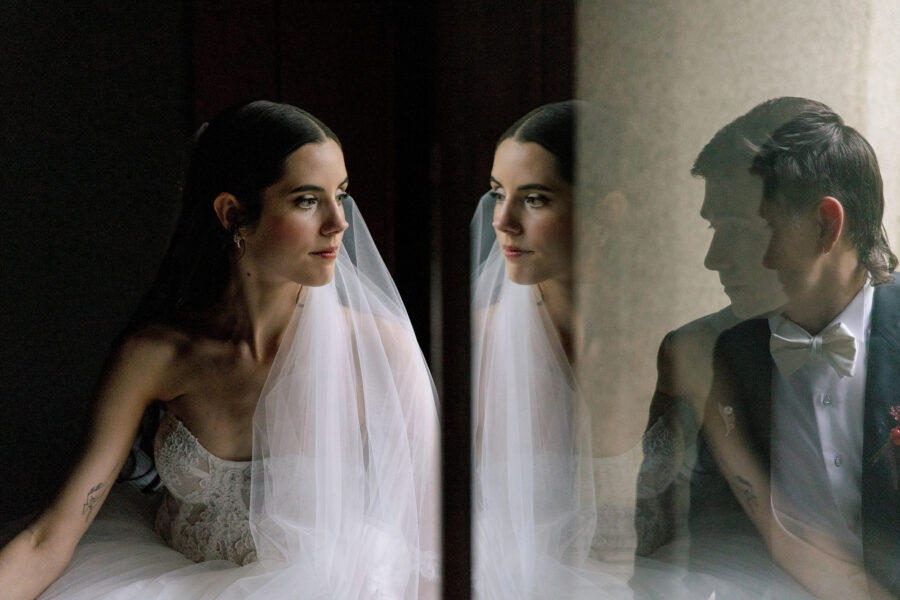
The morning belonged to Hotel Kaneyamaen, a ryokan in Fujiyoshida at the foot of the mountain that we return to, and to its garden of old maples, moss and stone. They got ready in tatami rooms where white cranes crossed the walls, the bird Japan has long put on wedding kimono. The only Fuji anyone saw that day hung on a wall there too, in a painting. Then they saw each other for the first time, beneath the maples in the rain, and the garden kept them in. On a clear day it would have shared their attention with the mountain. In the weather, it was the whole world.


The old Japanese calendar splits the year into 72 short seasons, and they married in the one called niji kakurete miezu: rainbows hide. It’s the moment the almanac admits the light is going and the skies are greyer. There’s something honest in a calendar that names a season for what you won’t see. It asks you to look at what’s in front of you. That day, it was red and gold and green, all of it wet and shining.


A Shrine Built for Those Who Couldn’t Climb
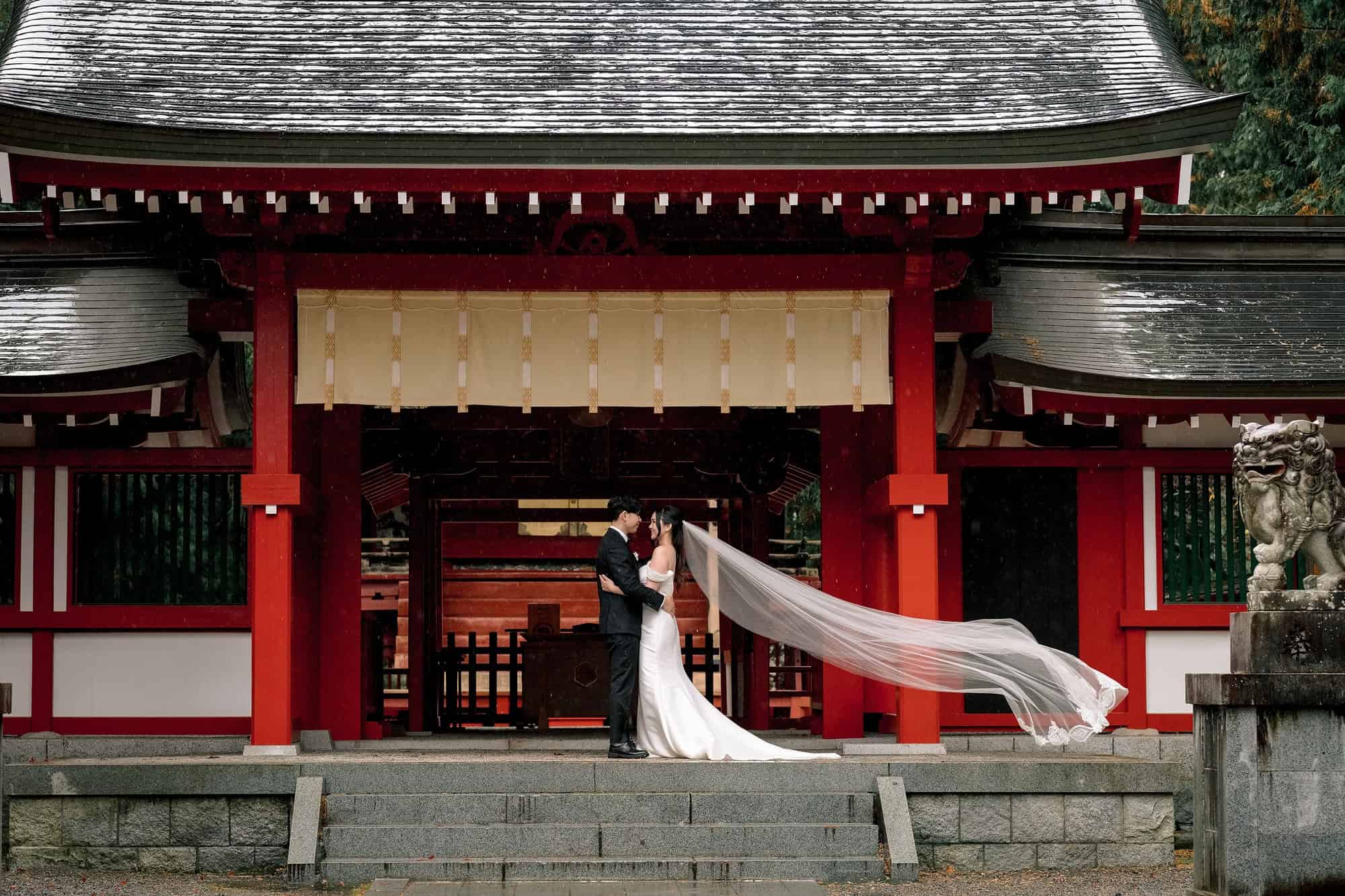
Fuji Omuro Sengen Jinja, where they were blessed, begins its story in 699, high on Fuji’s slopes at the mountain’s second station. It counts itself the oldest shrine on Mt Fuji. In 958, the shrine records, the Emperor Murakami founded a second shrine down on the lake’s south shore, among old pines, so that people could worship more easily. Its main hall, built in 1612 and now an Important Cultural Property, stood on the mountain until 1973, when it was carried down to join the shrine by the water.
So for more than a thousand years, this has been a place for honouring a mountain from below. People came to the shore because the summit was hard to reach, and they prayed to a peak they often couldn’t see. On a day when Fuji stayed in the cloud, the couple were standing in exactly the tradition the shrine was built for.
A priest blessed them in the hall, and each of them laid a branch of sakaki, the evergreen of Shinto offerings, on the rail before the altar. Then they walked back out into the red. The maples around the halls were in full colour, the vermilion of the buildings answered them, and the rain kept every other visitor away. A shrine this old is rarely this quiet. For a while it was theirs.


A Kawaguchiko Elopement in the Wind
By the time they reached the water, the weather had turned from soft to wild. They married at the edge of Lake Kawaguchiko in long autumn grass gone to gold, with the hills on the far shore disappearing and returning in the cloud, and a wind that wouldn’t let the veil rest. It had less in common with the Japan of postcards than with the moors of an English novel: windswept, grey and green and gold, and romantic in the old, stormy sense of the word.
They read the vows they’d written, shared the three cups of san san kudo, and the petals went up into the wind. Their son watched from a friend’s arms. Otherwise it was the two of them, the lake and the weather.
Japan has its own names for this weather too. Two days after their wedding, the old calendar turns to kitakaze konoha wo harau, the north wind sweeps the leaves from the trees. The colour they married in was the colour that wind comes for, still holding on the branches.
Afterwards they climbed a grassy rise above the lake and stood in the cloud as it poured over the ridges. Nothing up there stayed still for long, the sky least of all, and that was the gift of it. A landscape in motion can’t be repeated. It belongs to the people who stood in it, once.


Dinner on the Water
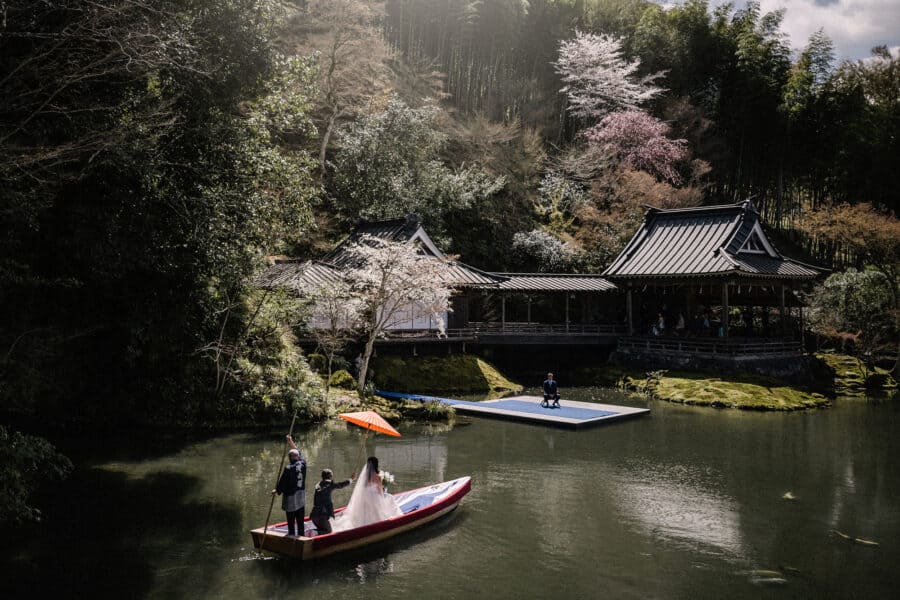
When the light went, their family and friends were waiting for them on Lake Kawaguchiko, aboard the Hamanashi Houseboat. It’s the only floating restaurant on the lake, named for a small plant that grows high on Fuji, between the fifth and eighth stations. The boat is built on the lines of a yakatabune, the roofed pleasure boats Japan has used for dining on the water since the Edo period, and reimagined for the lake, with chefs cooking on board. After a day lived outdoors in the weather, it was warmth: paper lanterns, a kitchen at work, and everyone who had come to celebrate them, with the lake dark all around.
That shift is the shape we love in an elopement like this. The vows belonged to the two of them, the evening belonged to everyone, and the plan held both without a seam. Rain doesn’t trouble a day built with that much room in it. The weather ended up as part of the story rather than something to be survived.


The Day After
They had come all this way with a dream of marrying in front of Mount Fuji, and the mountain never once showed itself. They were wonderful about it. Not a word of disappointment, only the colour, the wind and each other, which turned out to be more than enough.
That evening the rest of our team drove two hours on, ahead to the next wedding. Dee stayed behind. She had spent a year planning this day with the two of them, the forecast was turning, and she had a feeling the morning might clear. So she booked a room for the night and told them that if the mountain came out, she would be there.
It isn’t something any couple should expect, and it isn’t something anyone could promise. Mount Fuji keeps its own schedule. But that night the forecast was kind, and Dee was still close enough to meet it.
The newlyweds had a plan of their own. The bride didn’t want to undo her hair and make-up, so the two of them simply never went to sleep. They spent their wedding night awake together and watched the sky lighten.
At first light, Fuji was there. The cloud had gone, the sky was clear, and the mountain stood over the pale winter grass with snow on its summit, as if it had been there all along. Which, of course, it had. She was still in full make-up, her hair holding up beautifully after a night without sleep, and they went out to meet it, already married.


That’s what a team is for. While Dee was out at sunrise with the two of them, everyone else had moved on ahead and prepared the next wedding, so she could walk straight into it without a moment of catching up. She wasn’t late, and nobody felt the join. It was seamless, which is the whole point. And it gave two beautiful people their Fuji dream after all.
It was a lovely thing to be given the day after. But it was a gift, never the point. The wedding had already happened, in the rain and the wind and the colour, and it was whole without the view.


Bashō never did see Fuji that day at Hakone, and it’s the day he kept: the poem is still read more than three hundred years later. Weddings are often like that. What people hold on to is rarely the view they planned for. It’s the weather they stood in together, and who was standing beside them. We plan every wedding in Japan for the day it actually turns out to be, and we make our photography and film for the same reason: so that a day without Fuji can be kept exactly as it was. Missing the mountain only made the day more theirs.