“Just follow the music upstairs.” That was the instruction after the ceremony at this forest wedding in Japan, in the hills of Hakone. It was also a fairly good introduction to the rest of the day: there would be music wherever people gathered, something excellent to eat, and another part of the forest waiting around the corner.
By dinner, the MC was reporting that half the room was crying. Four cheesecakes were coming.
But first, a place where everyone could stay. For a couple whose lives had moved between Australia, Japan, Finland and France, that was a consequential choice. They could bring their people all this way and then have them nearby, with room for the conversations that rarely fit between a ceremony and a goodbye.
A Forest Wedding in Japan, With Room to Stay
Hakone Retreat sits among the trees of Sengokuhara, with modern buildings, wooden paths and decks that let the forest remain close. Its two accommodation areas, före and villa 1/f, make different use of that setting. The couple loved the woods, the property’s contemporary character and the prospect of a party on the deck; having their guests stay overnight gave all of it a different kind of possibility.
There’s something particular about arriving at a wedding and knowing that the people around you are staying too. The day can loosen a little. Someone you’ve just met at the ceremony is someone you might sit beside later, and the friend you haven’t seen for years doesn’t have to compress everything into one conversation over a drink.
That mattered here. When the MC asked where everyone had come from, hands went up for Australia, Japan, New York and Finland. These were people who knew the couple in different countries, at different ages, through different versions of their lives. The wedding made those separate relationships briefly available to one another.
We see that often in the decision to bring a wedding to Japan. A place can become the point where a far-flung life gathers itself. Hakone was already somewhere these two loved, so the invitation carried something personal: come here, stay with us, see a little of what we see.
We’d photographed a wedding at Hakone Retreat in the rain before. This time, May gave us soft light and a dry ceremony beneath the trees. Spring in the hills has its own pace, and the greenery had become a presence you could walk into.
Before Everyone Gathered
At first light, Fuji was visible beyond the Hakone hills, the cone clear beneath a pink and grey sky. Closer to the ground, the groom and his friends were getting ready in a wooden pavilion open to the trees. There were bow ties, whisky, a letter to read, and a silver Porsche 911 waiting in the forest drive.


The Porsche belonged to the groom.


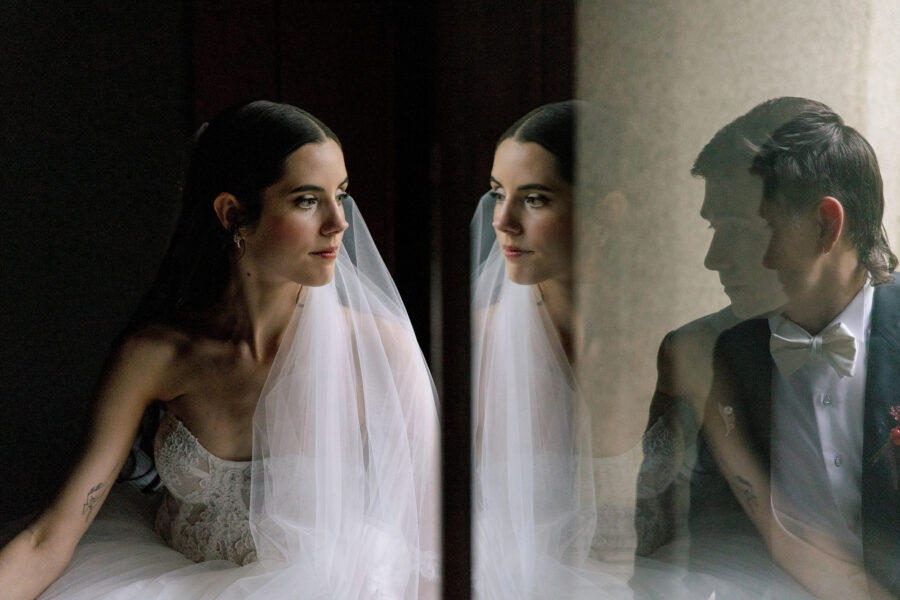
Elsewhere, the bride’s long tulle train moved through the woods. A line of pearls ran down her back, and a white flower sat in her hair.


We return often in our writing to komorebi, sunlight filtering through leaves. A forest also teaches you to look at the light when the sun is behind cloud: the open patches, the darker trunks, the way a face comes forward when everything around it softens. Working here means noticing what the trees are doing to the light, then finding the people within it.
Their first look happened on a deck among those trees. She walked up behind him; afterwards, they moved along a wooden walkway and stood beneath white noren. The same place that had given them a little room to meet each other would shortly hold everyone else.


Two Languages Beneath the Trees
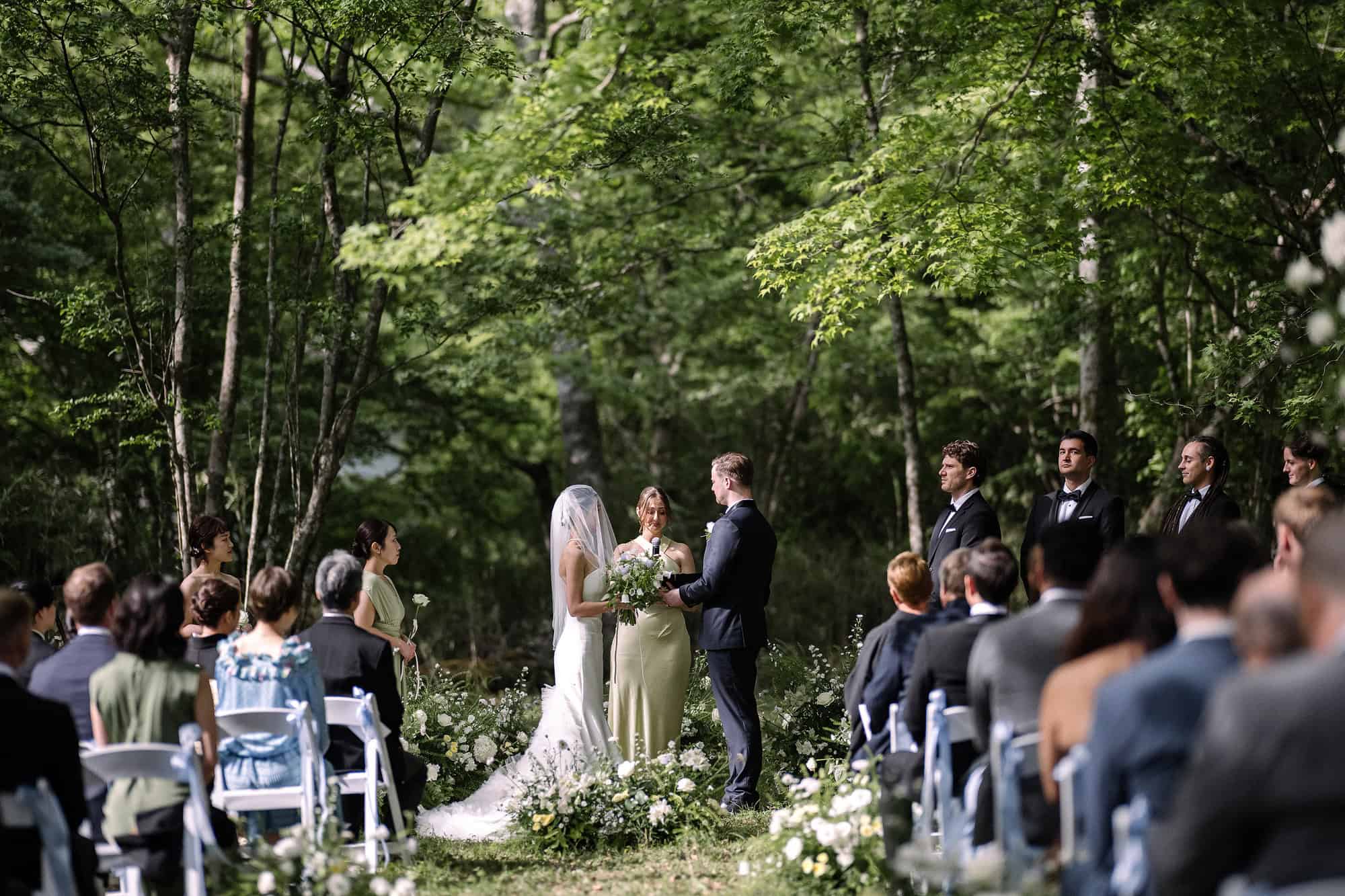
Her father walked her down the aisle, following a small flower girl in mint green. Cello and violin carried through the ceremony space. White flowers ran low beside the chairs and climbed a tree trunk, leaving the height and shape of the woodland to do what it already did.


The officiant spoke about Hakone as a place of forest, fire and water. It was a useful way to understand the choice: a landscape with volcanic life beneath it, and a day taking place in the quieter world above. The couple exchanged their vows in English and Japanese, then shared san-san-kudo, the three sake cups which their officiant framed through the past, present and future.


Two languages can hold different parts of a person. One may carry the voice of childhood, another the friendships and daily life built somewhere else. Hearing both at a wedding gives the people listening a place inside the ceremony, even when they don’t understand every word.
One friend remembered meeting the bride before they had a language in common. They communicated through smiles and gestures; now, he said, she was fluent, complete with the groom’s Australian sense of humour.
The bride is Japanese; the groom grew up on a farm in country New South Wales. They met in Australia and have since made homes in several countries. We don’t need their entire history to understand the room: the ease with which the evening moved between languages told us something about the life they’d made together.
After the rings and the kiss, the guests gathered on the hill for a photograph, with Dee directing the group. The little girls found their way back among the ceremony flowers. Then came that instruction to follow the music, and the whole gathering moved uphill towards cocktails.

The Terrace, Then the Table
The Australians had arrived in force, and the grazing board was keeping up. Fruit, cheese, pastries and a thoroughly generous spread covered the terrace tables, with signature cocktails served from a cart beneath a fringed white parasol. A guest later remarked how much they loved having live music everywhere.


The bride greeted her mother, dressed in formal black kimono, who lifted a hand towards her eyes as they smiled at one another. In the woods, the groomsmen were jumping about, and the bridesmaids held white paper wagasa with ribbons trailing from them. A wedding can contain all those registers within a few steps: the mother’s face, the friends being ridiculous, the couple finding a moment together among the flowers.


This is where a venue’s layout becomes part of the experience. Here, the movement from forest to terrace to dinner kept changing how people could be together. The ceremony had gathered everyone around the couple; cocktails let them move towards each other, and the long dinner tables gave those new conversations somewhere to settle.


Inside WOODSIDE, white flowers filled small vases and smoke rose where the chefs finished the food. The wood-fired dining room suited the setting without turning dinner into another formal performance. The groom’s toast was simple: “Let’s have a nice meal together and get drunk. Cheers.” Then, “Kanpai.”


A small box waited for each guest, with instructions to resist opening it until the unboxing ceremony. Inside was a yunomi, a teacup handcrafted in Kyoto, customised for that individual person. Dee had arranged them as gifts, each cup different from every other one.

We love the thought in that. A guest gift can acknowledge the person receiving it as someone particular, someone whose presence has been considered. Everyone had come to celebrate the same two people, but they hadn’t all come by the same route, or occupied the same place in their lives.
The cups gave that difference a physical form. They were made to leave Hakone, to travel back into separate homes, and to be useful there. Something from a gathering this rare could still belong comfortably in an ordinary day.
Four Cheesecakes and Several Decades of Friendship
The speeches brought different periods of their lives to the table. One bridesmaid had known the bride since junior high school, when they played tennis together. Giving her first speech in English, she called her “ride or die”.
The best man had met the groom at what he described as a summer camp for nerdy country kids. They’d grown up on farms roughly a thousand kilometres apart and had now known each other for twenty years. Another friend spoke about the couple as diving partners, and about the brightness the bride brought to the groom’s life.
You can learn a great deal about someone from the people who have stayed. The friend from school remembers a version of you your partner never met; the friend from another country knows what you were like when everything was new. Given a microphone, those people can bring years into a room in a matter of sentences.
This forest wedding in Japan had assembled a particularly well-qualified group of witnesses.
The couple love cheesecake, so the kitchen made four different ones. The bride had changed into a feathered evening look.

After the sparklers, DJ Shota, a two-time DMC Japan champion, kicked off the after-party on the decks under the stars. When he finished, DJ Tama took it indoors.


What Went Home With Them
Dee and our planning team shaped this forest wedding in Japan around a property the couple loved and the people they wanted close. We photographed it as it moved through the woods, onto the terrace, into the dining room and towards a night that grew steadily less restrained.
The MC had described the couple’s willingness to keep choosing adventure. Their Sydney friends apparently spend New Year’s Eve guessing which major life change they’ll announce next. Bringing everyone to Hakone gave those friends a chance to participate in one of the decisions themselves.
For a little while, the people from different countries and different chapters could know each other beyond a name in a conversation. They could hear the same speech and follow the same music.


Then there were those cups, each one made for a particular person. After so much travel to be together, everyone had something to take back. A wedding can last a long time in the life of an ordinary object.