The word elope began as a verb of escape. It came into English in the 1590s, probably from the Middle Dutch for running away, and only in the nineteenth century did it come to mean running off to marry. This Jinya Ryokan elopement went the other way. The couple came to Japan by sea, about as unhurried as an arrival gets, and gave their one day to each other at the pace of the light: a morning in a ryokan garden in Hadano, and an evening on a hillside of yellow rapeseed facing Mt Fuji as the sun went down.
It was the two of them and our team, at the very end of March, with the first cherry blossom opening over the rapeseed. We loved them for how fully they spent it. With no schedule to keep for anyone else, they took the whole day, and they used every hour of it on each other.


Their film holds what a single frame can’t: the day at the speed they lived it, and the last of the colour leaving the sky behind Mt Fuji.
Arriving by Sea
When the last details of their day were being settled, the couple were about to set sail. They had been planning a wedding for too long, with Covid getting in the way and then a move to the opposite side of Australia, and decided that eloping might be the best way forward. Then they booked “a Sydney to Tokyo cruise on a whim”, and saw in it “what a lovely opportunity to tie the knot.”
For most of Japan’s history, the sea was the only way anyone arrived. A ship gives a country back its size. You watch the coast come up over the horizon instead of dropping into the middle of it, and by the time you step ashore you’ve already spent days getting there. They reached Tokyo two days before the elopement. It suited a day that was never going to be rushed.
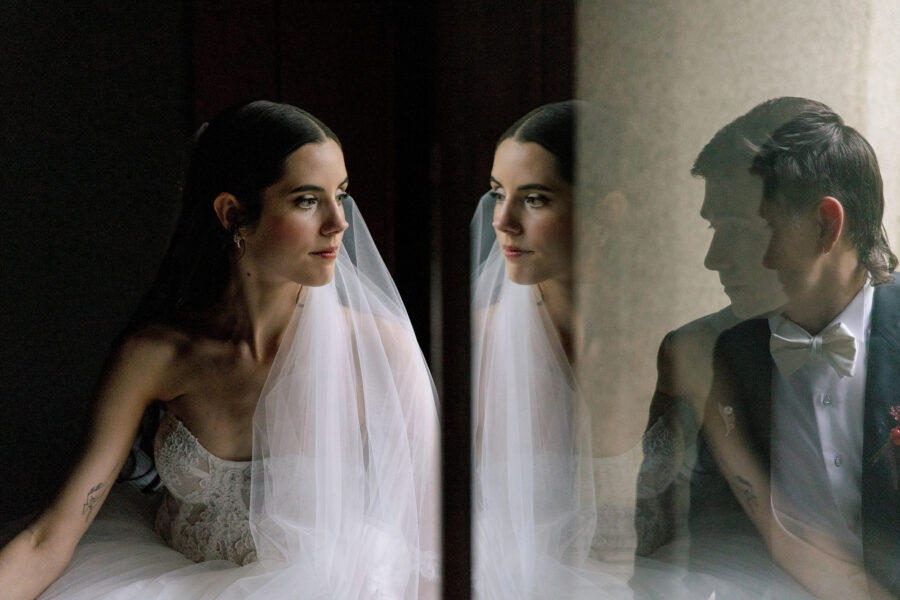
The day itself began at Jinya. That’s the quiet gift of a ryokan elopement. There’s no transfer to a venue and no lobby to cross in a gown. The morning happens in rooms of paper screens and old timber, and getting ready belongs to the same house as the garden outside.


A Garden at Tsurumaki Onsen
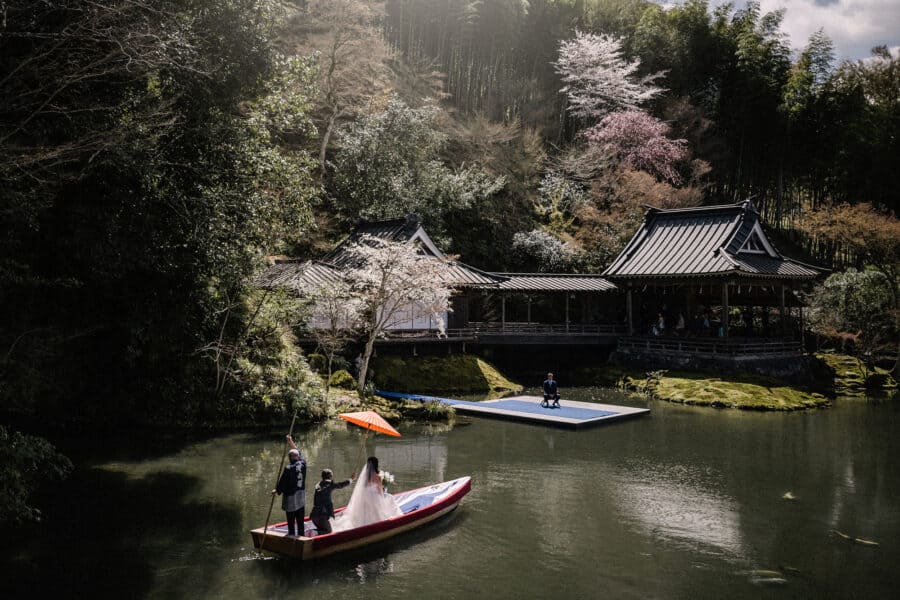
Motoyu Jinya sits in Tsurumaki Onsen, in Hadano, below the Tanzawa mountains, and it has been receiving guests for more than a century. The inn gives the garden’s size in the old measure, ten thousand tsubo, a little over three hectares. It describes its hot spring as rising from deep beneath the Tanzawa range, with a calcium content it counts among the highest in the world. An old inn in Japan tends to introduce itself this way, by what the ground gives it and how long it has looked after it. The house has collected its share of stories over those years.
For an elopement, a garden like this changes what the day is for. There’s no aisle to fill and no one to arrange. The paths, the stone lanterns and the bamboo become the whole world of the day. Jinya belongs to the people who keep it, and they lend it with real care. For one spring day it was the couple’s to wander, like a house they’d been handed the keys to.


Words on a Page
At most weddings, other people do the talking: a father, a best friend, a sister with a page of notes. An elopement removes the speeches along with the guests, and the only words left are the ones the couple bring themselves.
They had chosen early where those words belonged. Weighing Jinya against somewhere more open, they wrote that a ceremony at the inn would be more private, and “probably more magical for us”. So the words were read in Jinya’s bamboo, from a page written ahead of time. What was on it stays theirs, which is exactly where it belongs. We’ll only say that words written down are a particular kind of promise. They’re composed alone, in the writer’s own voice, and they can be kept. Years from now that page will still be in a drawer somewhere, saying precisely what it said that afternoon.
The rest of the garden hour was lighter, and it was a pleasure to be around. Two people who had just shared the most serious words of the day were laughing again before long, which is as good a sign for a marriage as we know.


The Flower That Lit the Lamps
In the spring of 1774, the poet and painter Yosa Buson visited Mt Maya, above what is now Kobe, and wrote one of the best-known haiku in Japanese: nanohana ya / tsuki wa higashi ni / hi wa nishi ni. Rapeseed flowers, the moon in the east, the sun in the west. The fields below him weren’t there for the view. Rapeseed was grown in that district for its oil, and through the Edo period rapeseed oil was burned in the andon, the paper-shaded lamps that lit Japanese rooms after dark.
So the yellow of spring had a second life as light. A flower that covered the fields by day was pressed and burned to keep the evenings going. Nanohana is still a spring season word in haiku, one of the ways a poem tells you exactly when it stands.
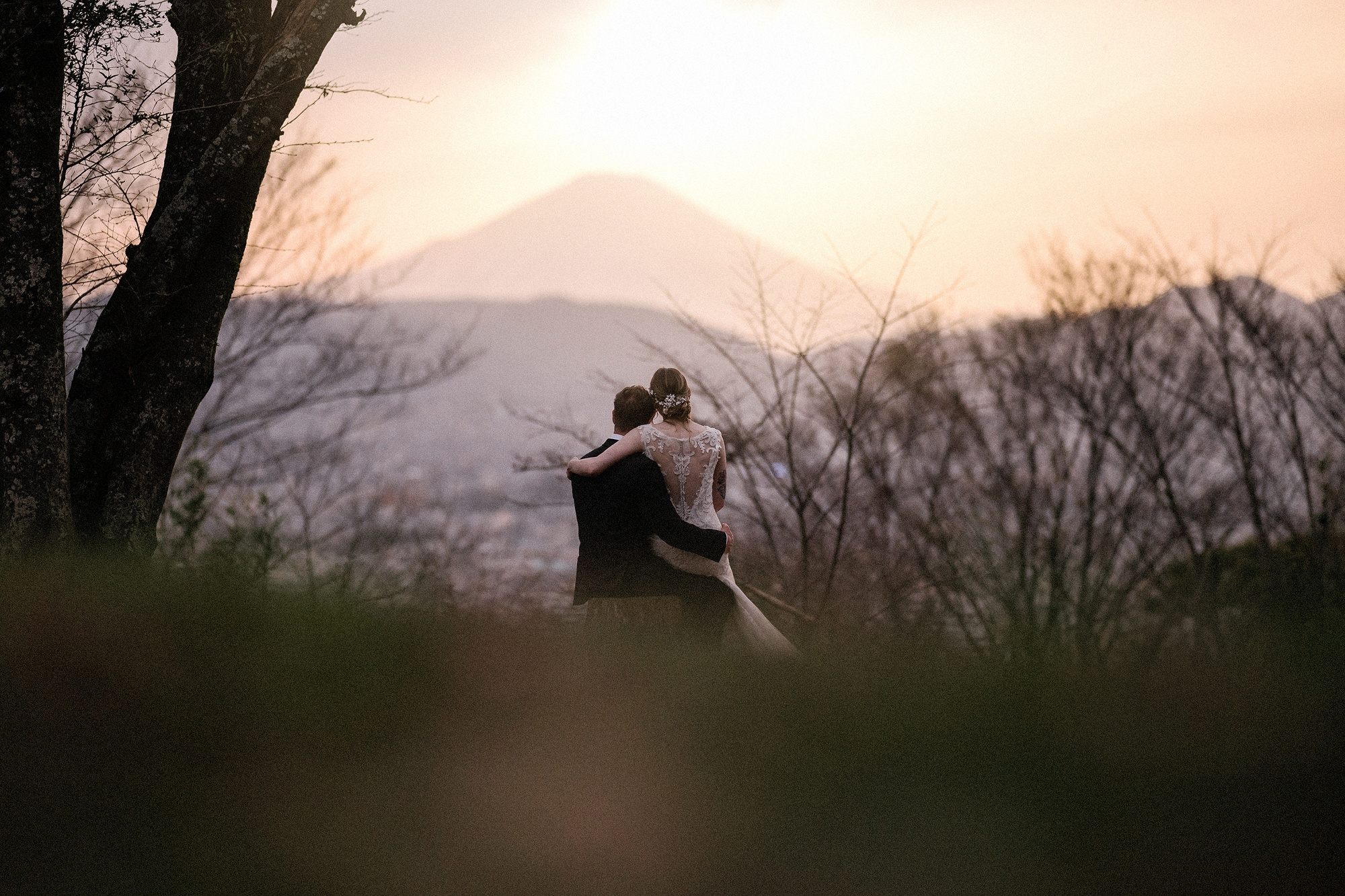
The couple spent the late afternoon on a hillside of rapeseed, with cherry blossom above it and Mt Fuji in the distance. It’s Buson’s scene with Fuji added and the moon not yet risen: the flowers at your feet and the sun going down in the west. Standing in the middle of it is the only way to read his poem properly, and that’s where they were.


Thunder Raises Its Voice
On Japan’s old calendar of seventy-two seasons, their day fell exactly on a seam. The five days before it were sakura hajimete saku, the cherry blossoms begin to bloom. Their elopement fell on the first day of kaminari sunawachi koe o hassu, when thunder raises its voice. It names the first rumbles of spring far off in the sky, and the thunder was welcome, because it brought the rain the fields were waiting for.
That spring the blossom ran late. After a March of cold snaps, Tokyo’s cherry trees opened on 29 March, five days later than average and fifteen days later than the year before. Their day was 30 March. The blossom arrived with a day to spare.
You can choose the week of a spring elopement in Japan, but never the bloom. That’s why we plan an elopement around the season and the light first, and the clock second, so that when the blossom is late, or early, the day still has somewhere good to go.

Until the Light Went
On a clear spring evening Mt Fuji can turn pink, and most people catch it for a minute from a car or a train window. They gave it the whole evening. The colour came up behind the mountain and settled over the valley, and they were still out on the hillside, in no hurry at all, as the sun went down beside it.
That’s the kind of elopement we believe in. It isn’t a shorter wedding. It’s a longer day, time spent on purpose with nothing else asking for it. One of the last embraces of that evening found its way into an essay of ours about a particular kind of hug, the one that says I see you. We made the photographs and the film as one piece of work, so that both the stillness of that evening and its movement would be kept.


Buson’s poem ends with the sun in the west. Their day ended there too. Elope still means to run. They came the long way, by sea, then spent the day standing still in all the right places: a garden at Tsurumaki Onsen, a grove of bamboo, a field of the flower that once lit Japan’s lamps, and a hill facing Fuji as the light went.