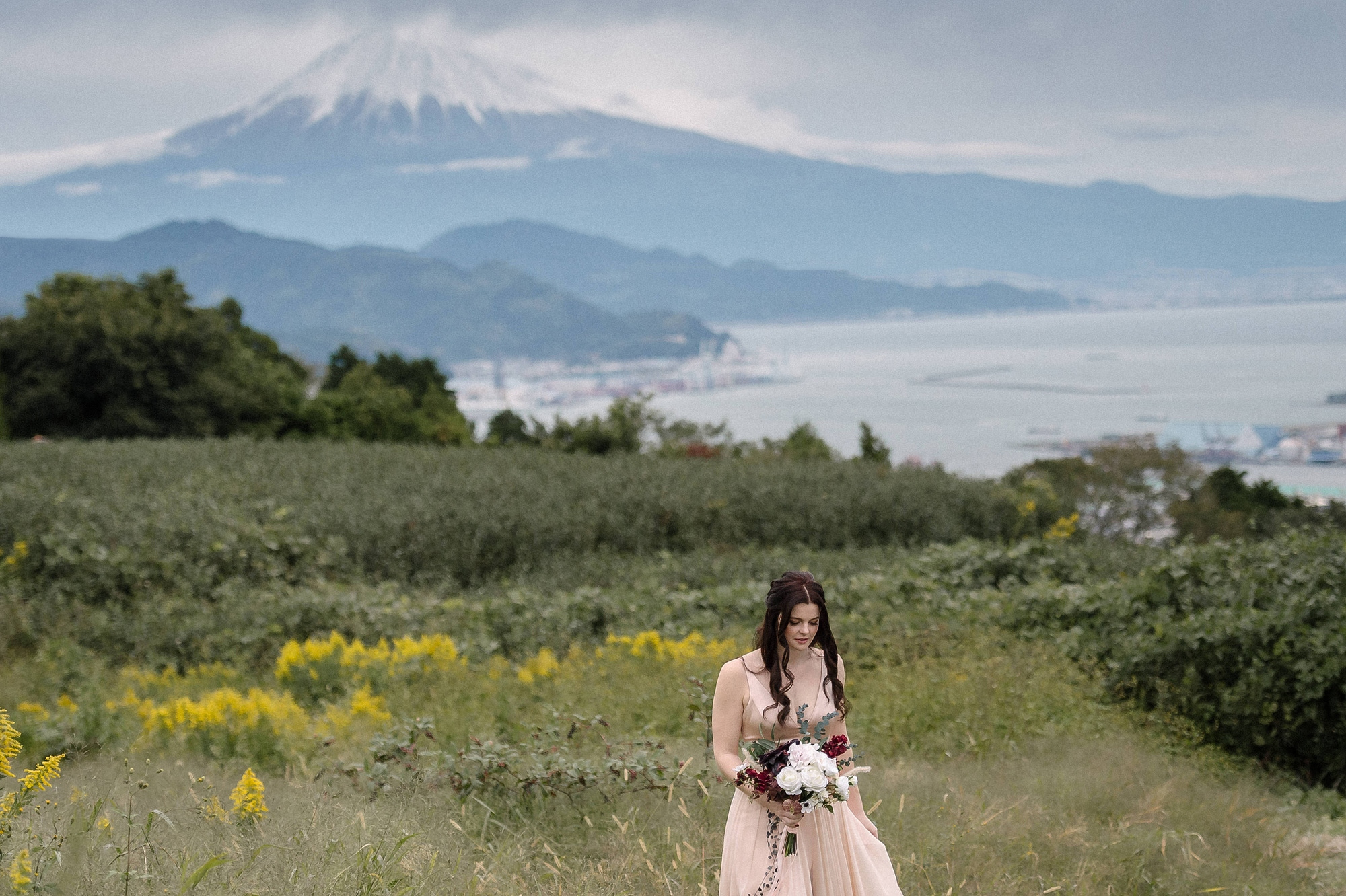
Some places can only be reached by waiting. For more than two years, Japan was one of them. Couples planned weddings here the way you’d write to someone overseas, never knowing when the reply would come. On 11 October 2022 the country brought back visa-free entry and let independent travellers in again. Two weeks later, on a hilltop of tea in Shizuoka, this couple married with Mt Fuji across the bay. Their Mt Fuji tea field elopement was one of the first weddings we celebrated after Japan opened its doors.
They’re an Atlanta couple. They met when he trained her on her first shift at a hole-in-the-wall bar, bonded over a favourite local pub and her cat, and got engaged under a Christmas light display, with his grandmother’s ring. By the time they first wrote to us, in the autumn of 2021, they’d been engaged for almost two years and had wanted to marry in Japan the whole time. Wanting it hadn’t brought it any closer. “It has been hard to even imagine this as an option for us,” she told us.

It was always going to be an elopement, just the two of them. They’re private people, and they knew exactly why. “We love our families and friends,” they wrote in their planning kit, “but no one will ever understand us the way we do.” Their people at home watched the vows over a video link, and saw the rest in the photographs.
Planning a Wedding for a Country That Was Closed
They signed with us in February 2022, while the border was still shut. The date they asked for, the 25th of October, was the one they’d hoped for from the start, chosen long before anyone could promise it. Through the spring and summer the news from Tokyo kept shifting: group tours with registered guides, then a summer with no word at all. In August we held a second date for them, a spring day in 2023, so the wedding would happen in one season or the other, whatever the government decided.
Holding two dates is its own kind of planning. Every booking has a twin, and every partner needs a last day to decide. The tea terrace team gave us until mid-October. We gave the couple the truth each time the news moved, which is most of what planning a wedding in Japan asks of us in any year. In late September the reopening was finally announced. Her reply was three words long: “I’m CRYING!”


The Tea Room in the Sky
They’d chosen their place months before. Shizuoka is tea country, and in its hills a local company working with tea farmers has built small private decks out among the bushes, each one yours alone for the time you book it. The couple fell for one called Tenku no Chanoma, the tea room in the sky. In their planning kit they’d included a clip of Elizabeth Bennet standing at the cliffs in Pride & Prejudice. Dee wrote back that this deck was Japan’s version of those cliffs, and one of her own favourite places in the world.
Within a day of the reopening news, Typhoon No. 15 reached Shizuoka. The operator’s own notice describes a linear rainband over the prefecture, landslides and flooded rivers, and a tea garden and wooden deck at Tenku no Chanoma that were both badly damaged, with no date for repairs. In the same week that the border they’d waited on for two years was finally given a date, the place they’d waited to stand in was lost. Her reply asked first whether everyone there was okay. Then: “While we are sad we know whatever we end up doing will be lovely.”


What followed was a fortnight of new plans made quickly. The golden tea field they loved next turns gold at another time of year, and the track up to it is steep for a wedding dress. The team suggested their deck at Nihondaira instead: untouched by the storm, the largest deck they have, and Fuji in view. The couple wrote back within hours: “The tea fields with the city and fuji view!” They added that they were glad their wedding could still support the tea fields. We booked the deck that week.
Nihondaira, a Hill Named for Its View
Nihondaira is a plateau above Shimizu, in Shizuoka City, and people have climbed it to look out for a very long time. The city’s own tourism pages say it takes its name from Yamato Takeru, the legendary prince said to have climbed it, and that in 1950 it was first judged the finest scenic spot in Japan, for the view of Mt Fuji over the port of Shimizu. The city still sums the place up in three things: Fuji, tea fields, the harbour.
The deck there was called Zenkei no Chanoma. Zenkei is the whole view, the panorama. A chanoma is something more domestic: in a Japanese house it’s the family room, where the tea is poured and people sit down together at the end of the day. The company took the word out into the fields, and its own description of a chanoma is a place to stop and breathe with the person who matters most to you, and no one else.


It’s hard to think of a better word for what this couple wanted. They didn’t want a venue. They wanted a room of their own, with the walls taken away and Suruga Bay where the windows should be. The deck came with tea grown on that hillside. A tea master had also blended a tea for the two of them from a questionnaire about their life with tea, and the packet carried an illustrated portrait of the two of them.
Vows Above the Tea Fields of Shizuoka
He rode up the hill blindfolded, so the first time he saw her in her dress would be on the deck. For her entrance they chose King Crimson’s “Islands”. For the moment after, “Liz on Top of the World” from the Pride & Prejudice score, the cliffs again, and then Bowie’s “Heroes”.


A prog-rock ballad, a film score about a woman at the edge of a view, and Bowie. It’s a truer portrait of the two of them than anything we could write, and not one of those choices was made with a guest list in mind. That’s what an elopement allows. Every choice answers only to the two people making it, and theirs added up to exactly who they are.
The same was true of the smallest things. Before they flew, each of them wrote to us separately, on the other’s behalf. He asked us to find a bottle of good local sake for their first night as a married couple, and told us she loves champagne and sour sweets. She told us he’d love a local beer. Neither knew about the other’s email, and Dee kept both secrets.


Autumn at Lake Shoji, Where Fuji Holds Something Close
From Nihondaira we drove around the mountain into the Fuji Five Lakes. Dee had warned them it would be unseasonably cold at the lakes that week. Fuji had snow on its shoulders, the pampas grass had gone pale gold, and the maples were just beginning to turn. Months later, Dee was still writing to them about how clear the mountain had been.
Lake Shoji is the smallest of the five lakes and one of the places listed as part of the Mt Fuji World Heritage site. Its view has a name. Yamanashi’s official tourism guide calls it kodaki Fuji, Fuji holding a child, because from this shore the mountain seems to cradle Ōmuroyama, a far smaller volcano on its lower slope. We like that this is the view Japan chose to name: the mountain at its most protective, holding something small close. For two people who’d kept their wedding to themselves for two years, it was the right shore.


Tenku no Torii, a Second Gate in the Sky
Their afternoon also took them up to Tenku no Torii, the torii of the sky, on the hillside above Kawaguchiko. It belongs to Kawaguchi Asama Shrine, which was founded more than a thousand years ago to calm Fuji’s eruptions, and it’s a place for worshipping the mountain from a distance. People climb up to stand under a red gate with nothing behind it but Fuji.
We didn’t plan the rhyme, but we noticed it. Their wedding was meant to begin at the tea room in the sky, and it ended up passing beneath a gate with the same word in its name. Japan took one sky from them and gave them another. Before the light went there was one more stop, a waterfall in the forest, its spray lit from behind.


Shibuya, Ten Days Later
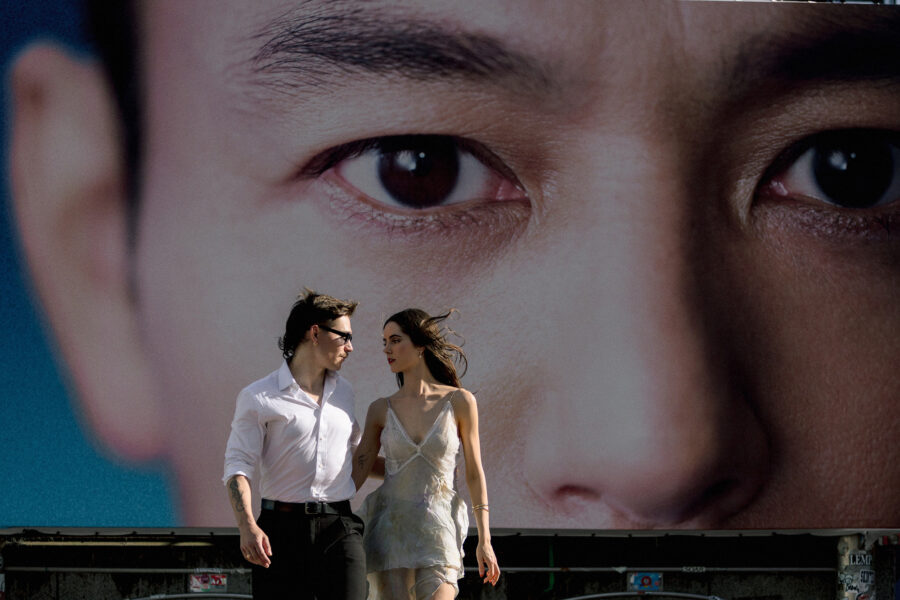
Ten days after the wedding, back in Tokyo, we spent an hour with them at Shibuya Crossing, in their own clothes, crossing and recrossing with the city. They’d planned part of the trip around a rock show at a Shibuya club, a band he’d been listening to for twenty years. The two people who’d stood alone on a hilltop of tea were just as at home in the crowd. That hour is as much a part of the photography we made for them as the deck at Nihondaira.


Still Coming Back
Seven weeks after the wedding, they wrote to thank us: “We still are overcome with how PERFECT everything was. The day itself, the pictures afterward.”
Japan made them wait two years. They’ve been coming back ever since: in December 2023 we had dinner together in Tokyo, and at the start of 2025 they were back again.
We wrote once that the best vows aren’t about settling down but about taking off, and this couple come to mind whenever we read it back. The Finns have a word for the pull of faraway places, kaukokaipuu. For these two, the faraway place became their own on a hill of tea in Shizuoka. They waited for the door to open, walked through it in the first weeks, and they’ve kept coming back through it since.