Japan’s oldest story begins in a bamboo grove. An old man who cuts bamboo for a living, and uses it, the story says, for every kind of thing, finds one stalk glowing at its base, and inside it a girl small enough to hold in his hand. Murasaki Shikibu, writing The Tale of Genji in the early eleventh century, called The Tale of the Bamboo Cutter the ancestor of every story that came after it. This is an origin story too: a bamboo grove elopement in Japan that became the first wedding our bamboo forest in Tochigi ever held.
It belongs to two people who were already in Japan in June 2022, when almost no one else could get in. They were both serving with the US Navy here, and a good deal of their planning was done by email from sea, signed off “Cheers from the sea.” Their very first message to us said, “We are both pretty adventurous individuals.” We had no idea yet how true that would turn out to be.
Adventure, for these two, meant something particular: choosing the thing nobody had tried, then turning up for it with their whole hearts. Every venue anyone marries in was once somewhere no one had married. Someone has to go first, and it tells you a great deal about two people when they would rather be first than be sure.


Their film keeps what a still frame can’t: the rain moving through the bamboo, the swing, and the lanterns coming on after dark.
A Bamboo Grove Before Anyone Married There
When they first wrote to us in the spring of 2021, Japan had been closed to visitors for a year, and Dee had spent much of it driving into the countryside, looking for places that weren’t in anyone’s guide. She sent them a long list: ryokan, an old farmhouse, villas in the mountains, a castle. Partway down was a working bamboo farm in Tochigi, with a short note beside it. Not done before, but they’re open to it.
They put it first. “The pictures really show through day and night,” they wrote back, and that was the decision made.
The family who farm it have tended bamboo and chestnuts on this land for more than a century, across three generations. In 2021 their grove had never seen a wedding. Dee went that June, and again in July, making a lantern at the farm’s own bamboo workshop and, as she wrote to the couple at the time, doing all she could to make connections and pave the way.
That is the part of planning nobody sees. Before a first can feel safe, someone has to know a place well enough, and earn enough trust from the people who keep it, that a couple can walk in without a precedent. Our bamboo forest began there, with that trust, and with this couple’s yes.


June 2022, With the Borders Still Closed
They had always planned something small: never more than sixteen people, the two of them included. By May 2022, Japan had been closed to tourists for more than two years. In mid-May their families learned they couldn’t get permission to travel. At the end of May the government announced that guided package tours could begin on 10 June, four days after the wedding. Travellers on their own would wait until October. So the guest list became two.
What we loved is how little that changed what they were to each other. They had agreed not to exchange gifts, “so that way we don’t try to outgift each other,” and wrote each other a card instead, to be opened on the morning of the wedding. On a day when nearly everyone they loved would be watching from the other side of the world, the first words each of them read were the other’s.


Love Letters in the Bamboo
An elopement is the two of you. It isn’t the absence of everyone else, and Dee wasn’t about to let an empty guest list mean an empty grove. She wrote to everyone who had been invited and asked each of them for a photograph, a few lines or a short video, and promised them a surprise. The groom’s mother wrote straight back: “They love games, so it is perfect.”
So after the ceremony, the couple were sent into the bamboo to find their people. The letters hung on white ribbon strung between the stalks, pegged beside family photographs and single carnations, each one sealed in clear plastic against the rain. A card on one of the lines called them love letters. Their families and friends watched the vows live from home. In the grove, they were waiting in paper. The videos they had recorded followed a month later, cut together and sent to the couple on their one-month anniversary.
We have thought about that afternoon often since the world opened again. Distance is the oldest problem in love, and the bamboo cutter’s story ends with it too: a daughter called home to the moon, leaving letters behind for the people she can’t take with her. The answer hasn’t changed in a thousand years. You write it down, and you make sure it’s found.


The First Day of the Rains
The old Japanese calendar divides the year into twenty-four solar terms, and one of them is bōshu, the time for sowing grain that grows with awns, rice among it. In 2022, by the National Astronomical Observatory’s own calendar, bōshu began on 6 June: their wedding day. That same day the Japan Meteorological Agency declared the start of the rainy season across the Kanto region. The nearest weather station recorded 43 millimetres of rain and never rose above 14.7 degrees. In June.
They saw it coming. A few days out they asked Dee what she made of the forecast. She set out the wet-weather plan and asked, gently, whether they were thinking of moving the date. Their reply came back within minutes: “We are definitely not talking about moving the date! We are excited regardless of potential weather and all about embracing the moment!!” They had searched Kyoto for Japanese paper umbrellas and found none that would survive a day like that, so they married under clear ones.
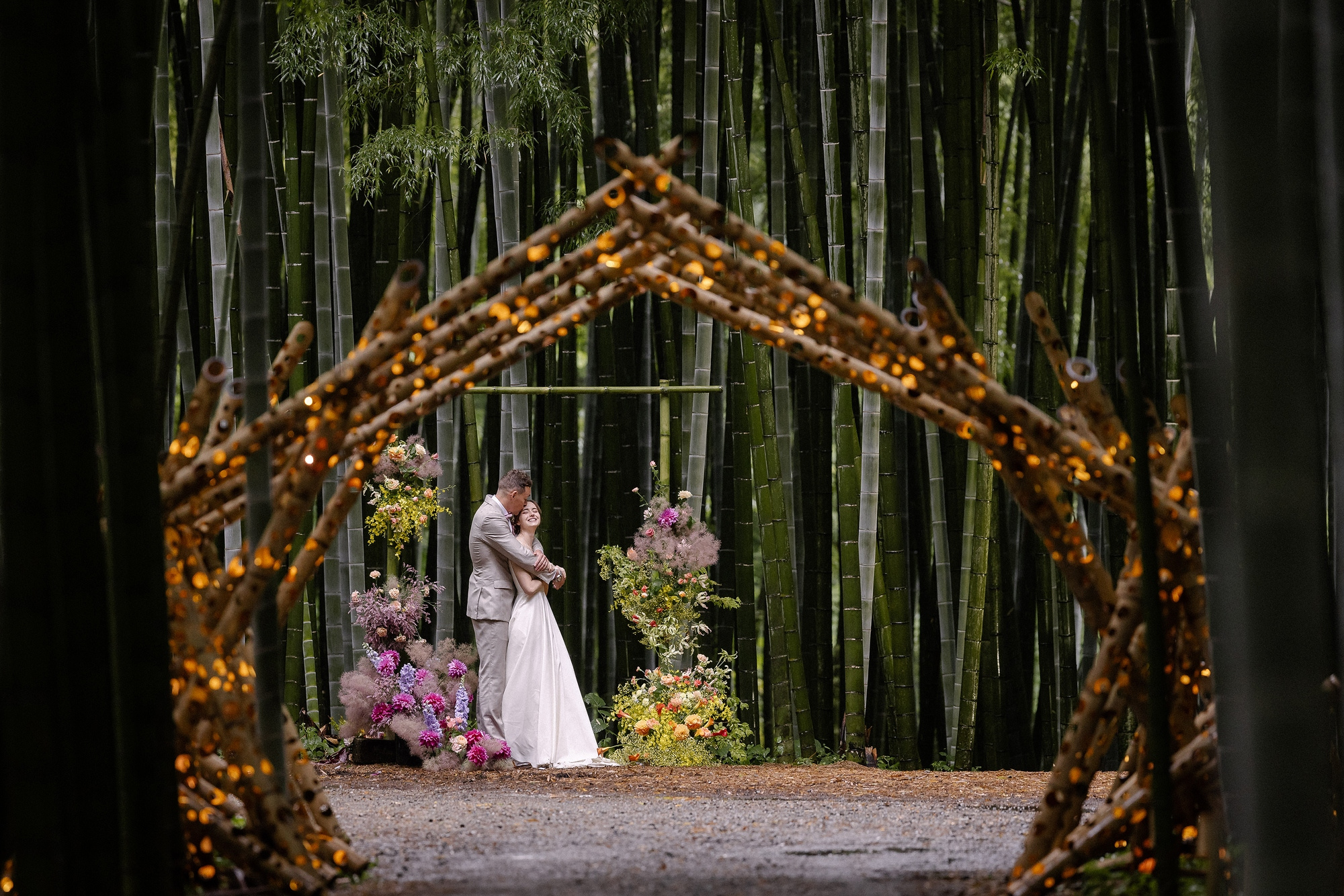
He saw her for the first time as she walked towards him down the bamboo avenue, which was their choice, and the right one. They married beneath the lit arch at the end of the avenue, and the rain did what it always does in bamboo. It deepened every green, and it brought the sound of the forest close.
We’ve come to love the old calendar for days like this one. It doesn’t call the wet season a problem. It calls it the season of planting. Something goes into the ground on a grey, cold day and comes up later as more than anyone could have pictured. That afternoon, a farm that had never held a wedding planted its first.


Adventurous, as Promised
Their first email promised adventure, and a wet bamboo swing in a full wedding gown is as honest a test of that as we know. She passed. Two months later they wrote to say the next plan was the summit of Mt Fuji. A typhoon had already seen off the first attempt.
June has its own word for what was growing around them. In the haiku calendar, young bamboo is a word for June itself: the spring’s shoots have shed their brown sheaths and shot up into new green culms, unfurling fresh young leaves. A bamboo grove in June is full of the year’s new growth, all of it already taller than anyone standing beneath it. It’s the month we’d choose for a bamboo grove elopement in Japan, for exactly that reason.
We can’t think of better company for two people beginning something. Nothing in that grove was finished. Everything was reaching.


A Dinner Under Bamboo and Stars
That was the title on their menu card, and in fairness to the card, the stars were in the plan. The rain kept them to itself, but dinner for two went ahead under a white canopy at the edge of the grove, with candles, string lights, Tochigi wagyu, and yuzu beer, which suited a groom who loves anything sour.
They opened a small sake barrel that evening, just the two of them. Japanese is careful with its words here. You never break a sake barrel; you open it. The round lid is called the mirror, kagami, for wholeness and harmony, and biraki, opening, is chosen because it speaks of good fortune widening out, as the brewers at Gekkeikan explain. Kagami biraki is usually the loudest moment of a wedding party, a whole room counting down around a barrel. Here it was two people and the rain on the leaves, and it meant exactly the same thing.


When the Grove Lit Up
There were no stars that night. The grove made up for it. The farm’s arch is built from bamboo drilled with holes and lit from inside, and after dark its glow runs the length of the path, while lattice spheres of bamboo hang lit between the stalks. Japan’s first story found light inside a bamboo stalk. The people who keep this forest have spent years putting it there.
She changed into a short dress for the night, they went back out into the rain, and they stayed. A few weeks later we sent them their film. He was at sea when it arrived, and wrote to say he was “doing everything in my power not to watch it,” because they had promised to watch it together when he got home. When they finally did, they wrote again: “Man what a day that was.”
Of everything they said to us, that’s the line we keep. Two people whose work kept sending them out to sea, saving the best thing for the moment they could share it.


The First of Many
When the farm saw the film, they asked whether they could share it, so that people would know a wedding could happen there. The question had been answered on a wet Monday in June. In the years since, we’ve come back to our bamboo forest again and again, in spring rain and in winter sun with guests gathered round, and no two days there have ever looked or felt alike. Every couple has made it their own. But it was these two who first made our bamboo grove a place where people marry.
Their album went to print that December, the two of them on the front cover and a detail of the bamboo on the back.
Opening a place that has never held a wedding takes planning that starts long before the couple arrives, and a team that knows how to hold a day steady when the weather turns. Our photography and film were made for exactly that kind of day.
There’s a line early in The Tale of the Bamboo Cutter that we think of whenever we drive back up to Tochigi. After the old man found the child in the glowing stalk, every time he went back into the bamboo, he found something precious hidden in it. We know the feeling.
The Day Before
The afternoon before the wedding, they sat at the farm’s workbench and drilled their own bamboo lanterns, then wandered the grove in jeans with nothing to do but get to know it. We’ve kept these for last. It’s the two of them before any of it, already at home in the bamboo.