Four days before he planned to propose beneath the cherry blossoms in Hirosaki, he wrote to ask whether there was any chance we could be there. Somehow, there was. Seats on the flights north to Aomori were scarce that spring, and the only ones we could get were on the same plane as the couple. They sat up near the front. We sat towards the middle. Whether he knew his photographers were further back in the same cabin, we still can’t say, and if he did, he hid it well. It’s an unlikely way to begin a cherry blossom proposal in Japan, and it’s one of the stories we love telling most.
We’d travelled light, with nothing in the hold, so when the plane landed we slipped past them both, out of the airport and on to Hirosaki ahead of them. Somewhere behind us, a man was carrying a ring through a country he’d never visited before.
A Cherry Blossom Proposal in Japan’s Far North
He was from Florida, on his first trip to Japan, and more nervous than he’d been in his life. They were already travelling in Japan, and he wanted one particular moment: to ask her as they stood among the cherry blossoms of Hirosaki Park. Hirosaki was new to us then, just as Japan was to him. We had a short head start to learn a park we’d never worked in: where the light came through the weeping cherries, which paths opened out, where we could disappear. And all the while we knew the real plan was his. He would ask where he would ask. We just had to be ready.
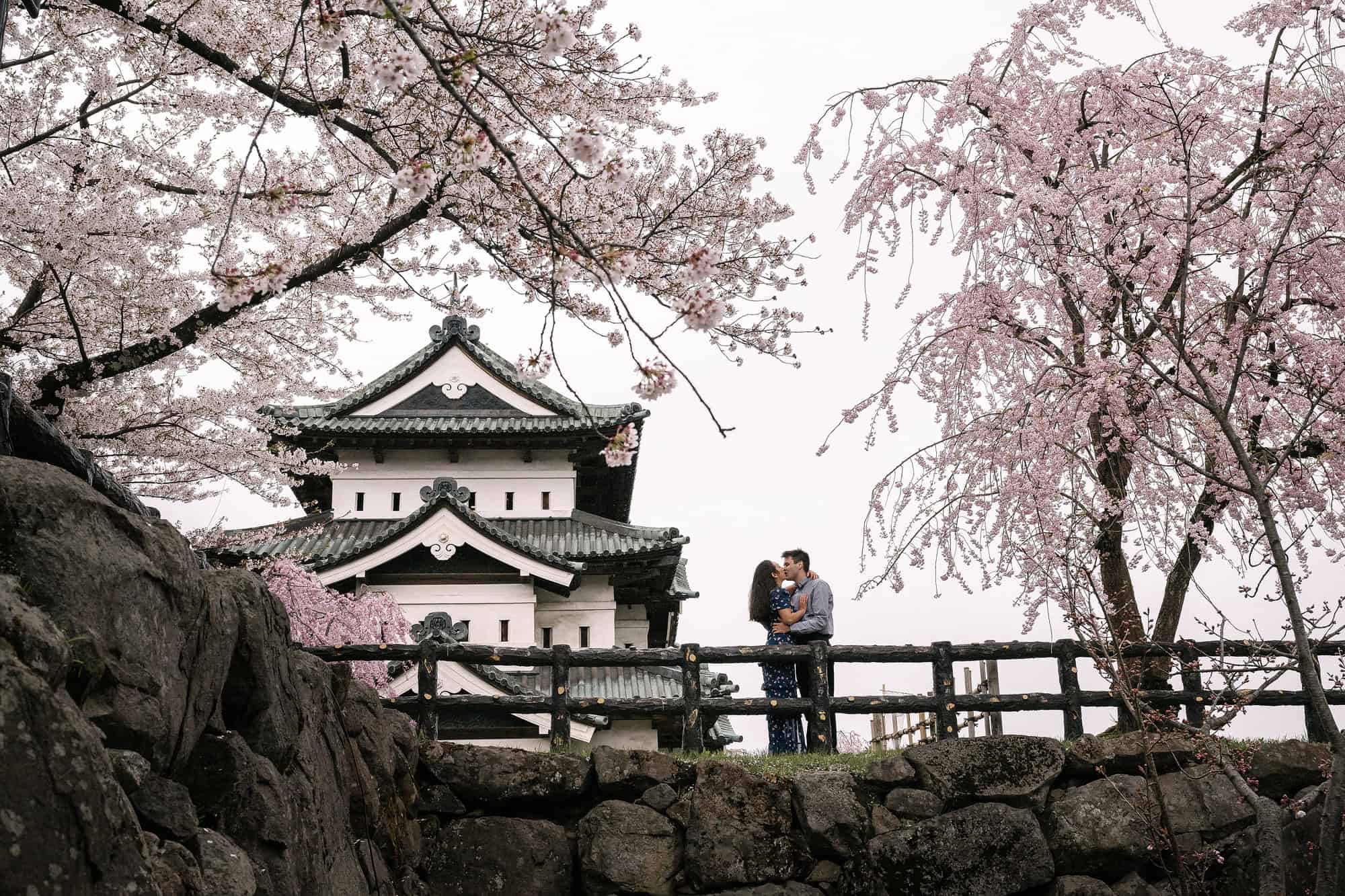
What followed was a flurry of messages between the trees and his phone: where the good spots were, where we were hiding. Then, bless him, he found the perfect spot. We were ready. He opened a black folder of printed photographs first, and then came the ring.


This is the part of our work people rarely see, and the part we’re proudest of. Preparation exists so the moment can happen wherever it wants to and still be caught. He never had to choose between the right place and the right second, and he never had to perform his proposal for a camera. It’s the thinking behind everything we plan in Japan: hold the structure firmly, so the people inside it are free.


The Earliest Spring on Record
A cherry blossom proposal in Japan is always a bargain with the trees, and that year the trees had made plans of their own. In 2023 the Somei-Yoshino in Hirosaki Park opened on 7 April, the earliest since records began in 1947, and reached full bloom on the 13th, earlier than in any year before it. By the day of the proposal the big canopy was already letting go of its petals, while the weeping cherries, which keep their own time, still hung full over the grass. On the old calendar it was the last kō of seimei, niji hajimete arawaru, when the first rainbow appears: one of Japan’s 72 seasons, five days long, and now theirs.
Once the question was answered, the pressure left the day and the day was simply theirs, with us alongside. We spent the rest of it together in and around the park, the kind of unhurried afternoon a proposal rarely gets. That’s the quiet gift of a proposal planned this way. Nobody has to hurry back to real life the moment the ring is on. The celebration gets the same room the question did.


Hirosaki Castle and the Keep Called a Turret
At the centre of the park stands a building with a naming problem. Hirosaki Castle was essentially complete by 1611, under the second Tsugaru lord, and its first keep burned after a lightning strike in 1627. When a keep finally rose again in 1810, in the southeast corner of the inner bailey, its ridge tag recorded a new turret, and the domain went on writing it down that way for as long as it ruled. After the Meiji Restoration, the army’s papers filed it as Corner Turret No. 1. It was the people of Hirosaki who began calling it the keep, in their own documents and their local newspaper, and the name held. Today it’s counted among the twelve original castle keeps left in Japan, and it’s the only one in Tohoku.
We think about that distance between what something is and what it’s called. By the time someone kneels, the building is usually finished: the years, the trips, the ordinary mornings, all of it already standing. The question is the moment someone finally writes down what it is. To ask it in the grounds of a keep that waited most of a century for its proper name felt to us like exactly the right audience.


A Castle That Knows How to Move
Hirosaki’s keep has also spent a surprising share of its life somewhere else. In 1897 a Hirosaki-born master carpenter, Horie Sakichi, moved it west so the stone walls beneath it could be repaired, and in 1915 it went back. A century later those walls were bulging outward again, enough that a large earthquake could bring them down. So in 2015 the city lifted the whole keep, 14.4 metres tall and around 400 tonnes, and moved it some 70 metres into the middle of the inner bailey, onto a temporary base with Mt Iwaki behind it. Then the wall came apart, all 2,185 stones of it, and every stone went back. The last one was set at the end of 2024.
That’s the keep in these photographs: whole, cared for, and not quite home. It stood on its temporary base for about ten years, and this summer Hirosaki began bringing it back. The first move came in July, and in August the city invited people to take hold of the ropes and help pull. So these frames hold a view with an end date, a castle and its blossom in a place it was only ever visiting. Couples rarely think of their photographs as records. Some of them become exactly that.
Few things last because they’re left alone. This keep has lasted because Hirosaki keeps being willing to lift it, mend the ground beneath it and set it back down, which is as good a description of a long marriage as we know.


The Seeing-Off Picture
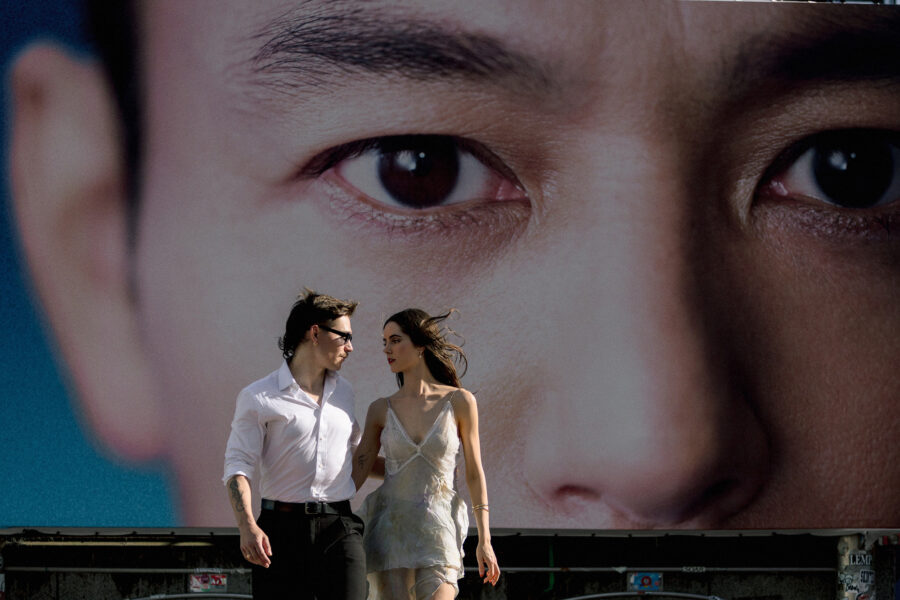
Later that afternoon, at Tsugaru-han Neputa Village, they stood in front of a neputa painting, a warrior’s face many times their size. Hirosaki gives its August to the neputa: around 80 lanterns, most of them fan-shaped and lit from within, pulled through the old castle town in the first week of the month. The custom was first written down in 1722 and is now one of Japan’s important intangible folk cultural properties.
The front of each fan carries a warrior, the kagami-e. The back carries the miokuri-e, the seeing-off picture, often a graceful woman, the side the crowd watches as the lantern moves away. We like that a town would paint both faces of the same thing, one to meet you and one to see you off. A proposal has both. It takes nerve on the way in, and something far softer once the question has been answered.

Petals on the Way Out
He had hoped for an apple orchard after the proposal, until we gently explained that in Hirosaki, Japan’s great apple country, April belongs to the blossom and the apples belong to autumn. By the time they were back under the blossom, the trees had begun to let go. Japanese has a word for that, hanafubuki, the flower blizzard, and it belongs to the end of the season rather than the peak. Since that first spring, Aomori has given us more chapters, from a cherry blossom wedding in Aomori to a post-wedding shoot in Hirosaki, and we’ve learned to love the scattering as much as the full bloom.
A proposal doesn’t turn two people into something new. It names what they already are, out loud, in a place they’ll always be able to find again. Hirosaki took the better part of a century to give its keep its proper name. He managed it in an afternoon, on his first trip to Japan, in the earliest spring the town has ever recorded, with his photographers exactly where he’d been told they’d be.


Two years later he wrote to us again. She was making the guest book for their wedding and wanted the Hirosaki photographs in it, and they meant to come back one spring to see the blossom again. We’ll be ready for that too.