“My favourite country is finally open!”
That was her email, not long after Japan let the world back in. She and her fiancé were planning their wedding in Singapore five weeks later, but before it they wanted something of Japan to take home with them: spring pre-wedding photos at Mt Fuji.
There was one complication. Late April is beautiful around the Fuji Five Lakes. It’s also spring, which means warmer air, rising haze, and a mountain perfectly capable of disappearing for an entire day.
We told them so, plainly. They came anyway. That decision became the story.

Why Spring Pre-Wedding Photos at Mt Fuji Come With No Promises
Her first thought had been Tokyo. Then came another email: “Our preference would be for this to be in Mt Fuji.” That settled where. It didn’t settle whether Fuji would actually appear.
This is one of the more useful things to understand about photographing the mountain. You can choose the season carefully, watch the forecasts, start before sunrise, and know which side of the lakes works with which light. What you can’t do is reserve the view. Spring asks for a particular bargain: the landscape is waking up, blossom is still possible at altitude, and fresh green is coming back, but the warmer air carries moisture, and Fuji can vanish into haze on an otherwise pleasant day.
They understood. More than that, she told us that even if the photographs weren’t ready to print for their wedding in Singapore, she still wanted to come, for the experience, as a “memory keepsake”.
There’s a considerable difference between travelling somewhere to extract a photograph from it and wanting the morning whether or not the photograph behaves. These two wanted the morning.

Fuji, First Light
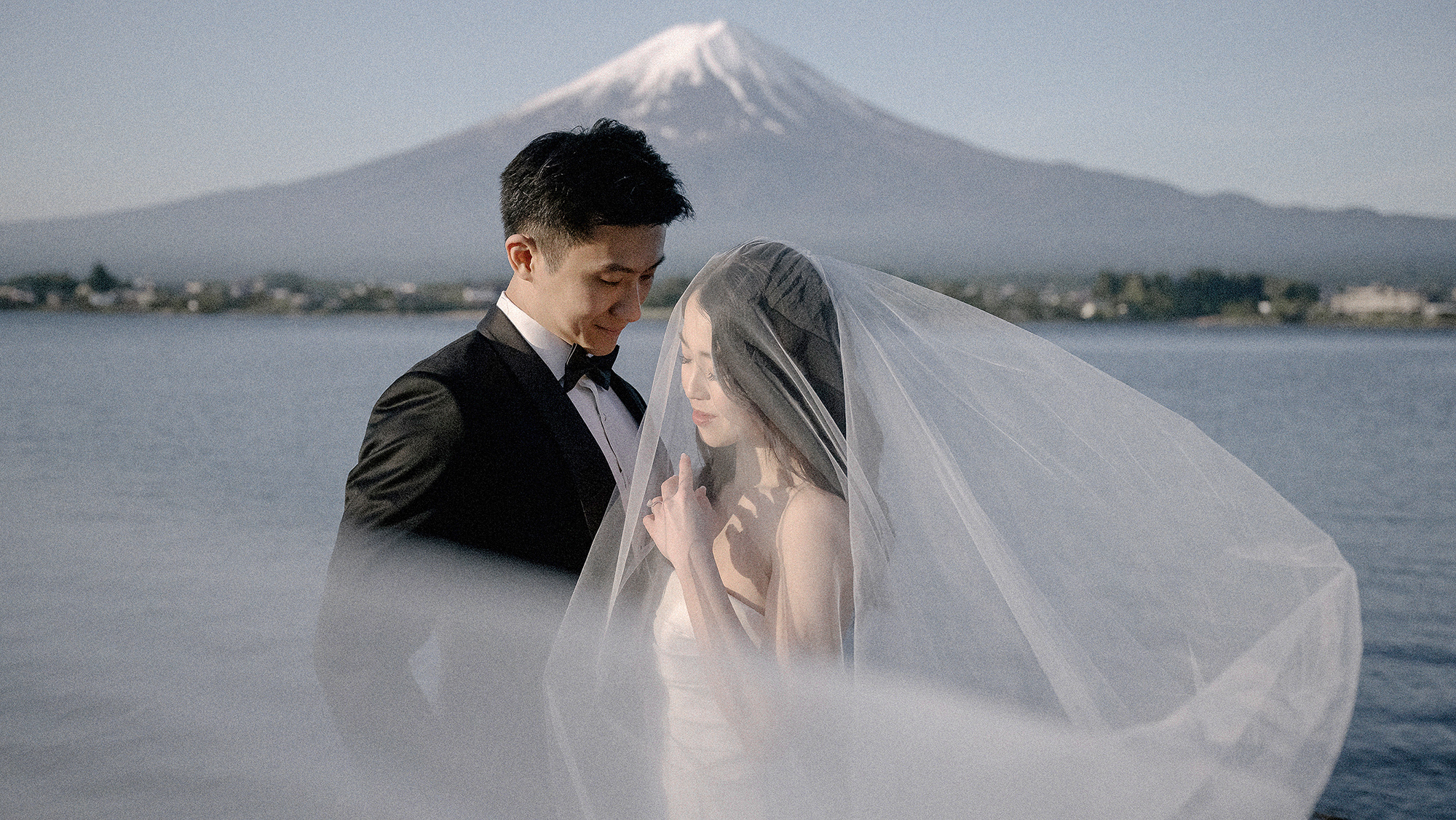
We began at Lake Kawaguchi before sunrise, and there she was: clear, with snow still across her upper slopes, the lake dark in front of her and the first light finding the grasses along the shore.
The forecast had offered no particular reason for confidence. Fuji apparently had other plans. She stayed.


For a photographer, this is the point where relief turns very quickly into greed. One clear view becomes the wish to see what happens from somewhere else, and around Fuji, somewhere else can change the meaning of the mountain completely.


Four Ways of Looking at a Mountain
Japan has spent centuries doing more than admiring Fuji. The mountain has been worshipped, feared, climbed, painted, written about and arranged into views. In one morning we moved through four quite different relationships with it.
At Lake Kawaguchi, Fuji was landscape, vast and distant across the water.
Higher on the hillside, Tenku no Torii framed her through a gate built so people could face and honour the mountain from afar.
Below it is Kawaguchi Asama Shrine, whose story reaches back to 865, when a shrine was founded on Fuji’s northern side after the great Jōgan eruption of the year before, to calm the volcano’s deity. More than eleven centuries on, that mix of reverence and fear is still part of the place.
And in the garden of the Itchiku Kubota Art Museum, built around one extraordinary textile artist’s lifetime of kimono, Fuji became composition again, glimpsed above stone, water and trees.
A lake that receives the mountain. A gate that addresses it. A shrine born from fear of it. A garden that frames it. The mountain hadn’t moved. Our way of looking at it had.

Spring Arrives Late at the Lakes
Tokyo’s cherry blossom had been over for weeks. Around the Fuji Five Lakes, more than eight hundred metres up, spring keeps a different timetable. Some of the weeping cherries were still holding their flowers, and the later yaezakura, with their heavy double blossom, were fuller still. So the morning gave them an unlikely pairing: snow across Fuji, and cherry blossom below.


Spring is often talked about as though it arrives in Japan all at once. It doesn’t. It moves north and uphill, following temperature rather than the calendar, and a train ride or a change in altitude can put you at a different point in the season entirely. That’s part of the pleasure of late April here. Tokyo had moved on. Fuji hadn’t quite finished.

Two Versions of the Morning
They brought two looks. The first was formal: her gown and long veil, his tuxedo. The second loosened everything: a softer dress, a short veil, and him in his own clothes.
It would be easy to call that variety for the photographs, but the change did something more useful. The first part of the morning acknowledged the wedding ahead of them. The second belonged to the trip they were already having.


Pre-wedding photography can become very produced, especially when the pictures are meant to appear at the wedding later, and everything starts serving the eventual display. This didn’t feel like that. They did hope to print photographs for Singapore. They were also standing under late blossom in Japan, laughing beneath the mountain, walking through spring grass, and spending one very early morning somewhere they had deliberately chosen to be. The photographs weren’t the only evidence it had happened.

Before the Wedding
Five weeks later, they married in Singapore. By then, this morning was already behind them.
That’s what we like about pre-wedding photographs approached this way. They don’t need to rehearse the wedding before it happens. They can record something else entirely: a trip, a favourite country, a season running late, and a mountain they knew might never appear and came to see anyway.
Fuji gave them the clear view. The lakes still had blossom. The photographs followed. But the part that stays with us was decided before sunrise, before any of us knew what the mountain would do. They had already chosen to come. The morning was worth having either way.