“My husband and I never had a wedding picture done of the two of us.”
That was the first line of her first email.
They were already married. They had a family. His work with the US Navy had brought them to Yokosuka, where on a clear day Mt Fuji sits across Sagami Bay, appearing and disappearing on the horizon with the weather and the season.
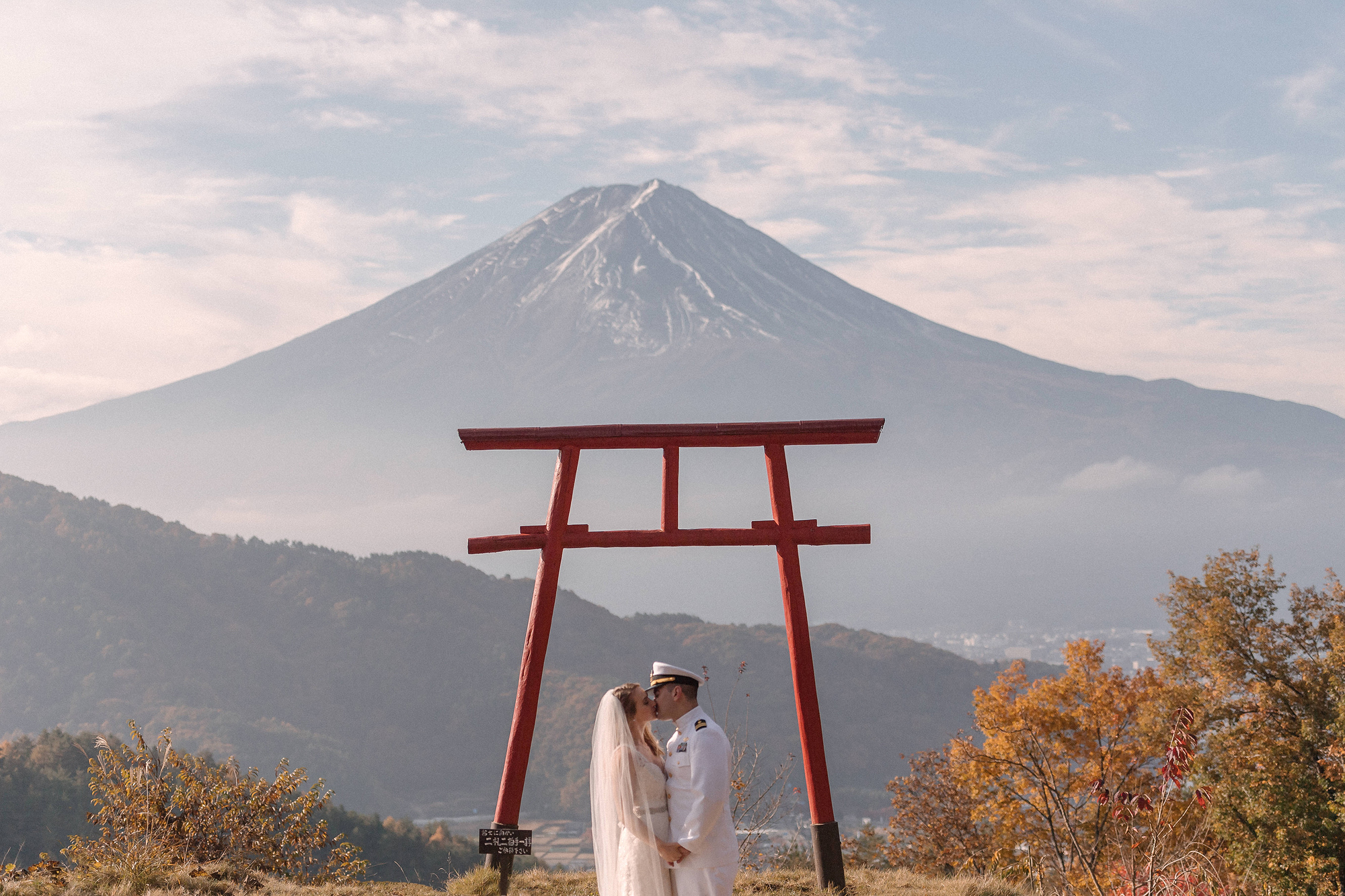
The wedding had happened years before. The photograph hadn’t. She wanted it now, and she knew where she wanted to stand for it: in front of Mt Fuji.
These Mt Fuji wedding portraits would be made long after the wedding day, and that turned out to matter more than we expected. Wedding clothes worn years into a marriage tell a different story.

The Photograph That Was Missing
Most wedding portraits are made at the beginning. The clothes are new. The promises have only just been spoken, and nobody yet knows exactly what those promises will be asked to hold.
These two did. By the time she put her gown on again and he stepped back into his Navy dress whites, the clothes belonged to people who had already lived some distance beyond the wedding: years together, a family, a posting to Japan, and all the largely unphotographed ordinary life that fills the space after a ceremony.
The clothes were the same. The people inside them weren’t.
They weren’t trying to recreate a wedding day they’d missed. They were making the portrait that day could never have held.
A Mountain on the Horizon
Living in Yokosuka gives you a peculiar relationship with Mt Fuji. From the western side of the Miura Peninsula, the mountain appears across Sagami Bay when the air is clear enough. Some mornings she’s unmistakable. By afternoon, gone. Then back again another day.
Fuji becomes less a destination than part of the horizon, and after living with a mountain at that distance for long enough, you want to go and stand in front of it.
She first imagined cherry blossom, but the blossom was never really the priority. Fuji was. She wanted the clearest possible view of the mountain, and that changed the season. Spring around Fuji can be beautiful, but warmth brings moisture and haze. By late autumn the air is colder and drier, the views open up, and the summit begins to carry snow.
So November it was. The decision was made for the mountain. Everything else arrived with it.
First Light, Without Fuji
We began at Lake Shoji before the sun had properly established itself. Fuji was nowhere to be seen. Mist covered the lake and moved through the hills on the far shore, revealing pieces of autumn forest and closing over them again.

There’s always a temptation, when someone has come specifically for Mt Fuji, to treat a hidden mountain as a problem. We don’t, not straight away. The Fuji Five Lakes make their own weather, and late autumn mornings often begin with cold air settling over water that still holds some warmth. Mist rises. Landscapes disappear and return. You work with the version in front of you.
That morning, Lake Shoji was almost monochrome: water, mist, a stony shoreline, and two people in wedding clothes, easy beside each other in the way years together make possible.

There was no mountain. There didn’t need to be. Not yet.


The Clothes, Years Later
The most interesting thing about the clothes wasn’t their formality against the landscape. It was their familiarity.
Wedding clothes are usually photographed at the moment they carry the most expectation. Before a ceremony, a gown can feel almost like a future tense. Years later, it means something else. She wasn’t wearing hers towards a marriage. She was wearing it from inside one.

His Navy whites carried their own history too: part of the life that had brought their family to Japan and put Fuji on their horizon in the first place. A wedding photograph usually says, this is where we began. These could say, this is who we became.

When Fuji Appeared: Mt Fuji Wedding Portraits at Kawaguchiko
By the time we reached Kawaguchiko, the morning had changed. The mist had lifted, and Fuji was there.
At Tenku no Torii, the red gate on the hillside frames the mountain almost impossibly neatly. From the right spot, the summit rises directly between its posts. It was the photograph she had described in that first email: her gown, his dress whites, Mt Fuji.


Getting exactly what someone asks for isn’t always the most interesting thing a day gives you, though. We’d already photographed them in the fog at Lake Shoji. Now the mountain was clear, and later there would be red maples and silver grass. The landscape kept changing while the same two people stayed inside it.
What Came With November
Autumn that year was extraordinary around Fuji. The maples had moved through orange into deep red, and beneath them the susuki, Japan’s silver grass, had turned pale and feathery as it went to seed. Susuki has been in Japanese poetry for more than twelve centuries, one of the seven flowers of autumn, and it still belongs to the season’s imagery, above all at tsukimi, the autumn moon viewing.


None of that was why they chose November. They chose November to see Fuji, and the colour came with it. That’s often how seasons work in Japan. You make one decision and inherit everything attached to it: the light, the temperature, the plants flowering or fading, the particular colour of a hillside. What looks at first like a compromise with the calendar becomes the character of the photographs.
Their family joined them for part of the morning too, so the picture that had been missing for years grew beyond the two of them. That felt right. Their marriage had too.


A Portrait of the Marriage
When the gallery arrived, she wrote: “I am overwhelmed with happiness about you making my dreams come true with these pics!”
They finally had their wedding photograph. By then, we weren’t sure that was quite what we’d made.
A wedding portrait holds two people close to the beginning of something. These came later, after enough shared life for the dress and the uniform to mean more than they could have the first time. After becoming a family. After crossing an ocean. After living somewhere Mt Fuji appeared on the horizon often enough to become part of their idea of home.
They had missed the photograph at their wedding. Years later, they stood beneath a red gate with the mountain behind them and made another kind entirely: not a recreation of where the marriage began, but a record of how far it had already travelled.