The first email arrived in November 2019.
They had taken their first trip together to Japan, and they wanted to come back the following September to marry, just the two of them.
Then the world closed.

By the time their Shibuya elopement finally happened, three and a half years had passed. For most of that time Tokyo existed for them at a distance: old photographs, YouTube walking tours, the memory of vending-machine coffee, and the peculiar ache of missing a city that had become important before they quite realised how important.
Waiting had done something useful. It had made them very sure about the Tokyo they wanted to come back to. Not an approximation of it. Their Tokyo.
Tokyo, From Melbourne
During Melbourne’s long lockdowns, they watched people walk through Tokyo on YouTube. The city looked strange in those films. Familiar streets were almost empty, and the movement and noise they remembered had gone. They went back through the photographs from their first trip and found whatever fragments of Japan they could at home.
Even canned coffee from an Asian grocery became part of it. It wasn’t the same, obviously. A vending machine on a Tokyo street has unfair advantages.

They booked the elopement anyway. Nobody could tell them when Japan would reopen, or when they’d be allowed in. But they’d already decided something more important: they weren’t going to marry somewhere else simply because somewhere else was available. Tokyo was part of the reason for marrying this way in the first place.
So they waited.
A Date That Kept Moving
September became another date, then another. Flights changed. Entry rules changed. Japan’s reopening came in stages, each one offering just enough possibility to start planning again before the next complication appeared.
Their wedding kept moving across the calendar. Their idea of it didn’t.
In April 2023, three and a half years after that first email, they were finally back. “Honestly feels like we have come back home,” she wrote from the hotel, “and we never want to leave.”


Having spent so long imagining Tokyo from the other side of a screen, they had no interest in making the city behave like a wedding venue. They wanted it as it was: crowded, neon-lit, slightly chaotic, and preferably with records playing somewhere.
Somewhere Tiny: A Shibuya Elopement in a Record Bar
The first idea was Golden Gai. That told us quite a lot. A conventional venue had never been the point. They wanted somewhere small enough to feel almost accidental, somewhere embedded in the city rather than set apart from it.
So we went looking. There are worse assignments than reconnaissance in Tokyo bars.
A few rounds of it brought us to Bloody Angle in Shibuya, a café by day and a record bar by night, lined with vinyl and marked by a glowing sign in the shape of a record. It took several conversations before we had a yes: for their ceremony, the bar would close to everyone else.

Their families and friends watched from Australia on Zoom. Records chosen together played on the turntable. They said their own vows, and toasted with the bar’s cocktails rather than ceremonial sake.
It wasn’t an unconventional venue made to look like them. It was somewhere they genuinely would have wanted to be anyway. That distinction matters.

The City With the Sound Back On
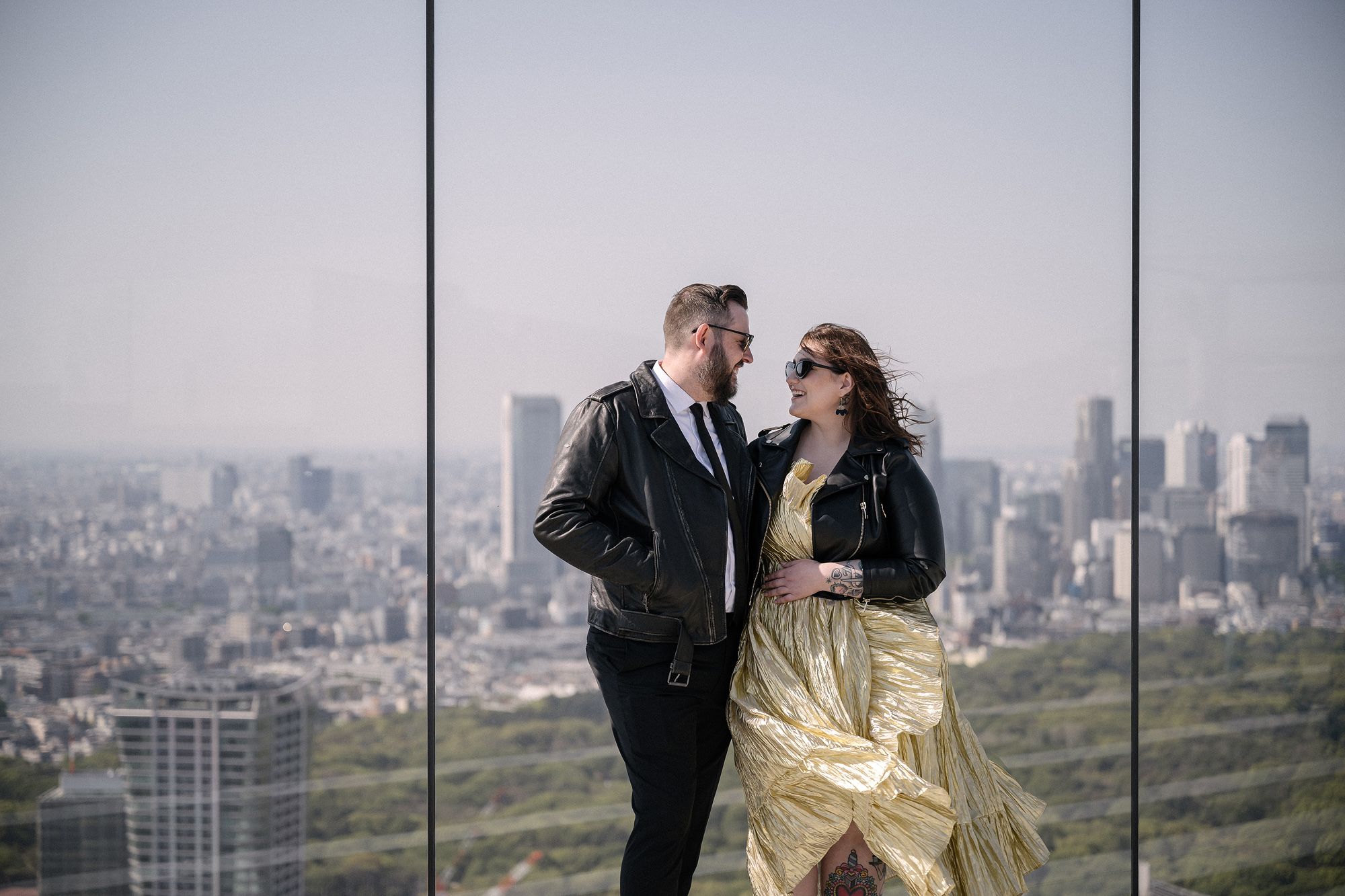
Before the ceremony, we took them above Shibuya.
Shibuya Sky opened in November 2019, the same month they first wrote to us. On their last trip it hadn’t existed. There’s something almost absurdly neat about that timing. While they were waiting to come back, Tokyo had carried on without them, and when they finally stood on top of it, the city was both familiar and slightly new.

For years Tokyo had been a walking tour playing on a laptop in Melbourne: empty streets, watched from a room they couldn’t leave. Now it had its sound back. Traffic below, people pouring across the crossings, trains and station announcements, music escaping from doorways, the low continuous hum that makes Tokyo feel less like a collection of landmarks than a living machine.
We photographed our way back down into it, from the rooftop into the streets and from daylight towards neon.


Dropping the Needle
The details made sense because they were theirs. He wore a leather jacket. They brought a Yashica twin-lens camera to their own elopement. The records had been chosen together. Nothing was added because someone had decided an elopement in Tokyo needed a particular kind of Japanese aesthetic. The city was already doing enough.
After the vows, there was no need to manufacture a transition into married life. They opened the door and walked back out into Shibuya, into the night and the neon, and moved through it married.
The Tokyo They Took Home
Dinner was at the top of the Park Hyatt. Lost in Translation had been part of their picture of Tokyo from the beginning, so it belonged here too.
But the ending of this story came later. Before leaving Japan, they bought every record that had played during their ceremony and carried them back to Melbourne. Once home, they made the marriage legal. And they had matching tattoos made of the neon record sign from the bar.

That last detail is our favourite. For more than three years, Tokyo had lived for them in things small enough to hold onto from Australia: photographs, films, walking tours, canned coffee, memories. When they finally made it back, they married above, inside and all the way through the city they’d been missing.
Then they carried pieces of it home again. The records. The photographs. And a little neon circle, drawn permanently on both of them.
Three and a half years to get to Shibuya. This time, they made sure some of it came back with them.