The old Japanese calendar gives the week they married its own name: kaiko okite kuwa wo hamu, the silkworms wake and eat the mulberry. It’s a season of work done out of sight. For generations at the foot of Mt Fuji, it meant the start of the year’s silk, raised indoors in the airy upper floors of thatched farmhouses while the weather did as it pleased outside.
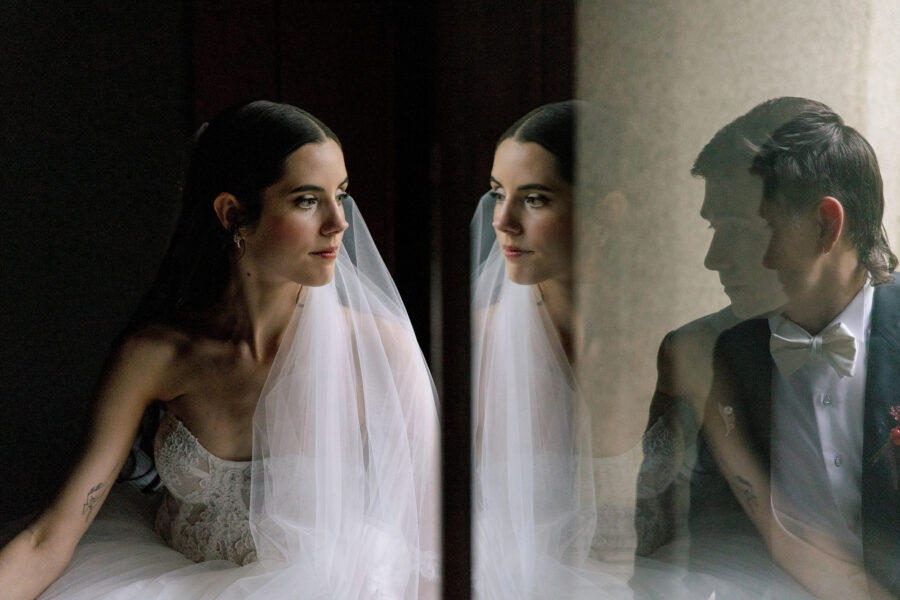
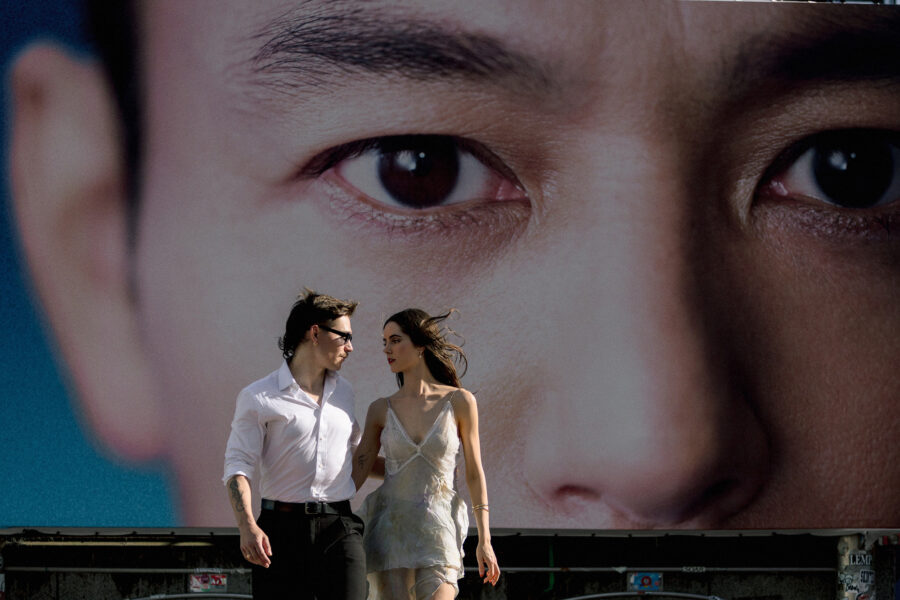
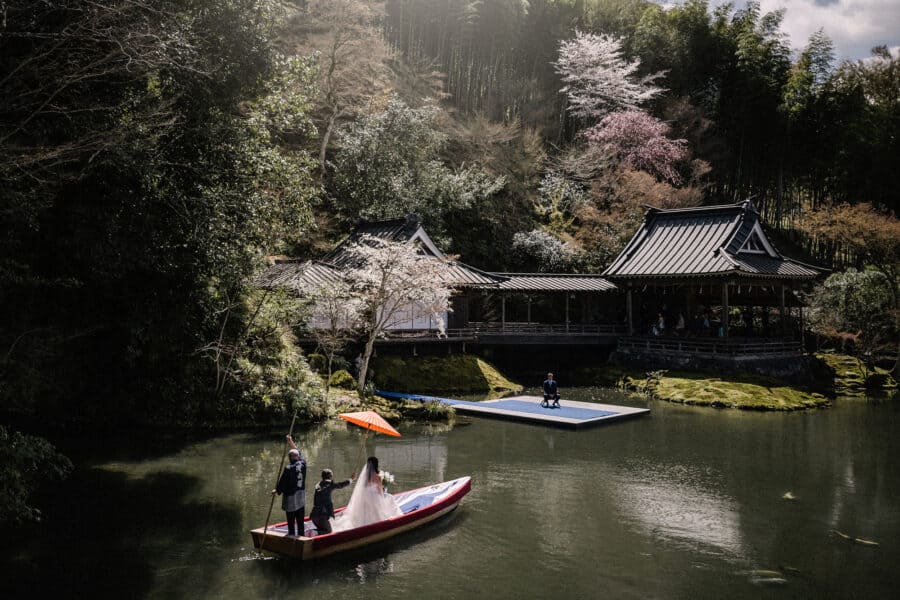
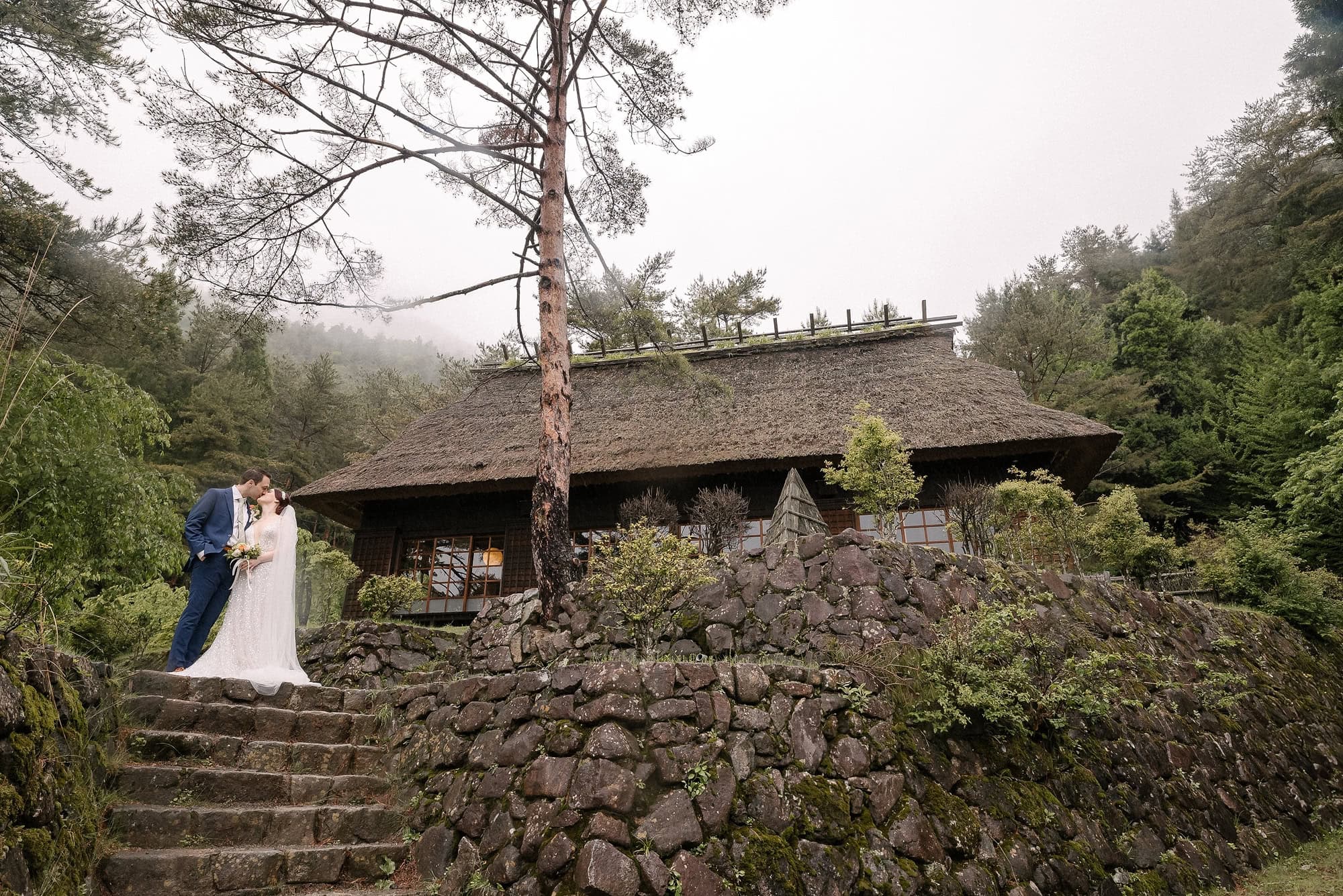
It’s a fitting name for this Saiko Iyashi no Sato Nenba wedding. There were six people in all, the couple and four of their closest friends, in a rebuilt thatched village on the shore of Lake Saiko. It rained, and Mt Fuji stayed hidden all day. They had planned for the mountain. What the day gave them instead was the inside of things: a house at the top of the village, a cello, and the friends they’d brought across an ocean. They made every hour of it their own, and we loved them for it.
A photograph holds a moment still. The film gives back the movement of the day: mist crossing the hills, rain on the village paths, the pace of six people with nowhere else to be. When the films were ready, Dee wrote to them that the rain had been “your own personal soundtrack”. The highlight film is above, and the full film of their wedding day keeps their vows.
Nineteen Months for One Date
They found us in the autumn of 2021, through destinationweddingjapan.com, while Japan’s borders were still closed and nobody could say when they’d open. Their plan was already clear. They would bring a handful of their closest friends, travel around Japan together, and then, as they put it, “After the tour, we will have an intimate ceremony.” They were asking for the spring of 2023, a year and a half away, in a country none of them could yet enter.
They chose to wait for it, and to wait with us. Their date was confirmed on the tenth of October 2022, the day before Japan reopened to travellers, in an email from Dee that told them the twenty-third of May was all theirs. By December, Dee could write to them that they had “such a wonderful connection to Japan” and really wanted to share it with their friends.


An intimate wedding at Mt Fuji was the plan from the first message, and the guest list was never a number to manage. It was four people. Those four crossed the Pacific and travelled Japan with the couple in the days before the wedding, so they reached the lakes already sharing the rhythm of a trip together. One of them would marry them. Days like those are the part of a destination wedding we’d protect above almost anything: time to become one small travelling party before anyone says a vow. By the time the six of them reached Lake Saiko, the wedding was simply where the trip had been heading all along.
The Torii, the Deck and the Village
The first plan began on Instagram. Early in 2023 the bride wrote to us that she had fallen in love with our photographs of Tenku no Torii, the red gate on the hill above Lake Kawaguchiko that frames Mt Fuji and nothing else. Dee had spent much of the pandemic arranging access for ceremonies there. The couple chose it.
Then the world came back. The hill that had been quiet through the closed years filled with visitors again, and in late April the shrine told us it could no longer close the space for anyone. It’s a working place of worship before it’s a view, and we understood completely. So did they. When Dee offered a deck with a view a few minutes from the torii, they wrote back that they were a little disappointed, and that the new place was “a bit more private which was important”.


In the week of the wedding the forecast turned to rain, and Dee moved the day once more, to Saiko Iyashi no Sato Nenba, a village of thatched houses on Lake Saiko with deep eaves and roofs made to shed rain. The cellist followed every change.
Three plans in a month can sound like a story about things going wrong. We see it the other way round. A plan’s real job is to protect the one thing that can’t move, and here that was a date they had waited nineteen months to reach, with four friends who had crossed an ocean for it. Everything else could be redesigned around that date, and it was, quietly, while the six of them travelled. They didn’t have to carry a single one of those decisions. Structure creates freedom: the venue changed twice, and the day they had waited for never did.
Silk on the Inside
The village’s own history, what was lost here and how the town brought it back, is a story we’ve told before. What the old village did for a living is told less often. The town’s account of Nenba lists forestry, charcoal burning, dairy and the raising of silkworms, and when it rebuilt the village, it recreated a room for raising them. The northern foothills of Mt Fuji have kept silkworms for a very long time. The silk woven here, kaiki, turns up in Ihara Saikaku’s The Life of an Amorous Man, and neighbouring Fujiyoshida is a weaving town to this day.
The detail we love is where kaiki was worn. In the Edo period, Yamanashi’s own account says, the style-conscious people of Edo prized it as the lining of a haori jacket. Their best silk went on the inside, where nobody passing in the street would see it. That’s iki, Edo’s word for a cultivated, understated kind of style: plain on the outside, extraordinary within, and kept for the wearer and whoever stood close enough to know.


Their wedding fell in the five days of the old calendar named for the silkworms waking. It’s when the spring silkworms begin to feed, and the real work of the year moves indoors. A day that ended up lined on the inside could hardly have chosen a better week.
They married in Gorone-kan, the house at the highest point of the village. On a clear day, the village says, it looks straight across the thatched roofs below to Mt Fuji. Its name means lying down on the floor for a nap, and it’s usually open for exactly that: tea, a book, a long conversation, an afternoon with nowhere to be. It also has a hall that works as a stage for small concerts. That day it was all three: a room facing a mountain no one could see, a place for six people to take their time, and a stage for one cellist.


Bach, Pachelbel and Totoro
The bride chose the music herself, and she chose it in order: Bach’s first cello suite, Pachelbel’s Canon, and “Path of the Wind” from My Neighbor Totoro. A cellist travelled out to the lakes and played all three in the rain. The first two belong at weddings everywhere. The third belongs to Japan, and to a film whose best-loved scene happens at a country bus stop in the rain, two sisters waiting with an umbrella. In Totoro, the magic arrives with the weather. It was a lovely thing to hear in a thatched village with rain on the roofs.
Months earlier, the couple had chosen their colours: citrus and sage, light greens with bright oranges and yellows. They couldn’t have known then that the day would be spent among moss-green kabuto roofs under a low sky, but the palette could have been chosen for it. Their small cake carried the same colours, in black tea and pear.


Dee shaped the ceremony with them, and one of their four friends led it. At six, a wedding has no audience. All six had travelled the country together, everyone was close enough to hear every word, and nobody was there to watch. For an intimate wedding, that’s the whole point, and it’s why we ask couples to decide who is in the room before they decide anything else.


The Cover They Chose
That summer, the couple chose the frame for the cover of their album. Of everything from the day, the thatched roofs, the village paths, the ceremony hall, they chose one from the evening: the two of them on a wet timber deck, and beyond the rail nothing but white fog. No mountain, no village, no view at all. It was the deck of the second plan, up the hill at Kawaguchiko, a few minutes from the torii where the first plan began. They reached the deck after all, just not for the vows.


We think that’s the truest thing in the whole story. They came for the most famous view in Japan, and the picture that will greet them every time they pick up the book is the one where the world has gone quiet and there’s only the two of them. The lining became the cover. Edo’s quietly stylish townspeople would have understood.
Planning a wedding at Mt Fuji means planning for a mountain that keeps its own hours. We plan for that so a couple never has to. Every change in this story happened around them. The day that came out of it was the one they had waited nineteen months for, with its best silk on the inside.