There’s a torii on the hill above Lake Kawaguchiko with no shrine behind it. What it frames is the mountain. It was built for people who honour Mount Fuji from where they stand, which, over the centuries, describes most of the people who have ever loved it.
They came from the United States, already married, and wrote to us asking for a few hours in Japan to celebrate it. They called themselves very adventurous, lovers of the outdoors, and they wanted the landscape to lead: two or three places, autumn colour, and, once we’d talked it through, Mount Fuji above all. He told us they would plan their whole trip around our calendar. They meant it, and we loved them for it.
By the time they reached us they were already married, and that changes a day more than people expect. There was no ceremony to arrive at and no guests to gather. Nobody was waiting for a speech. A Mount Fuji wedding photoshoot after the wedding asks one thing of a couple: to spend a whole day looking at something enormous, together, with nothing else to do. They were game for all of it: the dark, cold start, the drives between places, a mountain that hides more often than it shows. Afterwards, they told us it had been the best day of their whole trip.
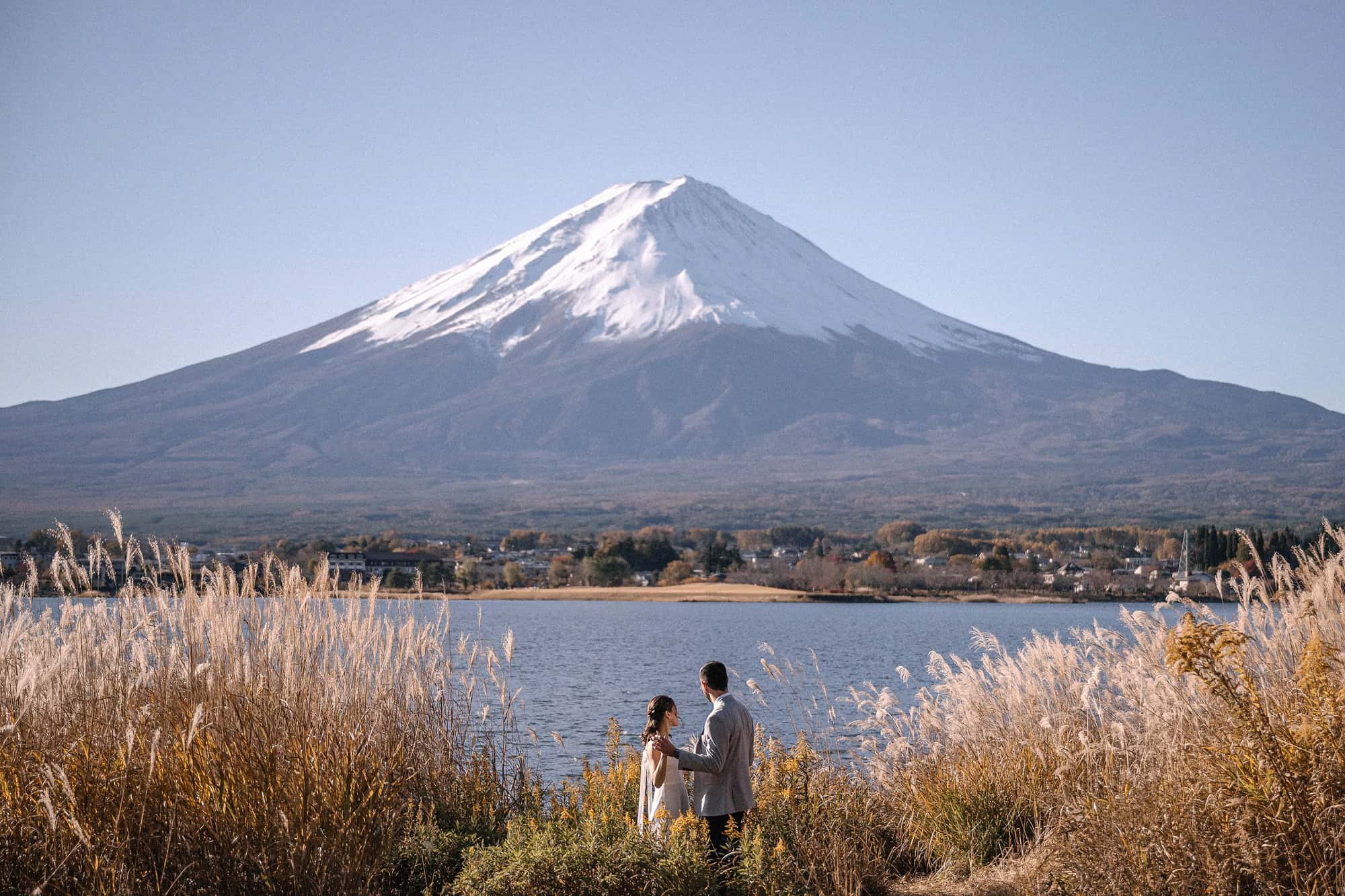
The mountain was clear all day. Completely clear, from the first pink on the snow to the middle of the day, at every place we stood. Tracey still calls it luck, and she’s right.


Tenku no Torii: A Gate That Opens Onto a Mountain
Kawaguchi Asama Shrine keeps its main hall at the foot of the hill. In the spring of 2019 it levelled a slope on the hill behind the shrine and set a red torii there, so that Fuji, the shrine’s goshintai, the sacred body of its god, could be worshipped beautifully. The Japanese word for a place like this is yōhaisho: a place for worshipping from far away. Nothing stands between the gate and the view, and the torii seems to float in the air. That’s how it came to be called Tenku no Torii, the torii of the sky.
Most torii mark a way in. You pass beneath one and you’ve arrived somewhere. This one asks you to stay where you are. The mountain isn’t reached by walking under the gate; it’s honoured by facing it. The shrine said it hoped visitors would come to know Fuji as something held sacred, not only as a view.
The early days of a marriage have some of that in them. The wedding is over, the new thing is still enormous and a little out of reach, and what you do is keep turning towards it. The gate was built for that kind of attention, and they began their day beneath it.


Forty-Five Days
On the far side of the mountain, Fuji City has kept a diary of its view since 1990. Three times a day, in the morning, at noon and in the late afternoon, someone on the eighth floor of city hall looks out and records one of three answers: the whole mountain, part of it, or nothing at all. It’s one of the quieter civic habits we know of. A city checks, every day, whether it can see the thing it loves.
In the year of this shoot, the city recorded the whole mountain at all three looks on 45 days. On 90 days it saw no mountain at all. November is one of the clearer months, and even then a clear morning doesn’t promise a clear noon. The city itself notes that a blue sky over town is no guarantee of the summit.
This couple had the whole mountain from the first light on its snow, above the valley at Kawaguchiko, along two lakeshores and into a village of thatched roofs, and it was still there, whole, in the middle of the day. It’s the kind of day you can’t plan, only be ready for, which is why we build a Fuji day around several places rather than one. The tea masters’ phrase ichi-go ichi-e, one time, one meeting, is usually said of people. On a day like this it holds for a mountain too.


Silver Grass, Before It Becomes a Roof
Late autumn on the shore of Lake Kawaguchiko belongs to susuki, Japanese silver grass. The Man’yōshū, Japan’s oldest collection of poetry, counts it among the seven flowers of autumn under an older name, obana, the tail flower. With the sun low behind it, every plume holds the light.
It has always been more than pretty. Susuki is kaya, the grass Japan thatches its roofs with. The country’s thatching association names it the most common thatch of all, and a roof laid in susuki can last thirty to fifty years. That only works because a meadow somewhere is cut every year, and sometimes burned, so it never turns back into forest. For generations those meadows were held in common, kept by the people who would one day live under them.
We love that the softest light of their morning came from a building material. It’s a fair picture of a new marriage: beauty that turns out to be structure, and a long life that depends on a yearly harvest. Thirty to fifty years, provided the field is cut every autumn. Most of the long marriages we know work on the same terms.


Lake Shoji, the Smallest of the Five
Lake Shoji is the smallest of the Fuji Five Lakes, about half a square kilometre of water, and it feels private in a way the larger lakes rarely do. In the middle of November its maples had turned red, the silver grass still stood along the shore, and the mountain was clear above both.
A small lake gives a very large mountain its true scale. Two people on the shore of Lake Shoji are almost nothing against Fuji, and there’s a freedom in that. After a wedding, when for months everything has been about the two of you, it’s a relief to stand somewhere that isn’t about you at all. We think every newly married couple deserves one day like that.


Nenba: A Village Rebuilt Under Grass Roofs
On the north-western shore of Lake Saiko stood a village called Nenba. Its farmhouses were thatched in the kabuto-zukuri style, the roof raised like a samurai’s helmet so that light could reach the upper floors where families raised silkworms. In September 1966, Typhoon No. 26 sent a debris flow down onto Nenba and the neighbouring Saiko district. Ninety-four people died or were never found. The next year every household left, and the survivors began again across the lake, as a village of guesthouses.
Forty years later, the town brought it back. Saiko Iyashi no Sato Nenba opened in 2006 on the ground where the old village stood: some twenty thatched houses, one of them a former silkworm house with two storeys of roof space, now a registered national cultural property. Another keeps the record of the disaster. The town set out to restore the village as it was before the storm, and what it chose to bring back was the thing people remembered: thatched roofs, and Fuji behind them.
The couple walked through Nenba on that same clear day, a few hours after standing in the kind of grass Japan has long thatched its roofs with. We think about this village often. A village can only be rebuilt as it was if someone remembers, and can show, how it looked. That’s the long view we take of a couple’s photographs. They’re made for a day decades from now, when someone needs to know how it really was.


What a Post-Wedding Photoshoot Is For
A wedding day belongs to everyone in the room. That’s its gift, and it’s how we plan it. The days after belong to two people.
More and more of the couples who find us have already married at home. They chose a lovely local venue because that’s where everyone could come: the grandparent who no longer flies, the family that can’t cross an ocean, the budget that had to stretch to hold everyone who mattered. It was the right wedding, full of the right faces. But somewhere at the back of their minds there was still another place, one they’d carried since long before the guest list, and it was never going to come to them. So they come to it, afterwards, just the two of them. It isn’t a second wedding. It’s the other half of the first one. Close to half of the couples who elope with us are doing the same thing the other way round: the promise made here, alone, with a big celebration waiting at home.
And we never let it feel like a photo shoot. That matters more than it sounds. Tell a couple they’re being photographed and they stand on a place. Give them a day instead, the early dark, the cold, the walk up to the gate, the first light finding the snow, and they stand in it, and the land gets into them. We make experiences, and the photographs are what an experience leaves behind. In five years, or ten, or twenty, we want them to open these pictures and be back on that hill in the cold, remembering the morning. Not the camera.
A post-wedding photoshoot in Japan gives a couple what the wedding day rarely can: time with nothing scheduled against it, and a place large enough to hold their whole attention. No one is waiting for them at dinner. No one needs a toast. The photographs that come out of a day like that are of a marriage rather than a wedding, and they tend to be the ones couples live with longest. Some couples take it the morning after, with the wedding still in their ears. Others, like these two, keep it for later. If you’re travelling to marry in Japan, keep a day like this for afterwards.
The next summer they wrote to us again, calling themselves our favourite Mt Fuji couple, about to board an icebreaker for Svalbard and asking which camera to pack. Adventurous was never wedding language with these two. It mattered to us more than they knew: we were packing for Greenland ourselves. Adventurers find adventurers.
A yōhaisho exists for people who honour a mountain without climbing it. Most of us love the largest things in our lives that way: from where we stand, facing them every day. It’s as good a description of a marriage as we know, and for one clear day in November, theirs had the whole mountain to face.