The message came from the UK, and it began with a page of ours. She’d been searching for views of Mt Fuji and found what we’d written about Tenku no Torii, the vermilion gate on the hillside above Kawaguchiko. Her girlfriend had always wanted to see Japan. She wanted to surprise her with the trip, and with a proposal in front of the mountain.
That one message became nearly a year of planning for a single morning, and an LGBTQ proposal in Japan we still talk about. The date carried its own weight: it was five years to the day since they first met. Fuji was for her girlfriend, who had always wanted to go, and it was “a nod to her family”, people who, as she put it, love to hike things.

The tea ceremony has a phrase for a gathering that will never come round again: ichi-go ichi-e, one time, one meeting. An anniversary is the one day of the year a couple gets to stand beside their own first meeting. She chose to ask her question there.
A Surprise Inside a Surprise
Her girlfriend didn’t know about the proposal. She didn’t know about Japan either. A few days before they left, the message to us read like a held breath: they were flying on Thursday, and her girlfriend still had no idea where. So the first surprise was the country. The second was waiting on a hill above Kawaguchiko.
The plan for the second was hers, and it was a good one. They’d walk up to Tenku no Torii early, while the light was still arriving. We’d already be there, a few strangers with cameras admiring the view. She’d ask us to take a picture of the two of them, and then she’d ask her question. The reveal came last, and she’d written it to us in a single line: surprise, it’s a proposal, and double surprise, we booked a photo session. If the morning turned against her, there was a plan B. The torii would become a meeting point for a tour, and the question would wait for Lake Shoji.


Plan A held. She asked at the torii.
A plan that light rests on a great deal of quiet work. The torii belongs to a shrine, and photography there needs permission, so we arranged a special permit. It was a Sunday in autumn colour season, with the Fujisan Marathon running around the lakes that same day, so the hour mattered more than usual. None of that was hers to carry. Her brief to us was clear: privacy, very few people, candid and never posed. The year of planning existed so that the morning would never feel like a production, and that’s the part of our work we’re proudest of when nobody notices it.
A Gate Built for Looking
Tenku no Torii is young. Kawaguchi Asama Shrine cleared the hillside and raised the gate in the spring of 2019 as a yōhaisho, a place to worship Mt Fuji from a distance, about half an hour’s climb above the shrine. The shrine itself is far older. It was founded in 865 by imperial order to calm an eruption of the mountain, and it’s now part of Fuji’s World Heritage listing.
So the gate does one thing: it turns you towards the mountain. Most people come for the picture, a red frame floating over the valley, and never notice that the frame is pointing somewhere. A proposal asks for the same gesture. You choose a direction, on purpose, and face it together. It felt right that their morning began there.

Music in a Ring Box
She’d first imagined strings: “What a Wonderful World”, or “Home” by Edward Sharpe & The Magnetic Zeros, played live. But a torii on a shrine’s hillside is a sacred place as well as a public one, and a musician would have turned the moment into a performance. So the music moved into the ring box. A musical one, small enough to hold in one hand and quiet enough for an audience of one. Dee loved it.
The flowers stayed small too. Red roses, white flowers, and tulips for her girlfriend, because tulips were her mother’s favourite. Every detail of the morning was chosen to be smaller than the moment, so that the moment could be the biggest thing on the hill.


Lake Shoji, Made by the Same Fire
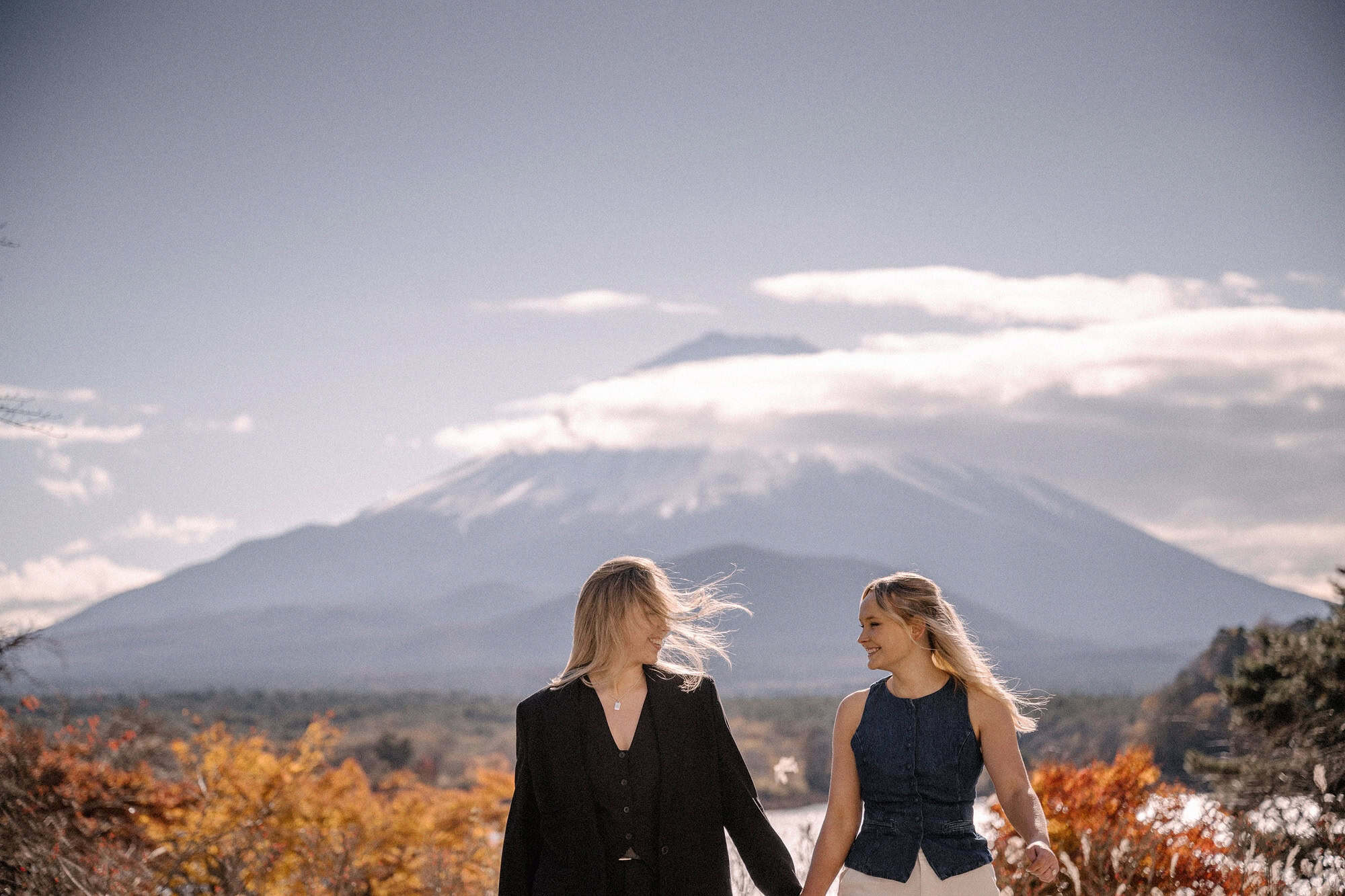
The second place was Lake Shoji, the view of Fuji they’d chosen to end on, and it shares a history with the first. In 864, Fuji began an eruption that lasted two years. Its lava filled most of a great lake called Senoumi and left the western edge behind as Lake Shoji, the southern shore still rocky and broken where the flow came to a stop. The following year, Kawaguchi Asama Shrine was founded to calm that same eruption. The gate where their morning began and the lake where it ended both answer to one fire.
The lake’s name is written with the characters for shōjin: diligence, devotion. Fuji-kō pilgrims once performed their purifying rites in its water on the northern shore, where the view of the mountain across the lake is at its best, with the small cone of Omuro-yama standing in front of Fuji. In 1895 a British-born hotelier, Harry Stewart Whitworth, opened the Shoji Hotel here and welcomed travellers to what he called “the Switzerland of the East”. More than a century later, two women from the UK stood on that shore for that view. We know this lake in every season, deep in snow as well as in the last week of November, and it never looks the same twice.
The mountain had spent the early morning under cloud. By the lake, it came out. Dee’s verdict afterwards was simple: Fuji at the end was perfect.


What a Year of Planning Is For
Devotion is a good word for a year spent on one morning. The cover story, the permit, the hour, the plan B, the strangers who weren’t strangers: all of it existed so that one person could walk up a hill thinking she was on holiday, and the other could stop managing long enough to be present for her own question. When we plan a proposal in Japan, that’s the whole point of the structure. We hold it, so the people inside it don’t have to.


Afterwards she told us the whole process had been “so magical and seamless”. The photographs went home as Christmas presents. Their grandmothers, 80 and 92, loved them, and they now hang on the walls of their parents’ and grandparents’ homes.
We think about that often. A question like hers is asked to one person, on one hill, on one morning. Its photographs end up in hallways on the other side of the world, looked at every day by the people who’ll be there for whatever comes next. That’s who a morning like this is really made for.