They had one particularly lovely request for the evening: could some local people be there too? Their wedding in a bamboo forest near Tokyo would bring their own guests to Wakayama Farm, in Tochigi. Afterwards, at a little jazz club in Utsunomiya, they wanted to join the life of the room.
The groom had suggested jazz, and the couple had asked for local company and an evening with room to unfold. The club invited some of its regulars. People who had never met the couple would become part of how they remembered getting married, bringing their own affection for the place into an occasion that had travelled from elsewhere.
We loved that openness in these two. They had thought carefully about their wedding and still left room for people to contribute something they could never have imagined in advance. By the time the groom’s mother was singing, the invitation had begun to work in both directions.
Winter Light in a Bamboo Forest Near Tokyo
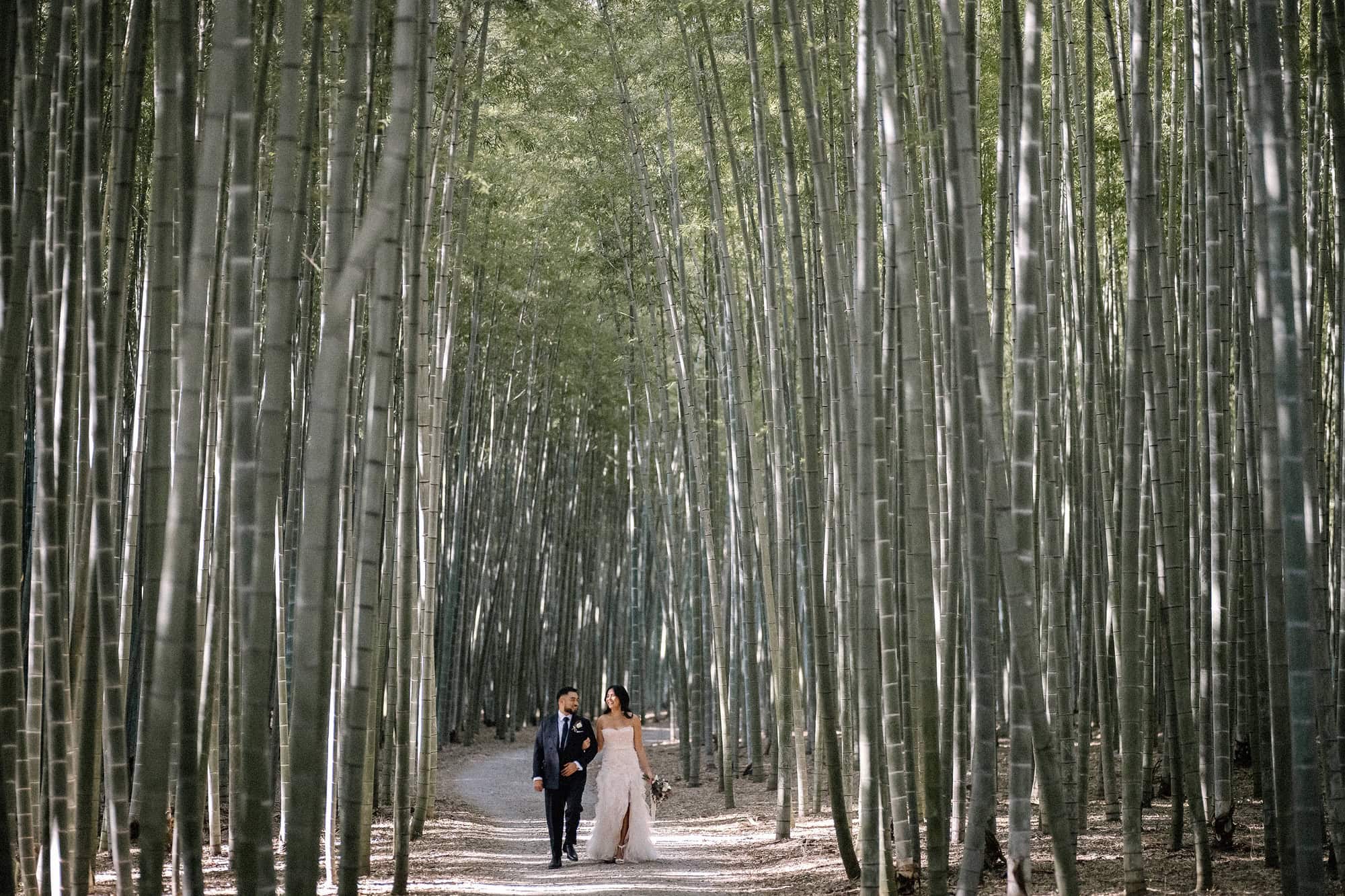
Our bamboo forest lies on the northern edge of Utsunomiya, the capital of Tochigi. The city is around fifty minutes from Tokyo by shinkansen, followed by a road journey to the location. That is the useful geographical answer for couples searching for bamboo close to the capital; the reason to come becomes more interesting once you understand whose landscape you are entering.
Three generations have cultivated bamboo and chestnuts here for more than a century. The beauty that greets a visitor belongs to that continuing work, to people who know this land through the seasons and have made their lives around caring for it. A wedding arrives for a day within something that has taken much longer to become possible.
The owners have become friends of ours, and that relationship is part of what we love about returning. We have celebrated here with a family and their little daughter, and with a couple who embraced spring rain and the glowing bamboo after dark. Those memories now accompany us into the grove, alongside the pleasure of introducing another couple to people and a place we care about.

This February day was fine and very cold, with beautiful komorebi moving through the bamboo. We spend our working lives paying attention to light, and still there are days when we want everyone around us to notice it too. The farm’s own welcome speaks of this same light and the sound of bamboo leaves: the things we find so moving as visitors are also things its caretakers have chosen to share.

That gives a wedding in a bamboo forest near Tokyo a connection beyond the view. The grove’s long cultivation and the couple’s brief gathering meet in the same place, each depending on people’s willingness to care for something. We felt that particularly strongly with a couple who were so interested in the people waiting beyond their own guest list.
The Familiar People in an Unfamiliar Place
Before the ceremony, they met for their first look along a corridor of bamboo. The morning’s preparations in a modern hotel had led them here, into the place where the occasion would become shared. For a little while, they had time to take each other in before turning towards everyone who had come with them.


Their ceremony was led by a friend. We are always interested in what that relationship brings to a wedding abroad: the person guiding the occasion carries a connection to the couple that began somewhere else, before this journey was imagined. Within a landscape new to the gathering, friendship provides a kind of continuity.
Dee’s design gave their guests a place to settle within the grove, with low wooden benches and white fabric draped from bamboo poles. It allowed the ceremony to feel considered while keeping the living forest close. For us, the care in those choices is about how comfortably people can give their attention to the couple, and how much of the place they can remain aware of while they do.
When the couple came back through their guests beneath a shower of white petals, the celebration was still held by people who knew them. Later, at the club, that company would grow to include people meeting them for the first time. We loved the possibility of both in one wedding: the recognition of being among your own people, followed by the pleasure of discovering how warmly others might receive you.

The Small Things That Travel With You
The morning had begun in a modern hotel room, a calligraphy scroll on the wall and the wedding still ahead of them. Before the grove, the guests and all that music, there were these smaller preparations: his shirt and braces, her gown, the rings waiting to be worn. We love having this part of the day to return to afterwards, once we know everything that followed.


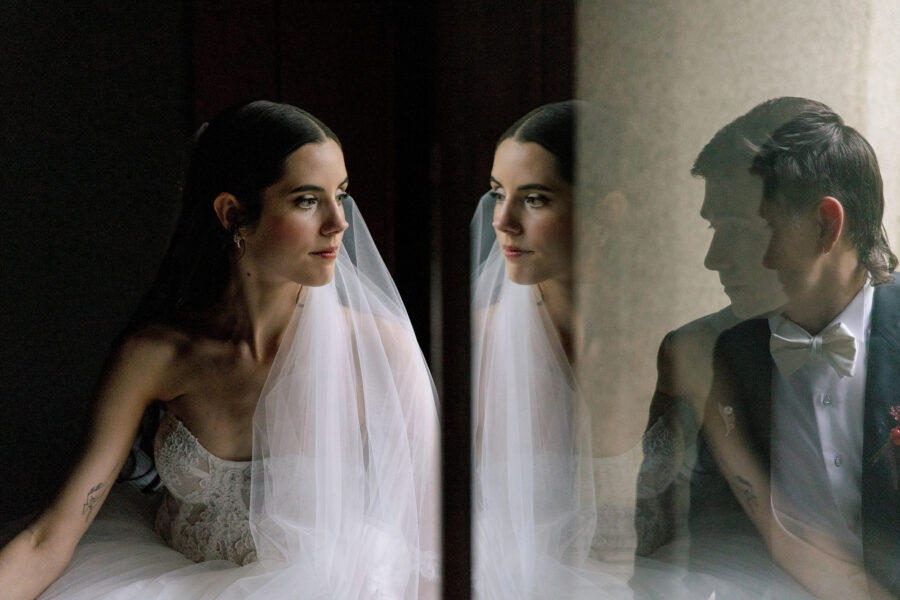
Her gown fell into tiers of ruffles, its shape beautifully clear against the pale concrete outside. Those portraits bring another side of Japan into the photographs, the clean lines of the hotel sitting beside the living architecture of the grove. Then, in the car’s rear-view mirror, her face appeared within a much smaller frame. Even on a day with landscapes like these, there is room for a photograph that lets the rest of the world fall away.


Among the morning’s details were a watch, cufflinks and small perfume vials. A wedding photograph does not have to contain everything to bring a day back: a scent can return someone to a particular morning with startling immediacy, while an object they wore can hold the memory of putting it on. We want to leave room for that private scale of remembering, alongside the extraordinary places they travelled to.

Back at the farm, the afternoon gave them time to enjoy the grove beyond the ceremony, including its extraordinary bamboo swing. A white fur stole came out as the air cooled, and the paths and installations began to glow. The same bamboo that had filtered the sun now held the light itself, carrying the place gently towards evening.


Winter changes the way people inhabit a place. They draw closer to warmth, notice the light leaving, appreciate the first room they enter afterwards. By dinner, the farm had another way of welcoming everybody in.


What the Farm Brought to the Table
The cold had made the warmth of the café especially welcome. The couple had spent time in the grove as its bamboo installations began to glow, and now their guests could sit down together to a multi-course Japanese feast prepared by the farm’s chef. We remember that meal with enormous affection. It was quite incredible.

The café opened in 2023 in an older building adapted for its new purpose. In an interview at the time, the owner spoke about wanting people to enjoy local agricultural produce; inside, bamboo was used between structural pillars that had to remain. The wish to share the place had become part of both the food and the room in which people would eat it.
At the wedding dinner, the first course arrived in small cups cut from green bamboo, arranged in a wooden box. There was an intimacy to encountering the material again at this scale, after spending the day beneath its height. Something that had surrounded the whole gathering could now be held in a hand, carrying the forest into the meal.

We love being able to introduce a couple to this fuller expression of a place. The people who welcome you, the way they prepare food and the pleasure they take in offering it all become part of what you understand about where you are. Staying for dinner gave the guests time to receive that care, and gave the farm a larger place in their memory than the ceremony alone could have done.
And beyond the farm, there was still music waiting.
The City Behind the Music
Utsunomiya’s jazz culture has a history of its own. This is the birthplace of saxophonist Sadao Watanabe, and the city established its Jazz Town committee in 2001. Kindaijin, the small club the couple chose, has been part of the local scene since 1960.
The city’s history of jazz, published in 2024, gives part of its postwar story a chapter heading that translates as “Jazz is proof of freedom and peace.” It is striking language for music, a way of remembering what people became able to feel and express together. A small club belongs to that larger history through the ordinary commitment of the people who keep playing and listening there.
Step inside and that history becomes a room: dark wood, chandeliers and candle sconces, black-and-white photographs, framed vests covered in pins, a piano, people sitting close enough for the music to reach everyone directly. Places like this accumulate a character through repeated evenings, familiar faces and the small habits of people who keep returning.
We find that continuity moving. A visitor may come for one evening, while the room owes its character to decades of other evenings, to people returning because the music means something to them. The couple’s wish to have regulars there acknowledged that life around the venue, and allowed it to become part of their own experience.
Our planning correspondence with the club carried their preference for local company and a relaxed evening, and the club responded by inviting some of the people who already knew it well. The couple brought their wedding guests; the club brought its own community. Each group had something to offer the other, with the music giving them a place to begin.
We find that a generous way to travel. You arrive with an occasion that matters enormously to you and allow the place to bring some of its own people into it. The celebration gains something you could never have specified in advance: the character of those particular people, on that particular evening, meeting yours.
When His Mother Sang
The musicians were phenomenal, and the evening filled with dancing, drinking and the pleasure of being close to live music. Among the regulars, a man in a pin-covered vest drew the couple into a hug. The welcome had become personal enough to reach across the room and put its arms around them.

Then the groom’s mother sang. She is an extraordinary singer, and the little club gave her a place to bring that part of herself into her son’s wedding. The groom’s idea had opened an experience for everyone; now someone he loved was helping to make the music inside it.
She had come to witness a new chapter in her son’s life, and her singing let the room hear something of the life she brought with her. A wedding introduces people through their relationships to the couple, but it can also give them space to be known more fully. Here, the mother of the groom was an artist among musicians, sharing something of herself with the people who had welcomed them. We felt very lucky to be there for that.
The enthusiasm reached behind the cameras too. One of us got up and sang, which still feels a little embarrassing given how phenomenal the musicians were. We had been welcomed into the evening as well.

The People They Had Yet to Meet
The Japanese idea of ichi-go ichi-e, one time, one meeting, feels particularly close to this room. Its regulars had a history of returning, yet their familiarity helped make an encounter that could happen only this way, with this couple, their guests and this music. Somewhere the locals knew well became somewhere the visitors would remember for the rest of their lives.
We often think about the trust involved in a choice like theirs. They allowed an occasion of enormous personal significance to be influenced by people they had never met. That openness gave the celebration access to the warmth and character of a community already there, and gave those people a reason to join in the couple’s happiness.
A wedding in a bamboo forest near Tokyo had brought them to this part of Japan. Their curiosity had taken them further into its life, from the farm’s welcome to a room in which the city’s musical history was still being made. We loved that they wanted to find out what might happen when their own people met the people of this place.
Our planning team worked with the farm and the club to make those encounters possible. Making the photographs asked us to stay attentive to what grew out of them, especially the relationships that had existed for only a few hours. An embrace between new acquaintances can hold a surprising amount of the meaning of a destination wedding.
Four Days Later, Fuji
Four days later, we met them again for a post-wedding shoot around Lake Kawaguchi, or Kawaguchiko. Mt Fuji was clear and snow-covered, the lake and mountain opening out around an afternoon they could spend together. They began in their own clothes before returning to the gown and navy suit, carrying the wedding into another part of their time in Japan.


By then, our relationship with them held the memory of that day too. We had been there for the ceremony, shared the pleasure of the dinner and heard his mother sing. There is a depth of familiarity that grows from experiencing people in such different company, and we were glad to have another afternoon in which to know them more closely.

The clarity of late winter around Fuji gave them an expansive setting after the intimacy of the grove and the club. We stayed through the changing light towards sunset, with the wedding already becoming something they could look back on together. There was room now for the two people at the centre of it all to spend time inside what they had just experienced.


We still think of these places together: the bamboo, the club, the mountain. The photographs hold the differences, while our memory keeps finding the same openness running through them. They had come to marry in a place they wanted to know, and left with people to remember there. Beneath Fuji, a few days into their marriage, their world already contained more than it had when they arrived.