The first email was about blossom.
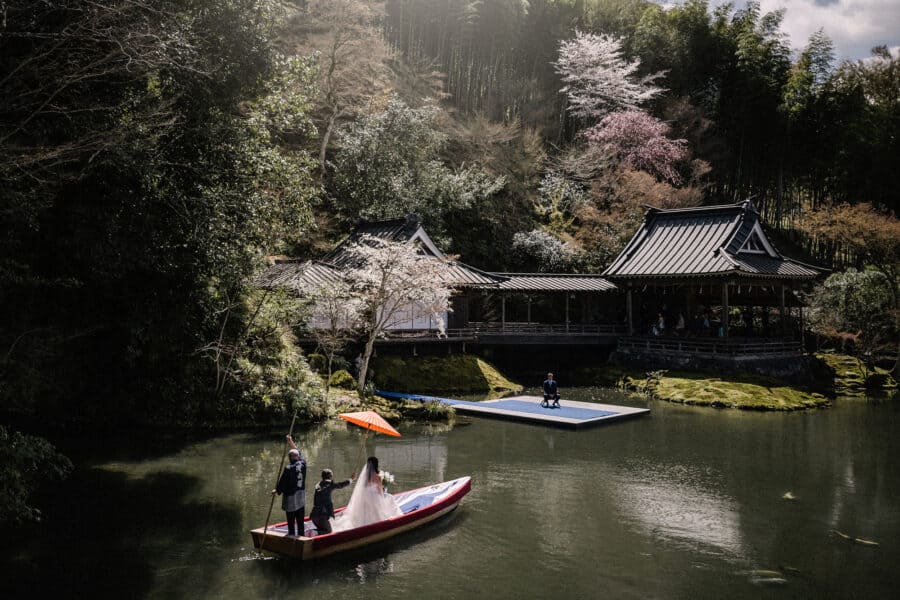
Their dream was to come from Florida in spring, marry somewhere near the cherry trees, and find a corner of Japan away from the obvious tourist route.
Then Japan reopened its borders, and suddenly April had a December alternative. They chose not to wait.
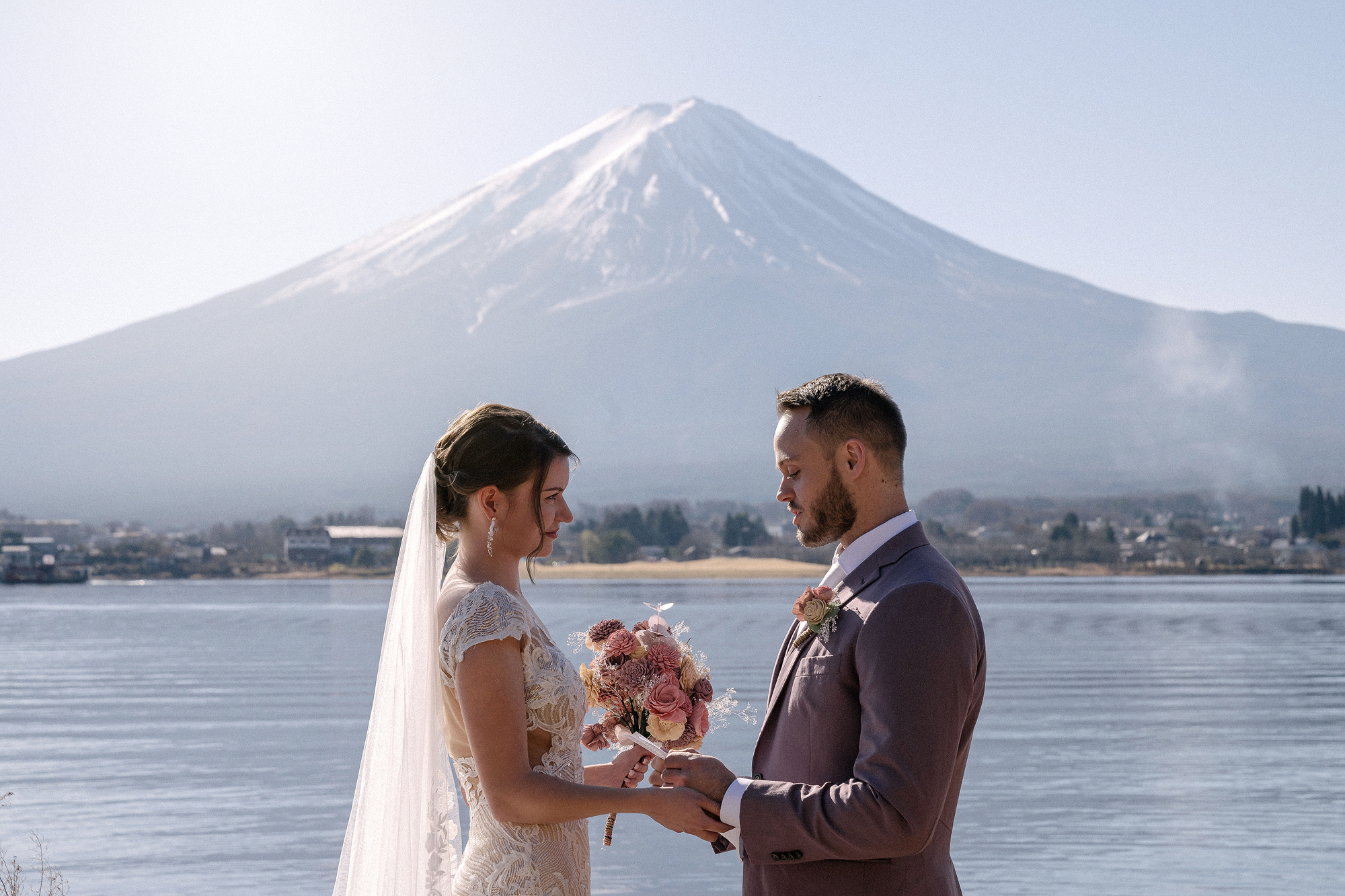
The blossom disappeared from the plan, and their Mt Fuji winter elopement became something entirely different: a lake almost empty, short December light, dry grasses at the water’s edge, and Fuji standing white and extraordinarily clear above it all.
They had imagined Japan in pink. Winter gave them the mountain.


What Winter Changes at Mt Fuji
Mt Fuji asks something rather inconvenient of wedding planning. You can’t book the view. The mountain makes her own decisions.
Spring brings blossom, soft light and new colour, but it also brings moisture into the air. Fuji can disappear into haze for hours, sometimes days, even when you’re standing almost beneath her.
Winter changes the odds. Cold, dry air clears the distance, and by December and January the mountain is usually snow-capped and at her most reliably visible. The landscape becomes sparer too: bare branches, tawny grasses, hard blue water and a horizon with very little competing for attention.
Japan’s old calendar of seventy-two seasons has a name for the week they married: sora samuku fuyu to naru, the sky turns cold and winter arrives. It’s difficult to think of a better description.


A Mt Fuji Winter Elopement by the Water
They married on the shore of Lake Kawaguchi, just the two of them, with Fuji across the water while they exchanged vows and rings. Afterwards they danced there at the edge of the lake.
No aisle, no rows of chairs, no guests being asked to stay cheerfully outdoors in December. This is one of the quiet freedoms of an elopement: a ceremony for two can occupy a landscape differently. We can wait for the light, and move if the wind changes. We can stand at the edge of a winter lake without wondering whether seventy people are slowly losing the feeling in their feet.
It was, for the record, very cold.

It was also exactly the kind of day winter makes possible at Fuji. Clear enough that the mountain wasn’t an occasional appearance in the background. She was there all day.
“Not Necessarily the Tourist Spot”
That line from their first email stayed with us.
Mt Fuji is one of the most photographed landscapes in Japan. Wanting to experience it without simply joining a queue for the same photograph as everybody else is entirely reasonable. It’s also increasingly difficult.
The answer isn’t a secret place nobody has discovered. There are very few secrets left around Fuji. The better answer is knowing when to go, where space opens up, how the light moves around the lakes, and which version of the mountain each place offers. That’s a different kind of knowledge.
They began the day at Kaneyamaen in Fujiyoshida, the town pressed close against Fuji’s northern foot, and saw each other for the first time in its Japanese garden before we moved out towards the lakes.


At Lake Shoji, the smallest of the Fuji Five Lakes, the view changes again. Fuji rises behind the smaller wooded shape of Omuroyama, and locals call the composition kodaki Fuji: Fuji holding a child. It’s one of those names that changes the photograph once you know it. The smaller mountain stops interrupting the view and becomes part of what the view means.
In winter, with almost nobody along the shore, the lake seemed to have more room than usual. So did they.

The Mountain, More Than Once
One of the peculiar things about photographing around Fuji is that the mountain can stay the same subject while becoming a completely different picture.
Across Lake Kawaguchi she was broad and white above the water. At Lake Shoji she sat layered behind Omuroyama. From the hillside at Tenku no Torii, the red gate framed her between its posts. Move a few kilometres and the relationship changes again.


The point was never to collect recognisable Fuji landmarks. It was to let the landscape keep changing around the same two people: water, winter grass, forest, a torii gate, and the mountain repeating in the distance. The photographs read less like a tour of Mt Fuji than an afternoon spent in conversation with it.


What the Season Gave Them
Their original plan would have been beautiful. We have no argument with cherry blossom.
But spring would have given them another wedding. Perhaps blossom. Perhaps Fuji. Possibly both, if the weather decided to be extremely generous.
December stripped the equation back. No blossom, no soft green, no ambiguity about the season. Instead they had cold air, empty shorelines, long views, and a snow-covered mountain that stayed with them from morning into afternoon.
There’s an important difference between settling for what remains when a plan changes and recognising what the new plan makes possible. This was the latter.
They came to Japan imagining one of its most famous seasons. What they received was one of its most famous landscapes, completely revealed.
Sometimes the better plan begins when you stop asking a place to be two things at once.