Every couple has a place they mean when they say “our spot”. It’s rarely the most famous view in the country. It’s the one you found together, went back to, and started measuring everywhere else against. This Arasaki Park elopement was built on one.
For this couple it was a stretch of coast in Yokosuka, on the western shore of the Miura Peninsula, where grey rock runs out into Sagami Bay in long ridges. Their wedding began with a question most couples never ask out loud: is the place we love good enough to marry in? Partway through planning, she wasn’t sure. So they went back to look. “It was even more beautiful than I remembered,” she wrote to Dee, and it was “the affirmation I needed that it is ‘our spot!'”

We think that’s the right way to choose a place to marry: from memory first, then tested against the real thing. A place you keep returning to already holds something of you. A wedding there simply adds one more layer.
They added film so they could keep their vows, and it keeps the whole day at the pace they lived it. It’s why our photography and film are planned as one piece of work: the photographs hold the moments, and the film holds the time between them. After watching it, the groom wrote that “having this as an heirloom will forever remind us of the perfect day we had.”
Where It Began
They met in Japan and fell in love here, both stationed near Yokosuka, a long way from home in the States. “We love Japan so much,” they told us, “because it’s where we met and fell in love.” She was due back in the US that summer. So they married before she left, in the country where it had all begun.
There’s a Japanese word for the place that raised you: furusato. It usually means a hometown, but it stretches. People who meet far from home often end up with two, the place they grew up and the place they became a couple. For these two, the second was Japan, and its exact coordinates were a headland on Sagami Bay.
Their families couldn’t travel, and it was an elopement, just the two of them, with their people joining from home on a screen. We built the day around that connection to the place. Before anyone dressed for anything, they had the morning at Arasaki as themselves: a picnic laid out by the rocks, time on the coast, nowhere they needed to be. A wedding in a place you love should start by letting the place be what it already is to you.


Pages of Stone
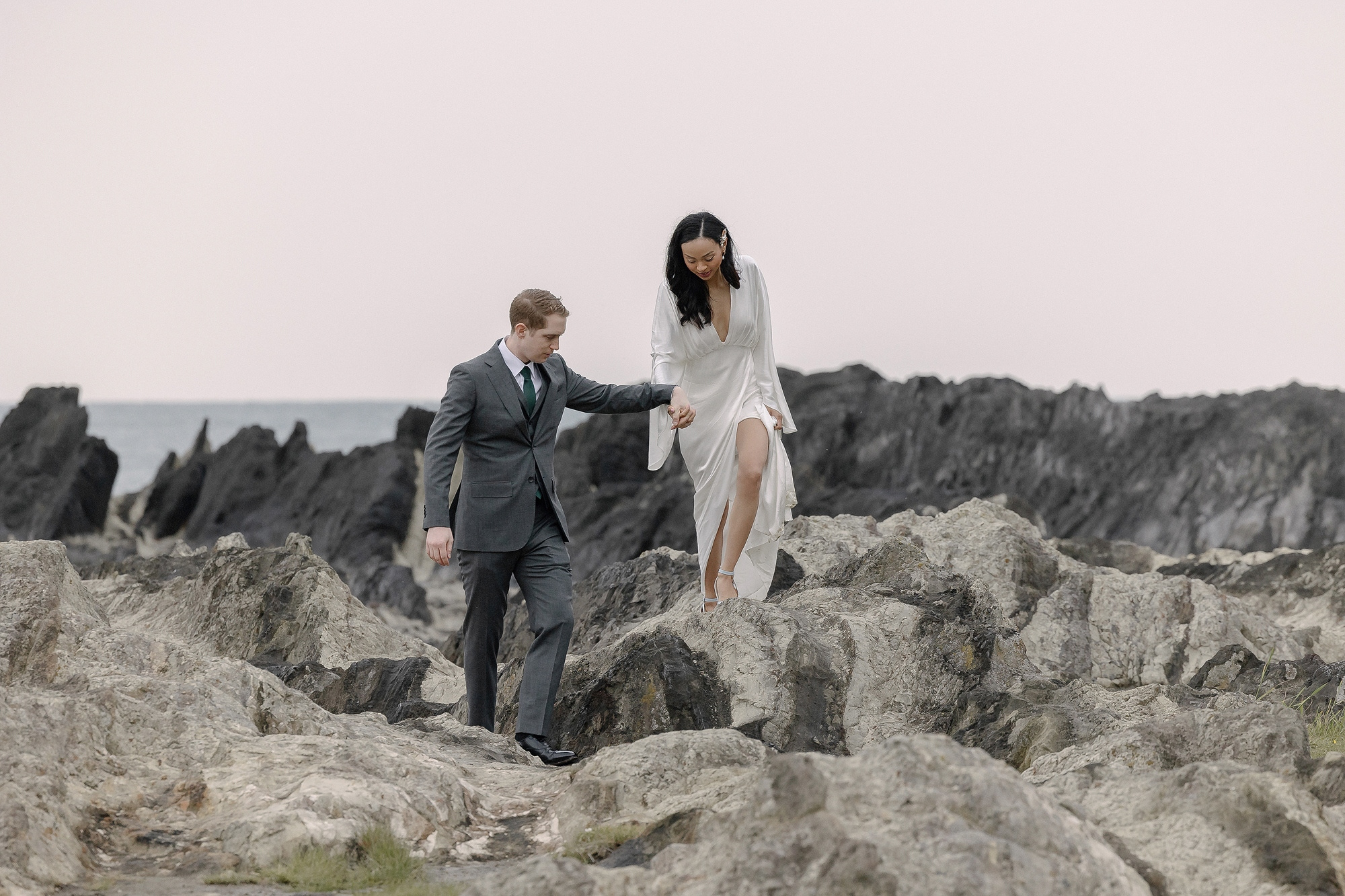
The rock at Arasaki was laid down when the Miura Peninsula was still sea floor. Kanagawa’s natural history museum dates these layers, the Misaki Formation, to roughly ten to five million years ago: pale siltstone and mudstone in alternating bands with black scoria, the cinders of old volcanoes. Yokosuka’s own geology notes record what happened next. The layers were tipped up to sixty or sixty-five degrees, and the sea went to work on them. The soft white bands wear away faster than the hard black ones, which is why the shore runs in fins and ridges, why the waves have planed wide wave-cut platforms out of it, and why several sea caves open into the cliffs.
Walk across Arasaki and you’re walking across the edges of those layers, stood on end like the pages of a closed book. Each band is a stretch of time that settled quietly before the next came down on top of it. It’s hard to imagine a truer setting for a couple who went back to a place to be sure of it, and found it had become theirs.


People have been choosing this headland for a long time. The cliff-ringed hill on the point, Shiroyama, is said to have held a castle of the Miura clan, who helped found the Kamakura shogunate. On a clear evening the view runs across Sagami Bay from the Tanzawa mountains to Hakone, Mt Fuji, the Izu Peninsula and Izu Oshima. On their day the sky stayed soft and white over the bay, and the mountains stayed behind it. They hadn’t come for the mountains.
An Arasaki Park elopement takes more arranging than a public park suggests. The park and its shoreline answer to different authorities, so the ceremony needed two separate permissions, and we secured both. When we plan an elopement, that’s the work we’d rather a couple never has to think about, so the only thing they carry onto the rocks is each other.
After All This Time
They got ready apart, at a small seaside ryokan, with the bay in the windows. After a morning spent side by side, they chose not to see each other again until the ceremony. “So much more special if we wait until the ceremony to see each other!” she told us. It gave the day a hinge. The two of them who’d picnicked on the rocks that morning met again on the same coast as a bride and groom.
His cufflinks were engraved with their wedding date and a line from Harry Potter, their shared thing: “After all this time?” on one, “Always” on the other. It’s a line between two fans, and it found an unexpected echo on a shore where every layer is a record of time passing.


The Sea She Loved
His mother loved the ocean. She didn’t live to see this day, and the bride found a way to bring her into it, a surprise for him: a framed photograph of her, there with them as they married above Sagami Bay. When they were planning, Dee had said that being near the ocean would be a tribute in itself. With the sea filling every direction, it was.
When their officiant became unavailable shortly before the day, they asked Dee to marry them, and she did.
They also opened a small sake cask, the kagami biraki that begins so many Japanese celebrations. The round lid is called the kagami, the mirror, and its shape stands for wholeness. You never say you’re breaking it. You say you’re opening it, because opening is a word that widens out into good fortune. Theirs was marked 寿, kotobuki, the character for celebration and long life. It’s a fitting first act for two people about to carry their marriage home to the other side of the world: to open something, together, and let it widen.


An Arasaki Park Elopement on Home Ground
The ceremony happened above the coast. The rest of the day happened on it, across the tilted rock, along the tide pools and up onto the grassy headland under its two wind-bent pines. None of it was new to them, and that’s what we love about a place a couple already knows. They weren’t discovering Arasaki for the first time. They were walking it again, married now, and every ridge they crossed already held a day of their own.
Arasaki is a public park, open to anyone who makes the trip. What made it theirs was going back.


Into the Cave
The day ended in one of Arasaki’s sea caves, where the sea has worked its way into the cliff until the stone gave way into a room. Inside, the layers curve overhead like the inside of a shell.
It’s an apt place to end a day like this. A sea cave is made by returning. The tide comes back to the same rock twice a day, every day, and the shape it leaves behind is the record of all that patience. A spot becomes “our spot” the same way.


It Could Never Live Up to This
After the film, he wrote one more line to us. “Both of us feel that we don’t need to do a large wedding when we get back to the States because it could never live up to this.”
We don’t think a wedding needs a crowd to be complete. It needs a place that means something, and two people fully present in it. They had both, on a coast they had chosen for themselves. All we did was make sure the day held still long enough for them to stand in it.