A House for Arriving: Pre-Wedding Photos in a Traditional Japanese House in Tokyo

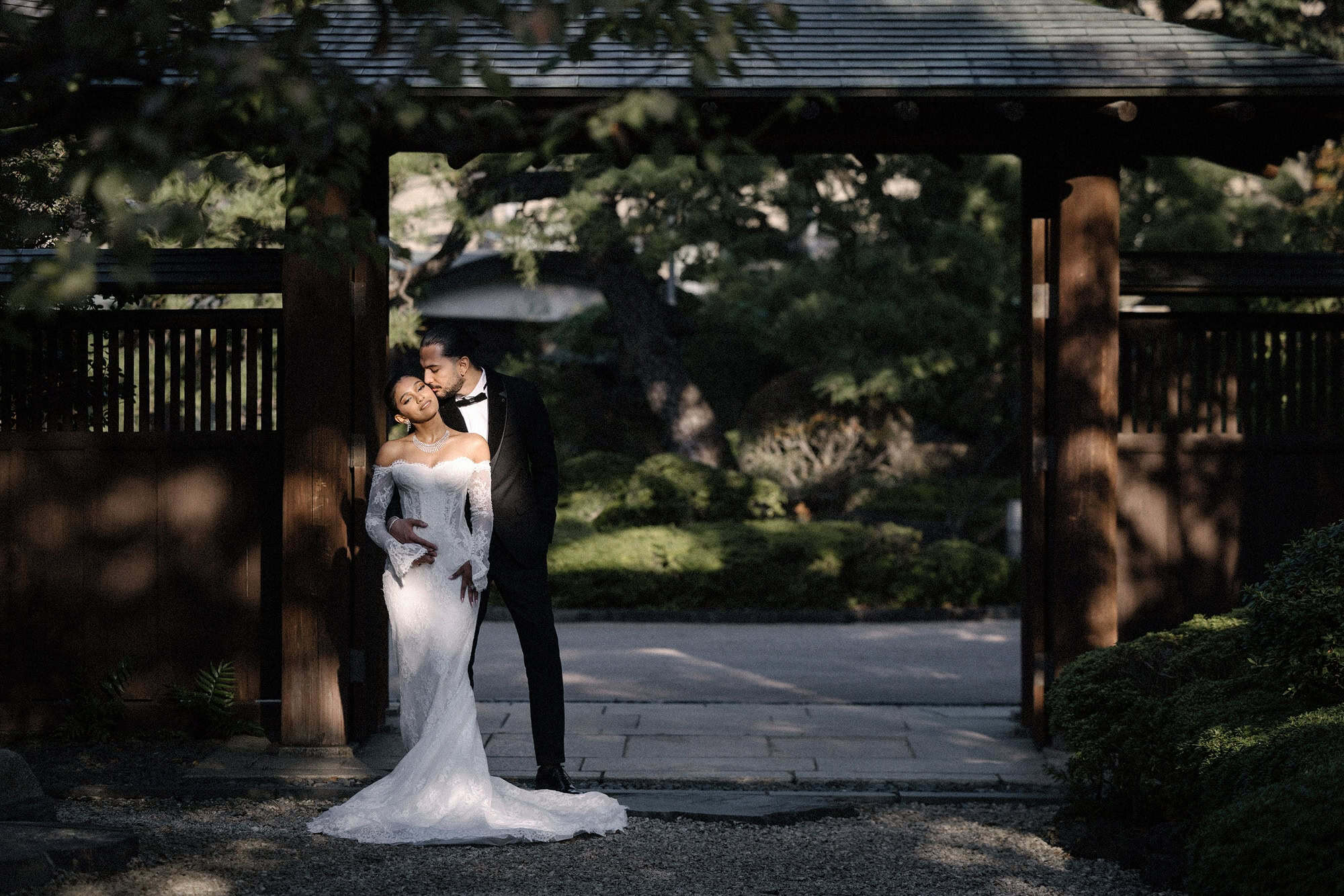
The groom kisses the bride's temple as they stand in the shade of a roofed wooden gate at a Japanese garden in Tokyo.

In 1920, a merchant from Aomori, at the far northern end of Honshu, had a house built in Tokyo. His family’s fortune had begun in cloth: a kimono-cloth shop, then cotton wholesale with a branch in the capital, then a bank, a soy sauce company and, in 1919, a major share in a new cement company back home. For his own house in Tokyo he reached for none of the new materials. He hired a shrine carpenter.

That traditional Japanese house in Tokyo is still standing, and on a clear November afternoon it held the pre-wedding photos of two people who had come a very long way to be there. They had flown in from the Middle East with a clear idea of what they wanted: editorial images, iconic and fashion-minded, with Japan as the canvas. It was a pre-wedding session that was really three things at once, part elopement, part engagement shoot, part fashion story. They could have been photographed almost anywhere. They chose a house that was built for arriving in this city from somewhere far away, and then feeling at home in it.

The couple embrace beside a large stepping stone in front of a traditional Japanese house in Tokyo, framed by maple branches and pines.
A lace wedding dress hangs in a tatami room of a traditional Japanese house in Tokyo, beneath wooden beams and pendant lamps.

A House That Cloth Built

The history his home town keeps of him says that in the Taisho years he built a house in Tokyo and spent his later life there. The house’s present keepers describe it the way a carpenter would: chosen timber, rare woods, and master craftsmen of every trade working to the limit of their skill. The man who built it is named as a miyadaiku, a carpenter of shrines and temples.

There’s something in that choice we keep coming back to. Within a year of backing a cement company to build his town’s future, he trusted his own home to wood and to a builder of shrines. The house has stood through the 1923 earthquake, the war and a century of Tokyo tearing itself down and rebuilding. Its keepers say that while many houses like it were lost, this one survived almost by a miracle. It’s the same house where we held a Tokyo garden wedding, and we keep its name to ourselves. It’s one of the places we bring couples into quietly, and we’d like it to stay that way.

The bride in an off-the-shoulder lace gown and a fine necklace looks down at her sleeve beside a shoji screen.
The groom in a black tuxedo stands in a long wooden corridor lined with glass sliding doors in a Japanese house in Tokyo.
In black and white, the bride in her long veil stands at an open window with the garden bright behind her.
The bride, seen from behind in her long veil, stands in soft light at the end of a warm-toned corridor.
  • The groom in a black tuxedo and bow tie buttons his jacket in a tatami room with wooden beams and a pendant lamp.
  • A close detail of the bride's hands folded over a lace sleeve, her engagement ring catching the window light.
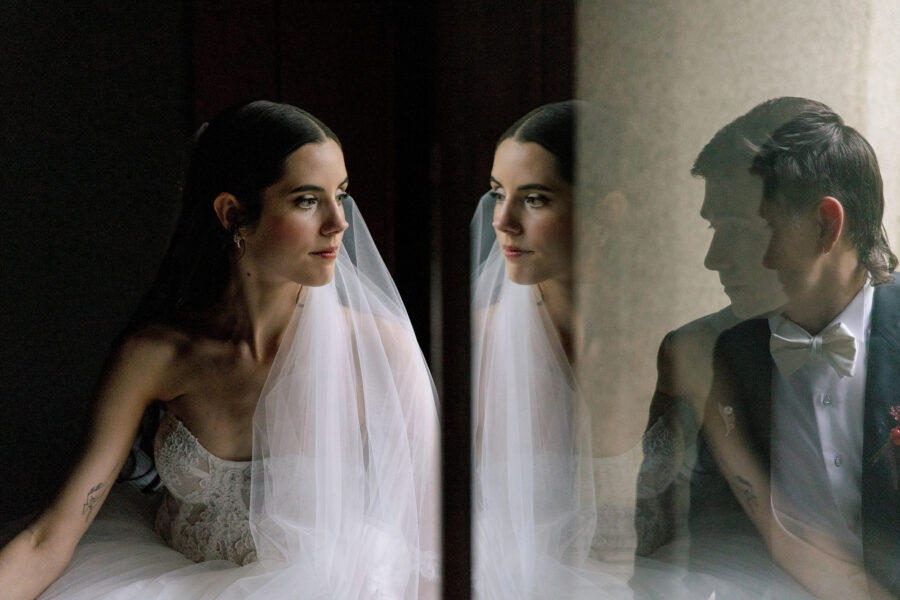
  • The bride in profile beneath a sheer lace-edged veil, her drop earrings and necklace glinting in window light.
  • In black and white, the bride looks back over her shoulder through a sheer veil in a room of a Japanese house.
  • In black and white, the groom stands in a wooden corridor beside glass sliding doors, one hand at his jacket.
  • The groom in a black tuxedo looks towards the light in a wooden corridor of a traditional Japanese house in Tokyo.
  • In black and white, the groom sits on the veranda floor by a glass door, hands clasped, sunlight across the boards.
  • The bride looks down beneath a long sheer veil, wearing a layered collar necklace and an off-the-shoulder lace gown.
  • In black and white, the groom waits with his back turned as the bride walks through the garden towards him.
  • In black and white, the bride stands beneath her lace-trimmed veil in front of the groom, who looks off to one side.
  • The bride smiles from beneath a shared veil as the groom leans his face against her hair in soft light.
  • The bride closes her eyes beneath the veil as the groom rests his cheek against her forehead in warm light.
  • In black and white, the bride glances back past the groom's shoulder, her face in a band of light against darkness.
  • The bride looks towards the camera from beside the groom's shoulder, half her face lit and the rest in shadow.
  • In black and white, the groom's profile fills the foreground as he lifts the bride's chin, her face turned to the light.
  • In black and white, the bride holds the groom's face close as they share a quiet moment, their faces almost touching.

Built for Shade, Just as Glass Arrived

A Japanese house begins with its roof. The eaves reach well past the walls, so the rooms sit inside a band of shade and the sun comes in low, from the side, already softened. For centuries, paper screens were how these houses let the light in, and a shoji still takes the edge off whatever reaches it.

Glass was a recent arrival. Japan’s first flat glass factory only began production in 1909, eleven years before this house was finished, so it was built right at the moment when the old way of living with shade met a new way of letting light in.

We think about that more than photographers probably should. The deep eaves of a house like this keep the sun low and sideways, and sideways light is the light we wait all day for. Most of what makes a portrait feel honest is what’s left in shadow. A room built to hold darkness gives two people somewhere to be close without being on show, and the light finds them in bands and slices rather than all at once. We’d rather work with the light a place already has than bring our own, and this house has been shaping its light for a hundred years.

The bride with her eyes closed beside the groom's profile, both lit by a narrow band of light against deep shadow.
The bride in lace and a layered necklace looks down as stripes of light and shadow fall across her shoulders.
In black and white, the bride rests a hand on glass sliding doors in a dim corridor as the groom stands behind her.

An Afternoon That Belongs to Two People

A wedding day belongs to a great many people. That’s its joy, and it’s why we care so much about giving guests space and time together. A pre-wedding shoot is the rare part of the story that belongs to the couple alone: no schedule held by anyone else, no guests waiting, and an afternoon to get used to the idea of each other in these clothes.

They saw each other for the first time that day in the garden, with nobody watching but us. The light that afternoon was spectacular, the low, late kind that slides in under the eaves. We know we talk about light a great deal. It’s how a chef talks about flavour: bring the right ingredients together and the result is something you can’t plan, only prepare for. We loved how completely they gave themselves to the house, to its corridors, its veranda and its garden, as if they had nowhere else to be. For two people who had come so far to get here, that was the whole point of coming.

When we plan a destination wedding in Japan, an afternoon like this is often where we’d start: somewhere with a history, no crowd, and time. It lets the wedding itself arrive already familiar, with two people who’ve spent a day being looked at kindly and have stopped noticing the camera. It’s why our photography and film begin long before the vows.

The groom waits with his back turned as the bride walks towards him through a Japanese garden in Tokyo for their first look.
Sharing one veil, the bride rests against the groom's chest in a close portrait from their pre-wedding photos in Tokyo.
The couple kiss beneath the bride's lace-edged veil, with the warm tones of a Japanese garden behind them.
The couple sit together on a large stepping stone before the glass-fronted veranda of a traditional Japanese house in Tokyo.

Light Through the Maples

In the middle of November, the maples in this Tokyo garden were still holding most of their green, and the afternoon sun came through them in pieces. The Japanese have a word for exactly that: komorebi, light through leaves. It’s a small word for a small thing, and it only exists for as long as the sun is at that angle and the leaves are still on the tree.

A garden like this is built on the same idea as the house. Nothing in it is shown all at once. Japanese garden makers call it miegakure, hide and reveal: paths bend so you come upon things slowly, stones sit half in shade, and a gate frames the next part of the garden before you walk into it. It’s a way of showing that asks you to slow down, and it suits two people at the beginning of something.

The couple stand close under sunlit maple leaves in a Japanese garden in Tokyo, the bride smiling towards the camera.
The bride wraps her arms around the groom's shoulders as they laugh together in low autumn sun beneath a maple tree.
The couple laugh together on a garden path in Tokyo, the groom leaning in beneath green maple branches.
In black and white, the couple walk hand in hand along a gravel garden path with stepping stones and old trees.
The groom kisses the bride's temple as they stand in the shade of a roofed wooden gate at a Japanese garden in Tokyo.
  • The bride stands on gravel beside a garden stone, her long veil and lace train spreading out behind her.
  • The bride holds out her veil in dappled light in a Japanese garden in Tokyo, with clipped shrubs soft behind her.
  • The bride walks through a Japanese garden past moss and clipped shrubs, her veil trailing across the gravel behind her.
  • The bride in profile beneath her veil, sunlight on her face and a softly blurred Japanese garden behind her.
  • The groom kisses the bride's forehead as they stand beside a Japanese house in dappled light through the leaves.
  • Seen through leaves, the groom kisses the bride's forehead beside the wooden frame of a traditional Japanese house.
  • The couple embrace in front of the veranda of a traditional Japanese house in Tokyo, her train spilling over a stone.
  • The bride leans back into the groom with her eyes closed, a slice of sunlight across her face and lace gown.
  • The couple embrace beside a slender maple in a sunlit Japanese garden in Tokyo, the bride smiling at the camera.
  • The couple stand on a gravel garden path beneath a maple, her lace train spread across the stones around them.
  • In black and white, the couple hold each other under the branches of a maple in a Japanese garden in Tokyo.
  • In black and white, the groom kisses the bride's cheek beside dark wooden gate posts as light falls across her dress.
  • In black and white, the couple share a kiss in a Tokyo garden, the bride's lace sleeves around the groom's shoulders.

Somewhere to Come Home To

A house built a century ago for a family arriving from the far north has spent a hundred years being somewhere to come home to. It was made for shade, for slowness and for staying, and it still keeps all three. For one November afternoon it did that for two more people who had travelled a long way, and it asked nothing of them except that they stay close and let the light find them.

In black and white, the bride's hands, wearing her rings, cradle the back of the groom's head in a close embrace.