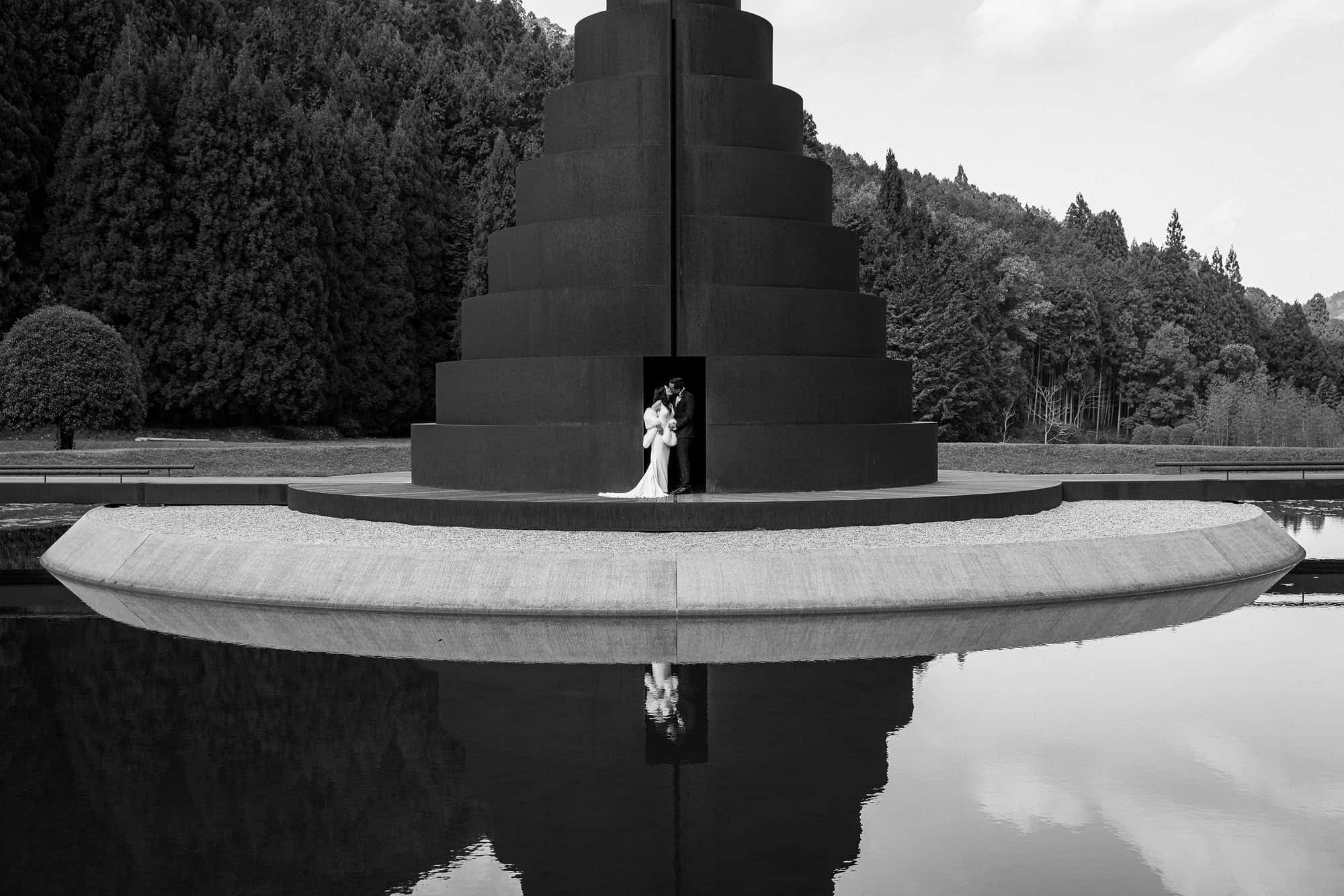
The couple stand in the doorway of a stepped steel tower mirrored in a still pond at Murou Art Forest, an elopement in Japan in black and white.

Walking Into the Work: A Murou Art Forest Elopement Beneath Borrowed Mountains

Dani Karavan’s list of materials for Murou Art Forest begins with sunlight and ends with singing birds. In between come rice fields, cedar trees, stone, Corten steel and glass. A work made partly of weather and birdsong can’t be finished in a studio. It’s finished each time someone walks into it, and it’s different depending on the hour they arrive.

We think a marriage is made the same way. The vows set it in motion, and everything after is the walking. This couple’s elopement in Japan made the case for us. They gave their one day to places other people had shaped: a garden in the hills of Uda that borrows its mountains, a hillside above Murou-ji that an artist turned into a single work, and last, a potter’s wheel, where they made something of their own.

They’re a California couple, deeply in love and deeply drawn to art. They didn’t come to Japan for a long guest list or a hundred tables of flowers. They came for story and for beauty, and for a memory the two of them would carry home.

It was an elopement, just the two of them and our team. Every hour was theirs to spend looking, and we loved them for spending it that way. They looked closely all day, and at the end, they made something. The day before, they were in Kyoto, a city that protects its borrowed views by law.

The couple kiss framed by the pillars of a vermilion torii, orange maples glowing in the forest behind, a Kyoto pre wedding shoot.
The groom holds the bride from behind in a Kyoto garden at peak autumn, red and orange maples and a carved stone marker around them.

What the Film Keeps

Karavan’s forest was made to be walked, and walking is the one thing a photograph can’t keep. The film gives them the day at the pace they lived it. Our photography and film are made as one piece of work for exactly this reason: some places need both. Their vows film stays private, as vows should.

Kyoto, Where a View Can Be Protected by Law

At Entsū-ji in Kyoto, the garden takes Mt Hiei inside it as its backdrop. The city has written that view into its building rules: nothing nearby may rise above 110.2 metres above sea level, the height of the temple room the mountain is seen from. Kyoto’s landscape white paper counts 49 protected views and describes them as something handed down by those who came before. It’s a city that treats looking as something worth defending.

The couple spent the day before they married on a Kyoto pre-wedding shoot, in a private moss garden in the north of the city, with the maples at their peak. On the old calendar it was the last kō of rittō, the start of winter, a five-day season named for the narcissus coming into flower. Nobody makes a moss garden in a season. Someone keeps it, year after year, and the people who stand in it rarely meet them. It was a fitting eve for two people about to marry inside other people’s work: a garden held together by keeping, the day before a garden completed by borrowing.

The couple walk small along a stone path through a moss garden in Kyoto, maples at full autumn colour arching over them.
The couple kiss beneath a vermilion torii on a gravel path through tall cedars and stone lanterns, the day before their elopement in Japan.
The couple embrace under a vermilion torii among stone lanterns and moss, maple branches in red and orange in the foreground.

Morning at Ozunu, Facing East

Ozunu is a new house under an old kind of roof. It’s one of two villas at Sasayuri-Ann, a place in Nara we return to, in Fukano, a hamlet in the hills of Murou that’s listed among Japan’s hundred best villages. Each villa is given whole to one party a day. Zao is a thatched farmhouse of about 150 years, restored. Ozunu, where the couple married, is newer: built under thatch, with modern comfort.

A drone looks straight down on the thatched teahouse, its raked gravel and rock garden and autumn maples, the couple small on the path.
The groom in a black tuxedo and bow tie looks toward the light in the dark timber corridor of the villa, ready for his elopement.

Within its gardens stands a tea room a century old, rebuilt. The villa’s own words say guests would feel as if they were staying in a famous temple. Ozunu shares its characters with En no Ozunu, the founder of Shugendo, and the man who keeps the villas is himself a Shugendo monk.

The couple kiss inside the round window of the thatched teahouse at Sasayuri Ann, her train falling over the stone step below.
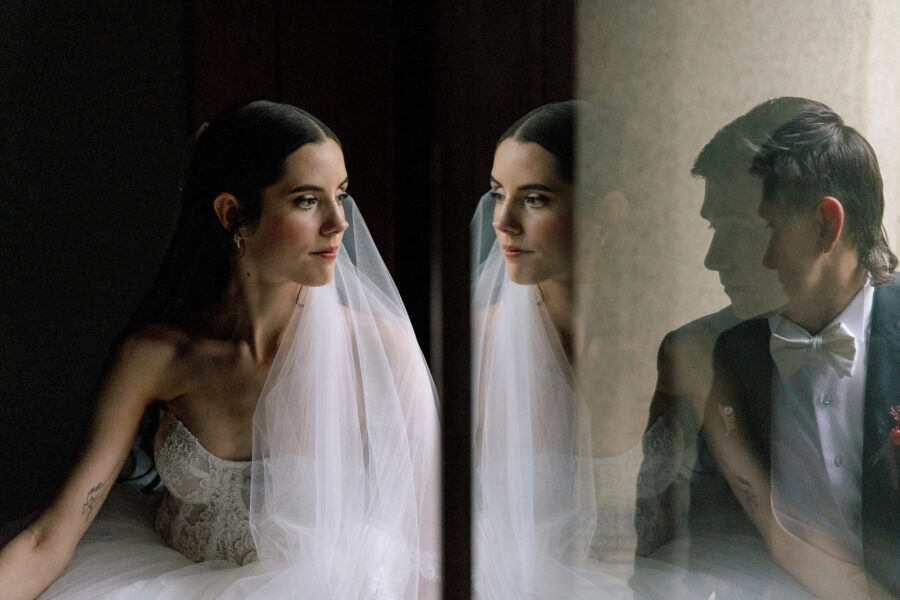
The bride glances over her shoulder in a fitted gown with a lace back, an ink painting on the wall beside her at the villa in Uda.

He has written about why the place exists. The thatched house and the sasayuri, the rare native lily that gives Sasayuri-Ann its name, had both nearly disappeared. Globalisation, he writes, has made Japan’s towns look alike. He quotes Bruno Taut: “Tradition speaks through architectural structures.”

A woman in kimono kneels to arrange the bride's lace train on checkerboard tatami below a round shoji window, in black and white.
The bride faces a glowing round shoji window, her lace cathedral train fanned across the checkerboard tatami of the villa in Nara.

Since 2006 the people of Fukano have protected the wild lily, work now registered as a UNESCO Association of Japan Future Heritage project. A thatched roof here is somebody’s argument, made by hand, about what deserves to be kept.

Ozunu’s main house faces south and east, so the morning arrives across the ridges before it reaches the rooms. For a couple getting ready, that’s the first thing the villa gives: the view comes to them. The house was theirs alone for the day, the hearth room and its round windows included. When we plan an elopement, those unhurried first hours are the ones we build the day around.

Sunrise turns the sky pink over ridge after ridge of mountains in Uda, Nara, seen from the villa on the morning of the elopement.
The groom getting ready on a cushion by the sunken irori hearth, a round window glowing in the tatami room of the Nara villa.
A fine pendant necklace laid across a pale notebook beside a black one and a small metal bowl, on dark timber at the villa.

Shakkei: Vows in a Borrowed Landscape

Most gardens end at their walls. A shakkei garden ends at the mountains. Shakkei means borrowed scenery, and the Japanese dictionary definition is exact: a garden-making technique that takes in the scenery beyond the garden, its mountains and trees, as the backdrop that forms the garden. The term first appeared in Chinese poetry, and Japanese gardeners practised the idea for centuries before scholars gave it a name. Ozunu is a quieter case than Entsū-ji, and a wider one: where Entsū-ji borrows a single mountain, Ozunu borrows a whole range.

The couple stand on a flat rock among sculpted pines, layer after layer of mountains in the haze behind them, in black and white.

The villa describes its garden in three layers: nearest, the dry rock garden inside the grounds, then the pine garden just beyond them. Past those is what the villa itself calls a borrowed-scenery garden made of mountain peaks. These are the ranges of the Murou-Akame-Aoyama Quasi-National Park, protected since 1970, and the highest peak in the view is Mt Kuroso, at 1,037.6 metres. The first two layers are tended by hand. The third lies well beyond the grounds, and the garden is incomplete without it.

The couple stand on a stone slab bridge in a raked gravel dry garden, a tiled wall and a lone pine against the hills of Uda.
The bride stands on a rock under sculpted pines, her long veil lifting in the wind and a bouquet of calla lilies in her hand.

They saw each other first in the nearest layer, the raked dry garden, where everything asks you to look closely at something small. The vows came later in the same garden, with the farthest layer, the mountains, behind them.

The bride walks toward the groom for their first look, along a stone path through a raked gravel dry garden, a Japanese garden wedding.
The bride steps up behind the groom on a stone path between sculpted shrubs and rocks for their first look, in black and white.
The bride steps up behind the groom on a great rock by the terrace for their first look, her lace train over its edge, mountains beyond.

A garden that borrows its mountains has accepted that the most important part of it can’t be owned or held. It commits to the view anyway, and arranges everything within reach so the far thing can be seen. We think that’s close to what a vow is. It’s hard to imagine a better garden to make one in.

The couple stand on the villa terrace looking across sculpted pines to layers of mountains, framed by the open glass doors, in black and white.
The couple face each other on the villa terrace, her veil lifting in the breeze, the pine garden and mountains beyond, in black and white.

They married on the first day of shōsetsu, light snow, in the five days the old calendar calls niji kakurete miezu: the rainbows hide. Their cask for kagami biraki was marked 祝, the character for celebration. With no guest list to toast, the whole of that word was theirs.

The couple laugh as they break open a small sake cask marked with the character for celebration, kagami biraki at their Japan elopement.
  • The couple walk hand in hand toward a vermilion torii and a tall stone lantern, cedars and moss all around, in Kyoto in autumn.
  • A drone view of a vermilion torii and a moss roofed shelter in a cedar forest in Kyoto, the couple small beneath the gate.
  • The groom holds the bride from behind on a mossy path in Kyoto, a vermilion torii and orange maples softly out of focus behind.
  • The groom holds the bride close in a sunlit Kyoto garden, the trunk of a great tree and autumn leaves glowing behind them.
  • The bride with her eyes closed at the edge of the frame, an ink painting of a deer on the wall beside her in the villa in Nara.
  • The bride stands before a glowing round window, hands at her waist, her lace train spread across the tatami, in black and white.
  • The bride getting ready in soft window light, in a fine strap gown and drop earrings, at a villa in the hills of Uda in Nara.
  • The couple kiss in front of the round window of the teahouse, pine branches reflected in its glass, in black and white.
  • A drone looks down on the couple on a great flat rock by the teahouse, raked gravel curving around the stones of the garden.
  • The couple stand on the teahouse step above the rock garden, a stone lantern and a tiled wall below the forested hills behind.
  • A drone view of the thatched villa at Sasayuri Ann, the couple on its veranda above a raked gravel garden and autumn maples.
  • The couple kiss on the timber terrace framed by glass doors, sculpted pines and layered ranges behind, an elopement in Japan.
  • Blue ridges of the mountains around Uda in Nara fade one behind another into the haze of a late November morning.
  • The couple step down a grassy slope from the thatched villa between sculpted pines, the bride in a white wrap and a long veil.
  • The groom and bride stand close on a flat rock under sculpted pines and bare branches, the pine garden in black and white.
  • The couple on a flat rock among sculpted pines, a maple with its last red leaves and layered mountain ranges rising behind.
  • The couple kiss on a rock among sculpted pines, her long veil trailing across the stone and the mountains soft in the haze.
  • The bride looks up into the branches of a sculpted pine from a flat rock, her veil blowing out behind her in the wind.
  • The bride stands on a flat rock under two sculpted pines, her lace edged veil streaming sideways in the wind over the stone.
  • The bride smiles over her shoulder on a garden rock, the lace hem of her veil falling over its edge, pines and hills behind.
  • The bride smiles down in a white wrap holding calla lilies and white roses, the groom beside her softly out of focus.
  • The bride in close profile, eyes lowered and smiling, the groom in his tuxedo behind her in soft focus at the villa in Nara.

Murou Art Forest: A Village’s Idea, a Friend’s Hands

It began as one man’s idea for his birthplace. The sculptor Inoue Bukichi was born in the old village of Murou, and he imagined a corridor through the forest that would turn the village into a museum where people and nature live together. The village took it up as the Murou Art Arcadia plan in 1997, and Inoue died that September without seeing any of it built. His friend Dani Karavan, whom the city calls the world’s leading figure in environmental art, took on the design and saw it through. It was completed in October 2006.

A drone view over the pond at Murou Art Forest in Nara, its round islands joined by a straight walkway, the forest turning gold.

Murou Art Forest in Nara is, by the city’s own account, a single sculpture of 7.8 hectares, with twelve works set into the slope. Uda City is careful to say that the word “park” came only from the public-works budget that paid for it, and that what was completed is Dani Karavan’s work of art. It sits on the mountain above Murou-ji, the temple known as the women’s Kōya because it welcomed women when Kōya-san did not. The park was paired with the Murou roadside station: the station was made to evoke earth, and the park, heaven.

The bride and groom stand apart on the stone spiral at Murou Art Forest in Nara, a wavy water channel leading to one round tree.
Seen from a stone spiral, the couple walk hand in hand up a wavy path toward a single round tree, Dani Karavan's design at Murou Art Forest.

Karavan also left a trace of his friend in it. A wavy path leads to Kōbō’s old well, narrowing as you walk it, and when you turn back the lines look parallel. It’s an illusion from Inoue’s own work, kept here as a homage. Uda’s tourism office says what connected the two men was respect, for each other and for Murou’s nature.

So the couple walked from their vows into a place built on one man’s care for another man’s idea. Part of a marriage is carrying your partner’s ideas as seriously as your own, sometimes further than they could carry them alone.

The groom reaches for the bride's hand on a sloping lawn at Murou Art Forest, a day built for two art lovers, forested hills behind.
The groom kisses the bride's forehead on the curving stone paths of Murou Art Forest, a white wrap around her shoulders.

On the Road of the Sun

Much of the park is built to follow the sun. A steel rod in the spiral water channel works as a sundial, and the channel’s form is said to come from a coiled snake slipping away, with a single sweet osmanthus where the flow begins. The Astronomical Tower stands in the second lake, and a slit in its south face draws a line of light inside it that moves with the hour and the season.

The couple kiss at the centre of a great stone spiral, its wavy path leading to a round tree, a sculpture by Dani Karavan, in black and white.
The couple climb the steep wooden stair of a stepped steel tower at Murou Art Forest, forested hills rising on both sides.
The couple kiss in the narrow doorway of a rust red steel tower, the moment mirrored in the still pool below at Murou Art Forest.

A narrow bridge crosses the water on the Road of the Sun, the line of latitude, 34°32′ north, that links Murou-ji to important shrines and temples. Sasayuri-Ann, by its own telling, sits just north of it. Karavan meant the line to reach on across the sea and connect places beyond borders. Their wedding day ran along it, from a villa just north of the line to a bridge laid across it.

The bride walks a timber boardwalk toward the groom between two tall rusted steel triangles, autumn leaves behind, at Murou Art Forest.

Karavan hoped people would gather and talk on the pyramid’s island. Step inside the pyramid and the Corten steel, left to rust on purpose, becomes a frame that cuts out the sky and the land around it. Ozunu frames its views too: the villa says the round window of its storehouse holds each season “like a painting”. The window gathers the seasons and the pyramid gathers the sky. The rhyme is our own, but the couple began their day among round windows and spent the afternoon beside a frame of rusted steel.

A rusted steel pyramid rises by a dark pond as the bride crosses the boardwalk beside it, part of Dani Karavan's design at Murou Art Forest.
The couple stand under a small roofed wooden gate in the villa garden, maples turning orange and a stone lantern beside them.

It’s hard not to see shakkei in the whole place. Uda comes close to naming it: the city describes the park as taking in the landscape of Murou’s mountain forests, with the verb torikomu, the same word Kyoto uses for the way Entsū-ji takes in Mt Hiei. The park’s own description speaks of using nature to make a second nature. A centuries-old garden principle and a piece of modern land art arrive at the same place: a work that finishes itself with a landscape it could never own.

The couple stand together at the top of the rusted steel stair tower, small against a soft sky and the autumn hills of Uda.
Hidden in front of the groom, the bride wraps her arms around his neck on a boardwalk, feathery trees in full orange behind, autumn in Japan.

An elopement at Murou Art Forest takes some care to arrange. The city requires a permit for professional photography there, and the park keeps its own seasons and closing days. We handle all of it, so what the couple meets is the work, the light and each other.

The couple walk a boardwalk beside a still pond, a stand of glowing orange trees behind them, at Murou Art Forest in Nara.
  • A drone view of the spiral water channel and round pond at Murou Art Forest, set in a clearing of dark cedars in Uda.
  • The groom holds the bride from behind at the end of an avenue of clipped hedges, the bride in her white wrap, at the art park.
  • The couple walk up a grassy slope beneath a bare branch, a wall of forest behind them at Murou Art Forest, in black and white.
  • A wide view of the stone spiral at Murou Art Forest with the couple at its centre, an elopement in Japan for two art lovers.
  • The couple walk arm in arm along the wavy stone path of the spiral at Murou Art Forest, the round tree behind, in black and white.
  • Seen from behind, the couple walk the wavy path toward a great round tree at Murou Art Forest, a black and white frame.
  • The groom twirls the bride at the heart of the stone spiral, framed by cedar branches, the round tree at the end of the path.
  • The groom dances across the stone spiral toward the bride as the wavy path runs up to a single round tree at Murou Art Forest.
  • The bride holds the groom's face as they kiss on the curving stone paths of the spiral, her white wrap slipping off one shoulder.
  • The couple stand beneath the great round tree where the wavy path ends at Murou Art Forest, in black and white.
  • The couple stand far off by the round tree as a curving path and its narrow water channel lead the eye toward them.
  • The couple walk hand in hand from the great round tree down the wavy stone path at Murou Art Forest, the groom smiling.
  • The couple embrace at the top of the stepped steel stair tower, forested hills in mist on each side, in black and white.
  • The bride and groom stand side by side at the top of the rusted steel stair tower, looking out over the autumn hills of Uda.
  • Seen from above, the couple cross a narrow timber bridge over a dark pond under a steel frame at Murou Art Forest, in black and white.
  • The couple walk hand in hand along a timber bridge through a steel frame above dark water and lawn, in black and white.
  • A stepped steel tower and its reflection fill a still pond at Murou Art Forest, the couple tiny in its doorway, in black and white.
  • The bride in a white wrap walks toward the groom waiting between two tall steel triangles at the art park, in black and white.
  • The bride crosses a long boardwalk by the pond, a red maple and a bare tree on the lawn behind her, at Murou Art Forest.
  • The couple laugh together on the boardwalk between two tall steel triangles, the forest dark behind them, in black and white.
  • The groom stands with his back to us, the bride's hands clasped behind his neck, a stand of feathery orange trees at Murou Art Forest.

Clay at the End of the Day

After a day spent moving through things other people had made, a garden and a sculpture the size of a hillside, they ended it by making something themselves, at a local pottery studio. Whatever each of them made alone at the wheel, the piece we remember is the one they shaped together: a moon vase, each of them making one half. A moon vase is thrown as two bowls and joined at the middle, and it only becomes the vase once the halves meet.

The bride in a short white dress leans over the wheel to shape a clay bowl, tools laid out on the bench, in a pottery studio in Mie.
The groom and the bride shape a tall clay vase together at a pottery workshop in Japan, shelves of white bisque ware behind them.

There’s a quiet reversal in that. At Murou Art Forest, the work stays still and you move through it. At the wheel, you hold still and the work turns through your hands. A marriage asks for both, and they began theirs by doing each in turn.

Clay spins on the potter's wheel as two hands press it into a thick ring, the afternoon after the vows, in a pottery studio in Japan.

Clay is honest about hands. Every pressure you give it stays, and once it’s fired it stays for good. The potter fired it and sent it home to them. Whatever else that vase becomes, it’s the first thing they made together as newlyweds, and it carries both of them in it.

The groom wraps his arms around the bride from behind as she finishes the clay vase on the wheel, a pottery workshop in Japan.

Borrowed scenery and land art ask the same thing of the people standing in them: finish the work by being there. They answered it twice on the day they married, once in a garden and once on a hillside. A marriage asks it too, every day after the vows, and no one else can do it for them.

  • Clay covered hands draw up a tall cylinder on the potter's wheel, the first shape of a vase, in a pottery class in Japan.
  • A small tool trims the rim of a wide clay bowl as the wheel turns, one hand steadying it, in a pottery studio in Japan.
  • The groom in his tuxedo shirt and bow tie lifts a wooden bat with a clay bowl on it, a wall of glazes and tools behind him.
  • The groom and bride bend over the wheel together shaping a round clay vase, tables and shelves of bisque ware around them.
  • The couple's fingers meet on the neck of the clay vase as they smooth it together at the wheel, a close view in the studio.
  • The bride reaches deep inside the clay vase to shape its belly as the groom works beside her at the pottery wheel.
  • The bride smooths the shoulder of the clay vase as the groom watches closely, basins of water on the wheel table in front.
  • The groom grins behind the bride as she works the clay vase on the wheel, the studio shelves full of white ware behind them.
  • The bride smiles down at the finished clay vase on the wheel, the groom's arm beside her, at a pottery studio in Mie.
  • A hand holds the upturned clay vase steady as another carves marks into its base with a fine tool, at the pottery wheel.
  • A close view of the base of the handmade clay vase, its throwing rings circling two carved marks, set on the wheel to dry.