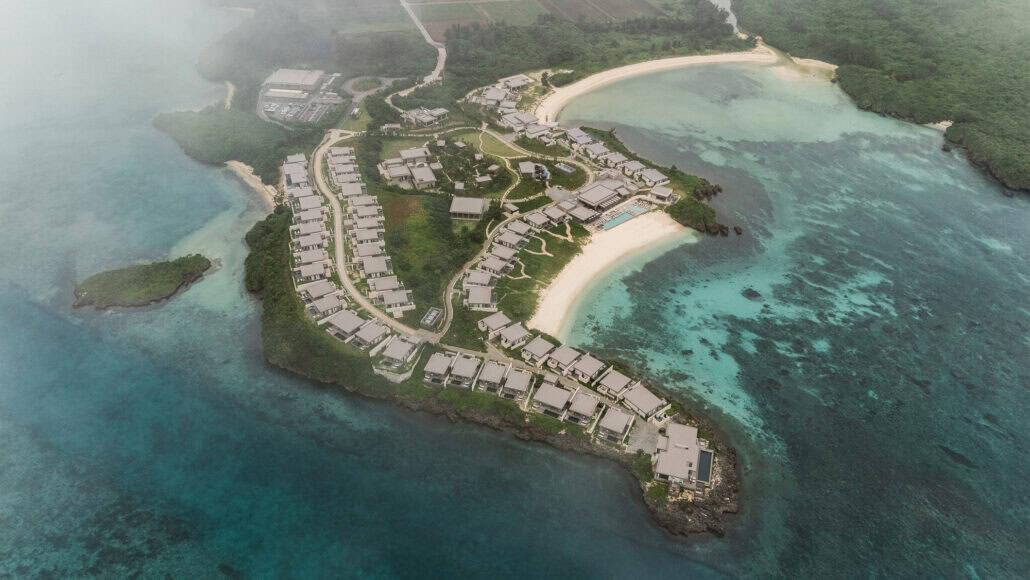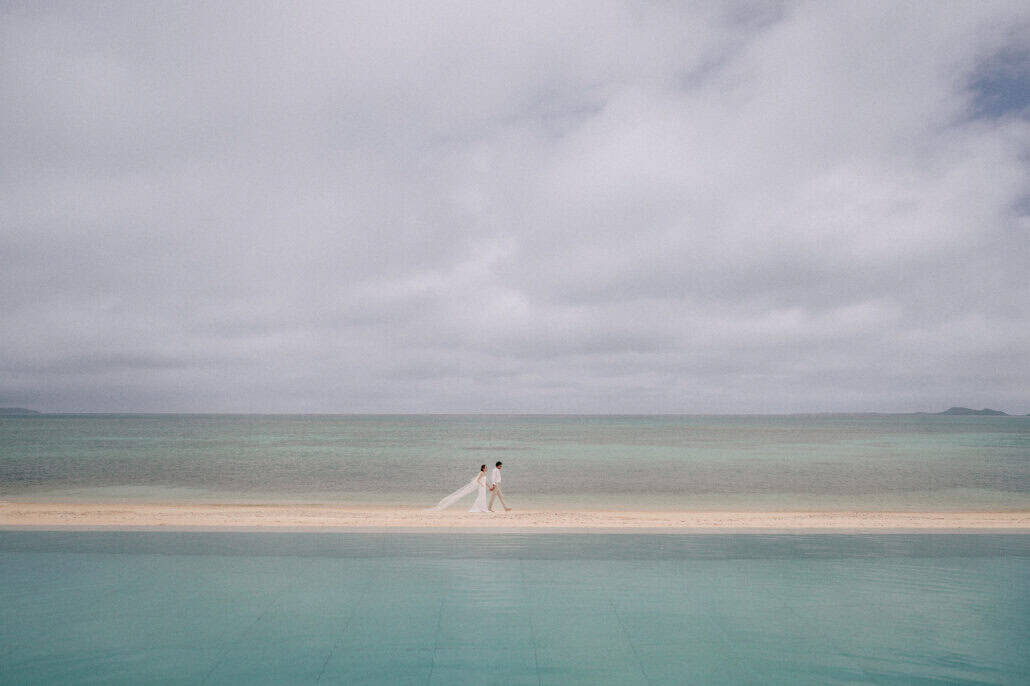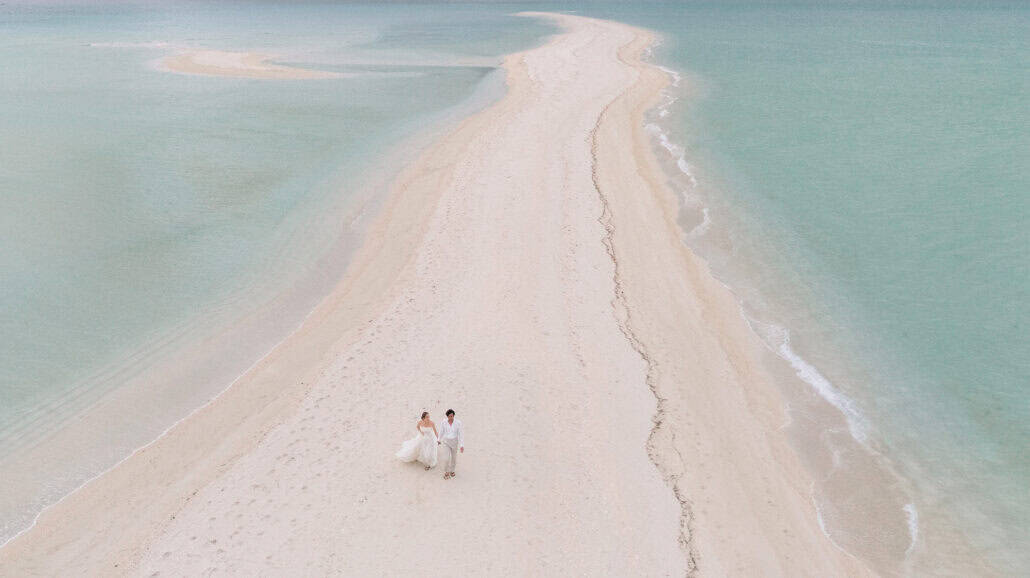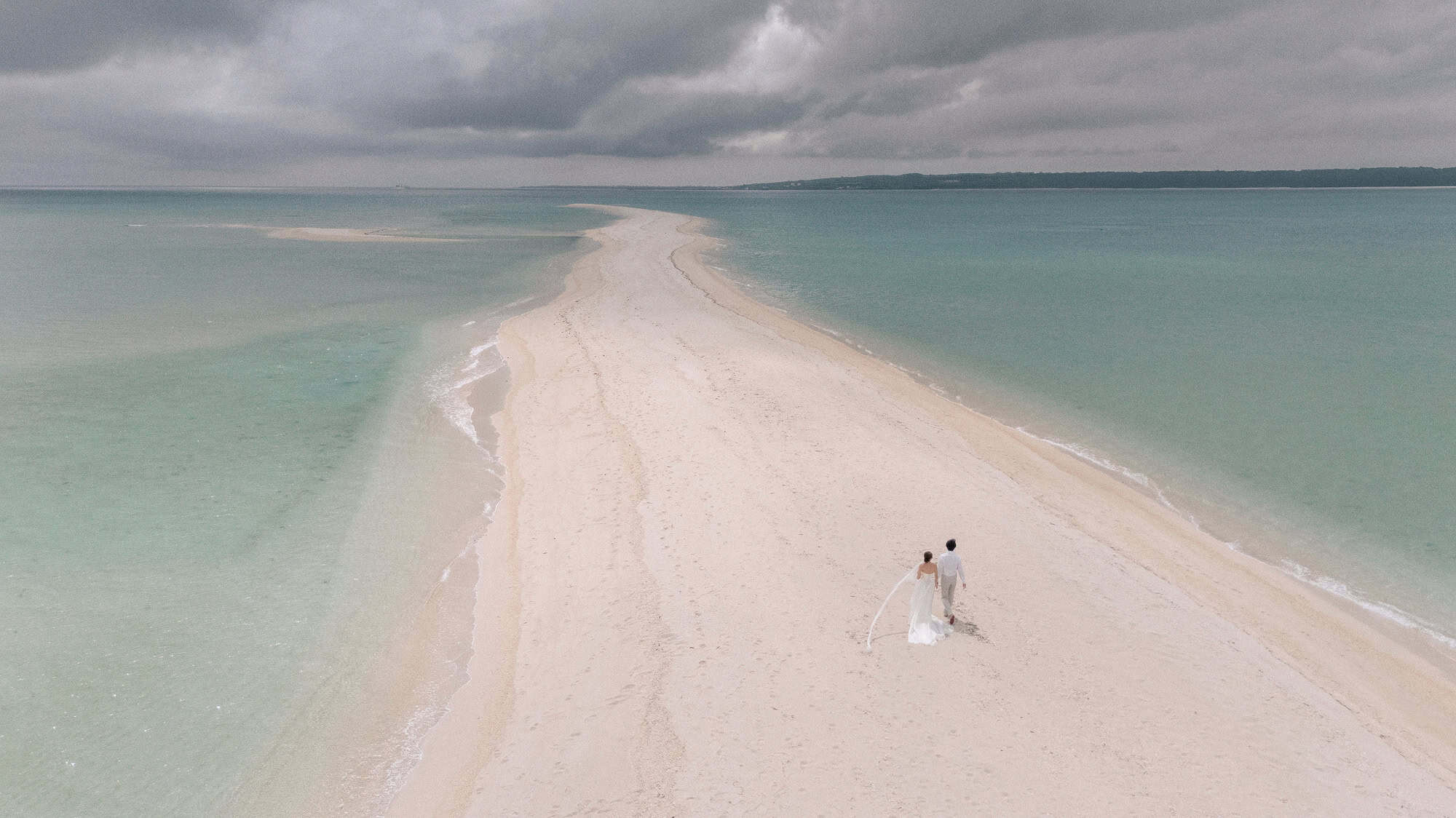
The blue is frankly showing off. Out beyond the shore, a white sandbar lifts out of the sea, and two people in wedding clothes stand on it looking wonderfully small. This Rosewood Miyakojima wedding began with room for that: a day out on the island together, before their family gathered and the celebrations became everyone’s.
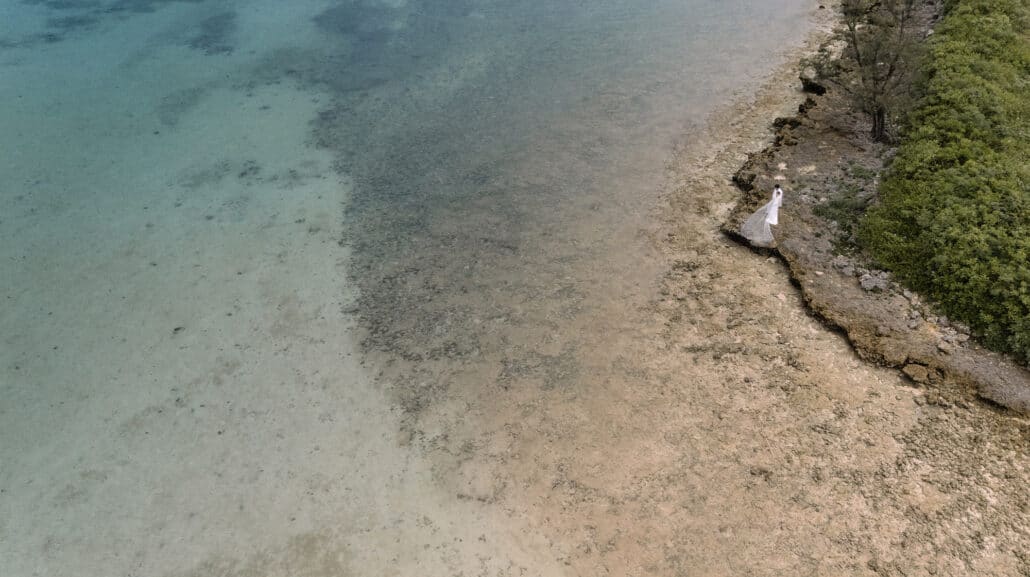
From above, the dress makes a pale mark against the sand. Beyond it, the water changes colour with its depth, from almost transparent at the edges to a turquoise that would look suspicious if you hadn’t been there yourself. We were there. We can confirm the sea needs very little assistance.
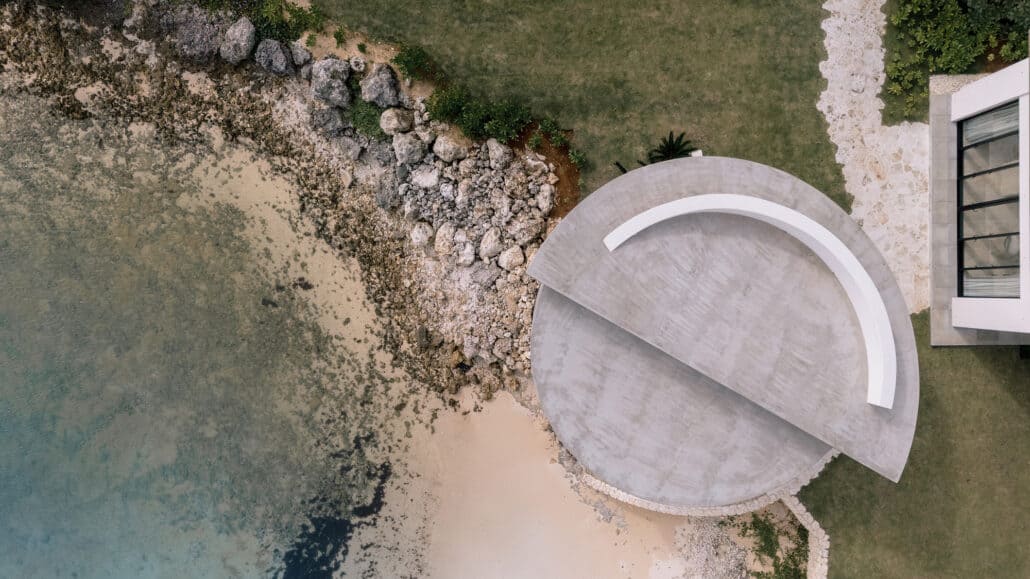
They would marry the following day in a round chapel beside that same water. It was the first wedding at Rosewood Miyakojima. There was the pleasure of being part of a beginning, and the much larger pleasure of watching a family make a place their own.
The resort was new. Almost everything that made these days feel so particular to Miyako Island was considerably older.
What the Blue Is Made Of
Miyakojima is an island of raised coral limestone, porous enough for rain to sink underground, with no substantial rivers carrying sediment out to sea. That, together with the pale coral sand, helps explain the extraordinary clarity and colour of the water around it. There is a whole island beneath the view. The history of Miyako’s water begins in that stone.

The same geology that gives a visitor this beautiful sea made fresh water precious for the people who lived here. Springs and wells were essential to daily life; communities grew around them. The island’s habit of cherishing water and praying for it came from needing it, day after day, season after season. The Miyakojima Tourism Association describes that relationship between the springs, the villages and prayer.
It changes the way you look at the landscape. A spring becomes somewhere people depended on one another. Rain becomes something a community waited for, something that could determine how the next part of the year unfolded. The beauty is still there, but you begin to see the lives inside it.
That is part of the pleasure of choosing a wedding in Okinawa and then looking more closely at the particular island you’ve chosen. Miyakojima has its own ground beneath your feet, its own relationship with water, its own ways of understanding what deserves care. You can come for the colour and find yourself interested in a great deal more.

Our earlier work in Okinawa has kept bringing us back to that feeling. We love that a place can become more familiar without becoming fully known. There are still questions to ask, details we have walked past before, things someone who lives here might notice long before we do. That curiosity matters to the photographs. It keeps us looking carefully, even somewhere whose beauty might easily persuade us we have already seen what we came for.
A Place the Tide Lets You Visit
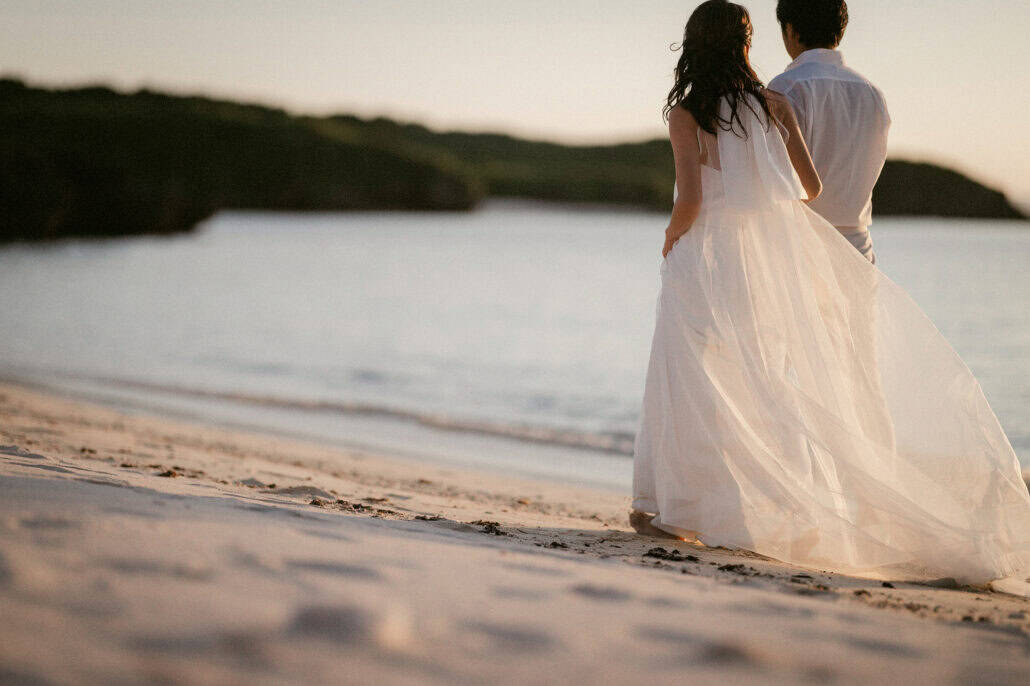
The sandbar was part of their pre-wedding shoot, reached by boat the afternoon before the ceremony. At low tide it emerges; later, the sea covers it again. It makes quite a setting for a ball gown, with a fairly uncompromising approach to opening hours.

Out there, the island recedes and the scale changes. The dress has space to move. The two people inside this enormous view become the thing your eye keeps returning to, precisely because there is so little around them. A strip of sand, an expanse of water, and the person you came with.
We love what happens when a place asks something of you. Here, being there meant going out by boat and paying attention to the tide. The experience already had movement and anticipation in it before we lifted a camera. A photograph can hold the shape of that afternoon, but the couple also gets to keep the journey out, the feeling of standing there, the knowledge that the place will disappear again.
There is a particular intimacy in sharing somewhere temporary. You can put it on a map, yet the exact place you stood may be under water when you return. The memory belongs partly to your timing, to having gone together when you could.
A multi-day wedding in Japan gives these experiences their own space. There was no need to squeeze the sandbar between getting dressed and greeting the family. It could be an afternoon in itself, with the wedding still ahead of them.

A Rosewood Miyakojima Wedding With the Island All Around It
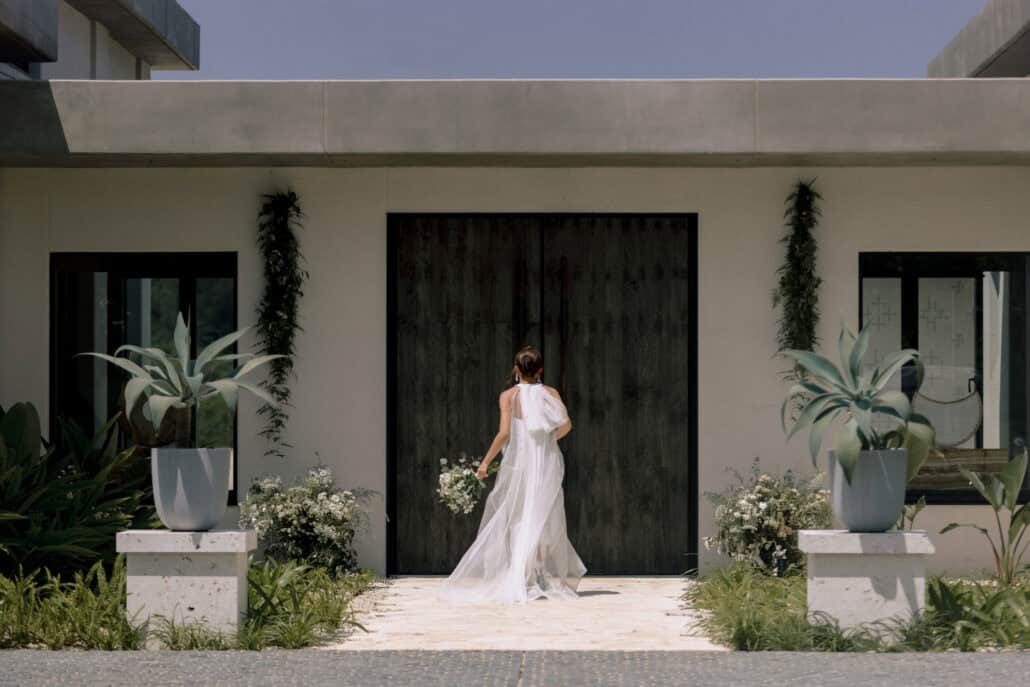
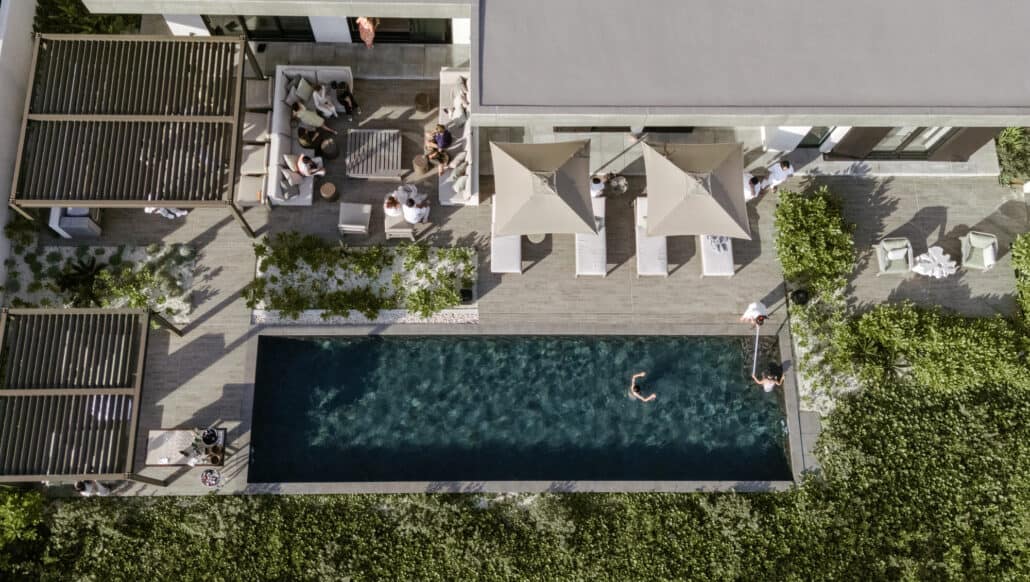
Rosewood Miyakojima opened as Rosewood’s first property in Japan. Its architecture draws on the Ryukyu Islands and uses local limestone, so the connection to the landscape is there in the buildings themselves. Pale walls, strong shapes and the sea beyond them give the eye somewhere to settle.

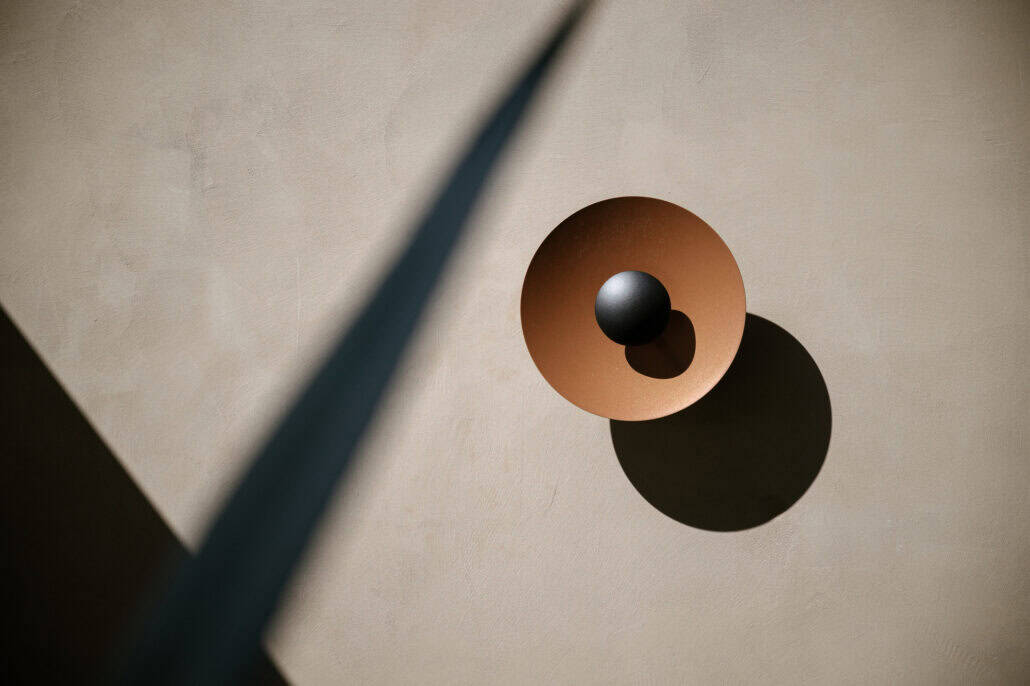

We were especially taken with the stone. As Wallpaper reports, the white limestone is expected to darken over time, coming closer in colour to the rocky shore. We like a building whose future includes the weather. It allows the island to keep having a say in how the place looks.

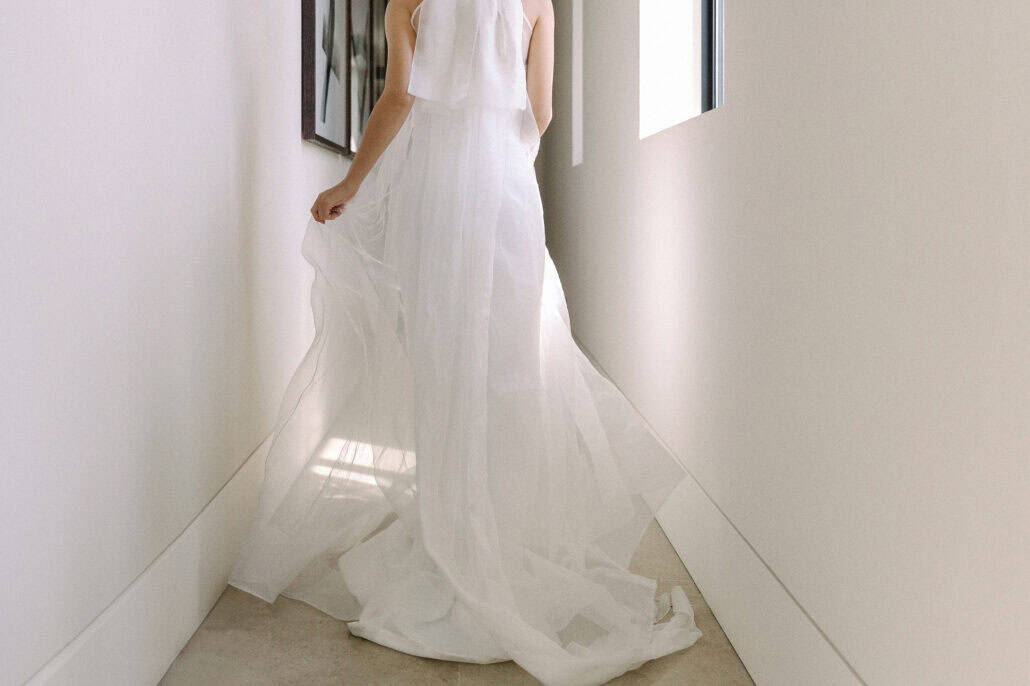
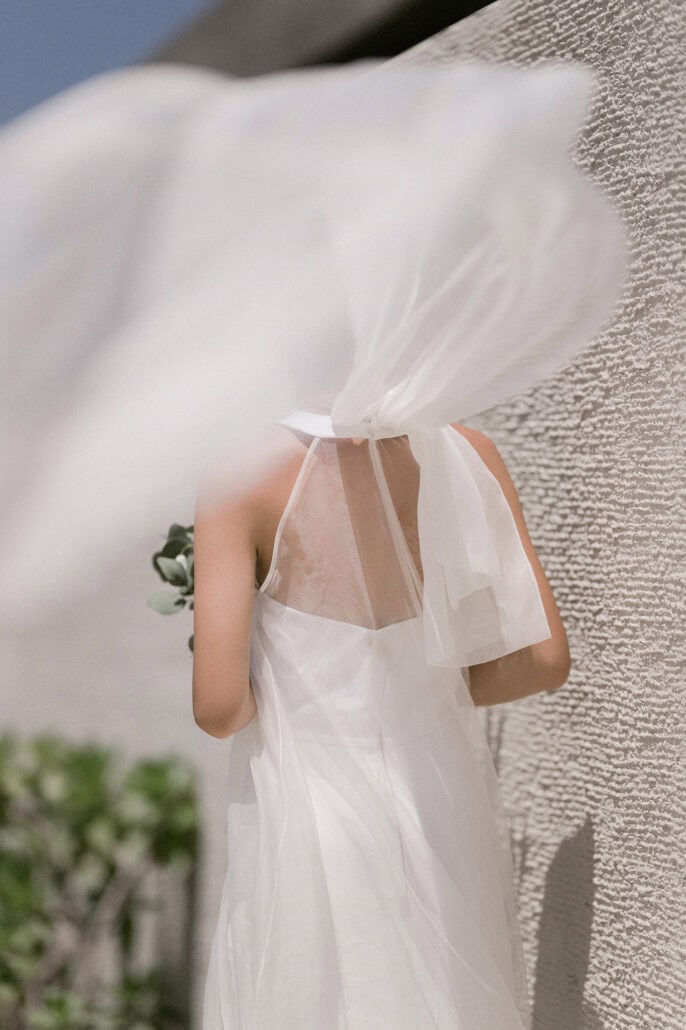
For photography, that combination of considered architecture and an unmanageable sea is rather good company. There are clean lines to work with, then a veil catches the wind and changes the whole composition. A white wall holds a shadow; a little later, cloud alters it. You work with what the island is doing that day.
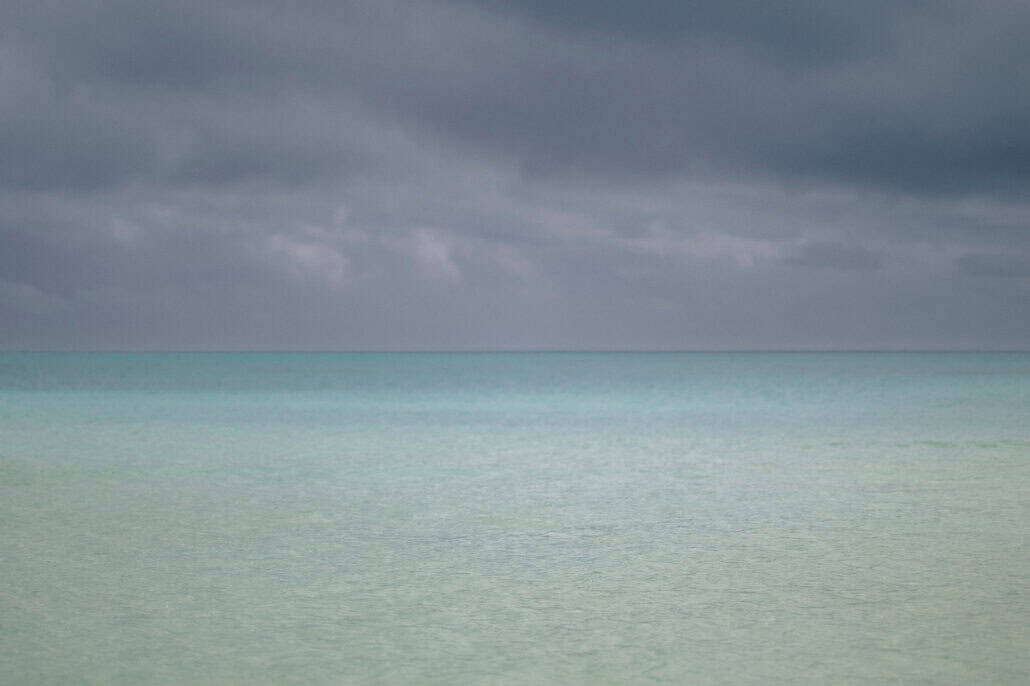
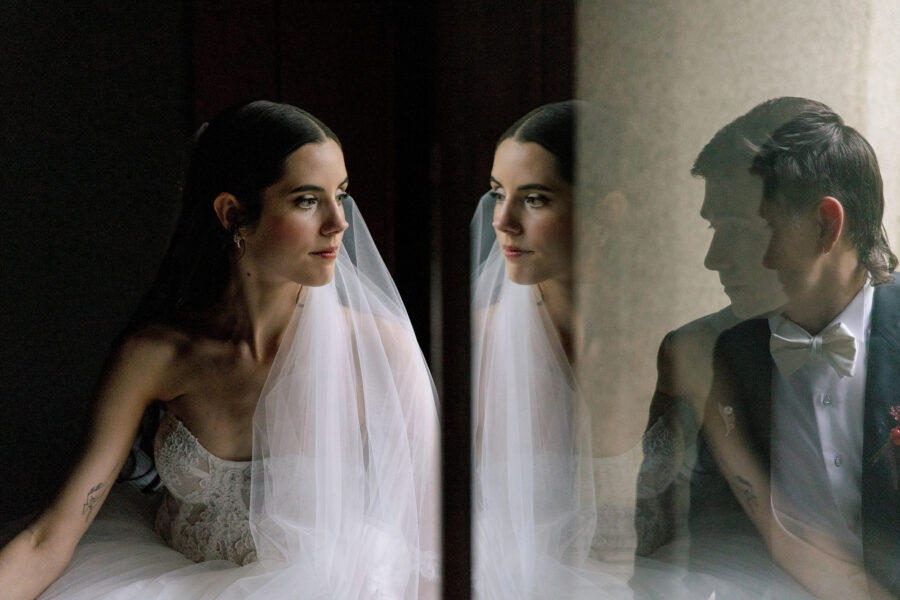
Their first morning had begun with a storm and silver-green light over the water. Along the reef rocks, the bride’s long veil was thoroughly occupied by the wind. At the pool, the bronze crescent stood against the horizon while the water seemed to carry on towards the sea.


The following morning came up clear. By the chapel, her dress lifted in the breeze against the curved wall. Across the two days, Miyakojima kept changing its expression, and the photographs could change with it.


Water at the Door, Family Inside
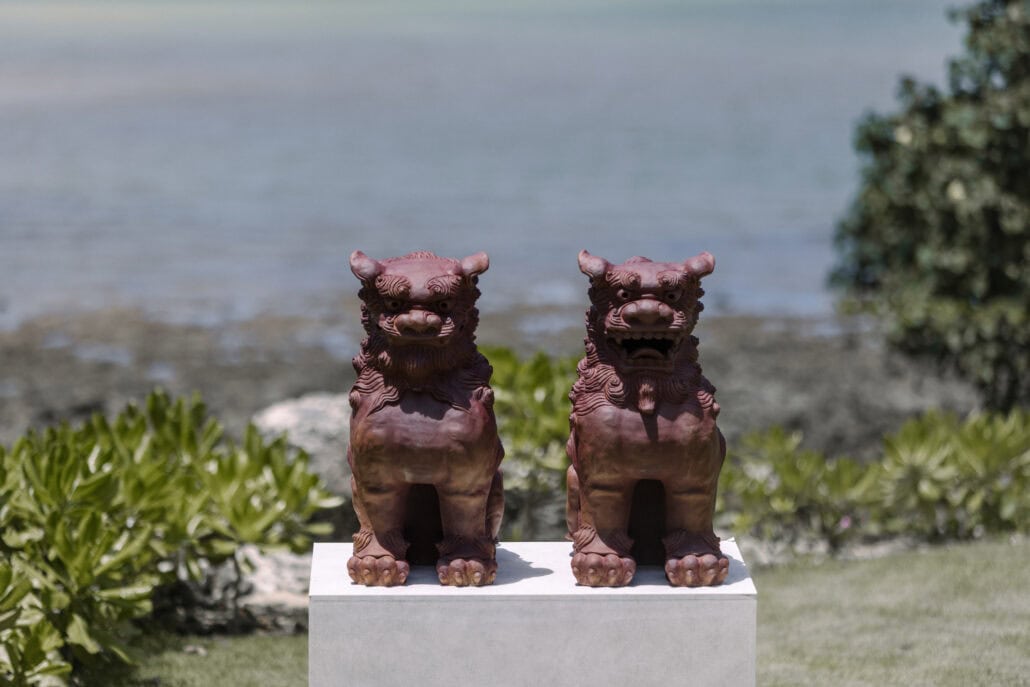
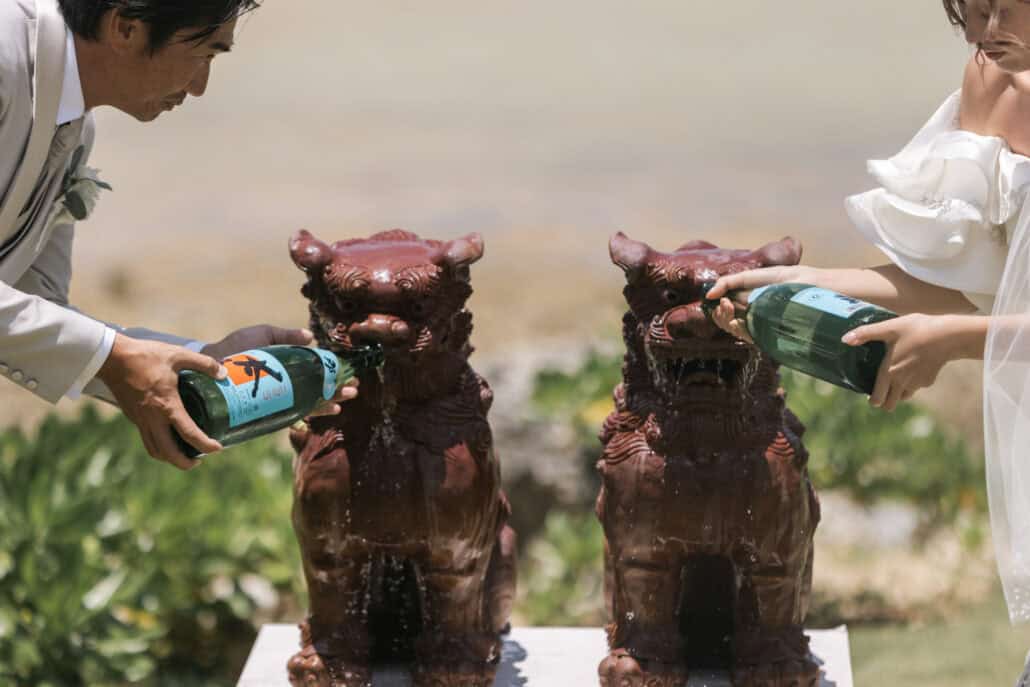
Before the ceremony, the couple stood outside with their family and friends and poured water and awamori from black cups on wooden handles over a pair of red clay shisa. These guardian lion-dogs are a familiar presence in Okinawa, one mouth open and one closed. Here, the family watched as the two of them tipped the cups over their heads.


Then they went into the chapel by the sea. Its round form held the gathering at the water’s edge, bringing the vast view down to the scale of a room full of family. Outside, the horizon went on. Inside, everyone had come to witness the same two people.

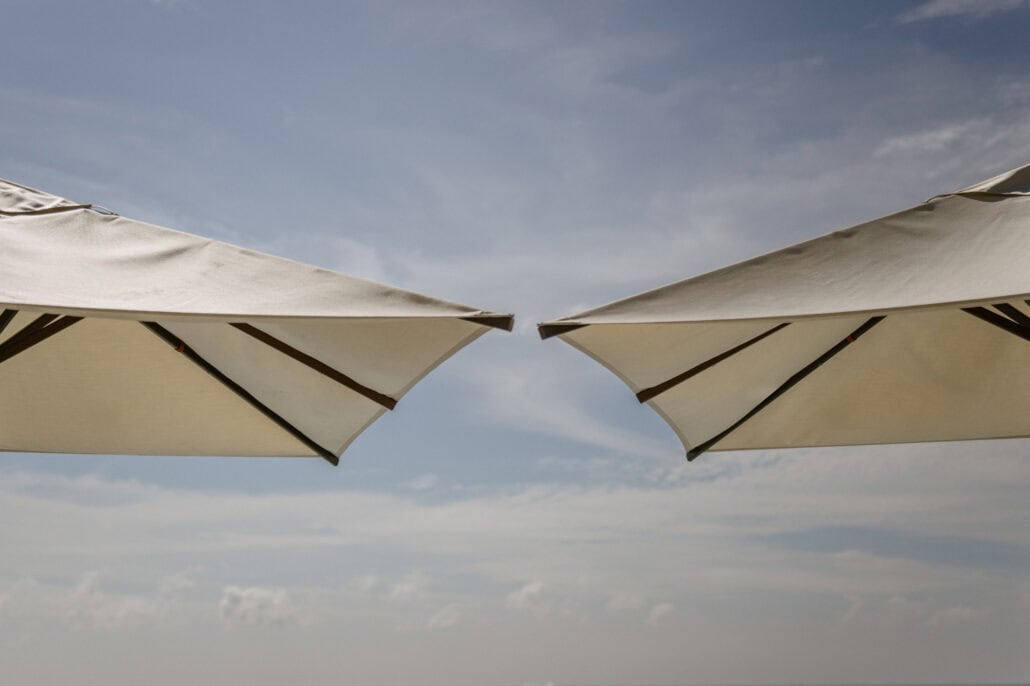
Afterwards, petals filled the air as they walked out. On the beach, blue parasols rose above the family photographs, with several generations gathered together. The sea had its turquoise, the family had its whites, and the wind remained very much involved.

This is where an Okinawa destination wedding becomes something people carry home personally. They have stood on the beach together now. They know how the place felt, who they were beside, what happened just before everyone turned towards the camera.
One Table, Several Generations
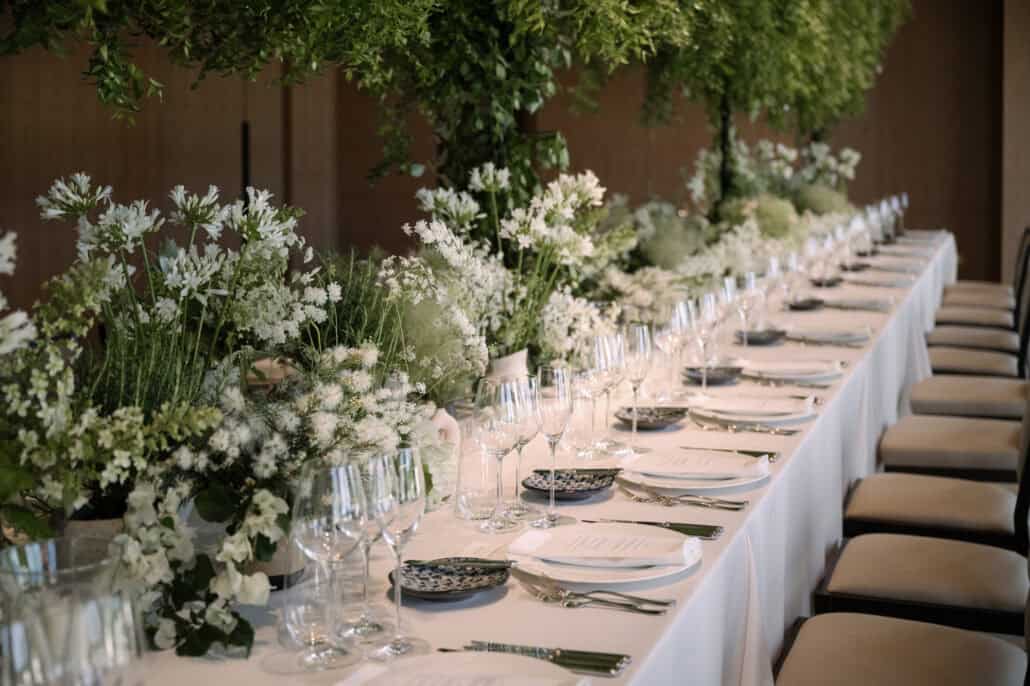
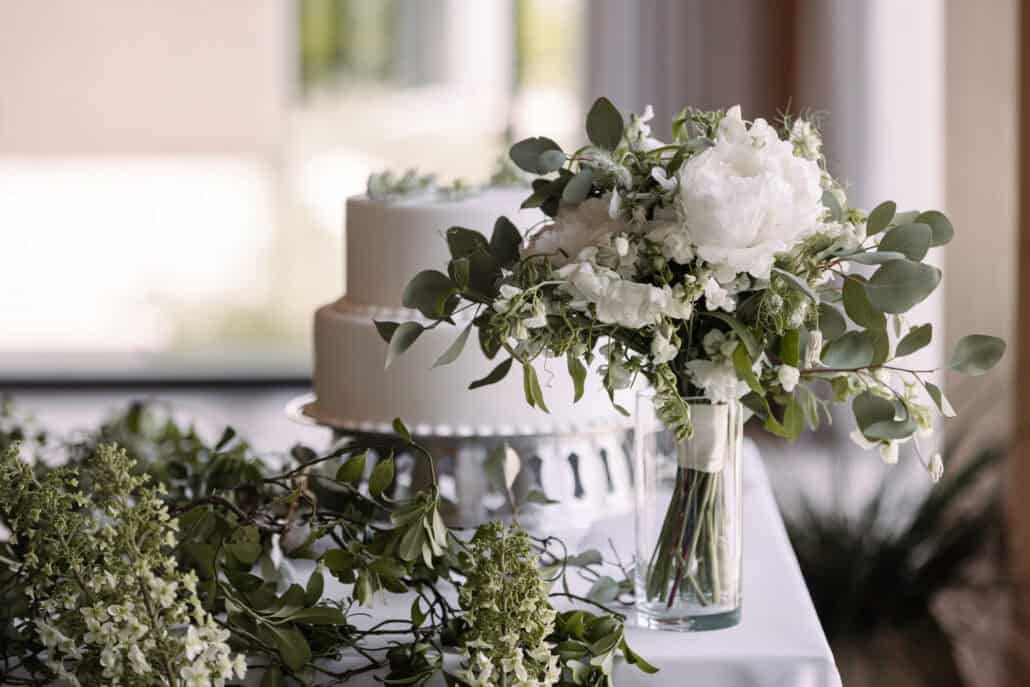
Lunch brought everyone to one long table, with white flowers running down it and greenery overhead. The chef spoke to the room, and the kitchen team finished plates in front of the guests. Sea grapes, umibudō, brought something of Okinawa to the meal itself.


The groom’s welcome began with thanks: “Thank you for taking the time to join us for our wedding.” He spoke about the weather too, and how happy they were to begin with everyone there. After the previous morning, the clear sky had earned its mention.
We often hear the fullest meaning of a destination wedding in these welcomes. Someone stands up, looks around the room and thanks people for coming. Beneath those few words are journeys, arrangements, lives temporarily reorganised so that everyone could sit down together in this place.
For a family spread across several generations, the table gathers people who remember different versions of you. Some have known you all your life; others have become part of it much more recently. A wedding gives those relationships a shared afternoon, a meal, a view out of the same window. The past is present without anyone needing to recite it.
That is why we return to ichi-go ichi-e, the particular gathering that happens only once. You might visit Miyakojima again. You might bring some of these people back. This table, with everyone exactly as they were that afternoon, belongs to that day.
The island’s beauty gives such a gathering somewhere extraordinary to happen. The people give you a reason to remember which afternoon it was.

Letting the Weather Into the Photographs
Early June sits within Okinawa’s rainy season, something to consider when thinking about the best time to get married in Japan. Here, the two days held a storm, soft grey light, clear sunshine and the colours of evening. There is no promise of that exact sequence for anyone else. We think the tropical weather is insanely beautiful. Light and shadow. There’s no light as spectacular as sunlight against a stormy sky. And the clouds and the weather move through fast. It’s all so magical.

What we bring to this is the experience to recognise what is possible as the light changes, and the attention to keep the couple at the centre of it. A long veil against dark water has a different feeling from a figure in bright sun against pale stone. Both can belong to the same wedding, because both belong to what happened.
We care about that relationship between beauty and memory. Years of photographing weddings have made us increasingly interested in the details a couple may recognise before anybody else does: the light they remember stepping into, the wind that kept lifting a veil, the closeness of the person beside them in the middle of an enormous landscape. Those details give a photograph a private significance within its wider beauty. Anyone might love the image; the two people inside it have their own reasons. We want to make room for both.

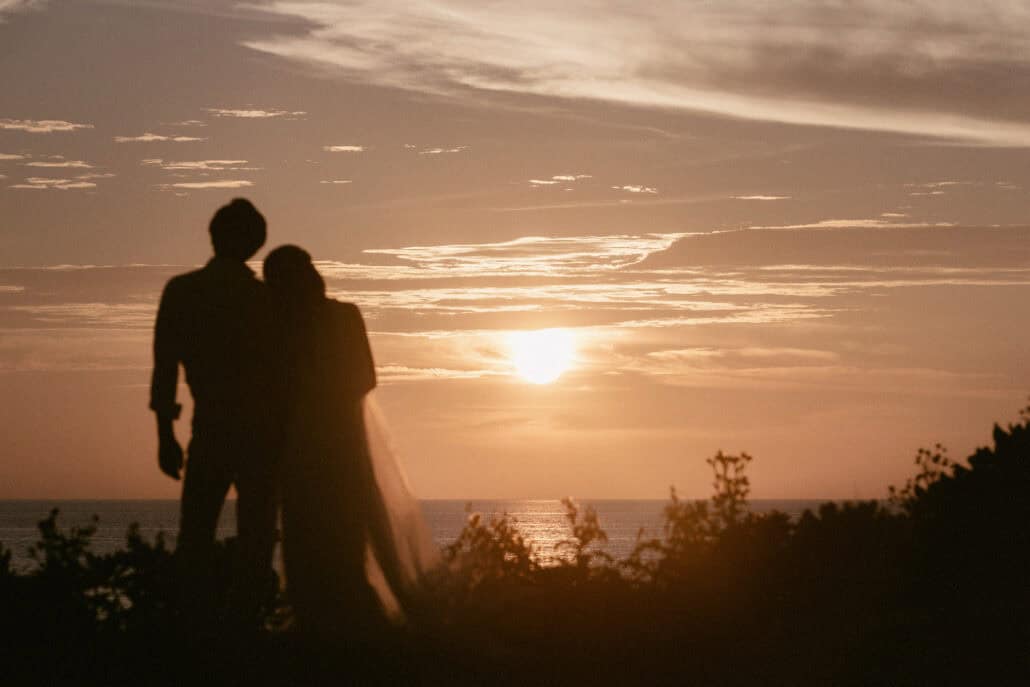
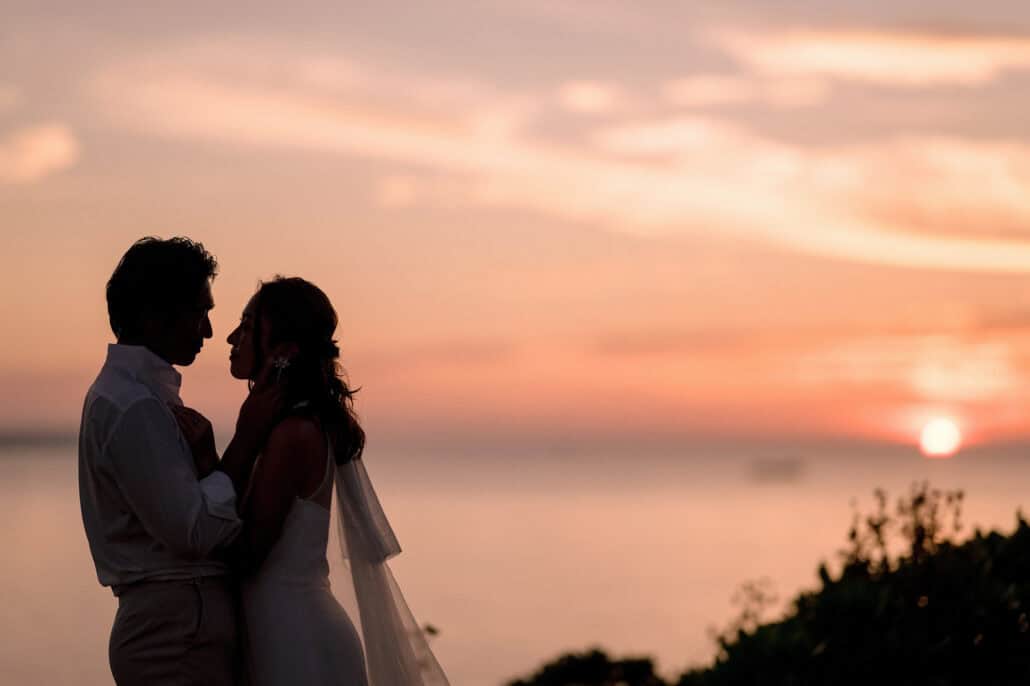
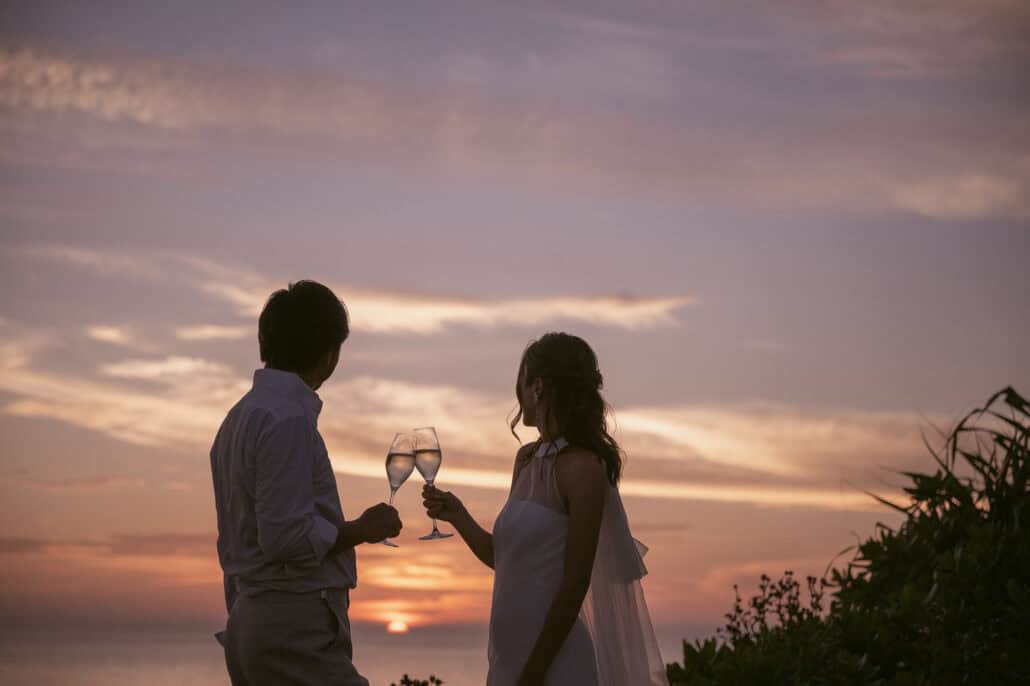
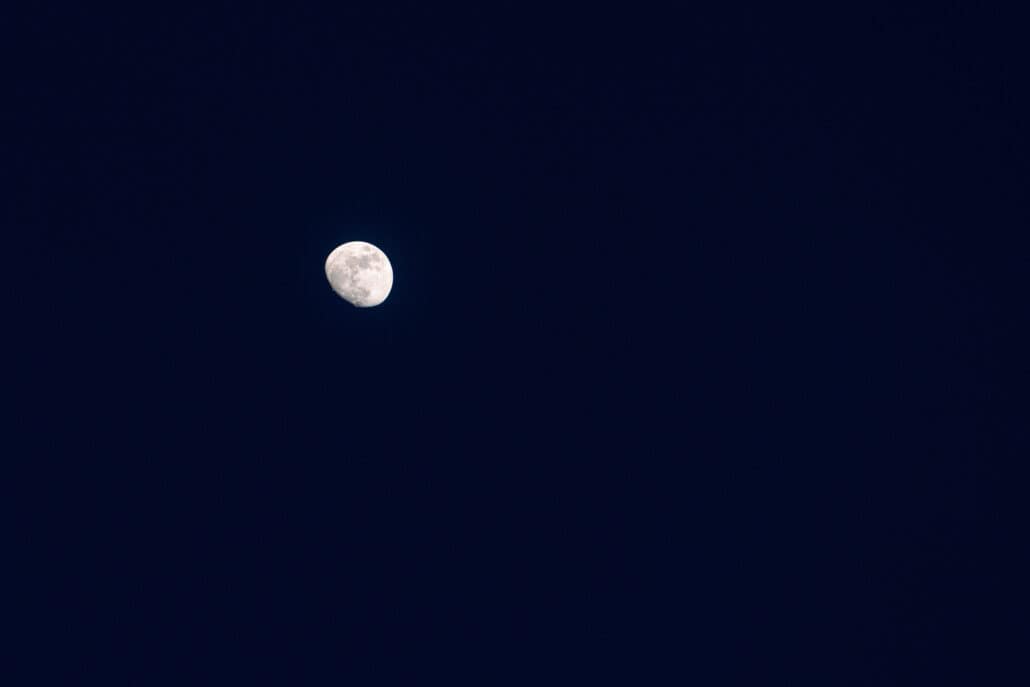
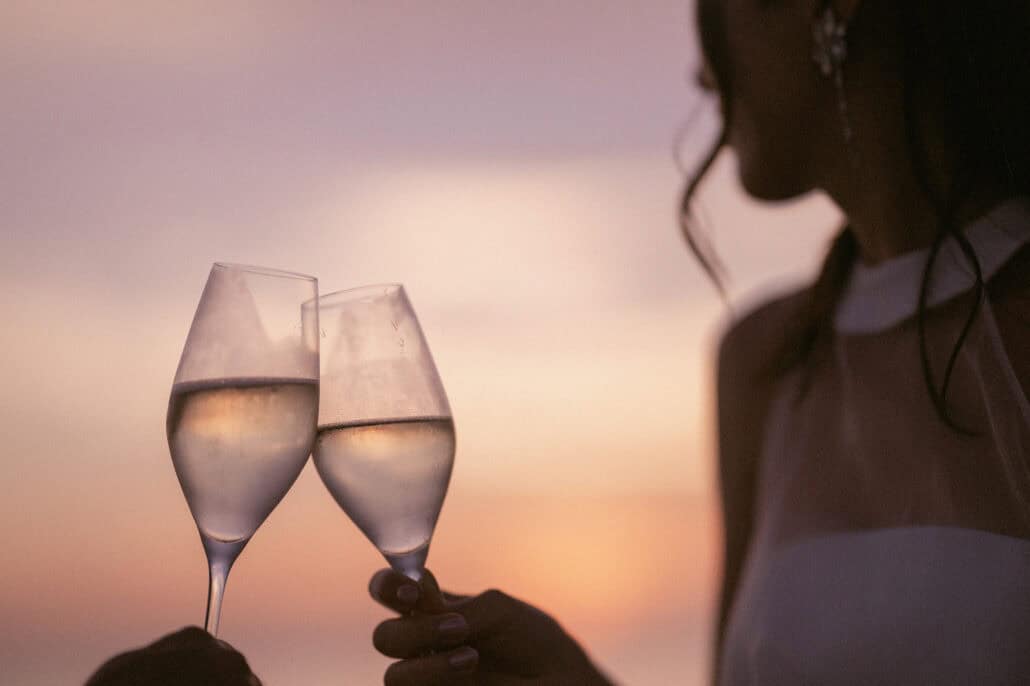
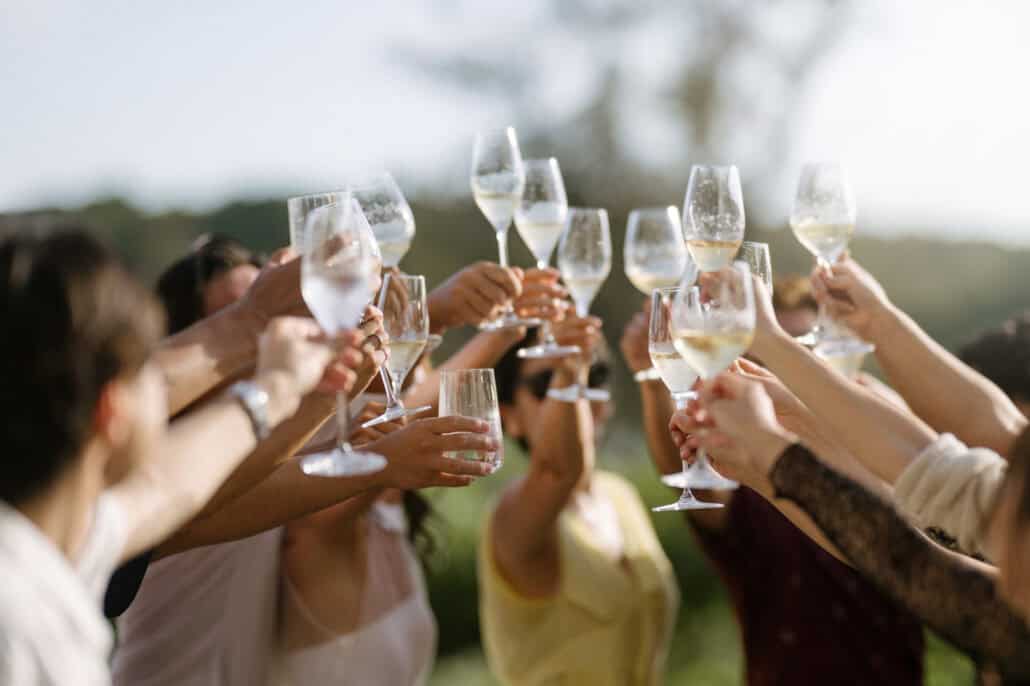
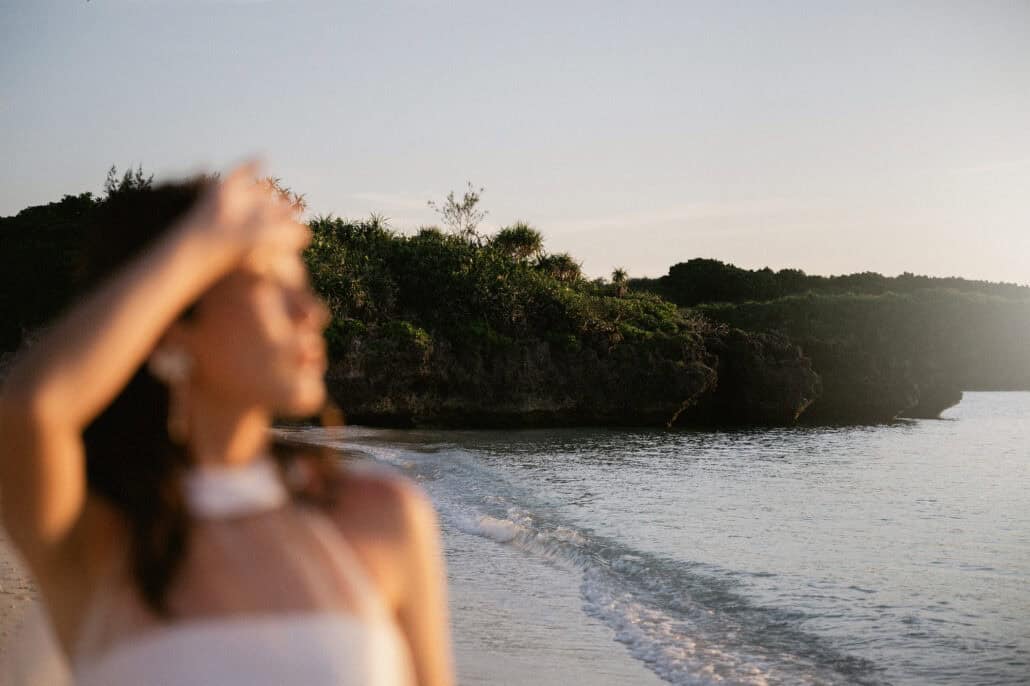
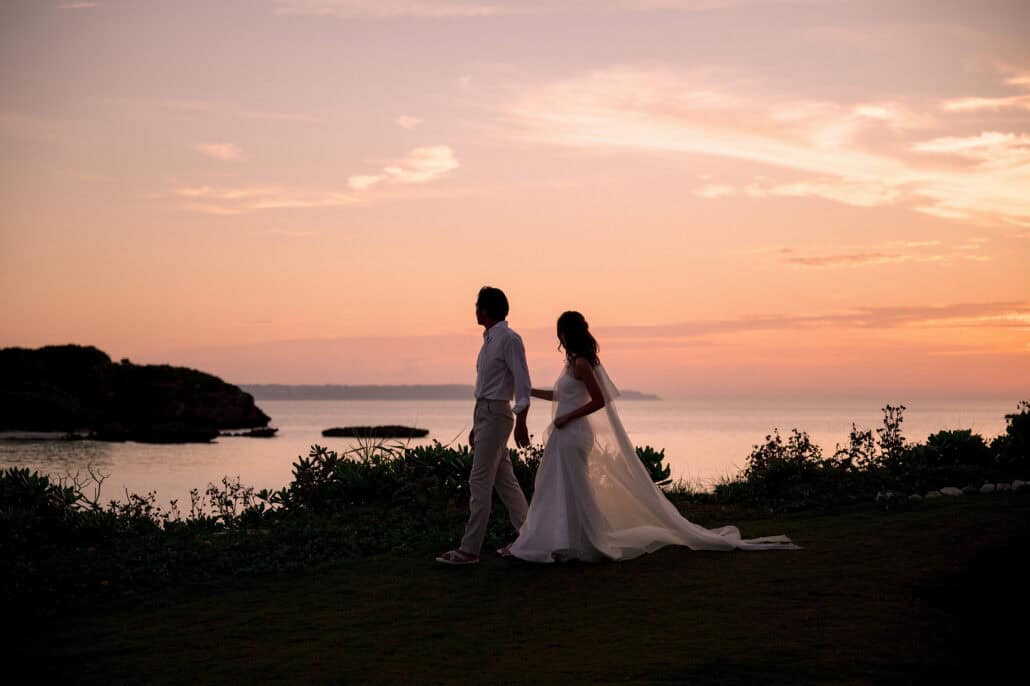
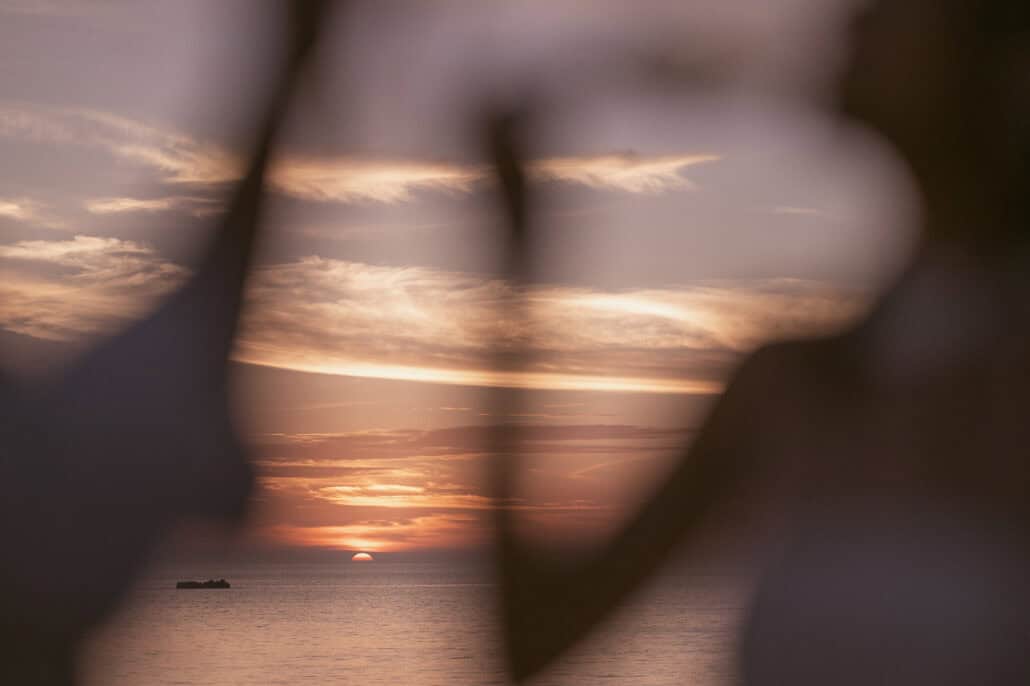
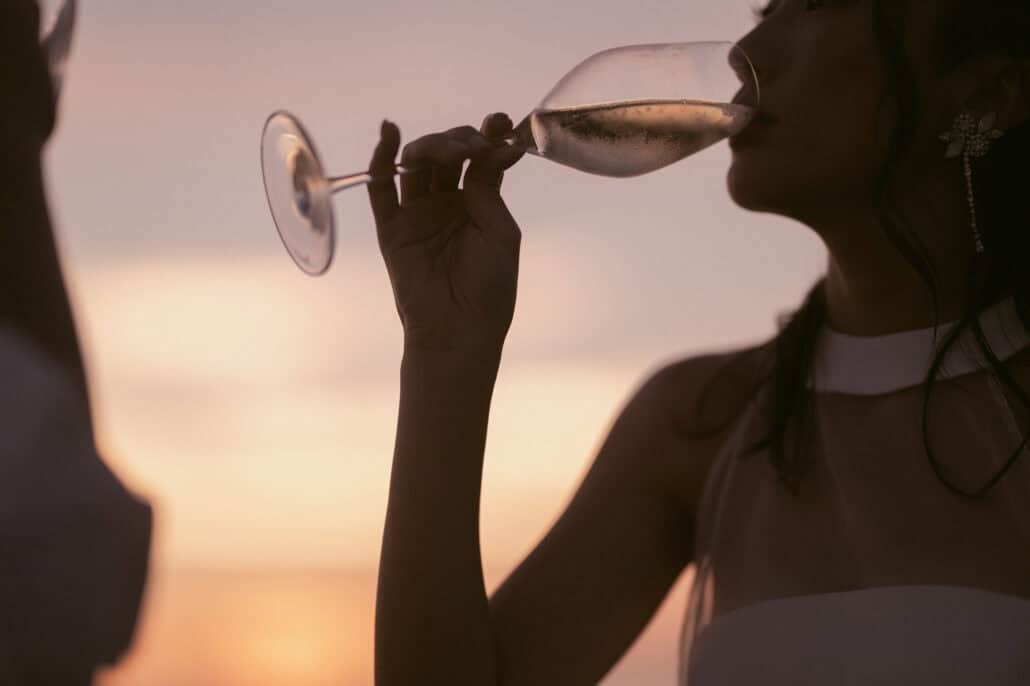
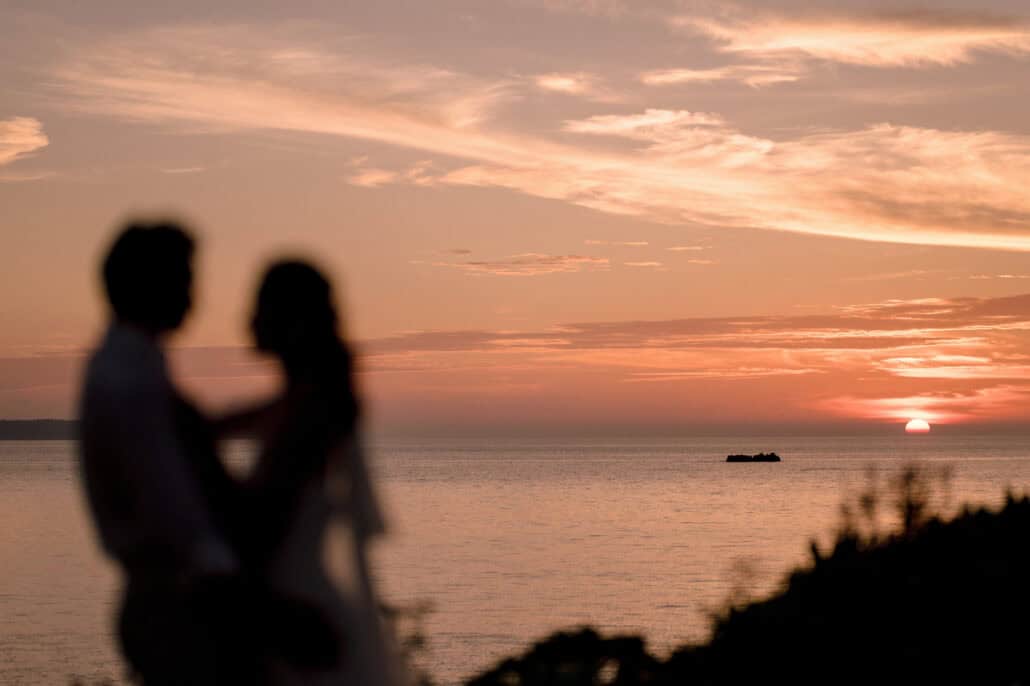
Later, there was champagne outside, the beach and the clifftop at sunset, then the moon above a lit terrace. After a day spent with their family, the two of them could step back into the island together. The surroundings that had felt so expansive the day before now held the memory of their wedding too.



Before Rosewood Miyakojima welcomed this first wedding, we were invited to consult on its approach to destination celebrations. We brought experience of weddings at Rosewood properties internationally, alongside many years of planning and photographing weddings in Japan. Working with Rosewood’s team in Hong Kong, their Miyakojima team and the local wedding planning team, we contributed to the preparations as the property approached its opening.
There is something especially rewarding about being involved at that stage, when there is time to consider how a place’s approach to hospitality will become part of a family’s most personal occasion. Couples arrive with their own understanding of what a wedding means, shaped by culture, family and the life they have built together. Understanding those expectations takes careful conversation. The smallest detail can carry enormous significance to the person asking for it, and experience teaches you to be curious about why.
These are the conversations we love having. They bring together so much of what has held our attention throughout our working lives: people, place, the traditions we carry with us and the possibilities we discover somewhere new. At Miyakojima, that meant thinking about how a celebration could feel deeply personal, understanding what a destination wedding brings, all the while allowing the island’s character to remain an essential of the experience.
Our team also made the photographs and films of that first wedding. Helping shape an experience and then being entrusted with its memory brings a particular responsibility. You think about how the day feels while people are living it, and about what they might treasure when they look back. Here, that attention belonged to the couple and the family who had come to celebrate them.
We’ve since returned to Miyakojima twice with couples considering their own wedding at Rosewood. It is a pleasure to revisit a place through someone else’s hopes for it; different people notice different things, and familiar surroundings acquire new possibilities. For couples considering a wedding or an elopement at Rosewood or elsewhere on the island, our wedding planning begins with that attention: what draws you here, what you want the occasion to mean, and how you want to share it with the people who matter to you.

The luxury here is in the care that allows those different parts to sit comfortably together: the intimacy of a family table, the attention of the kitchen, the freedom to go out onto the water and come back to people waiting for you. The scale can be extraordinary while the experience stays personal.
What Stays With You
The blue has a life beyond the view, too. Rosewood describes working with local communities and a research institute on sea turtle conservation, part of caring for the waters where Miyakojima’s sea turtles live. It is a useful reminder that what makes this coast remarkable continues long after any of us leaves it.
A Rosewood Miyakojima wedding brings you into that living place for a little while. You arrive with clothes, flowers, plans and people, and the island supplies conditions you could never entirely design. Then something happens between all of them that becomes yours.
This short film carries the two days from the open water into the gathering itself: the couple out on the sand, their family beside the chapel, the table and the evening. There is pleasure in seeing the wind move through it all again.
Somewhere out there, the sandbar is disappearing under the tide. The stone is beginning its slow change of colour. The family has gone home with photographs, and a place that used to be a beautiful idea has become somewhere they were together.

Years from now, someone will see water that shade of blue and remember who was standing beside them. We like to think of that as another way a wedding keeps going.