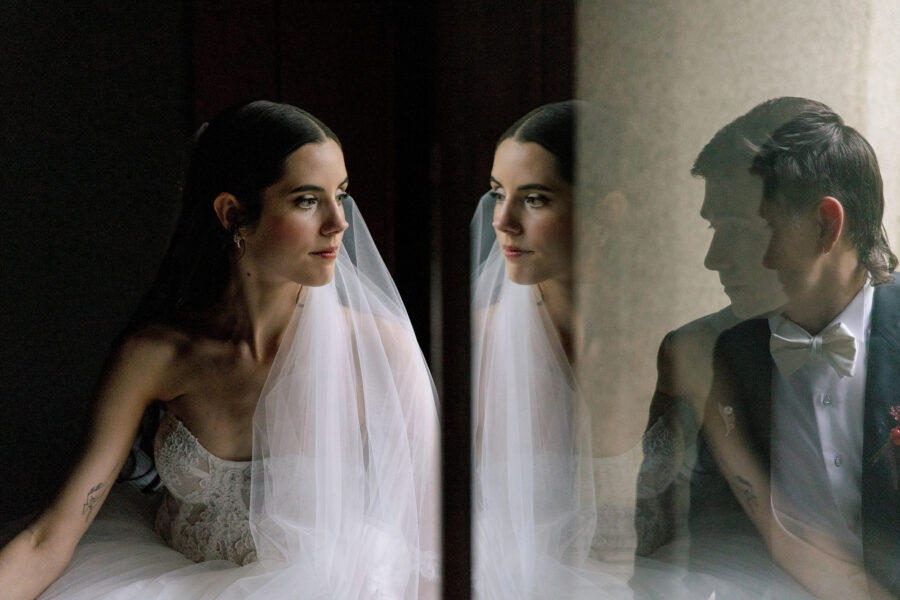
Two rockers from Salt Lake City chose us for their Tokyo engagement photos because of one of our quietest frames. In it, a couple sit on the subway and look at each other as if they’re saying goodbye for a long time. She told us it was the quiet in it that made her know.
We’ve thought about that choice often since. People who live loudly tend to know exactly where the quiet is, because they’ve had to go looking for it. Tokyo is built the same way. It rarely turns its volume down, and it’s full of rooms, alleys and rooftops where the noise falls away, if you know where to find them.

Two Rockers on a Bucket-List Trip
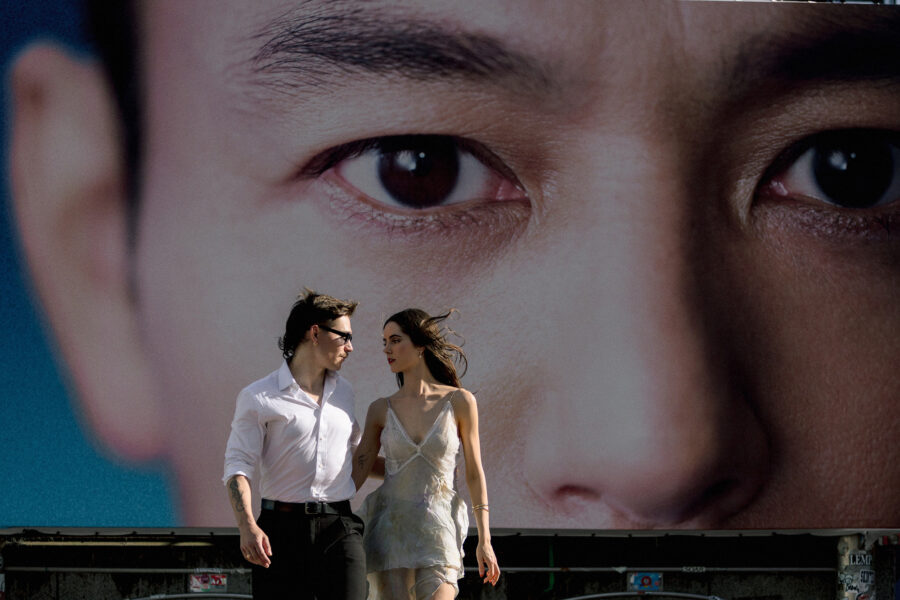
They were newly engaged, and Japan was the trip they’d kept on their bucket list: close to three weeks of it, starting in the middle of March. Her brief for our day together was precise and entirely theirs. Three looks: something casual for the morning, streetwear for the city, and a gown and a suit for the night. The streetwear came with three words, edgy, sexy and mysterious, and a capital-letter VERY in front of the edgy.
She wanted food in the pictures too, ideally while they were dressed up, because that was funny and very them. His contribution was a note of pure good sense: shoot at the start of the trip, before they’d eaten their way across Japan. We loved them both for it. Couples who know who they are write the clearest briefs, and we planned the route around three changes of clothes and the city each one belonged to.


The Year’s First Blossom, in a Tokyo Park
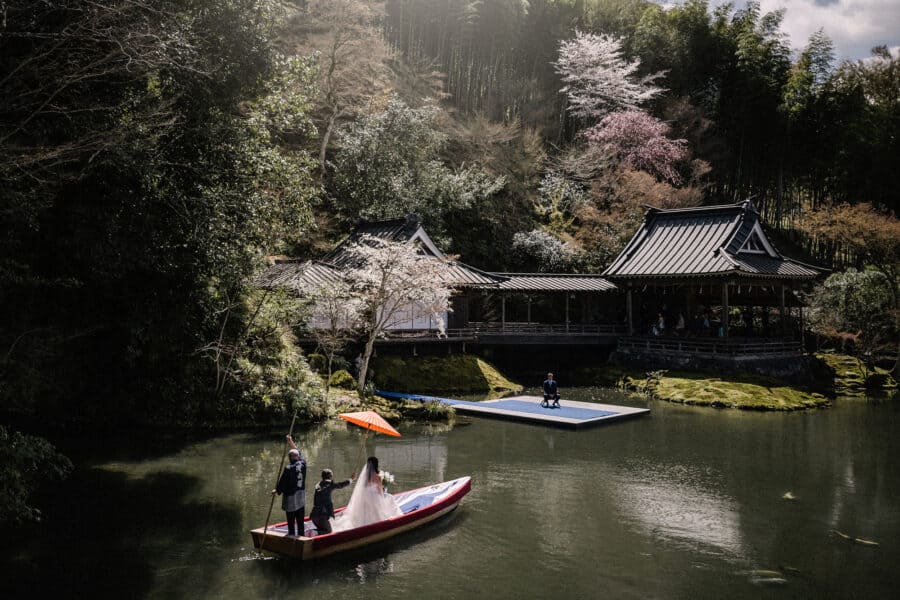
Tokyo’s cherry blossom season opened on 14 March 2023, the day their trip began. The Japan Meteorological Agency declares it from a single sample tree at Yasukuni Shrine, once five or six flowers are open, and that year it came ten days ahead of the average, tying the earliest date on record. Two days later we walked them into a Tokyo park in Shinjuku, where the early trees were already out over the water. The first look was the simplest, jeans, sweaters and boots, and it suited the blossom. Hanami is kind to people who don’t try to compete with the trees.
Japan’s old calendar had a name for that morning as well. Its 72 seasons divide the year into five-day kō, and 16 March 2023 was the first day of namushi chō to naru, “caterpillars become butterflies”. It’s an oddly exact name for a day built around three changes of clothes. Nobody planned the rhyme. The calendar simply got there first.


Shinjuku, a Town Named for Setting Out
Shinjuku began as a place for people leaving. In 1698 a new post station opened on the Kōshū Kaidō, the highway west out of Edo, as the first stop beyond Nihonbashi. The town that grew up around it was Naitō Shinjuku, the new lodging, and the district still carries the name. It was built for people at the start of a journey.
That’s why his note about timing was wiser than it sounds. Engagement photos are a portrait of a beginning, and they’re best made while it still is one: early in the trip, before the miles and the meals, in a part of Tokyo whose name still means the new lodging.
Shinjuku has kept rooms for loud people for a long time, too. Shinjuku LOFT opened as a rock live house in 1976, and in the late 1970s the bands of the Tokyo Rockers scene, Japan’s answer to punk, made it their stage. Since 1999 it has lived two floors underground in Kabukicho. The streetwear look belonged on these streets. For two rockers from Salt Lake City, Kabukicho was less a backdrop than a neighbourhood with their kind of music in its basements.


Golden Gai and the Small Rooms of Shinjuku
A few streets away, Golden Gai keeps around 280 bars, most of them ten to fifteen square metres. After the war the occupation authorities moved Shinjuku’s black market onto what was then a reed field. It became an unlicensed red-light quarter until the Anti-Prostitution Act took full effect in 1958, and then it became bars, where writers, poets and theatre people argued through the night. It outlasted the land speculators of the bubble years, and it’s where we always end up when a couple wants Shinjuku at its most itself. A district of rooms that hold a handful of people makes its own argument about cities: the best of a big one is usually found small.

The food she’d asked for found its way in at a lantern-lit counter on the edge of Omoide Yokocho. That lane was born in the black market too, around 1946, as a run of stalls called Lucky Street. When flour was rationed, its cooks turned to the offal of cattle and pigs, which wasn’t on the controlled list, and grilled it on skewers. Some 300 stalls once ran from the Kōshū Kaidō to the Ōme Kaidō, and about 60 remain. It’s hard to think of a better answer to a brief that asked for something funny and very them: a city eating elbow to elbow, at a counter that exists because people once cooked what nobody had thought to ration.


A Train, and Nobody Leaving
As the evening came down there was a platform, and a train came through fast enough to turn into a blur of light. We think of it as the frame that answered the one that brought them to us. A train again, two people holding still while everything moves, and this time nobody is leaving.
We don’t set out to photograph goodbyes. But a picture of two people who could be parted, and aren’t, comes close to what an engagement promises. It’s the quiet she recognised in our work, found again in the middle of the loudest part of the day.


Shibuya Sky Engagement Photos, Above the Noise
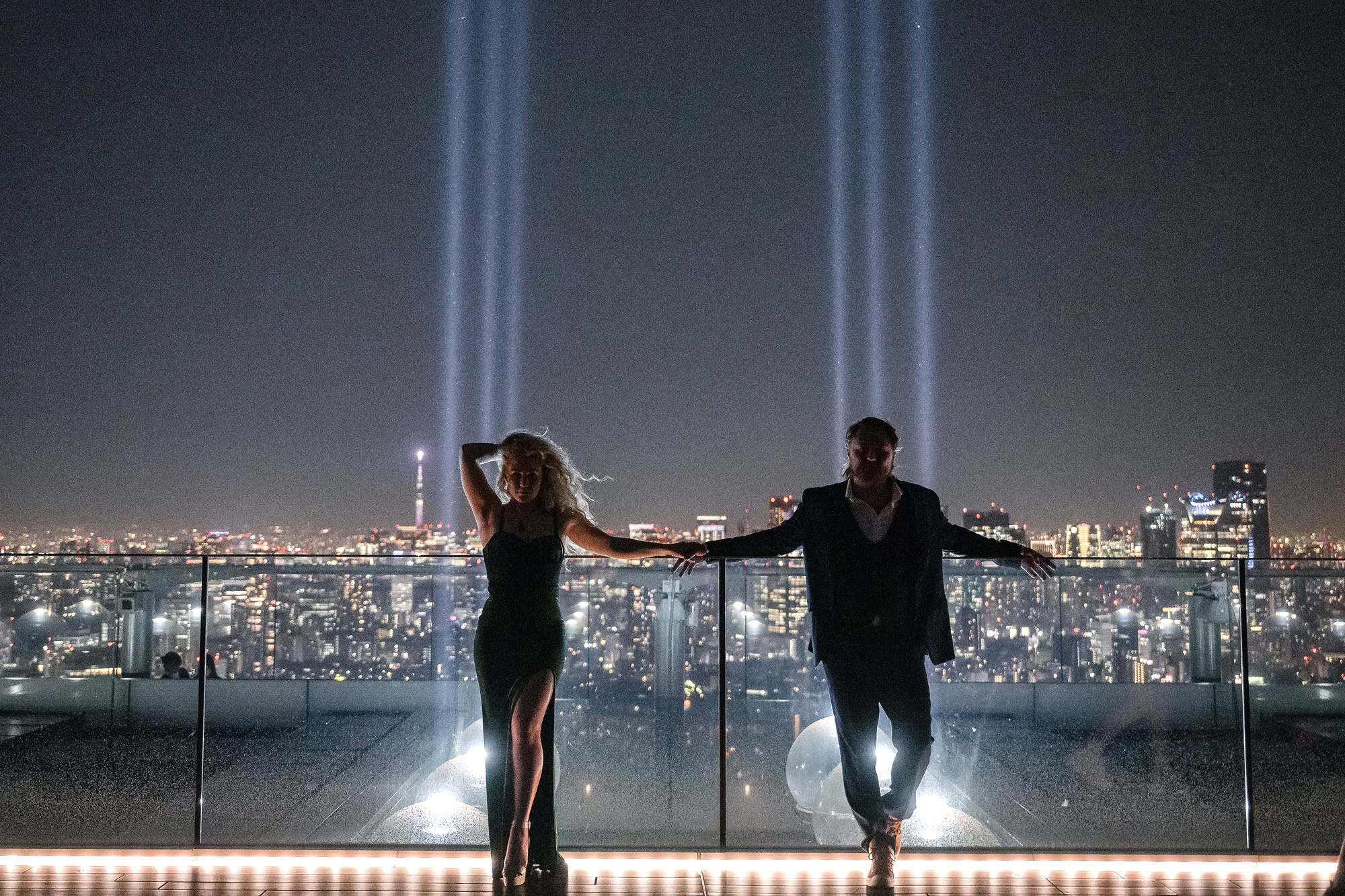
Shibuya Sky is an open roof 229 metres up, looking down on Shibuya Crossing. After dark, eighteen searchlights rise from it in a show called Crossing Light, and the city goes quiet in the only way Tokyo ever does, by being far enough away. The third look, a long dark gown and a navy suit, was made for this. From up there one of the loudest districts in Tokyo is a field of light with no sound at all, and two people who had spent the whole day inside the noise could stand above it and simply look.


Just below the roof, the night had a soundtrack. Paradise Lounge is a music bar on the 46th floor, designed by Tom Dixon, with a counter that runs fifteen metres into a DJ booth and records chosen under the eye of FPM’s Tomoyuki Tanaka. Two rockers in evening clothes, raising a glass in a room built around records, may be the truest portrait of them we made all day.


What Tokyo Engagement Photos Are For
They brought their own energy through the city all day, and by the end of the night the streets around Shibuya Crossing had all of it. Afterwards she wrote that everyone who’d seen the gallery was speechless: “The shots. The essence. The feelings!” They’ve talked about coming back for a fifth or tenth anniversary, with his younger brothers along, somewhere grand, “a castle or something”. We hope they do.
Tokyo engagement photos are made at the start of things, at the new lodging on the road out of town. The best reason to make them well is that two people will keep coming back to them, years down that road, to remember who they were when all of it was still ahead.