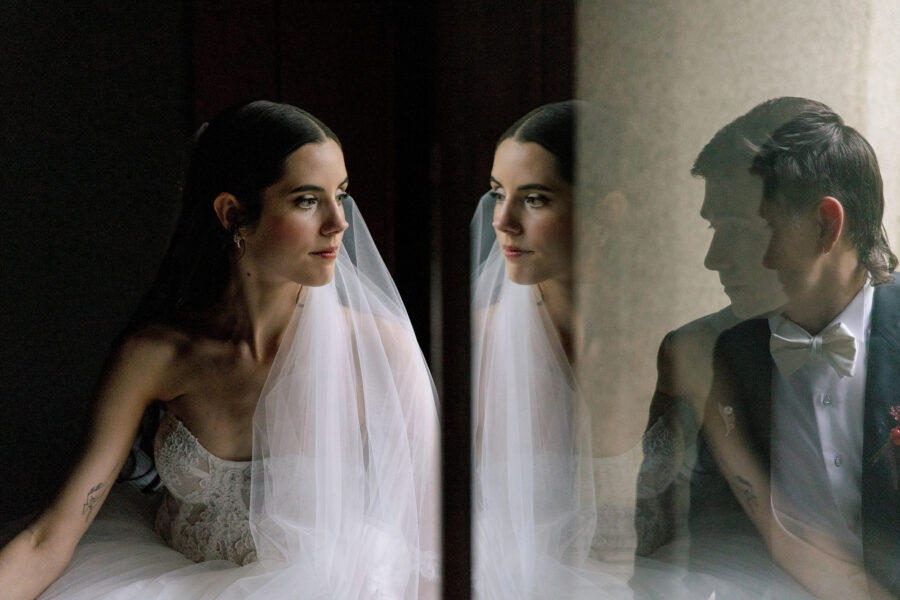
In the autumn of 2021, two grooms from Northern Ireland wrote to us about a very small wedding: the two of them, two friends and a photographer, anywhere in Japan we thought right. The country was closed to visitors at the time, and it would stay closed for most of another year. They booked anyway, that December, for a place none of them could yet enter. What they had in the end was a tea ceremony wedding in Japan, in a Kawagoe garden on a cold February morning, followed by an afternoon of the old town’s most ordinary pleasures.
Their brief, when it came, asked for “a garden quite traditional but ending in a sky bar”. Old Japan and new, in a single day. When the borders finally opened in the autumn of 2022, Dee wrote to tell them it was all happening for real, and the capital letters in her email said the rest. Their day fell on a Tuesday in mid-February, which happened to be Valentine’s Day.
Booked Through a Closed Border
Booking a wedding abroad is always a leap. Booking one in a country that won’t yet let you in is closer to a promise, made to a place before you’ve met it. For more than a year their wedding lived in emails and video calls, a date held and a retainer paid, while Japan stayed shut and the rest of life carried on around it. They held on the whole way. That kind of patience is its own form of trust, and we never took it lightly.
They’re easy people to love. Dry, quick, generous with their thanks and quietly modest about themselves, the kind of couple who make a long planning year feel short. Their voices stayed with us long after the day, too. Dee wrote afterwards to tell them that Tracey had just watched Derry Girls all the way through again, because she missed their accents.
On paper this was an intimate wedding, and an LGBTQ wedding with two grooms at its centre. Neither label tells you much. What tells you about it is the guest list. With two places to fill, every name on it is a decision, and theirs went to two friends, one of whom booked most of the travel and the hotels herself. That says a great deal about the friends they keep.


Vows Under a Parasol Made for Tea
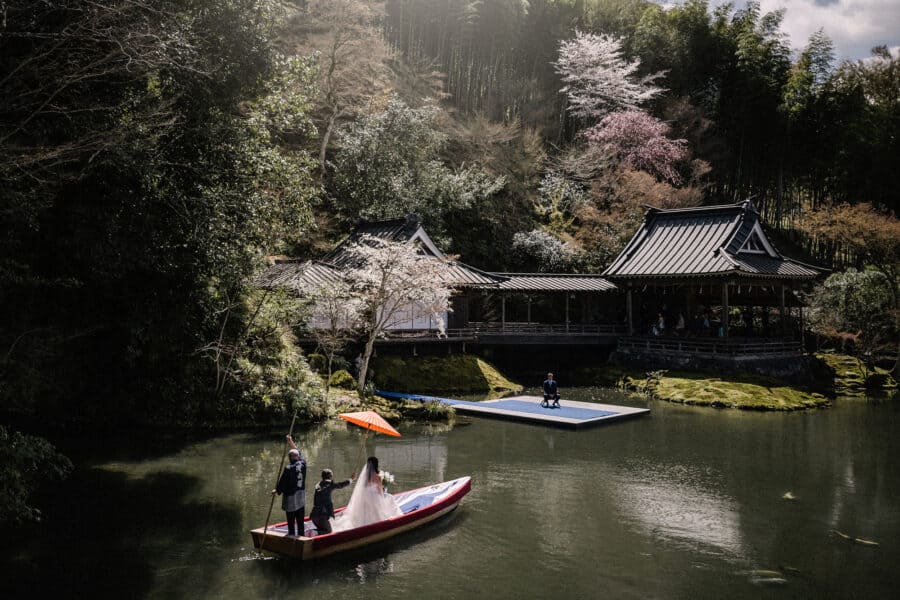
The big red umbrella in the garden at Tantoku has a name and a purpose. It’s a nodategasa, the parasol of nodate, tea taken in the open air, made to shade a tea gathering outdoors. So before anyone had lifted a bowl, the tea was already present, standing over the two of them while they made their promises. It’s a small piece of Japanese hospitality that most people walk straight past, and we like that it sheltered their vows.


They wrote those vows themselves. One of them had his finished early; the other was still searching for the words a month out, which anyone who has tried will recognise. The one still searching also asked for a sake toast, something he said he’d love to do, so there was sake in the garden. Kawagoe in winter is properly cold, and Dee’s last email before the day promised blankets and snacks waiting in the van. Planning for a winter wedding is mostly that: thinking of the warmth before anyone has to ask for it.
A Tea Ceremony Wedding in Japan, for Everyone in the Room
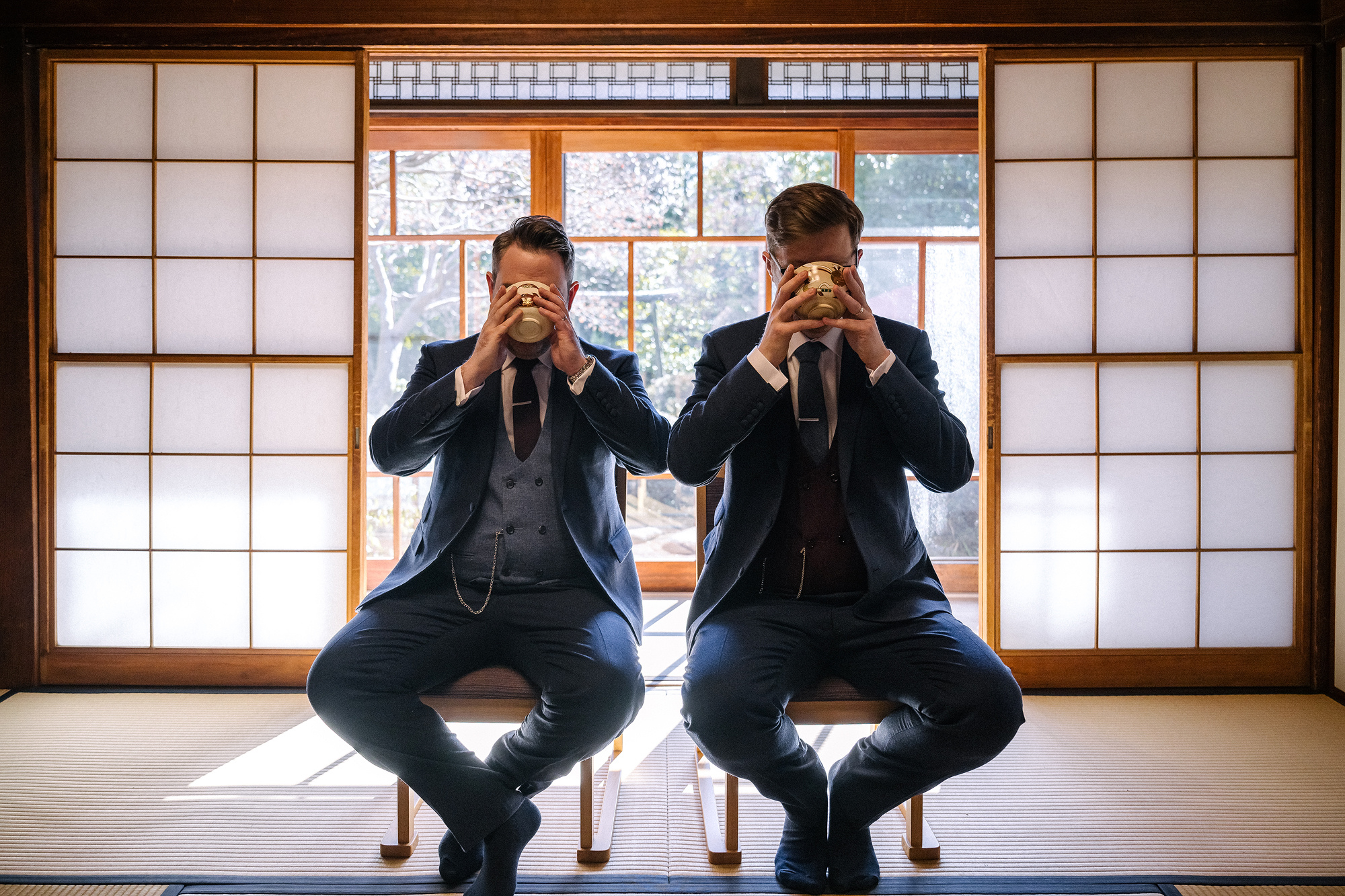
The tea ceremony was their own addition, and they asked for it “for all of us”: a bowl for everyone, rather than a ritual for the couple while their friends looked on. Tantoku’s okami led the Japanese tea ceremony herself. Dee had told them weeks before that her service was among the finest and most sincere we’d been offered anywhere. Four people, one host and a quiet tatami room. That was the whole of it, and it was enough to hold the morning still.


Long before Kawagoe was known for sweet potatoes, it was known for tea. Two schoolbooks written around Kyoto in the fourteenth century name Kawagoe tea as the famous tea of Musashi Province. Historians at the Iruma City Museum believe it was grown around Muryōju-ji, a great Tendai temple whose surviving halls include Kita-in and Nakain. When war reached the east and the great temples declined, the name vanished from the record for centuries. A stone in the grounds of Nakain still marks the place as the birthplace of Sayama tea, the tea Saitama is known for today.


We don’t know where the leaves in their bowls were grown, and it doesn’t much matter. Four people drank matcha together in a town that has been drinking it for the better part of seven hundred years, which makes Kawagoe as natural a home for a tea ceremony wedding in Japan as anywhere near Tokyo. The tea room has a phrase for a gathering like that, ichi-go ichi-e, one time, one meeting: this company, in this hour, will never assemble again in quite the same way. It’s usually offered as a reason to pay attention. For four people who had waited out a closed border to sit in one room together, it hardly needed saying.


Ordinary, Delicious Kawagoe
The ceremony and the tea each had a form, and both kept it. The afternoon had none, and that was planned too. When we plan a wedding in Japan, we build the formal hours carefully so that the hours after them can stay loose: no schedule, nowhere to be, a town to wander in the clothes you married in. Structure is what makes that kind of freedom possible.

Koedo, the old quarter of Kawagoe, is very good at loose. Its streets of clay-walled kurazukuri storehouses gather around the Toki no Kane bell tower, and the town’s appetite has a long history. In the Edo era, roast potato sellers in the capital advertised Kawagoe sweet potatoes with a pun on their signs: kuri yori umai jūsan ri, better than chestnuts, thirteen ri. Kuri, chestnut, sounds like nine ri, yori sounds like four, and nine and four make thirteen, roughly the distance from Edo to Kawagoe. The potatoes reached the city by boat down the Shingashi River, and they’re still all over town, in long sweet chips, in Kawagoe pudding and in almost everything else.

Around the corner, Kashiya Yokocho, Candy Alley, began in the early Meiji era with makers of plain, cheap sweets. After the Great Kantō Earthquake of 1923 hit Tokyo hard, Kawagoe made the city’s dagashi in its place, and by the early Shōwa era some seventy makers lined the lane. About thirty shops remain. In 2001 Japan’s Ministry of the Environment named the alley one of its hundred fragrant landscapes, for the old-fashioned smell of sweets that drifts down it, which may be the most charming official honour we know.
So this is a town that has fed Tokyo before, with potatoes in the Edo era and with sweets after the earthquake. On a February afternoon it fed four more people, eating standing up, two of them in their wedding suits. It’s the part of a wedding day that gets planned least, and we’d argue it matters as much as any. Weddings aren’t performances. At their best they’re life, a little elevated, and life includes a skewer of dango in the street with the people you love.
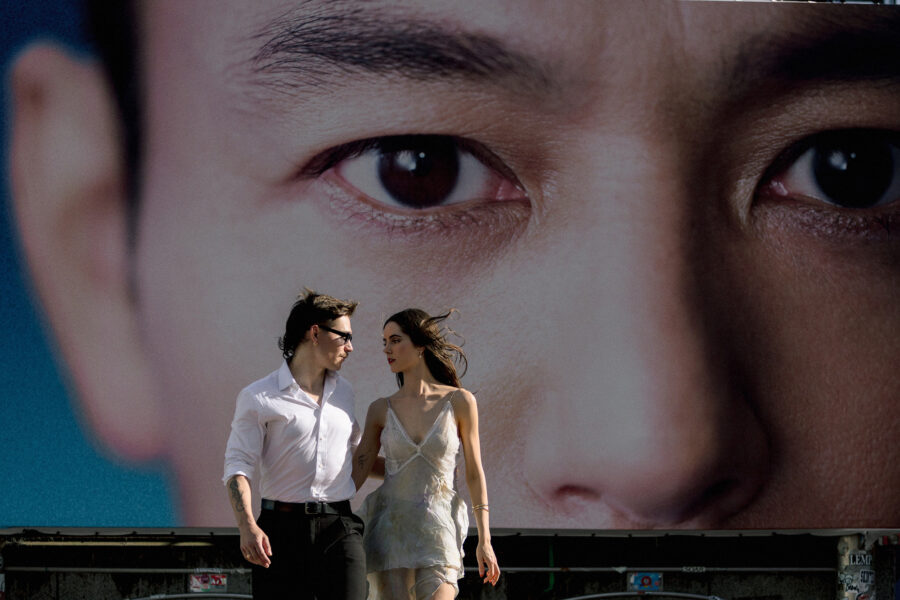
Their brief had asked for a day that began in a traditional garden and ended above the city. It closed in the thick of Tokyo instead, in Shibuya, where the crowd stops for no one. Old Japan in the morning and new Japan by evening: the contrast they’d asked for arrived on its own.


A Map on the Living Room Wall
On the day, we gave them a print: their names, a map and the coordinates of the place they married. Months later, while their album was being designed, one of them wrote to say it hangs framed in their living room and “means the world to us”. They asked for the album cover to match it, so it does, the same map and the same coordinates on the case of the book. They’d also asked us to choose the album’s photographs ourselves, because we’d be better, they said, at picking the ones that told the story of the day. It’s the most generous thing a couple can say to us, and we took it as seriously as the day itself.
Coordinates are a strangely exact kind of keepsake. Latitude and longitude don’t record the cold, or the tea, or which of them laughed first. They record only where. But a wedding is one of the few days in a life that can be pinned to a single point on the earth, and once it is, everything else gathers around it: a winter garden, matcha for four, an afternoon of sweets in Little Edo. The tea room’s phrase holds the hour, and the map holds the place. On a wall in Northern Ireland, two numbers do the remembering.
They’ve told us there’s a place to stay with them if we’re ever in Ireland. One day we’d like to see that map where it hangs.