A Red Thread Wedding Ceremony at Mt Fuji, in Cherry Blossom Season

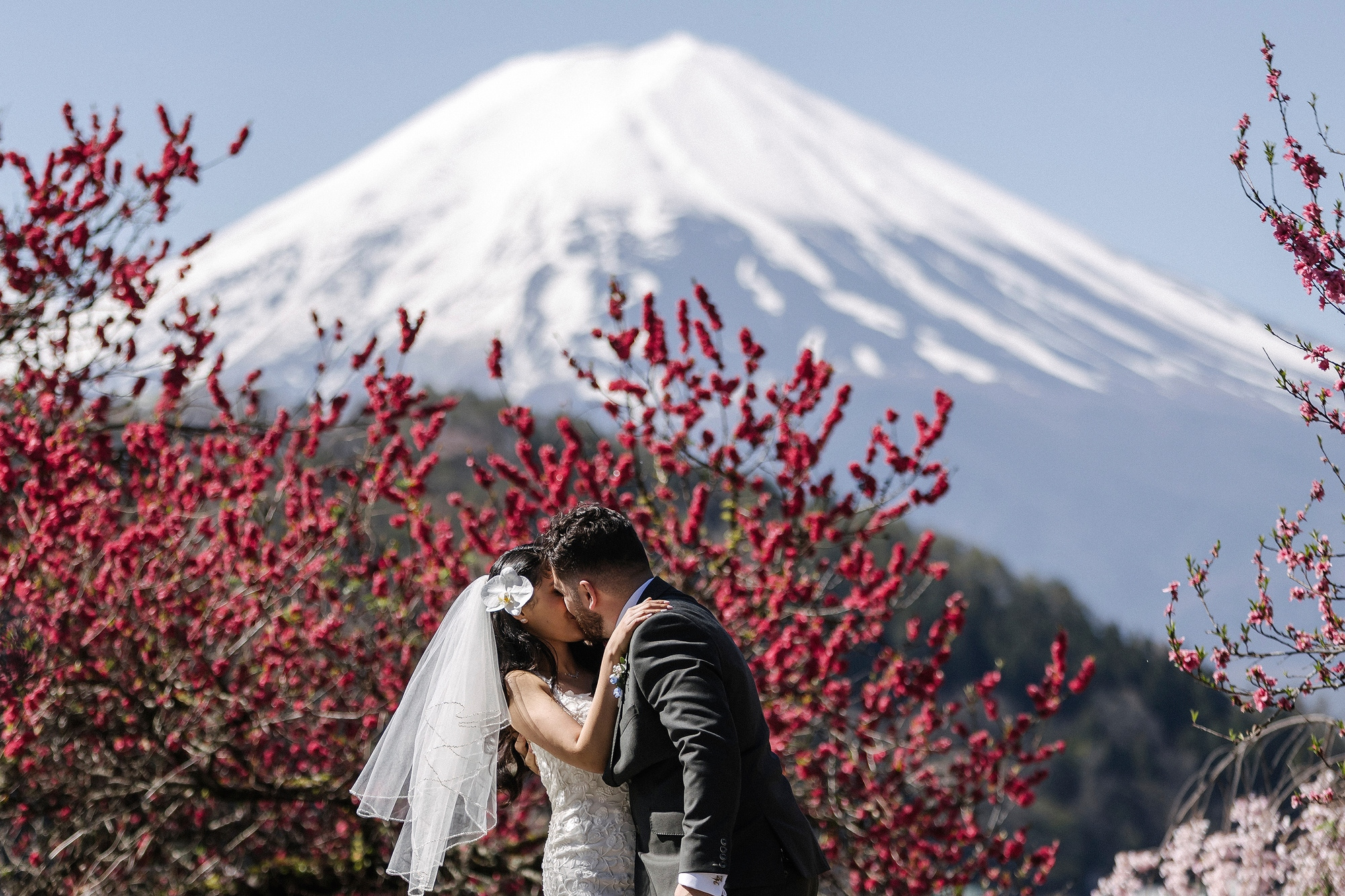
The bride and groom kiss among deep pink blossom with a snow-covered Mt Fuji behind them, at their cherry blossom elopement in Japan.

An old Chinese story, first written down in the Tang dynasty, says the person you’re meant to marry is tied to you from birth by a red cord no one can see. In the version their celebrant told at this red thread wedding ceremony at Mt Fuji, the thread can be stretched by distance or tangled by life, but it never breaks.

Theirs had already been stretched a little. They’re a couple from Wales who met working at the same restaurant during the pandemic, neither of them expecting to fall in love, and who wrote to us with an idea to elope in Japan, “just us two”. The spring they first hoped for was already full. They came back a year later and asked for the next one. Choosing to wait a whole year for a season tells you a great deal about two people, and about the kind of wedding they meant to have: unhurried, and entirely on purpose. Japan had been a lifelong dream for them both, the culture, the food and the anime they had watched since they were children, and they wanted this to be the day they promised, wholeheartedly, to be together no matter what.

When we asked what had to be part of the day, they named four things: the cherry blossom, Mt Fuji, the shrine and the string. Their elopement in Japan held all four. Each of them, it turns out, carries a much longer story than a single morning can.

Their film moves at the pace they lived the day, and it’s set to “Romantique” by Jordan Critz, one of the two pieces of music they sent us before they flew. They chose songs the way they chose everything else, by the detail: of the other one, they told us they loved the moment, a minute and a half in, when the birds and the violins arrive. Our photography and film are made as one piece of work for days like this, when the sound of a place matters as much as the sight of it.

A Red Thread Wedding Ceremony at Mt Fuji

The story behind the red thread is called The Inn of Betrothal. A young traveller named Wei Gu finds an old man sitting on temple steps, reading a book by moonlight. The book, the old man explains, is a register of marriages, and the bag at his side holds red cord, which he uses to tie together the feet of those who’ll one day be husband and wife. He became the Old Man Under the Moon, and his name is still a word for matchmaker. When the story reached Japan, the cord moved from the ankle to the little finger, the same finger children hook together when they make a promise.

In black and white, the bride and groom hold a thread looped between their hands during their red thread wedding ceremony.

The couple married on an open lawn above a lake in the Fuji Five Lakes, in what their celebrant called a spring a little colder than usual, with the mountain behind them wrapped in its own weather. They read their vows from small cards. Then came the thread, tied between them, and before long it had tangled, and both of them were laughing. Of all the ways a legend can be honoured, we like that one best. It skipped the part about destiny and went straight to the small print.

The groom reads his vows from a small white card, a cufflink at his sleeve, beside the bride in her veil.
The bride laughs as the groom reads his vows on a lawn above a lake in the Fuji Five Lakes, with mountains behind.

The thread had been there all morning in smaller forms. They got ready apart and exchanged gifts across the distance: perfume for her, personalised cufflinks for him. It’s a modest gesture, and the kind we notice: on the morning of their wedding, each of them was still thinking about what the other would love.

The groom fastens his watch over a dark waistcoat while getting ready for his elopement at Mt Fuji.

A thread is a good image for a marriage because it’s soft. It doesn’t hold by being rigid. It holds by being tied, and tied again, and laughed at when it knots. Fuji kept its summit in cloud for the whole of the ceremony, which is its right on any morning it chooses. By the time they walked back across the grass as a married couple, the snow on its upper slopes was starting to show.

The couple stand together on an open lawn for their elopement ceremony, Mt Fuji's snowy slopes rising into cloud behind them.
The just married couple walk hand in hand across the lawn, her bouquet in her hand, with the snow on Mt Fuji behind.
  • The groom's leather shoes, the bride's silver sandals, perfume, ring boxes and a watch laid out on a tatami mat.
  • A diamond engagement ring and two wedding bands reflected on a dark surface, before an elopement at Mt Fuji.
  • The bride puts on her earrings by a window while getting ready, a small vow card on the blanket beside her.
  • Morning light falls across a dark ridge under heavy cloud in the Fuji Five Lakes on the morning of the elopement.
  • The snowy summit of Mt Fuji shows faintly through layers of morning cloud above a line of trees.
  • In black and white, the bride and groom hold each other on the lawn, her long dress spread on the grass, before their vows.
  • The groom laughs, hand to his face, as he sees the bride holding her bouquet of pale flowers on the ceremony lawn.
  • The bride holds her vow card and looks at the groom, a lake and wooded mountains soft behind them in the Fuji Five Lakes.
  • The bride reads her vows to the groom on an open lawn, with the cloud covered slopes of Mt Fuji behind them.
  • The groom reads his vows to the bride under a wide sky of drifting cloud, the base of Mt Fuji showing behind the trees.
  • The bride listens to the groom's vows, smiling, with the lake and dark wooded hills behind them.
  • The couple exchange vows on a high lawn with green, cloud brushed mountains rising behind them near Mt Fuji.
  • The bride touches her eye as the groom reads his vows, the snowy flank of Mt Fuji and green pines behind them.
  • The bride smiles up at the groom during their elopement ceremony, the lake and mountains behind them in soft focus.
  • The bride places the ring on the groom's finger in front of Mt Fuji, its snowy slopes half hidden in cloud.
  • The bride and groom embrace after their vows, small against the cloud wrapped snow of Mt Fuji and a line of pines.
  • The couple kiss behind her bouquet of blue and white flowers, with the lake and mountains of the Fuji Five Lakes behind.
  • Mt Fuji's snowy summit sits under a cap of cloud on a spring morning, above dark trees and red spring leaves.
  • In black and white, the newlyweds lean their heads together, her bouquet against his suit, the lake bright behind them.
  • In black and white, the bride and groom walk hand in hand across the grass toward Mt Fuji, her veil lifting in the wind.
  • The couple walk across the lawn toward the snow covered slopes of Mt Fuji, her bouquet hanging at her side.
  • A wide black and white view of the newlyweds walking toward Mt Fuji, cloud drifting across its snowy upper slopes.
  • In black and white, the couple stand close beneath the snow streaked slopes of Mt Fuji as cloud rolls over the top.
  • Mt Fuji emerges from its cloud above the ceremony lawn, the bride and groom small in the lower corner of the frame.
  • The just married couple walk and laugh across the lawn with Mt Fuji behind them, her bouquet of pale flowers in hand.
  • Mt Fuji's snowy slopes beneath a band of white cloud and blue sky in mid April, seen from the elopement lawn.
  • In black and white, the newlyweds lean together laughing, her orchid in her hair, with Mt Fuji in the distance.
  • The bride rests her hand on the groom's jaw as they lean in close, his curls lit by the morning sun.
  • In black and white, the bride holds the groom's face as they rest their foreheads together, eyes closed.
  • The groom and bride touch foreheads with eyes closed in soft spring light during their elopement in Japan.

Lake Shoji, Where Mt Fuji Holds Its Child

Lake Shoji is the smallest of the Fuji Five Lakes, barely half a square kilometre of water, and from its northern shore it offers a view with its own name. Mt Fuji stands behind the smaller, darker cone of Mt Omuro, and the pair look like a mother holding a child. It’s known as Kodaki Fuji. The name is closer to the truth than it sounds: Omuro was born from an eruption on Fuji’s own flank, so in a real sense it is the mountain’s child. The lake itself was shaped by Fuji too. In the ninth century, lava poured into an older and larger lake and left the shoreline that’s here today.

Mt Fuji holds the smaller Mt Omuro in front of it above Lake Shoji, the couple embracing on the stony shore below.

In 1895 an Englishman, Harry Stuart Whitworth, who later took Japanese nationality, spent a year travelling the foothills of Fuji in search of the place with the finest view of the mountain. He found it here. He opened a Western-style hotel overlooking the lake, called the area the Switzerland of the Orient, and for the first time the Five Lakes had something that drew travellers from abroad.

The couple walk along the stony shore of Lake Shoji with snow capped Mt Fuji and Mt Omuro rising behind them.

He spent a year looking for the view. They spent a year waiting for the season. Lake Shoji has been rewarding that sort of patience for well over a century, and its shore is still largely free of building. What the couple met there was what Whitworth met: clear water, a hard wind off the mountain and Fuji, finally out of its cloud, holding its child across the lake.

The groom wraps his arms around the bride as the wind lifts her veil and hair, the water of Lake Shoji bright behind them.
  • A wide view across Lake Shoji to Mt Fuji and Mt Omuro, the bride and groom embracing at the edge of the water.
  • The bride's veil streams in the wind as the couple kiss on the shore of Lake Shoji, Mt Fuji over the far trees.
  • The bride and groom walk laughing along the shore of Lake Shoji, her veil blowing out behind her, with Mt Fuji above.
  • In black and white, the couple walk the shore of Lake Shoji with Mt Fuji and Mt Omuro across the water.
  • The groom kisses the bride's forehead by the lake, with snowy Mt Fuji soft in the background on a clear spring day.
  • The couple hold each other close on the pebbled shore, Mt Fuji and its smaller neighbour rising across the lake.
  • In black and white, the bride and groom stand side by side looking out over the lake, her veil lifting in the breeze.
  • In black and white, the groom raises his arm beside the bride at the water's edge as light sparkles across the lake.
  • A black and white view of Lake Shoji with Mt Fuji on the horizon and the bride small on a curve of the shore.
  • The couple walk hand in hand along the edge of Lake Shoji beneath a clear, snow covered Mt Fuji.
  • The groom holds the bride from behind as her veil and hair blow across the sparkling water of the lake.
  • In black and white, the bride smiles down as her veil blows around her shoulders on the shore of the lake.
  • The groom kisses the side of the bride's head as she looks down, sunlight glinting on the lake behind them.
  • The bride closes her eyes as the groom leans into her hair, an orchid tucked behind her ear and the lake glittering behind.
  • The bride and groom walk along the shore of Lake Shoji, small beneath Mt Fuji and Mt Omuro under a blue sky.
  • The couple stand close and smile at the edge of Lake Shoji, with Mt Fuji's snowy cone rising over the forest behind.
  • The bride in shadow and soft light, eyes lowered, with red lips and her dark hair falling over her shoulder.
  • The bride looks to one side against a dark background, a white orchid in her hair and her face lit by a shaft of sun.

Cherry Blossom Season at the Foot of the Mountain

The cherries around the Five Lakes flower weeks after Tokyo’s, at the mercy of altitude and of whatever the spring decides to do. In a colder year than usual, nobody can promise where the blossom will be on a given day. In spring we watch it ourselves in the days before an elopement rather than trust a forecast, because the difference between a tree in bud and a tree in flower is one warm afternoon.

The groom kisses the bride's temple among deep pink blossom, with Mt Fuji rising softly in the distance.

What they found was the full range of it: deep pink blossom with Fuji clear above, and long avenues of weeping cherry, shidarezakura, whose branches fall like curtains to the grass. On the old calendar, the five days they married in are called niji hajimete arawaru, the rainbows begin to appear. After winter, the air is finally damp enough to bend the light.

The bride smiles under the hanging branches of a weeping cherry in full flower, a white orchid in her hair.

Japan plans its spring around a fortnight it can’t control. Building a wedding inside it is a decision to give your day to something that won’t wait for you. They’d already waited a year for it. It waited, just long enough, for them.

The groom lifts the bride among weeping cherry trees, with snow covered Mt Fuji above a dark green hillside.
  • The bride and groom walk over a small wooden bridge, reflected in a puddle scattered with fallen petals.
  • The couple stand close among deep pink blossom and pale weeping cherry, Mt Fuji soft behind them.
  • The groom leans his head to the bride's among deep pink trees in flower, a weeping cherry and Mt Fuji behind them.
  • The groom kisses the bride's cheek among deep pink blossom, Mt Fuji's snowy cone in the clouds behind.
  • The bride and groom stand among deep pink blossom on a gravel path, with Mt Fuji and a weeping cherry behind them.
  • The couple stand together in front of deep pink and pale blossom with Mt Fuji and a wooded ridge above them.
  • The bride stands alone among deep pink and pale blossom with snow capped Mt Fuji behind her on a clear day.
  • The couple face each other among red pink blossom with a clear, snow covered Mt Fuji filling the sky behind.
  • The groom dips the bride into a kiss among deep pink blossom, with Mt Fuji's snowy summit above them.
  • In black and white, the couple stand among weeping cherry trees on a hillside with Mt Fuji behind them.
  • The groom lifts the bride among pale weeping cherries with snow capped Mt Fuji and green hills behind them.
  • The groom holds the bride up among weeping cherry trees on a hillside, Mt Fuji white against a clear blue sky.
  • A close view of double pink cherry blossom and young copper leaves against a blue spring sky in the Fuji Five Lakes.
  • Pale pink weeping cherry blossom hangs against a soft blue sky in mid April in the Fuji Five Lakes near Mt Fuji.
  • The bride laughs among the hanging branches of a weeping cherry in full flower, a white orchid in her dark hair.
  • The couple kiss beneath the hanging branches of a weeping cherry tree on a green bank in spring.
  • The bride and groom walk arm in arm under weeping cherry blossom, both looking down and smiling, on a green bank.
  • The groom and bride laugh as they walk hand in hand beneath weeping cherry blossom on their elopement in Japan.
  • Shadows of cherry blossom fall across the lace of the wedding dress, the bride's hand at her side.
  • The bride stands beneath a weeping cherry with her veil over her face and blossom shadows on her lace dress.
  • The bride looks down under her veil among weeping cherry blossom, light falling across her shoulders.
  • A close portrait of the bride under her sheer veil, framed by soft pink weeping cherry blossom near Mt Fuji.
  • The couple walk along a path through an avenue of weeping cherry trees in full flower near Mt Fuji.
  • In black and white, the bride and groom walk hand in hand through a tunnel of weeping cherry blossom.

The Blossom and the Rock: A Sengen Shrine Blessing

The Sengen shrines that ring Mt Fuji honour Konohanasakuya-hime, whose name means the princess of the flowering trees. At the head shrine, which counts more than thirteen hundred Sengen shrines across Japan, the cherry is her sacred tree. One of her stories is a marriage story, and it comes in two halves.

The couple kiss beside a vermilion shrine fence under white cherry blossom at a Sengen shrine near Mt Fuji.

When the heavenly prince Ninigi asked to marry her, her father, the mountain god Oyamatsumi, offered him both his daughters: the blossom princess and her elder sister, Iwanaga-hime, the princess of enduring rock. Ninigi kept the blossom and sent the rock home. And so, say the old chronicles, the lives of the emperors, and in one telling everyone’s, became as brief as blossom on a tree. In later centuries Iwanaga-hime was worshipped in her own right as a guardian of long life.

The groom rests his head on the bride's shoulder by a wooden shrine hall, white cherry blossom and cedars behind them.

A wedding in cherry blossom season sits right on that old fault line. Blossom is why people come, and it’s also why the moment can’t be kept. We’ve always thought a vow is an attempt to have both sisters: to choose the blossom, and to ask it to last like stone. The couple went to the shrine for a blessing after their own ceremony, in a hall among cedars and white cherries, where a priest led them through the rite and they offered the evergreen branches a Shinto blessing asks of you. The shrine was one of their four, and it closed a circle the morning had opened. Their celebrant had told an old Chinese story about a thread. The priest stood for an older Japanese one, about a marriage, a mountain and the blossom.

The bride and groom hold sprigs of evergreen as a priest guides them during their Shinto blessing at a Sengen shrine.
  • An old gilded wooden plaque reading Sengen shrine in kanji, with orange brocade offerings beneath it.
  • A Shinto priest in white robes hands the groom a sprig of evergreen during the shrine blessing.
  • A Shinto priest waves a purification wand over the bride and groom as they sit inside the shrine hall.
  • A large paper lantern marked Sengen shrine hangs over the hall where the couple sit for their Shinto blessing.
  • A priest in white and purple bows before the altar as the bride and groom sit in the shrine hall.
  • The bride and groom stand on the veranda of a wooden shrine hall among tall cedars and white blossom.
  • Rows of paper fortunes tied up at a Sengen shrine near Mt Fuji, seen through a soft dark foreground.
  • In black and white, the couple walk through a torii gate onto a path lined with banners and tall cedars.
  • Fine branches of white weeping cherry blossom hang over the shaded grounds of a Sengen shrine near Mt Fuji.
  • The bride and groom stand before a wooden Sengen shrine hall between two stone lanterns and guardian lions.
  • The bride lifts her face to a shaft of sunlight in profile, the groom soft behind her at the shrine.
  • In black and white, the bride and groom stand side by side in a beam of sun against the dark shrine.
  • The couple stand in a pool of sunlight against the deep shadow of a shrine building near Mt Fuji.
  • The bride leans her head on the groom's shoulder in a shaft of light outside a shadowed shrine hall.
  • In black and white, the newlyweds lean together in bright sun with the shrine hall dark behind them.
  • The bride turns her face to the sun beside a long vermilion shrine fence under white cherry blossom.
  • The bride stands in the light beside the vermilion fence of a Sengen shrine as cherry blossom hangs above.

What the Lava Grew

The same eruptions that drew Lake Shoji’s shore decided what was in their lunch. Around four fifths of Yamanashi is mountain, and much of the land around Fuji lies on old lava, where rice never did well. So people here grew wheat, and they kept a dish that the rest of Japan let go. Hōtō, broad flat noodles simmered in miso with vegetables, came over from China in the Heian period and faded almost everywhere as rice spread. In Yamanashi it stayed, and it’s still what you eat when the wind comes off the mountain.

Two iron pots of hoto, Yamanashi's flat wheat noodles in miso broth with vegetables and greens, on a wooden table.

They ate it in a small local restaurant, the groom still in his suit, at a long wooden table under hand-written signs. It’s one of our favourite things about an elopement. With no guest list to host and no reception to run, the day can make space for the ordinary pleasures of a place, and the ordinary pleasures are often where a place is most itself. The afternoon took them up to a lookout above the valley, with the whole of Fuji now clear above the town.

The couple stand together at a viewpoint with Mt Fuji and the town spread out in the valley behind them.
  • Mt Fuji rises over a wide valley and town, with a green ridge in the foreground on a clear spring afternoon.
  • The groom lifts hoto noodles with chopsticks in a small local restaurant, the bride across the table from him.
  • The couple share a lunch of hoto noodles and juice at a wooden table in a local restaurant in Yamanashi.
  • The newlyweds eat hoto across a long wooden table in a local restaurant hung with signs and framed pictures.
  • A wide view inside a small local restaurant in Yamanashi where the couple eat hoto at a long wooden table.
  • The groom kisses the bride's head at a lookout, with Mt Fuji and the town below hazy behind them.
  • In black and white, the couple stand on a hillside lookout with Mt Fuji rising beyond the valley.
  • In black and white, the couple embrace on a wooded hillside with Mt Fuji and distant peaks behind them.
  • The bride and groom stand by a wooden railing at a lookout, Mt Fuji above the valley and town behind.

Tangled, Never Broken

The day ended where gardens in Japan tend to end things, under a weeping cherry, among clipped pines and stone lanterns, in the long light of the afternoon.

The couple hold each other among clipped shrubs and pines in a Japanese garden, a weeping cherry above them.

The red thread legend is usually told as a story about finding each other. We think the more useful half is the part their celebrant didn’t skip: stretched by distance, tangled by life, never broken. That’s where most of a marriage is lived. These two had already proven they could wait for something. On the morning they married they proved they could laugh at a knot. Of the four things they asked for, three belong to the mountain and the season. The string is the one they keep.

In black and white, the bride wraps her arms around the groom beneath a weeping cherry in a Japanese garden.
  • A wooden lantern hangs under the eaves beside a latticed window in a Japanese garden in the afternoon.
  • The bride's face is reflected in a wooden framed window that looks out on a green Japanese garden.
  • Two hands meet over a beaded white clutch held against the lace of the bride's wedding dress in soft light.
  • The bride looks out through soft green leaves in a Japanese garden, her dark hair over her shoulders.
  • The bride and groom embrace under a large weeping cherry in a Japanese garden of clipped shrubs.
  • The bride holds the groom close and smiles down at him beneath the branches of a weeping cherry.
  • The couple embrace in a Japanese garden, framed by the dark shape of a stone lantern and the trunk of a pine.
  • Branches of a weeping cherry hang over clipped azaleas and pines in a Japanese garden in mid spring.
  • The bride and groom stand in a Japanese garden, seen through a curtain of weeping cherry blossom.

A month later, when the first photographs reached them, she wrote that the experience had been “life changing”, and that the rest of their trip through Japan had helped them understand each other better. When the film arrived, his reply was shorter: “We were both blown away!”