A Rainy Day Elopement in Japan, at Jinya in Cherry Blossom Season

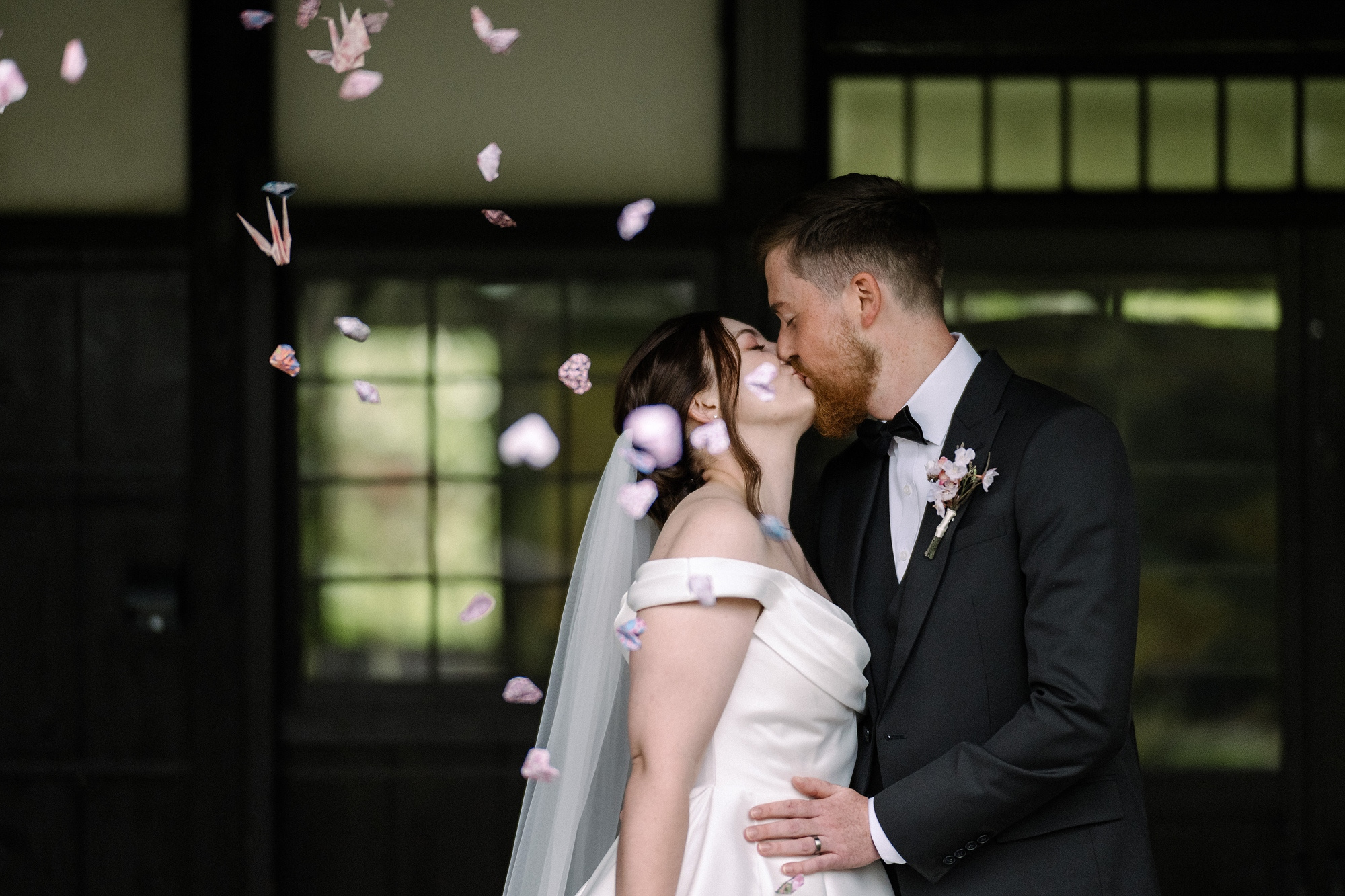
Paper cranes and pink petals fall around the bride and groom as they kiss in front of the dark timber hall of Genji-kan at Jinya.

This rainy day elopement in Japan fell inside a season with its own name. From late March into April a long spring rain settles over the Pacific side of the country, and Japan calls it natane-zuyu, the rapeseed rain, after the yellow nanohana that flower while it falls. Japanese dictionaries list it as a season word for haiku. A country that names its weather after its flowers isn’t inclined to treat a wet day as a ruined one.

The couple flew in from country Victoria for two nights at Jinya, the ryokan in Tsurumaki Onsen at the foot of the Tanzawa mountains, and the rain came with them: full, steady, committed rain that settled in for the day. Standing that afternoon in a field of the very flowers the rain is named for, our bride gave the day its verdict. “Yeah, I actually love the rain.”

Before the wedding, they described themselves to us as “big picture” people, two people who wanted to be themselves and enjoy their day “care free and in love”. They told us how they talk to each other, too: they can lock eyes and know exactly what the other is thinking, nearly always because of a private joke. Plenty of couples hope for that. Few can say it so plainly, and fewer still hold it all day in the rain. They even left the music for their film to us, with a line we’ve kept: “it only makes sense to trust you with the music as well.” That trust is a gift to a team. It’s also, we suspect, what let the weather into the day as a guest.

They’ve known each other since they were twelve, in the same homeroom in their first year of high school. They grew up as friends and finally got together at seventeen. Years later her first message to us had the lightness of two people who have known each other that long: they wanted to holiday in Japan, she wrote, and “might as well get married along the way!” They took care of the paperwork at home before they flew. Japan, they told us, was their real wedding.

Mt Fuji came out at sunrise that weekend. We kept it to ourselves, so the first time they saw it was in their film. That felt right. When the film arrived, she wrote that it was “a beautiful surprise to have Fuji included in the footage”, and that they’d have regretted missing it had they known on the day. Her shrine stamp book, the goshuin-chō she can’t pass a temple or shrine without adding to, has a Snoopy hidden on every page and, when it comes to Fuji, a work in progress. The film gives them the mountain they missed, and the rest of the day again at the pace they lived it, rain and all.

Two Nights at Jinya, Tsurumaki Onsen

Jinya has been receiving guests since 1918, when it opened as a villa for the Mitsui family, and its memory goes back further than that: the ground it stands on was once a samurai camp, which is what its name means. The inn names its rooms after people from The Tale of Genji, and the hall they married in front of, Genji-kan, was rebuilt from a building about three hundred years old. It’s a place laid down in layers by people who meant it to be stayed in.

So they stayed. Two nights is what turns a ryokan from a venue into somewhere you live for a while. By the morning of the wedding they’d already slept there, eaten there and learned their way around, and Jinya already knew them. Getting ready in a room that’s already yours is its own kind of calm. Nobody has to find their feet, and the hours before a wedding can be spent on each other rather than on the building.

The bride stands in her off the shoulder gown in a pale tatami room at Jinya, a round lamp behind her and a pink bouquet in her hand.
The groom turns up the collar of his white shirt with a black bow tie hanging loose, his jacket on a hanger behind him.
The bride looks out through her long sheer veil in soft window light, her off the shoulder gown just visible beneath it.
The groom stands in profile inside a deep round window set into a white wall, dressed in his dark tuxedo and bow tie.
  • A round lamp patterned with fine interlocking circles glows on a dark wall above a slim wooden shelf in a room at Jinya.
  • The groom's waistcoat and tuxedo jacket hang from a wooden rail on a white wall either side of a slatted wooden panel.
  • The groom is a dark silhouette fixing his collar at a tall window, cherry blossom on the branches outside.
  • In black and white, rain falls in streaks from the edge of a wide timber roof over blossoming trees.
  • White bridal shoes, a wooden ring box holding two rings, a perfume bottle and small pink paper shapes lie on a tatami mat.
  • A diamond engagement ring, a diamond band and a plain band sit reflected on a dark glossy surface with soft blossom behind.
  • In black and white, the groom stands by a narrow strip of window light in a dark room, buttoning his white shirt.
  • The groom faces the camera inside a round window in a white wall, buttoning his tuxedo jacket over a black waistcoat.
  • The groom in a black tuxedo stands at a wooden veranda rail, a mass of white cherry blossom spilling in beside him.
  • The bride looks down and smiles softly behind a sheer veil, her bare shoulders and off the shoulder neckline in pale light.
  • In black and white, the bride stands at a barred window in a plaster room beside her wedding gown hanging from the frame.
  • The bride's reflection in her white gown and veil fills a tall wooden framed mirror leaning against a pale wall.
  • The bride smiles with her eyes lowered, her face half hidden by the soft folds of her veil and her dark hair in loose waves.
  • In black and white, the bride twirls her full gown in a bright room, framed twice by two doorways in a dark wall.

A First Look With the Blossom Just Out

Early April put them right at the opening of the cherry blossom, a narrow window to land in from the other side of the world. Blossom forecasts shift with every warm week, and anyone who has planned around hanami learns that the trees keep their own calendar. That spring it ran in their favour, and her bouquet answered it in pink.

There’s a quiet reversal in it for a couple from Victoria. April at home is autumn, the days drawing in. They flew north into the opposite season and arrived at its very start, in a country where April is when the school year and the working year begin, and the cherry blossom comes out to meet it. Of all the times to start a marriage, it’s hard to think of a better one than the week a whole country agrees to begin again.

A first look suits two people who talk with their eyes. There’s no aisle in the way and nobody to perform for, just the moment one of them turns round and the private joke starts again. She had the first line, and it was a good one: “I’m wearing heels and I’m still not tall enough.”

The groom leans in close as the bride smiles with her pink blossom bouquet, cherry trees in flower filling the space behind them.
Seen over the bride's shoulder and veil, she cups the groom's face in her hand as he smiles back at her on a wooden veranda.
The couple walk hand in hand away along a covered timber veranda, cherry blossom on both sides and their reflection in the glass.
The bride leans back into the groom inside a round window in a pale wall, both of them looking up at each other and smiling.
  • The bride and groom face each other holding hands on a timber veranda, cherry trees in full blossom all around them.
  • The groom looks down at the bride with a hand at her waist as she smiles back, holding her bouquet of pink blossom.
  • In black and white, the bride reaches up to touch the groom's face as he smiles, her bouquet held against his jacket.
  • The bride laughs and looks down at her pink bouquet as the groom stands close with his back to the camera.
  • In black and white, the groom smiles widely as the bride walks toward him across the room in her veil.
  • The groom kisses the bride under the wooden beams of the veranda, her long veil falling to the floor behind her.
  • The bride and groom lean cheek to cheek against the veranda rail, her pink blossom bouquet held between them.
  • In black and white, the bride and groom hold each other at a glass rail with blossoming trees beyond.
  • A branch of white cherry blossom with new buds and young leaves reaches across a soft green background.
  • The bride sits in a round window in a pale wall with one hand on its edge, her gown and long veil spread out below.
  • The bride smiles out from behind a sliding paper screen half open across a round window in a pale plaster wall.
  • The bride and groom share a kiss inside a round window set deep in a pale wall, framed by its smooth curve.

A Koto in the Rain at Genji-kan

They married in Jinya’s garden at the foot of Genji-kan, with the old hall’s dark timber behind them and the rain working through the garden beyond. A koto played for them, live and unamplified. The player had told us beforehand that he wanted to play it naturally, just the koto, and afterwards he wrote to say the rain had soaked the garden into a ceremony with real atmosphere. We’d put it the same way. Rain darkens old timber, deepens the green of a Japanese garden and quietens everything else, and a hall made from a building three centuries old is at its most itself on a wet day.

Their ceremony included san-san-kudo, the sharing of sake from three cups, three sips each. The sake was Zarusō Hōrai, brewed since 1830 by the Ōya Takashi brewery in Aikawa, with groundwater from the Tanzawa mountains, the same range Jinya sits beneath. Its name carries a second story. Hōrai is the mountain of the immortals in old Chinese legend, and Japanese weddings have long set it on the table as the shimadai, a decorated stand modelled on Hōrai, with pine, bamboo and plum, cranes and turtles. So their three small cups held a little of two mountains: the legendary one in the name, and the Tanzawa in the water.

In black and white, the bride and groom kiss in the wet garden in front of Genji-kan, the old tiled hall at Jinya, a koto player beside them.
The bride and groom face each other to read their vows in the garden at Jinya, green planting and a stone lantern around them.
The bride smiles down at a small vow card held between them as the groom looks on, her veil falling behind her shoulders.
Seen past the groom's shoulder, the bride listens with tears in her eyes, soft green garden blurred behind her.
The bride brings her hands to her eyes as the groom stands smiling beside her under the dark eaves of Genji-kan.
A koto player in hakama plays beside the seated bride and groom under the eaves of the old hall, her blossom bouquet in her lap.

Paper Cranes and a Thousand Years

That’s where the cranes come in. Before the ceremony, the two of them sat down with our team and folded paper cranes. One of them called it a way to “transfer the stress onto a piece of paper”, and origami has had worse descriptions.

In Japan the crane is the bird of long life. The old saying gives the crane a thousand years and the turtle ten thousand, and Japan has long used both as emblems of celebration, which is why they keep company with Hōrai on the shimadai. Even the town carries one: Tsurumaki is written with the character for crane. When the vows were done, the cranes they’d folded went up with the petals and came down over the kiss. A thousand years is a lot to ask of a piece of paper. They made theirs by hand, together, in the last hour before they married, and there are worse ways to begin on a thousand years.

In black and white, paper cranes and petals fall as the bride laughs with her head back and the groom grins beside her.
The bride and groom hold each other in a green garden at Jinya under a cherry tree in full white blossom.
In black and white, the bride lifts her full skirt and hurries along a wet garden path, the groom walking just ahead.
  • The groom waits in his tuxedo in the green garden at Jinya beside an old gnarled tree and a stone lantern.
  • The bride lifts her gown and steps across a small wooden bridge in the green garden, seen through leaves.
  • The groom stands waiting under the eaves of Genji-kan as a koto player sits at his instrument beside him.
  • Seen through pine branches, the bride and groom face each other in the garden in front of the old hall at Jinya.
  • Cherry blossom and spring green surround the long tiled roof of Genji-kan, the couple tiny in the garden below.
  • The bride smiles at the groom as they hold a small vow card between them, the dark windows of the old hall behind them.
  • The groom reads his vows with his head bowed as the bride listens, soft green pines and garden behind them.
  • In black and white, the bride smiles with tears in her eyes as she looks up at the groom during their vows.
  • The groom kisses the bride under the eaves of the old timber hall, his hand on her waist and her veil behind her.
  • The bride brings her hands to her face as the groom stands smiling with his hands clasped on the stone floor of the hall.
  • The bride and groom kiss in front of the dark windows of Genji-kan, her blossom bouquet held at her side.
  • In black and white, the bride and groom sit side by side listening as a koto player in hakama plays beside them.
  • Coils of white silk koto string rest on the polished wooden end of the instrument beside its brocade trim.
  • In black and white, a koto player leans over his instrument under the timber eaves as the seated couple look on.
  • A koto player in hakama plays the long wooden instrument as the bride and groom sit smiling behind him.
  • In black and white, the bride's hand rests in the groom's on his knee, a slim bracelet on her wrist catching the light.
  • The bride and groom stand small beneath tall old trees in the garden at Jinya, a pond and rocks in front of them.
  • The bride and groom smile at each other with her blossom bouquet between them under white cherry blossom in the garden.

Into the Rain It Was Named For

In the afternoon we took them out of Jinya to a field we know nearby: a slope of nanohana under a single great cherry tree, with cloud low on the hills behind. It was the rapeseed rain falling on rapeseed flowers, the season and its namesake in the same place at the same moment, and they stood in the middle of it under one umbrella. That’s where she said she loved the rain. One of them added, “I think we just won, but in a different way.”

They had. A dry day would have given them a fine field. The rain gave them the field the season is named after, at the exact moment it’s named for, and a light no one can book: soft and even, with the yellow louder than it ever is in sun. An elopement in the rain only works if the couple is willing to walk out into it. These two went first.

A single large cherry tree in white blossom stands above a slope of yellow nanohana, a dirt path and forested hills behind.
The couple stand small under a clear umbrella in a field of yellow nanohana, a great cherry tree in blossom and misty hills behind.
The groom holds a clear umbrella over the bride as she leans back against him in the yellow flowers, looking up and smiling.
Through out of focus yellow flowers, the bride and groom smile at each other in the field, the cherry tree pale behind them.
The bride and groom hold hands and laugh together, waist deep in yellow nanohana under the blossoming cherry tree.
  • The couple share a clear umbrella on a muddy path through yellow nanohana, a great cherry tree in blossom above them.
  • The bride and groom kiss on a wet path below a towering cherry tree in white blossom, yellow flowers either side.
  • Branches of pink blossom hang above a soft blur of yellow nanohana in the field on a grey and rainy spring day.
  • The groom holds a clear umbrella as he kisses the bride among yellow nanohana, the cherry tree and hills behind them.
  • The bride and groom stand close under a clear umbrella in a field of yellow flowers, the cherry tree in blossom behind.
  • The bride leans against the groom on a path through yellow nanohana, the white cherry tree and mist on the hills beyond.
  • The couple stand far off in a sea of yellow nanohana, the cherry tree and misty forested hills rising behind.
  • Seen through out of focus yellow nanohana, the bride and groom are soft shapes facing each other in the rainy field.
  • The groom wraps his arms around the bride as they smile in the yellow flowers below the cherry tree in blossom.
  • The groom kisses the bride's cheek among tall yellow nanohana, the cherry blossom a pale cloud behind them.
  • The bride and groom face each other among yellow flowers below the great cherry tree, green hills rising on the right.
  • Slender branches of pale pink blossom cross the frame in soft, even rain light against dark green leaves behind.
  • A close view of small pink blossoms and new green leaves along slender branches on a damp spring day.

A Rainy Day Elopement in Japan, After Dark

By the time they came back to Jinya it was dark, and the rain hadn’t let up. They finished the day the way they’d spent it, the two of them alone, at dinner in a private room called Kiku, chrysanthemum, which the inn had found a way to keep for them. That’s Jinya’s hospitality in one gesture: a quiet room, held for two.

After dark, the couple stand in a glowing glass room above a rain dark garden, her gown swirling as she turns.
In black and white, the couple embrace almost nose to nose, raindrops lit up like sparks in the dark trees behind them.
In black and white, the groom holds the bride close by a wide window onto a dark garden at night, her hand on his shoulder.

We’d never promise a couple sunshine in Japan, in spring or in any season. What we can promise is a day that doesn’t depend on it, and people who know where the rain looks best. When we’re planning an elopement in Japan for April, Japan’s spring rain is part of the season we’re planning for, as surely as the blossom. And our photography and film are made to keep a day like this whole, the sound of it as well as the light.

A rainy day elopement in Japan asks one thing of a couple: to decide that the day they got is the day they wanted. Japan named this rain, wrote it into its poems and grew a field of yellow flowers under it. These two walked out into it together and made it theirs.

  • The groom kisses the bride's temple in warm lamplight, the two of them reflected in a dark glass door beside them.
  • The couple embrace by a glowing wall lamp at the edge of a dark veranda, her gown bright against the night.
  • In black and white, the couple embrace beside a glass wall on a narrow walkway, a lamp burning behind them.
  • A single red koi swims just beneath the surface of a dark garden pond dimpled all over by falling rain after dark.
  • In black and white, the bride and groom dance in an empty room before a wide window onto the night garden.
  • In black and white, the bride and groom rest their foreheads together in soft light from the side, his hand at her back.
  • In black and white, the groom dips the bride into a kiss in front of a long window onto a garden at night.
  • In black and white, the groom twirls the bride under his raised arm before a wide window onto the dark garden.
  • In black and white, a soft blur of the embracing couple fills the foreground of a rain wet garden lit at night.
  • In black and white, the couple hold each other beside a timber post under the eaves, the dark wet garden behind them.
  • In black and white, the couple face each other in silhouette as lit raindrops fall through the trees behind them.
  • In black and white, the couple kiss under the eaves of a veranda at Jinya at night, trees dark in the rain behind them.

The morning after, before a single photograph had reached them, they wrote that they were over the moon with how the day had gone: “the rain, the shine, the mud, the laughs and the tears!!” Later, with the photographs in hand, she put it more simply: “It just felt like we all just got to hang out for the day with a side of wedding action.” Before any of it happened, they had given us their own words for what they wanted. “A day just for us, a life just for us.”