We first met this family in Tokyo in 2015. They were living here with their four children, a friend had sent them our way, and we made their family photographs before they went home to the United States. Years later, they asked us to fly to the Caribbean for an Amanyara wedding celebration with only five people beside them: their four children, and their pastor, who is also a close friend.
It was a recelebration of their marriage, and the bride knew exactly what she wanted it to feel like. She wanted the day to “mirror the intimacy and sacred nature” of their marriage, and she asked us for something we don’t hear often enough: less coverage, more meaning. A ceremony at sunset, an intimate dinner, and their faith at the centre of both.
We’ve thought about that brief many times since. Most of what makes a celebration feel sacred is settled before anyone arrives, in the decision about who will be there and what the day is for. They’d made both decisions with complete clarity. Everything else, the island included, was there to serve them.
A film gives them the evening at the pace they lived it, with the light going down over Northwest Point the way it did. Our photography and film are made as one piece of work for days like this one, where the stillness and the movement each hold something the other can’t.
A Family We First Met in Tokyo
Japanese has a word for the ties that draw people into each other’s lives: en. People speak of it with a kind of gratitude, as something given rather than arranged. Ours with this family began with a friend’s recommendation and a family session in Tokyo, and it has carried us a long way from there.


Photographing a family across the years is one of the quiet privileges of this work. We’d photographed these four as children, in the city we live in. At Amanyara they stood beside their parents as young adults. You arrive at a day like that already knowing the people in it, which is the best preparation there is.
Back in Tokyo she’d told us she loved our work. Years later, she trusted it enough to ask for less of it. We took that as the compliment it was. A family who has known you for years doesn’t need to be shown what you can do. They need you to understand what matters to them, and then to protect it.
An Amanyara Wedding at the End of a Single Track
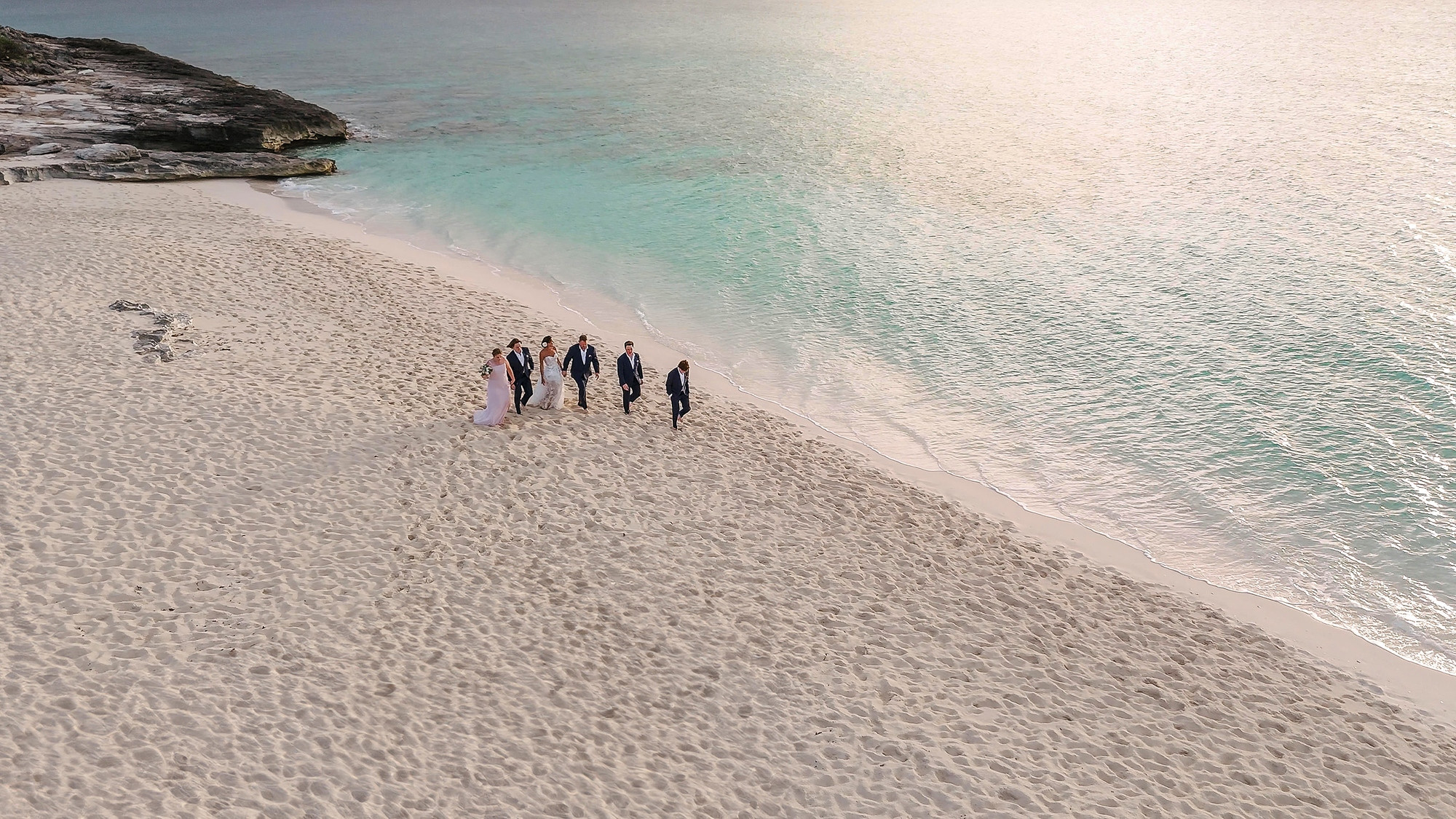
Amanyara sits on the west coast of Providenciales, at Northwest Point, and the only way in is a single track that winds through an 18,000-acre nature reserve. Aman describes the resort on the shores of that reserve, looking out over half a mile of white sand beaches and the North West Point Marine National Park. It opened in 2006 as the only Aman in the Caribbean, designed by Jean-Michel Gathy around black infinity pools and pavilions reflected in still water.


Seclusion is the obvious gift of a place like this, but it isn’t the most important one. Aman’s own invitation for Amanyara is that “multi-generations are invited to gather and celebrate”, and this family took it at its word. Two generations, one close friend, half a mile of sand and no one else in the frame. A place reached by one road suits a day that only has room for the people who matter most.
The setting also gave the day its proportions. Seven people on a beach that size could feel small. Instead, the space around them made every gesture legible. When a celebration is this intimate, the landscape becomes the only crowd, and Amanyara is a generous one.
Where the Caicos Bank Meets the Atlantic
The Caicos Islands sit on an underwater plateau, and the turquoise everyone associates with Turks and Caicos comes from that plateau: shallow water lying over pale sand, throwing the light back up. Off Northwest Point the bank ends in what divers simply call the wall, a sheer drop from the shallows to the Atlantic floor. The coast here is ironshore, the islands’ own word for the old marine limestone that breaks the shoreline into small coves and rocky points.
We love knowing that about the beach where they celebrated their marriage. The ceremony was on the sand at sunset, with their four children standing around them, and on the west coast of Providenciales the sun goes down over open water, somewhere out beyond the edge of the bank. Their beach lies where the shallows give way to the deep ocean, and the last light of the day came across both.


There’s something fitting about a sacred ceremony at the hour the day is handed over to the night. Nobody arranges a sunset. You come for it, you stand still, and it happens to everyone present at once. For a family whose faith sits at the centre of their lives, with their pastor and friend among them, it was hard to imagine a better hour. At one point the family gathered into a single circle on the sand, heads bowed, while the last of the light went down around them.


Less Coverage, More Meaning
Her request for less coverage was one of the clearest briefs we’ve been given. Coverage is a quantity. Meaning is a judgement about where to stand, when to step back, and which moments the family will want to look at years from now. Asking for less is really asking for that judgement, and for the trust to let it work.


It changes the shape of the work. A smaller presence leaves more of the day unobserved and entirely theirs, which is its own form of what we’ve come to think of as the real luxury: time that belongs to the people living it. The photographs that come out of a day like this aren’t fewer by accident. They’re fewer because every one of them had to earn its place.
We think more couples will ask for this, and we hope they do. The most valuable thing a photographer brings to an intimate celebration like this Amanyara wedding is discernment: knowing which handful of moments the family will want to hold, and having the restraint to let the rest of the evening simply be lived.
For the People Who Weren’t There
When the only people present are family and one close friend, the photographs carry an extra responsibility. They become the way everyone else is included: the family and friends who would have loved to be there, and who will see it only afterwards. The bride put it better than we could. The photographs, she wrote, let people who weren’t there glimpse “a very meaningful passage in our lives and our life together”.


That’s the measure we hold ourselves to. Not whether a picture is admired, but whether it lets someone who wasn’t on that beach understand what the evening meant. A year later, the groom wrote to say they were grateful we’d been part of it, and that they smile whenever the photos come up on Instagram. For a studio like ours, there’s no better review.
Dinner was in a candlelit pavilion, and it stayed small for the same reason the ceremony did. An evening like that doesn’t need a programme. It needs a table, good light and the people who know you best.


The Next Chapter, in Atlanta
Two years after Amanyara, we were flown from Tokyo to Atlanta for their son’s wedding at the Piedmont Driving Club, where his father stood beside him as best man. The faith we’d seen at the centre of the sunset ceremony was there again in Atlanta, in the family’s prayers and in the sermon that held the courtyard.
That’s the work we’re proudest of, and it rarely shows up in a single post. A family in Tokyo, the parents celebrating their marriage at Amanyara, and then their son marrying in Atlanta. Each day stands on its own, and each one is richer for the ones we’ve already seen. Whether we’re planning a wedding in Japan or travelling to photograph one somewhere far from it, this is what we hope for: to be invited into a family’s story more than once, and to understand it a little better each time.