At Hyakuna Garan, the sea isn’t something you simply place behind a wedding. It decides the shape of the shore.
Twice a day the water draws back across the reef below the hotel, leaving pale flats, rock pools and coral, and twice a day it returns. Their Okinawa beach wedding was planned around that movement, with the ceremony set for an hour when the beach would be there to receive them.
Seventeen people, the two of them included: small enough that the wedding could follow the coast, rather than asking the coast to follow the wedding. The sea set the time. As it turned out, it explained a good deal about the rest of the day too.

A Coast That Keeps Time
Hyakuna Garan sits in Nanjo, on the south-east coast of Okinawa’s main island, and this stretch of shore has been watched for a very long time. A short walk away is Yaharazukasa, a sacred place in Ryukyuan tradition, where Amamikiyo, the goddess said to have made the Ryukyu Islands, first stepped onto the main island after coming from across the sea. A stone marks the spot offshore. At high tide it disappears completely, and when the water recedes it stands clear again.
The mythology is considerably older than our planning spreadsheet. The practical lesson is much the same: pay attention to the tide. For their ceremony, that meant working with Hyakuna Garan to set the hour by what the water was doing, rather than choosing a time and forcing everything else around it. Some landscapes tolerate being treated as scenery. This coast is better when you allow it some authority.


Why Okinawa
The reason they were bringing everyone here was family. Hers would travel from Hong Kong. His would cross the Pacific from the United States. They wanted somewhere in Japan that could become more than a wedding venue once everyone arrived.
“We’re most excited to treat our families to this vacation!” she wrote. That was the scale of the idea from the start: not just to marry somewhere beautiful, but to give the people closest to them a reason to travel together.

Japan already held part of their story. They had become engaged at Kawaguchiko in February 2023, with what she called “a glorious view of Mt. Fuji.” For the wedding they came much further south, to islands that were their own kingdom until 1879. For centuries before that, Ryukyu looked outward across the water, trading with China, Japan and Southeast Asia, and its culture grew partly out of those meetings.
That history matters here, because this was a wedding made by people travelling towards one another from different sides of the sea.
Seventeen People
She’d written two words in her questionnaire: “Keeping things simple!”
Simple didn’t mean there was little involved. A ceremony timed to the tide, families flying in from two continents, photography and film, Ryukyuan dancers and dinner for everyone don’t become simple to produce just because the guest list is short. The simplicity belonged to their experience of it. That’s what we’re for.


Seventeen people meant there was room: room for the ceremony time to move with the tide, for everyone to be close enough to hear the vows, and for dinner to feel like dinner rather than an event with its own internal traffic system. Her aunt and uncle were there, the two she calls her second mom and second dad. There were no bridesmaids or groomsmen. Nobody needed a title to explain why they mattered, and with a wedding this size, nobody was in the back row.


An Okinawa Beach Wedding, When the Beach Was Ready
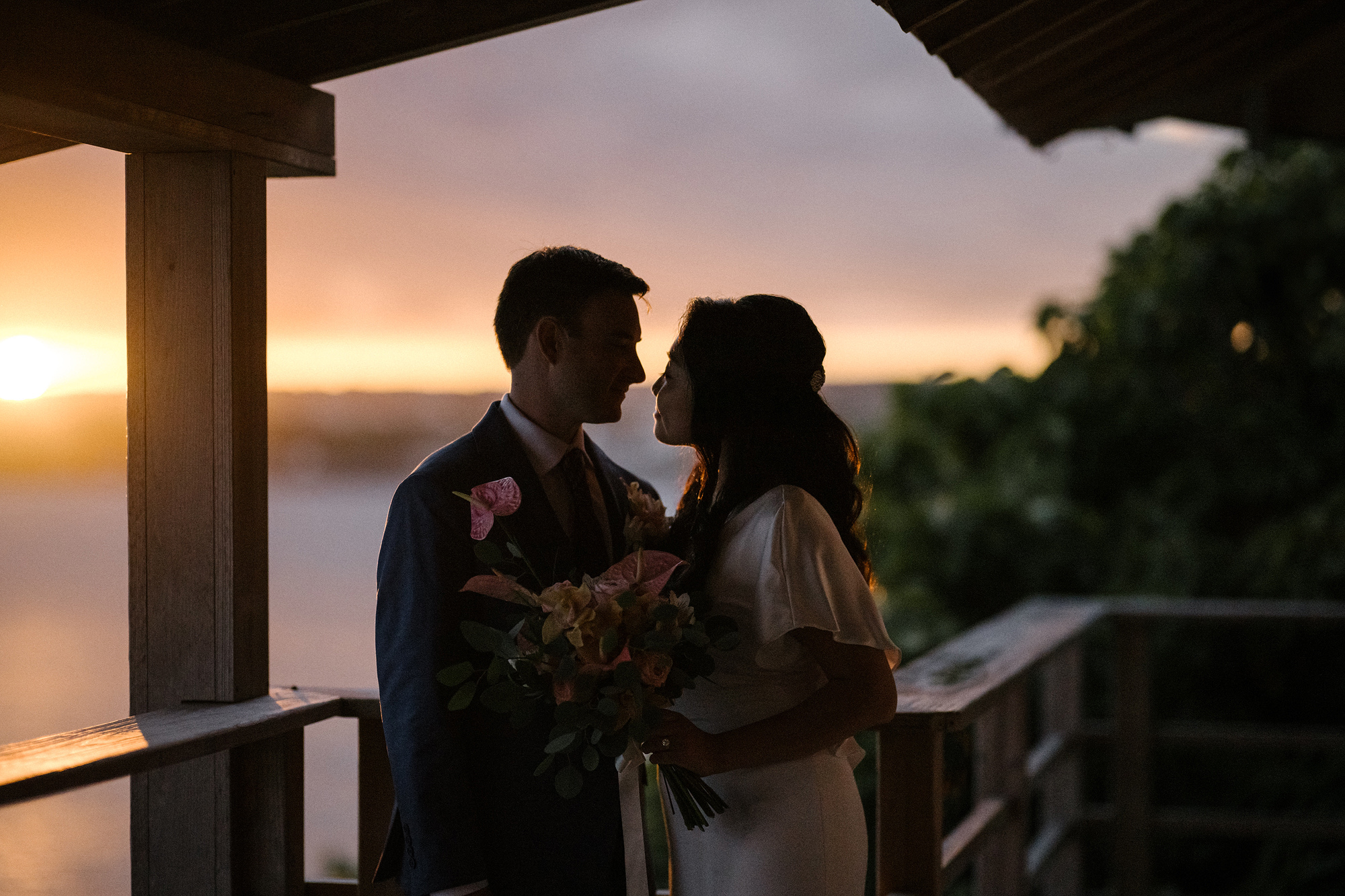
By ceremony time the shore below Hyakuna Garan had opened, and there was no need to ask much more of it: sand beneath them, the sea beyond, seventeen people gathered close, and petals on the sand afterwards.


At this scale the landscape doesn’t have to be overwhelmed for a ceremony to register in it. It was already doing something far more complicated than decoration. It was changing the whole time: water advancing and retreating, cloud moving in off the Pacific, light finding and losing the reef. By evening the coast would be another place again.


An Old Language of Welcome
At dinner, Okinawa came into the wedding another way.
Ryukyuan classical dance has its roots in the court of the old kingdom, where dances were part of the hospitality offered to envoys arriving from China, and the islands built an unusually rich tradition of performance through centuries of exchange with their neighbours. The dancers at the wedding performed Yotsudake, named for the four pieces of bamboo clicked in each dancer’s hands, in bingata, Okinawa’s vividly dyed cloth, under red hanagasa flower hats.


It would have been easy to call it traditional Okinawan entertainment. At this wedding, the history made it something more. One family had flown in from Hong Kong, the other had crossed the Pacific, and here was a court art whose whole history was bound up with receiving people who had come from overseas. Hospitality has been part of Okinawa’s relationship with the wider world for centuries. Now seventeen people sat at one table because each of them had made a long journey to get there.
Then the shishi arrived. Okinawa’s guardian lion is there to keep misfortune away, and the groom took the full blessing, head bowed beneath its painted jaws.


The Coast Without the Wedding
We’d met them on the beach the afternoon before: no wedding clothes, no guests, no ceremony waiting to begin. The tide was further out, leaving coral rocks standing above shallow pools that held the evening sky. It was the same coast, and it looked nothing like the same place.
That’s one of the things we love about working beside water. A mountain stays more or less where you left it. A shoreline rearranges itself while you’re having dinner.


The next day this beach would hold their families and their vows. That evening it belonged almost entirely to the two of them, walking among the coral and the tide pools as the sky moved from blue to pink, with no schedule left to satisfy. Every wedding has a version most of the guests never see. This was theirs.


What Everyone Crossed For
When she first wrote to us, what she was most excited about wasn’t the dress, the photographs or even the ceremony. It was bringing their families on the trip.
That makes the scale of this wedding easier to understand. Seventeen wasn’t a reduced version of something larger. Seventeen was the point: enough to hold the people who mattered, few enough that everyone could share essentially the same day.
They came from Hong Kong and America to a coast in southern Okinawa, to a place whose history, mythology and culture have been shaped again and again by what arrived across the water. The tide decided when they could marry. Ryukyuan hospitality followed them into dinner. And outside, the water came back over the reef, as it always does.
The wedding didn’t need to hold the landscape still. It only needed everyone to be there at the same time, and for seventeen people who had crossed that much sea to find one another, that was plenty.