Full Faith in Sake Country: A Niigata Elopement

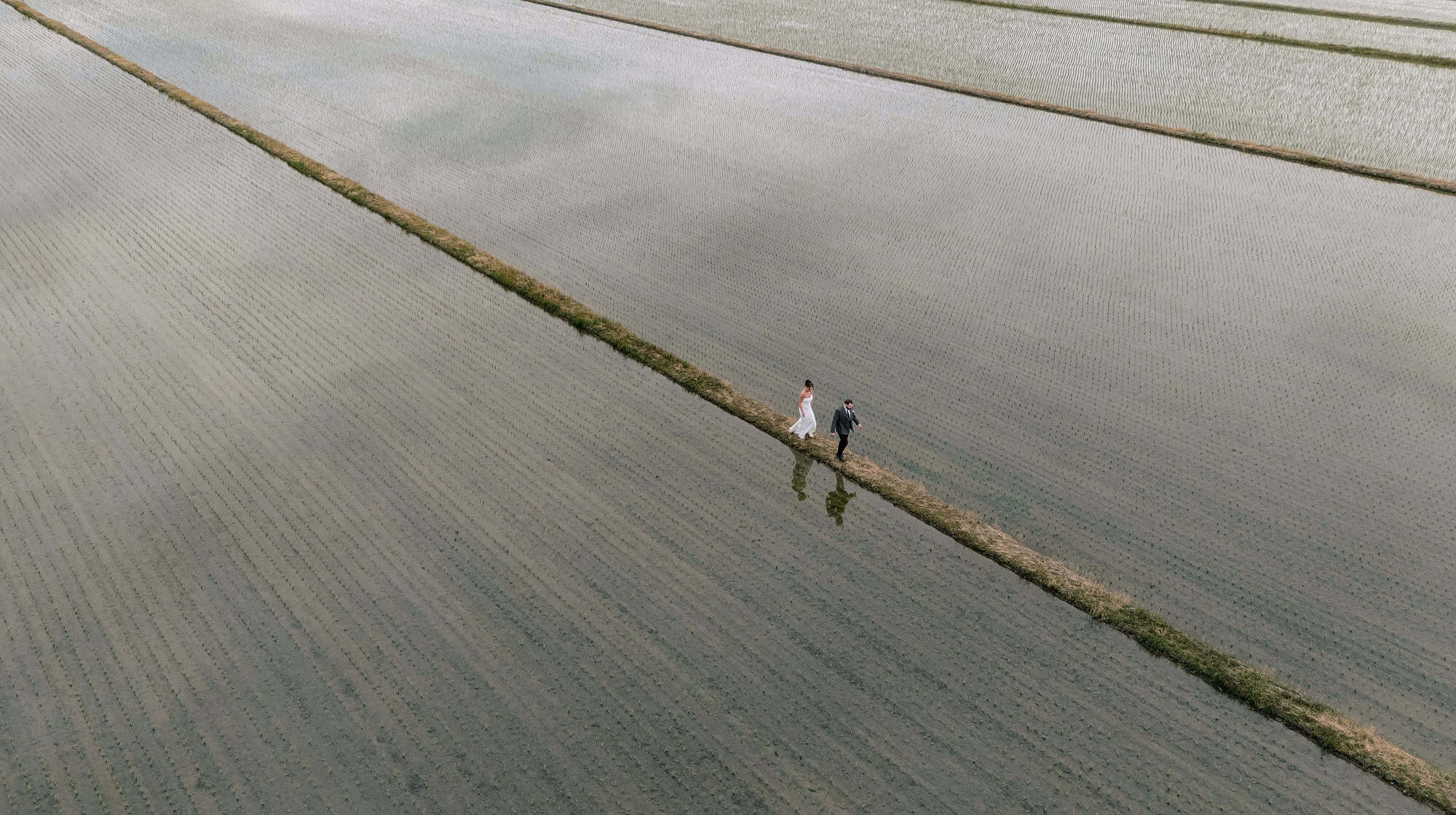
Seen from a drone, the newlyweds walk a narrow grass path between still, flooded rice paddies in Niigata, their reflections beside them.

Some couples arrive with a venue already chosen. This one arrived with an open map. They’d followed our work on Instagram for a while, they wanted spring or summer, and they were happy for Japan to decide the rest. So we proposed somewhere new: a Niigata elopement, in a private garden in Shibata, with an onsen town to come home to and sake country all around. Their reply is one we’ve kept: “We put our full faith in you!”

We take a sentence like that seriously, because it describes the job better than we can. Couples planning a wedding in Japan are surrounded by places that all look good in a photograph. What they’re really asking for is judgment: which place will feel like theirs, and why. Niigata sounded like theirs before they’d seen it. It’s rice country and sake country, on the Sea of Japan side of the main island, well off the routes most first trips to Japan follow. For two people who call themselves adventurous, that was the point.

The bride and groom embrace on a stone slab bridge in Sekisensou, a private Japanese garden in Shibata, red azaleas and old pines around.

A Polar Bear and a Reindeer

They met in December 2019 at SantaCon in downtown Cincinnati. He was dressed as a polar bear and she was dressed as a reindeer. He was talking to her brother when she walked over and introduced herself, and a week later they went on their first date. We collect first-meeting stories, and very few tell you as much, as quickly, about the couple you’re about to plan for.

They’re from the Kentucky side of the river from Cincinnati, and they describe themselves as easy going, goofy, outgoing and adventurous. They love to travel, to find a new restaurant, and to spend time with their dog, who was beside them when he proposed on a walk by a lake near home. He had always wanted to travel to Japan, so they asked themselves a simple question: why not get married here, and make the honeymoon part of the same journey?

Why elope? They put it better than we could: for “the adventure and intimacy of it just being the 2 of us.” Their wish list had five lines: a private place for their vows, nature, some city, a great dinner, and lots of pictures. Every line is about how the day would feel, and none of it is about how it would look to anyone else. That’s what an elopement is at its best, a deliberate choice to give the day entirely to each other.

The groom hugs the bride from behind and both laugh on a shaded garden path in Shibata, Niigata, on the day of their elopement in Japan.

Somewhere We’d Never Been

Their first note mentioned cherry blossom season, as most first notes about Japan do. Then they let it go, and we loved them for it, because it opened the whole country. The blossoms draw everyone to the same few weeks and the same famous places. Without them, we could plan around the couple instead of the calendar.

Our proposal was Niigata, an idea we’d been shaping for a while: a private historic garden, an onsen town, and sake country around both. It would be the first elopement we’d ever photographed there. They love the local breweries and wineries back home, and they told us it felt very fitting, and that nobody having done it before only made it better. When we plan an elopement somewhere new, that kind of trust is what lets us build it properly.

Niigata has more sake breweries than any other prefecture in Japan, close to ninety of them, and it’s the country’s leading rice prefecture. Those are really one fact. Sake starts in the paddies, and the snow that buries Niigata every winter comes back as the water. For two people whose idea of a good weekend at home includes a local brewery, sake country was never a theme. It was simply the right place for them to begin.

An aerial view of the plain near Tsukioka Onsen in Niigata, flooded rice fields stretching in long rectangles towards the villages.

Tsukioka Onsen, Found by Accident

They spent two nights in Tsukioka Onsen, a hot spring town in the rice fields on the eastern edge of the Echigo Plain, a short drive from Shibata. Its beginning is our favourite Niigata story. In 1915, men drilling for oil struck hot water instead, a spring of more than 50 degrees, and a public bath went up beside the well. The town grew around it.

The water is a weakly alkaline sulphur spring, emerald green, and one of the richest in sulphur anywhere in Japan. The town says it will blacken precious metals and that it’s kind to the skin. People once looked at the colour of the water, it’s said, to guess the next day’s weather.

We think about that oil well more than we probably should. A whole town exists because somebody treated a failed plan as a find. Our couple had the same instinct. They came for the blossoms, let them go, and found a place they could never have searched for, because nobody had put it on a list yet.

In late May the fields around Tsukioka have just been planted and still stand in water, so for a few weeks the whole plain holds the sky. On the evening they married, the two of them walked the raised paths between those paddies, in the fields that will one day become somebody’s sake.

The bride spreads her arms beside the groom on a path between flooded rice paddies near Tsukioka Onsen, the pink dusk sky reflected below.
The couple kiss on a raised path through flooded rice fields at sunset during their Niigata elopement, forested hills under a pink sky.
  • In black and white, the bride and groom walk one behind the other along a rice paddy path in Niigata, young rice planted in the water.
  • A top-down drone view of the couple standing on the long straight path that splits two flooded rice fields outside Tsukioka Onsen.
  • Straight from above, flooded rice paddies in Shibata, Niigata, divided by a pale farm road and thin green banks between the fields.
  • An aerial view over Shibata in Niigata of round clipped shrubs planted in tidy rows beside a grassy field and a dense green thicket.
  • Rows of round clipped trees seen from directly above in Shibata, Niigata, their soft green crowns casting small shadows on the grass.

Sekisensou, a Private Garden in Shibata

For the vows, we chose Sekisensou, a private historic garden in Shibata, the old castle town a short drive from the onsen. The Mizoguchi lords ruled from Shibata for more than 270 years without ever being moved elsewhere, and in their day this ground was where the domain’s samurai trained in riding and archery. The garden came in the early Meiji years, and its name came from a poem: in 1921 Shibata’s first mayor, also known as a poet, visited at the age of 84 and wrote a few lines about a garden whose hill and waterfall are each a pleasure to look at. Sekisensou doesn’t open its gate to the public. We arranged it for the two of them alone, and for one day it was theirs.

Its next owners tie it to Tsukioka. The house became the villa of the Ishizaki family, who refined oil in Niitsu, so the garden where they married and the onsen where they slept both owe something to the oil under this part of Niigata. Its detached rooms and tea room are now Registered Tangible Cultural Properties, and since 2011 the garden itself has been a Registered Monument.

The groom ties his black tie in a traditional Japanese room, shoji shadows in the foreground, getting ready for his Niigata elopement.
The bride stands at a wall of old glass windows over the garden as a helper kneels to arrange her train, a lattice ceiling above them.
Seated on a low wooden step in a tatami room, the bride adjusts her shoe, her pearl dotted veil and long train spread across the mats.

It’s a garden of water and stone. The Shibata River runs right through the middle of it, a public river crossing private ground, which the garden itself calls very rare; until the early Showa years, rafts of timber still floated down it. The water winds beneath slabs of stone laid as bridges, its banks built up with great rocks and moss, old pines trained low over the water, stone lanterns gone green with age, and azaleas coming into flower. The rooms look onto it through old glass, so even getting ready happened with the garden in view. He saw her dress for the first time at a weathered timber gate, which seems right for a garden that rewards patience. Nothing in it shows itself all at once.

  • Close detail of star moss on the ground of a Japanese garden in Shibata, green leaves soft in the foreground on the elopement morning.
  • The wedding bands and engagement ring reflected on a dark surface, a detail from the morning of a Niigata elopement in Japan.
  • A round solitaire engagement ring standing on a black reflective surface, catching the light against soft out of focus highlights.
  • The groom's silver cufflinks shaped like two hunting dogs, set on black glass with their reflections beneath them.
  • The bride's white perfume bottle with a gold clasp against a black background, warm round lights glowing behind it.
  • A bamboo spout over a stone tsukubai water basin in a private Japanese garden in Shibata, glossy green leaves around it.
  • Round stepping stones set in thick moss lead through a private Japanese garden in Shibata on the morning of the elopement.
  • The groom's leather belt coiled beside a grey paisley tie on a dark surface, wedding morning details for an elopement in Japan.
  • Large white six petalled flowers open among green leaves in a private Japanese garden in Shibata, Niigata, on the elopement morning.
  • A single purple iris flowering among tall green leaves in a Japanese garden in Shibata, more buds rising around it.
  • A moss covered stone lantern stands among white flowers before an old wooden house in a private Japanese garden in Shibata.
  • Pink azaleas in front of an old garden house with long glass windows and a wisteria trellis in the Sekisensou garden in Shibata.
  • An old twisting pine leans over a stone slab bridge and red azaleas, a wooden garden house behind, in a private garden in Shibata.
  • Two vow books, the rings in their box, pearl trimmed bridal shoes, a white rose boutonniere and maple leaves laid on tatami and tulle.
  • In black and white, the groom sits by an open shoji window looking out at the garden on the morning of their elopement in Japan.
  • A round carved wooden panel of plum blossom and a small bird, a detail from the traditional rooms where the couple got ready.
  • A soft focus detail of an old painting of women in kimono beside the water, inside the traditional garden house in Shibata.
  • The bride's bouquet of white roses and eucalyptus rests against an old ink painting inside a traditional Japanese room in Shibata.
  • An old painting of a bearded warrior in blue robes above a lion like beast, inside the garden house where the couple got ready.
  • The bride and a helper reflected upside down in a polished table, the garden showing through the tall glass windows behind them.
  • The bride holds her white rose bouquet in soft window light along a wooden corridor, her pearl dotted veil over one shoulder.
  • The bride sits on a low step in a tatami room and looks down at her dress, her pearl veil falling softly over her shoulders.
  • The groom stands under a weathered timber garden gate with a stone lantern beside it, waiting for the first look in Shibata.
  • The bride walks up behind the groom for their first look beneath a timber gate in a private Japanese garden in Shibata, Niigata.

Vows and Rings, and Nothing Else

Their plan for the ceremony was one line long: “We will just do our vows and rings.” No officiant, no script, nobody to perform for. They stood together on a stone bridge over the water and read each other words they had written themselves, and we’ll leave those words where they belong.

In black and white, the groom smiles with his eyes lowered as the bride comes up beside him for the first look of their Niigata elopement.
The bride smiles as the groom reads his vows to her on a stone bridge in the Sekisensou garden in Shibata, an old house behind them.
The bride and groom share their first kiss after the vows, standing on a stone slab bridge beside an old garden house in Shibata.

We’ve come to believe the simplest ceremonies are the most exposed, in the best way. With no officiant to set the pace and no audience to play to, there’s nothing between two people except what they’ve decided to say. It asks more of a couple than a full wedding does, and it gives more back. A private garden is the right room for it.

  • The bride smiles at the groom as he turns to see her for the first time under a garden gate during their elopement in Japan.
  • Seen from behind, the groom embraces the bride under the timber gate after their first look, her bouquet of white roses in view.
  • The bride and groom stand together under a weathered timber gate in a Japanese garden, her long veil trailing on the stones.
  • Framed by pines and maples, the couple kiss beneath a wooden garden gate during their Niigata elopement in a private garden.
  • In black and white, the groom kisses the bride's head beneath a garden gate, the scene softened by leaves in the foreground.
  • The couple read their vows to each other on a stone slab bridge over the river in Sekisensou, pink azaleas in the garden in Shibata.
  • The bride reads her vows from a small card to the groom, framed through pine branches in a private Japanese garden in Niigata.
  • The groom reads from his vow book with a smile while the bride listens beside him under the pines of a Japanese garden in Shibata.
  • The bride wipes a tear as the groom reads his vows from a card in a green Japanese garden during their elopement in Japan.
  • The couple hold each other after their vows, half hidden behind a twisting pine branch in a private garden in Niigata.
  • A wide view of the private garden in Shibata, the bride and groom small on a stone bridge above the water, ferns and azaleas around them.
  • The couple embrace at the water's edge with an old pine and a garden house behind them in a private Japanese garden in Shibata.

A small sake cask was waiting afterwards on the red felt by the windows, marked 祝, the character for celebration. In a country that has sealed marriages with sake for centuries, it was the obvious first toast. Their first dance song was Al Green’s “Just for Me”, which could stand as the title of the whole day.

  • Seen through a twisting pine branch, the bride smiles at the groom on a stone path in a private Japanese garden in Niigata.
  • The groom takes the bride's hand as she steps across moss and stones under a twisting pine in a Japanese garden in Shibata.
  • Green maple leaves fill the frame, with the bride and groom a soft white and grey blur among the trees of the garden in Shibata.
  • A drone view down on the couple on a stone bridge over the river in the Sekisensou garden, ringed by pines, rocks and stepping stones.
  • The groom holds the bride's long veil beside a tall stone lantern in a Japanese garden, maples arching over them and water behind.
  • In black and white, the groom kisses the bride's forehead as she gathers her veil beside a stone lantern in the garden.
  • The groom laughs as the bride spreads her sheer pearl veil around them both in front of a mossy stone lantern in Niigata.
  • Holding hands, the couple walk through a grove of tall pines in a Japanese garden in Shibata, red azaleas at their feet.
  • The groom kisses the bride's cheek among tall pines and clipped shrubs in a private Japanese garden on their elopement day in Niigata.
  • In black and white, the couple's hands rest together at the bride's waist beneath her sheer veil scattered with pearls.
  • In black and white, the bride stands with her pearl veil drawn over her head and a soft smile, dark garden foliage behind her.
  • A towering old pine leans over the water as the couple hold hands on the rocks beyond it in a private Japanese garden in Shibata.
  • The bride and groom hold hands on a mossy rock among pink azaleas, her veil trailing behind her, in a Japanese garden in Niigata.
  • The couple embrace high on a rock arrangement above the water in the Sekisensou garden, moss, ferns and great stones around them.
  • In black and white, the groom laughs with his head tipped back as the bride hugs him from behind and smiles over his shoulder.
  • The bride and groom kiss behind a screen of green leaves, her beaded off shoulder sleeve catching the light, in a Japanese garden.
  • In black and white, the bride wraps her arms around the groom's neck under dark trees in the garden on their elopement day in Japan.
  • The couple embrace in the garden, seen through the dark wooden frame of an old window, her buttoned dress against his grey jacket.
  • The embracing couple seen through an old window and reflected in a polished surface below, framed by the dark wood of the garden house.
  • The bride laughs as she leads the groom by the hand past a weathered wooden wall in Shibata, now in a strapless wedding dress.
  • A slow shutter blurs the couple into motion as they walk hand in hand past a long dark wooden wall in Shibata, Niigata.
  • Small clusters of white flowers on a green branch, soft against the deep green of the garden on the elopement day in Shibata.

A Bottle With Their Names on It

They’d told us early on how much they love the breweries near home, so the sake had to be more than a toast. Kikusui, a Shibata brewery founded in 1881, made them a bottle with a custom label, their own sake from the town they married in. Wine people talk about terroir, the way a bottle carries the ground it came from. Sake has its own version, made from rice, water and a brewer’s hands, and a label with your names on it ties that ground to a single day. We like a bottle that can travel home in a suitcase and wait for the right night.

A small sake cask painted with the red character for celebration, cranes and pine, on a lacquer tray with cups on red felt.
A bottle of sake with a custom label made for the couple's elopement in Japan, a carved plum blossom panel behind it.
  • The groom walks through the garden past a glass corridor where a sake cask waits on red felt, the bride just behind him.
  • The groom sips sake from a small cup beside the bride, framed through green leaves in front of the old glass windows of the garden house.
  • The bride and groom sit laughing on the wooden veranda of the garden house in Shibata, small sake cups in hand, white roses beside them.
  • The couple sit side by side on the veranda of an old glass windowed garden house in a private Japanese garden in Niigata.
  • A moss flecked carved stone lantern fills the frame, the couple blurred behind it on the veranda of the garden house.
  • Detail of old clay roof tiles and a carved ridge end on a garden house in Shibata, framed by fresh green leaves overhead.
  • Through soft maple leaves, the groom leans close to the bride on the veranda of the garden house beside a stone lantern.
  • The couple kiss in a room of tall glass windows full of green maples, the scene mirrored in a polished table beneath a hanging lamp.
  • The groom rests his cheek against the bride's hair as she smiles down in the soft light of a wooden corridor in the garden house.
  • In black and white, the groom looks out of an old window with the bride blurred in the foreground in the garden house in Shibata.
  • The bride and groom stand close in window light in a wooden corridor, both looking towards the garden, her pearl veil at her shoulder.
  • In black and white, the bride closes her eyes and smiles in the window light while the groom stands close behind her.
  • The bride laughs as the groom turns towards her in a traditional room, an old painted folding screen standing behind them.
  • An old hanging scroll painting of carp swimming among water plants, with calligraphy and red seals, inside the garden house.
  • Blue and white patterned door pulls with gold tassels on a pair of pale wooden sliding doors in the traditional garden house.
  • The couple stand close in the gap between two sliding doors, warm light on the paper and the bride's long veil reaching the floor.
  • In black and white, the groom holds the bride from behind in a doorway between shoji screens, her veil falling to the floor.
  • The couple's faces seen through old glass, layered with reflected green leaves from the garden outside the window in Shibata.
  • In black and white, the bride's beaded sleeve and veil and the groom's face seen through glass layered with reflected leaves.
  • The bride looks towards the window light as the groom looks over her shoulder, a white rose boutonniere on his lapel.
  • The couple seen through the glass panes of an old wooden door, the bride smiling, framed by fresh green maple leaves.

The Castle Town That Keeps Things

Shibata keeps its history close together. Omon, one of the town’s old breweries, was founded in 1790 directly in front of Suwa Shrine, and its first sake was named Suwazakari after the shrine. The name Omon came later, from a fourth-generation brewer who came home from study in Germany taken with the crests of Europe’s royal houses and wine estates. The labels still carry a Western shield, and the cup sake spells the name AU MONT, as if it were French.

The brewery also changed who gets to make sake. It took on women brewers at a time when brewing was still almost entirely men’s work, and in 1975 one of them, Shiiya Kazuko, became the first woman to pass Japan’s first-grade brewery technician exam. The novelist Miyao Tomiko researched her novel Kura, about a sake brewing family, there.

Nearby stands the Ashigaru Nagaya, a thatched row house built in 1842 for eight households of the domain’s foot soldiers. It’s the only one of four that survives, people lived in it until 1968, and it’s now an Important Cultural Property.

The couple walk hand in hand past the Ashigaru Nagaya, a thatched Edo period row house for foot soldiers in Shibata, Niigata.
The newlyweds sit on a bench between giant wooden sake barrels marked with the Omon name at a sake brewery in Shibata, Niigata.
The couple walk under a vermilion torii towards the hall of Suwa Shrine in Shibata, Niigata, along a stone paved approach.

We love a town like this for an elopement because nothing in it is staged. Sake has been brewed in front of that shrine for more than two centuries, and the foot soldiers’ house was a home within living memory. Two people from Kentucky walked through it in their wedding clothes, stopped at the brewery for a glass, and Shibata simply carried on being itself. That’s the version of Japan we most want couples to meet, lived in rather than arranged.

  • A wide view of the bride and groom walking a quiet lane beside the long thatched roof of the Ashigaru Nagaya in Shibata.
  • The bride and groom laugh as they walk hand in hand in front of a wooden sake barrel at the Omon brewery in Shibata.
  • In black and white, the bride and groom raise two stemmed glasses of sake in a toast at a brewery tasting in Shibata, Niigata.
  • In black and white, the bride sips sake from a stemmed glass at the counter of a sake brewery in Shibata, Niigata.
  • In black and white, the groom tastes sake from a small glass at a brewery in Shibata, a white rose boutonniere on his jacket.
  • Rows of Niigata sake bottles with brush lettered labels lit warmly on wooden shelves at the Omon brewery in Shibata.
  • The two black characters of the Omon name fixed on a studded wooden brewery door with iron ring handles in Shibata, Niigata.
  • The newlyweds walk out laughing in front of an old dark timber storehouse wall on a street in Shibata, Niigata.
  • The groom rests his head on the bride's shoulder behind a branch of small white flowers, both smiling, on their elopement day in Niigata.

Tokyo, Two Nights Before

Their wish list asked for some city, and Tokyo gave them its loudest. Two evenings before the garden, they walked Shinjuku as the lights came on, across the crossings and into Kabukicho and the lanes of Omoide Yokocho. Kabukicho takes its name from a kabuki theatre planned after the war and never built. The name, given in 1948, outlived the plan. Omoide Yokocho began in those same years as a market of street stalls on the burnt ground west of the station, and its lanes still run on grilled skewers and counters a few seats long.

Edo had a word for districts like these: ukiyo, the floating world of theatres, lanterns and nights that ran into morning. Two days later the same couple stood on a stone bridge in a garden in Shibata with nobody else in sight. Japan lives in both registers at once, the neon and the moss, and they gave each its own night.

The couple walk through Omoide Yokocho in Shinjuku beneath paper lanterns and pink blossom decorations on their Tokyo night.
The couple kiss beneath the Godzilla head in Kabukicho, Shinjuku, on their Tokyo night before travelling north to Niigata.
  • In black and white, the couple walk hand in hand down a Shinjuku side street as a cyclist passes, menus and signs on the shopfronts.
  • The couple kiss in warm evening sun on a Shinjuku street, her white floral dress against his navy jacket and the shopfronts behind.
  • The couple kiss on a busy Shinjuku crossing as people stream past them across the zebra stripes in Tokyo.
  • The bride walks a Shinjuku crossing in her white dress under neon signs, the groom just ahead of her in the evening crowd.
  • Arm in arm, the couple cross a wide Shinjuku street in her short white floral dress and his navy jacket, Tokyo traffic behind.
  • The groom kisses the bride's cheek in the middle of a crowded Shinjuku crossing, neon signs and billboards rising behind them.
  • In black and white, the couple walk close past a payphone booth beneath an elevated road in Shinjuku, Tokyo.
  • The couple walk through the narrow lantern lit alley of Omoide Yokocho in Shinjuku, small bars lining both sides of them.
  • The bride looks back over her shoulder as the groom looks down beside her, city lights glowing in soft circles behind them in Shinjuku.
  • Hand in hand, the couple stand beneath a giant anime mural and a red pachinko sign in Kabukicho, Shinjuku, Tokyo.
  • The couple kiss in front of a huge anime billboard in Kabukicho, Shinjuku, the painted characters smiling down on them.
  • The couple sit together on a steel staircase in front of a black and white dragon painted on a shutter in Shinjuku, Tokyo.
  • The couple walk along a Kabukicho street in front of large black and white billboards, her white dress swinging as she steps.
  • The couple stand small in front of a vivid painted mural of a woman, koi and flowers on a building in Kabukicho, Shinjuku.
  • A low detail of the bride's pink heels and the groom's jeans as they walk along a lit Shinjuku street in the evening.
  • The couple look up together below the Godzilla head on the building above Kabukicho in Shinjuku, Tokyo.

They put their full faith in us, and Niigata repaid it. The places that end up feeling most like a couple’s own are rarely the ones they’d have found by searching. They’re found the way Tsukioka’s water was, by someone digging where nobody expected anything, and two people willing to step in.